![Twenty [kw] of heat is to be removed from 375 [k] water flowing at 0.15 [kg/s] into the inner pipe of concentric tube heat ex](http://img.homeworklib.com/images/cddde5d6-ff4c-4075-a75c-135f3be8b5dc.png?x-oss-process=image/resize,w_560)
Homework Answers
Add Answer to:
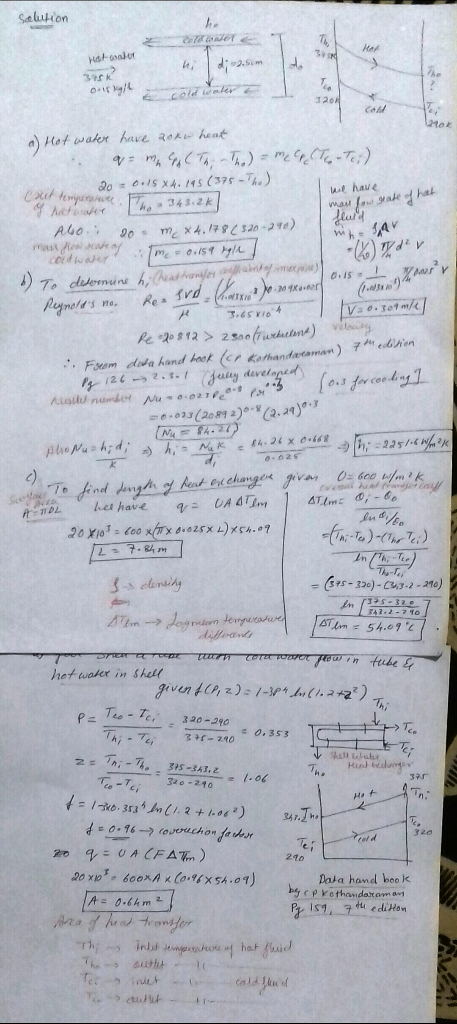
Twenty [kw] of heat is to be removed from 375 [k] water flowing at 0.15 [kg/s] into the inner pipe of concentric tube heat exchanger. Cooling water enters the annulus at 290 [k] and leaves at 320...
A concentric tube heat exchanger for cooling lubricating oil is comprised of a thin-walled inner tube...
A concentric tube heat exchanger for cooling lubricating oil is comprised of a thin-walled inner tube of 25 mm diameter carrying water and an outer tube of 45 mm diameter carrying the oil. The mass flow rates of both fluids are 0.1 kg/s. The exchanger operates in counter-flow with an overall heat transfer coefficient of 60 W/m2
A concentric tube heat exchanger for cooling lubricating oil consists of a thin-walled inner tube of...
 A concentric tube heat exchanger for cooling lubricating oil
consists of a thin-walled inner tube of 25 mm diameter carrying
water and an outer tube of 45 mm diameter carrying the oil. The
exchanger operates in countercurrent flow with an overall heat
transfer coefficient of 55 W/m2 K and the tabulated average
properties given below. Mass flow rates of oil and water are both
0.1 kg/s, oil enters the exchanger at 100°C, and water enters the
exchanger at 30°C. (a)...
A concentric tube heat exchanger for cooling lubricating oil
consists of a thin-walled inner tube of 25 mm diameter carrying
water and an outer tube of 45 mm diameter carrying the oil. The
exchanger operates in countercurrent flow with an overall heat
transfer coefficient of 55 W/m2 K and the tabulated average
properties given below. Mass flow rates of oil and water are both
0.1 kg/s, oil enters the exchanger at 100°C, and water enters the
exchanger at 30°C. (a)...
Required information A shell-and-tube heat exchanger is used for cooling 47 kg/s of a process stream...
 Required information A shell-and-tube heat exchanger is used for cooling 47 kg/s of a process stream flowing through the tubes from 160°C to 136°C. This heat exchanger has a total of 100 identical tubes. each with an inside diameter of 2.5 cm and negligible wall thickness. The average properties of the process stream are: p = 950 kg/m”, k = 0.50 W/mK, Cp=3.5 kJ/kg.K, and -20 mPas The coolant stream is water (cp=4.18 kJ/kg K) at a flow rate of...
Problem 2: Heat exchanger (25 points) Cold water (op 4179 J/kg K) enters the tubes of a heat exchanger at 20 °C at a rate of 3 kgs. while hot oil (cp 2200 J/kg.K) enters the shell at 130 C at the sam...
 Problem 2: Heat exchanger (25 points) Cold water (op 4179 J/kg K) enters the tubes of a heat exchanger at 20 °C at a rate of 3 kgs. while hot oil (cp 2200 J/kg.K) enters the shell at 130 C at the same mass flow rate and leaves at 60°C The heat exchanger consistsoftwo shells and 20 tubes, each executing four passes (two passes per shell). If the W/m2-K, assume the tube wall is very thin with convective heat transfer...
QUESTION 4 (25 marks) Water (Cr 4.208 kJ/kg.K) at flow rate of 5.11 kg/s s heated from 78°C to 98°C in an economize...
 QUESTION 4 (25 marks) Water (Cr 4.208 kJ/kg.K) at flow rate of 5.11 kg/s s heated from 78°C to 98°C in an economizer inside a boiler. The boiler is a cross flow heat exchanger with single pass, shell fluid mixed and other fluid unmixed. The average water velocity in the 1.5 cm diameter (D) tube is 1.27 m/s. On the shell side, hot air (C,-1.0341 kJ/kgK) was used as the heating fluid with 7.3 kg/s of it entering the exchanger...
A counter-flow heat exchanger is stated to have an overall heat transfer coefficient of 284 W/m2.K...
 A counter-flow heat exchanger is stated to have an overall heat transfer coefficient of 284 W/m2.K when operating at design and clean conditions. Hot fluid enters the tube side at 101°C and exits at 71°C, while cold fluid enters the shell side at 27°C and exits at 42°C. After a period of use, built-up scale in the heat exchanger gives a fouling factor of 0.0004 m2 K/W. The surface area is 93 m². Assume both hot and cold fluids have...
A concentric-pipe parallel-flow heat exchanger is to heat water (cp = 4.18 kJ/kg.K) from 20°C to...
 A concentric-pipe parallel-flow heat exchanger is to heat water (cp = 4.18 kJ/kg.K) from 20°C to 80°C at a rate of 1.2 kg/s. The heating is to be accomplished by geothermal water (Cp =4.31 kJ/kg.K) available at 160°C at a mass flow rate of 2.0 kg/s. The inner pipe is thin-walled and has a diameter of 1.5 cm. If the overall heat transfer coefficient of the heat exchanger is 640 W/m2.K, determine the length of the pipe required to achieve...
[10] Design Problem As shown in the figure below, a double-pipe parallel-flow heat exchanger is used...
 [10] Design Problem As shown in the figure below, a double-pipe parallel-flow heat exchanger is used to heat cold fluid which is water (Cp = 4180 J/(kg.K), p = 1000 kg/m) from 20°C to 80°C at a rate of 0.15 kg/s. The heating is to be accomplished by hot fluid, which is geothermal water (Cp = 4310 J/(kg.K), p = 1050 kg/m²) available at 130°C at a mass flow rate of 0.25 kg/s. The inner tube has an inner diameter...
Two-pipe concentric concentric) for cooling the engine oil with the help of a water stream in...
 Two-pipe concentric concentric) for cooling the engine oil with the help of a water stream in a large diesel engine a reverse (opposite) flow heat exchanger is used. Water at a flow rate of 0.3 kg/h from inside pipe with an inside diameter of 56 mm It flows. The inner pipe is made of stainless steel with a heat transmission coefficient of 16 W/mc and is meat (wall its thickness is 3 mm. Apart from this there is another pipe...
(40 pts) Shell-and-Tube Heat Exchanger to make Jell-O Cups A counter-current shell-and-tube heat exchanger is used...
(40 pts) Shell-and-Tube Heat Exchanger to make Jell-O Cups A counter-current shell-and-tube heat exchanger is used to heat Jell-O solution (water + gelatin) using saturated steam on the shell side. Jell-O solution must be heated to at least 80 oC, poured into individual plastic cups, and then cooled to make the solid Jell-O cups. The Jell-O solution is heated with steam that enters the shell at 2.0 bar (Tsteam = 120oC) and exits as a saturated liquid. At this temperature...
 A concentric tube heat exchanger for cooling lubricating oil
consists of a thin-walled inner tube of 25 mm diameter carrying
water and an outer tube of 45 mm diameter carrying the oil. The
exchanger operates in countercurrent flow with an overall heat
transfer coefficient of 55 W/m2 K and the tabulated average
properties given below. Mass flow rates of oil and water are both
0.1 kg/s, oil enters the exchanger at 100°C, and water enters the
exchanger at 30°C. (a)...
A concentric tube heat exchanger for cooling lubricating oil
consists of a thin-walled inner tube of 25 mm diameter carrying
water and an outer tube of 45 mm diameter carrying the oil. The
exchanger operates in countercurrent flow with an overall heat
transfer coefficient of 55 W/m2 K and the tabulated average
properties given below. Mass flow rates of oil and water are both
0.1 kg/s, oil enters the exchanger at 100°C, and water enters the
exchanger at 30°C. (a)...
 Required information A shell-and-tube heat exchanger is used for cooling 47 kg/s of a process stream flowing through the tubes from 160°C to 136°C. This heat exchanger has a total of 100 identical tubes. each with an inside diameter of 2.5 cm and negligible wall thickness. The average properties of the process stream are: p = 950 kg/m”, k = 0.50 W/mK, Cp=3.5 kJ/kg.K, and -20 mPas The coolant stream is water (cp=4.18 kJ/kg K) at a flow rate of...
 Problem 2: Heat exchanger (25 points) Cold water (op 4179 J/kg K) enters the tubes of a heat exchanger at 20 °C at a rate of 3 kgs. while hot oil (cp 2200 J/kg.K) enters the shell at 130 C at the same mass flow rate and leaves at 60°C The heat exchanger consistsoftwo shells and 20 tubes, each executing four passes (two passes per shell). If the W/m2-K, assume the tube wall is very thin with convective heat transfer...
 QUESTION 4 (25 marks) Water (Cr 4.208 kJ/kg.K) at flow rate of 5.11 kg/s s heated from 78°C to 98°C in an economizer inside a boiler. The boiler is a cross flow heat exchanger with single pass, shell fluid mixed and other fluid unmixed. The average water velocity in the 1.5 cm diameter (D) tube is 1.27 m/s. On the shell side, hot air (C,-1.0341 kJ/kgK) was used as the heating fluid with 7.3 kg/s of it entering the exchanger...
 A counter-flow heat exchanger is stated to have an overall heat transfer coefficient of 284 W/m2.K when operating at design and clean conditions. Hot fluid enters the tube side at 101°C and exits at 71°C, while cold fluid enters the shell side at 27°C and exits at 42°C. After a period of use, built-up scale in the heat exchanger gives a fouling factor of 0.0004 m2 K/W. The surface area is 93 m². Assume both hot and cold fluids have...
 A concentric-pipe parallel-flow heat exchanger is to heat water (cp = 4.18 kJ/kg.K) from 20°C to 80°C at a rate of 1.2 kg/s. The heating is to be accomplished by geothermal water (Cp =4.31 kJ/kg.K) available at 160°C at a mass flow rate of 2.0 kg/s. The inner pipe is thin-walled and has a diameter of 1.5 cm. If the overall heat transfer coefficient of the heat exchanger is 640 W/m2.K, determine the length of the pipe required to achieve...
 [10] Design Problem As shown in the figure below, a double-pipe parallel-flow heat exchanger is used to heat cold fluid which is water (Cp = 4180 J/(kg.K), p = 1000 kg/m) from 20°C to 80°C at a rate of 0.15 kg/s. The heating is to be accomplished by hot fluid, which is geothermal water (Cp = 4310 J/(kg.K), p = 1050 kg/m²) available at 130°C at a mass flow rate of 0.25 kg/s. The inner tube has an inner diameter...
 Two-pipe concentric concentric) for cooling the engine oil with the help of a water stream in a large diesel engine a reverse (opposite) flow heat exchanger is used. Water at a flow rate of 0.3 kg/h from inside pipe with an inside diameter of 56 mm It flows. The inner pipe is made of stainless steel with a heat transmission coefficient of 16 W/mc and is meat (wall its thickness is 3 mm. Apart from this there is another pipe...
Most questions answered within 3 hours.
-
Where is the error in this code sequence?
String s1 = "Hello";
String s2 = "ello";...
asked 11 months ago -
Financial data for Joel de Paris, Inc., for last year
follow:
Joel de Paris, Inc.
Balance...
asked 11 months ago -
Consider this reaction:
Al2(SO4)3 (aq)+ BaCl3
(aq) Al2Cl6 (aq)- +
3BaSO4(s) . What is the...
asked 11 months ago -
Suppose that Savneet is considering increasing her
recent random sample from 20 car rentals to 40...
asked 11 months ago -
Trucks arrive at an unloading terminal at an average rate of 120
per hour.
Trucks arrive...
asked 11 months ago -
Why are methanol and ethanol completely soluble in water while
octanol is not very little soluble....
asked 11 months ago -
A facilities manager at a university reads in a research report
that the mean amount of...
asked 11 months ago -
When the CuSO4 is rehydrated by adding water to the anhydrous
compound, is this an endothermic...
asked 11 months ago -
A ray of sunlight is passing from diamond into crown glass; the
angle of incidence is...
asked 11 months ago -
A block of mass 0.249 kg is placed on top of a light, vertical
spring of...
asked 11 months ago -
how do the kidneys compensate in the presences of acidosis
a) trigger hyperventilate
b) reserve acid...
asked 11 months ago -
Question 501 pts
The rental rate of capital to the firm increases. Which of the
following...
asked 11 months ago