
Homework Answers
Add Answer to:
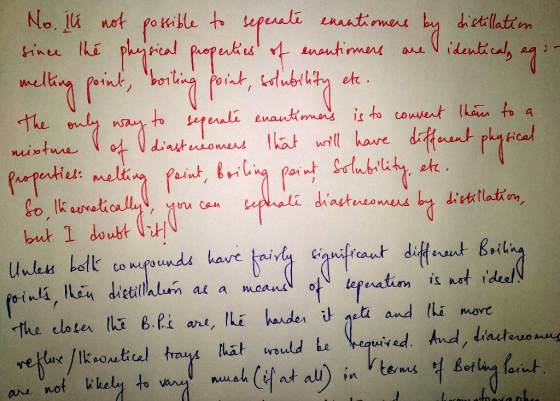
Can you separate enantiomers by a simple distillation column? Can you separate diastereomers by simple distillation column. Explain your answers with detail reasons. Can you separate enantio...
A simple distillation was performed to separate a mixture containing both hexane and heptane. Explain why...
A simple distillation was performed to separate a mixture containing both hexane and heptane. Explain why the observed starting vapor temperature in the simple distillation should be above the boiling point of hexane. Then, explain why if a fractional distillation was performed instead you would have a better separation (be sure to include how the fractionating column works in your explanation).
Which technique, recrystallization or distillation, would be most likely to separate each of these pairs? Explain...
Which technique, recrystallization or distillation, would be most likely to separate each of these pairs? Explain your answers in complete sentences. Butylbenzene and 1-chloro-2,3,3-trimethylbutane Triiodomethane and 1-nitro-2-naphthol 2. For each pair, state whether you could get away with simple distillation or whether you would need fractional distillation. Explain your answers in complete sentences. ethylcyclohexane and bromocyclohexane cyclooctane and methyl acetate Is it possible to obtain pure (200-proof) ethanol, using fractional distillation, from a fermentation mixture that contains equal...
please explain your answers 11. Indicate whether the pairs of compounds shown below are enantiomers, diastereomers,...
 please explain your answers
11. Indicate whether the pairs of compounds shown below are enantiomers, diastereomers, structural (constitutional) isomers, the same compound, or different compounds which are not isomers. (0.25 pts ea = 1 pt) vs. нон Но н. он он HOCHS HT CH3 C vs. Broh H₃CH НОСН2СНО нон нон H How HOCH CHO н JONH2 NH2 HOC CH2SH HSCHE CO2H
please explain your answers
11. Indicate whether the pairs of compounds shown below are enantiomers, diastereomers, structural (constitutional) isomers, the same compound, or different compounds which are not isomers. (0.25 pts ea = 1 pt) vs. нон Но н. он он HOCHS HT CH3 C vs. Broh H₃CH НОСН2СНО нон нон H How HOCH CHO н JONH2 NH2 HOC CH2SH HSCHE CO2H
Someone please help me with this problem Enantiomers have very similar physical properties, while for diastereomers...
 Someone please help me with this problem
Enantiomers have very similar physical properties,
while for diastereomers they can be very different. This fact is
important in the separation or resolution of enantiomers. In the
lecture, we looked at how chiral chromatography is used to separate
enantiomers: first, by reacting them with an optically pure chiral
reagent (i.e., pure R or S) to form a pair of diastereomers, then
separating them using chiral chromatography, and finally detaching
the chiral reagent to...
Someone please help me with this problem
Enantiomers have very similar physical properties,
while for diastereomers they can be very different. This fact is
important in the separation or resolution of enantiomers. In the
lecture, we looked at how chiral chromatography is used to separate
enantiomers: first, by reacting them with an optically pure chiral
reagent (i.e., pure R or S) to form a pair of diastereomers, then
separating them using chiral chromatography, and finally detaching
the chiral reagent to...
Can you explain why the answer is enantiomers... For the following pair of compounds, indicate whether...
 Can you explain why the answer is enantiomers...
For the following pair of compounds, indicate whether they are
enantiomers, diastereomers, constitutional isomers or
identical.
Br City CH3 CH2CH3 H3C— Br and and H H3cqcH2CH3 Cl CH3
Can you explain why the answer is enantiomers...
For the following pair of compounds, indicate whether they are
enantiomers, diastereomers, constitutional isomers or
identical.
Br City CH3 CH2CH3 H3C— Br and and H H3cqcH2CH3 Cl CH3
SIMPLE DISTILLATION 5. Which compound has a higher boiling point, ethanol or dimethyl ether? Explain 6....
 SIMPLE DISTILLATION
5. Which compound has a higher boiling point, ethanol or dimethyl ether? Explain 6. What are azeotropic mixture? 7. In today's setup what is the position of the thermometer? 8. What are two ideal solvents that we can separate using simple distillation?
SIMPLE DISTILLATION
5. Which compound has a higher boiling point, ethanol or dimethyl ether? Explain 6. What are azeotropic mixture? 7. In today's setup what is the position of the thermometer? 8. What are two ideal solvents that we can separate using simple distillation?
For lab we separated hexane and heptane using fractional and simple distillation. 4. Based upon your...
For lab we separated hexane and heptane using fractional and simple distillation. 4. Based upon your results, do you think you could separate a mixture of n-heptane and isopropanol (bp 82ºC)? Explain. Based upon your results, do you think you could separate a mixture of n-heptane and toluene (bp 115 ºC)? Explain.
Give some reasons that would lead you to purify a liquid by using vacuum distillation rather...
Give some reasons that would lead you to purify a liquid by using vacuum distillation rather than by using simple distillation.
Questions about distillation: Titration Data - Fractional Distillation -Simple Distillation - Temperature (Celsius) -- -- ---...
 Questions about distillation:
Titration Data - Fractional Distillation -Simple Distillation - Temperature (Celsius) -- -- --- --- --- --- -- --- -- --- B.P. methanol = 65C B.P. ethanol = 78C 0 0 0 0 0 0 0 0 0 15 Volume (ml) 1. Why does the fractional distillation show no change in temperature while the system is heated and approximately 20mL is distilled? What is occurring when the temperature increases rapidly at about 25ml? 2. At 70°C, the vapour...
Questions about distillation:
Titration Data - Fractional Distillation -Simple Distillation - Temperature (Celsius) -- -- --- --- --- --- -- --- -- --- B.P. methanol = 65C B.P. ethanol = 78C 0 0 0 0 0 0 0 0 0 15 Volume (ml) 1. Why does the fractional distillation show no change in temperature while the system is heated and approximately 20mL is distilled? What is occurring when the temperature increases rapidly at about 25ml? 2. At 70°C, the vapour...
How can you separate a mixture of ethanol and acetone besides doing a distillation?
How can you separate a mixture of ethanol and acetone besides doing a distillation?
 please explain your answers
11. Indicate whether the pairs of compounds shown below are enantiomers, diastereomers, structural (constitutional) isomers, the same compound, or different compounds which are not isomers. (0.25 pts ea = 1 pt) vs. нон Но н. он он HOCHS HT CH3 C vs. Broh H₃CH НОСН2СНО нон нон H How HOCH CHO н JONH2 NH2 HOC CH2SH HSCHE CO2H
please explain your answers
11. Indicate whether the pairs of compounds shown below are enantiomers, diastereomers, structural (constitutional) isomers, the same compound, or different compounds which are not isomers. (0.25 pts ea = 1 pt) vs. нон Но н. он он HOCHS HT CH3 C vs. Broh H₃CH НОСН2СНО нон нон H How HOCH CHO н JONH2 NH2 HOC CH2SH HSCHE CO2H
 Someone please help me with this problem
Enantiomers have very similar physical properties,
while for diastereomers they can be very different. This fact is
important in the separation or resolution of enantiomers. In the
lecture, we looked at how chiral chromatography is used to separate
enantiomers: first, by reacting them with an optically pure chiral
reagent (i.e., pure R or S) to form a pair of diastereomers, then
separating them using chiral chromatography, and finally detaching
the chiral reagent to...
Someone please help me with this problem
Enantiomers have very similar physical properties,
while for diastereomers they can be very different. This fact is
important in the separation or resolution of enantiomers. In the
lecture, we looked at how chiral chromatography is used to separate
enantiomers: first, by reacting them with an optically pure chiral
reagent (i.e., pure R or S) to form a pair of diastereomers, then
separating them using chiral chromatography, and finally detaching
the chiral reagent to...
 Can you explain why the answer is enantiomers...
For the following pair of compounds, indicate whether they are
enantiomers, diastereomers, constitutional isomers or
identical.
Br City CH3 CH2CH3 H3C— Br and and H H3cqcH2CH3 Cl CH3
Can you explain why the answer is enantiomers...
For the following pair of compounds, indicate whether they are
enantiomers, diastereomers, constitutional isomers or
identical.
Br City CH3 CH2CH3 H3C— Br and and H H3cqcH2CH3 Cl CH3
 SIMPLE DISTILLATION
5. Which compound has a higher boiling point, ethanol or dimethyl ether? Explain 6. What are azeotropic mixture? 7. In today's setup what is the position of the thermometer? 8. What are two ideal solvents that we can separate using simple distillation?
SIMPLE DISTILLATION
5. Which compound has a higher boiling point, ethanol or dimethyl ether? Explain 6. What are azeotropic mixture? 7. In today's setup what is the position of the thermometer? 8. What are two ideal solvents that we can separate using simple distillation?
 Questions about distillation:
Titration Data - Fractional Distillation -Simple Distillation - Temperature (Celsius) -- -- --- --- --- --- -- --- -- --- B.P. methanol = 65C B.P. ethanol = 78C 0 0 0 0 0 0 0 0 0 15 Volume (ml) 1. Why does the fractional distillation show no change in temperature while the system is heated and approximately 20mL is distilled? What is occurring when the temperature increases rapidly at about 25ml? 2. At 70°C, the vapour...
Questions about distillation:
Titration Data - Fractional Distillation -Simple Distillation - Temperature (Celsius) -- -- --- --- --- --- -- --- -- --- B.P. methanol = 65C B.P. ethanol = 78C 0 0 0 0 0 0 0 0 0 15 Volume (ml) 1. Why does the fractional distillation show no change in temperature while the system is heated and approximately 20mL is distilled? What is occurring when the temperature increases rapidly at about 25ml? 2. At 70°C, the vapour...
Most questions answered within 3 hours.
-
Where is the error in this code sequence?
String s1 = "Hello";
String s2 = "ello";...
asked 11 months ago -
Financial data for Joel de Paris, Inc., for last year
follow:
Joel de Paris, Inc.
Balance...
asked 11 months ago -
Consider this reaction:
Al2(SO4)3 (aq)+ BaCl3
(aq) Al2Cl6 (aq)- +
3BaSO4(s) . What is the...
asked 11 months ago -
Suppose that Savneet is considering increasing her
recent random sample from 20 car rentals to 40...
asked 11 months ago -
Trucks arrive at an unloading terminal at an average rate of 120
per hour.
Trucks arrive...
asked 11 months ago -
Why are methanol and ethanol completely soluble in water while
octanol is not very little soluble....
asked 11 months ago -
A facilities manager at a university reads in a research report
that the mean amount of...
asked 11 months ago -
When the CuSO4 is rehydrated by adding water to the anhydrous
compound, is this an endothermic...
asked 11 months ago -
A ray of sunlight is passing from diamond into crown glass; the
angle of incidence is...
asked 11 months ago -
A block of mass 0.249 kg is placed on top of a light, vertical
spring of...
asked 11 months ago -
how do the kidneys compensate in the presences of acidosis
a) trigger hyperventilate
b) reserve acid...
asked 11 months ago -
Question 501 pts
The rental rate of capital to the firm increases. Which of the
following...
asked 11 months ago