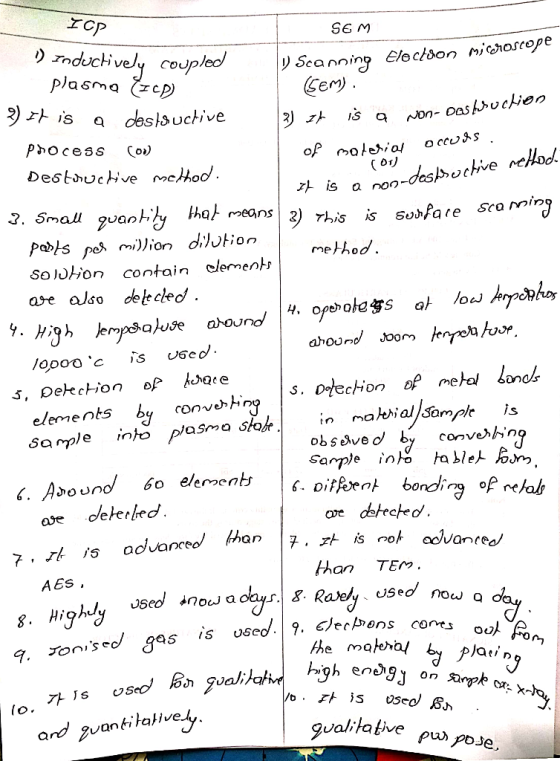
Which is the difference between the ICP (spectrometry by induction of plasma) and the SEM (scanning electron microscope)?
Which is the difference between the ICP (spectrometry by induction of plasma) and the SEM (scanning electron microscope)?
Homework Answers
Add Answer to:
Which is the difference between the ICP (spectrometry by induction of plasma) and the SEM (scanning electron microscope)?
Why are high energy electrons in a scanning electron microscope (SEM) used to bombard samples?
Why are high energy electrons in a scanning electron microscope (SEM) used to bombard samples?
Course work ICP-OES (cont) 1. In atomic emission spectrometry list the emission sources used. Describe what...
 Course work ICP-OES (cont) 1. In atomic emission spectrometry list the emission sources used. Describe what is meant by a plasma and inductively coupled plasma. 2. What is the difference between an inductively coupled plasma and a direct current plasma? 3. List the components of an 1CP spectrometer. 4.Write notes on the sample introduction system. 5. Describe two configurations used for observing emission from the ICP
SAMSUNG 18. The Biomedical Engineering (BME) Program is interested in purchasing a new scanning electron microscope...
 SAMSUNG 18. The Biomedical Engineering (BME) Program is interested in purchasing a new scanning electron microscope (SEM). The cost of the microscope is P2,000,000; however, the prices have been dropping at the rate of about 5% per year. The program can set aside about P320,000 annually into an account that will accrue interest at 10%. How long will it be before BME can purchase the microscope?
Tabulate the similarities and differences between TEM(Transmission electron microscopy) and SEM(Scanning Electron Microscopy) regarding (a) sample...
Tabulate the similarities and differences between TEM(Transmission electron microscopy) and SEM(Scanning Electron Microscopy) regarding (a) sample preparation (4), (b) processing (4), (c) instrumentation (4), (d) detection (4) and (e) the structures that can be observed (3), (f) staining (3), (g) IHC (4) and (h) ISH (4).
The electron beam in a typical scanning electron microscope produces kinetic energies of 22.0 keV. (a)...
 The electron beam in a typical scanning electron microscope produces kinetic energies of 22.0 keV. (a) Assuming that relativistic effects can be ignored, what is the speed of the electrons? 8.791 10m/s (b) What potential difference is required to produce electrons of this energy? Number Units (c) This accelerating potential difference is applied over a distance of 2.00 cm. What is the electric field in that region? NumberUnits
The electron beam in a typical scanning electron microscope produces kinetic energies of 27.0 keV (a)...
 The electron beam in a typical scanning electron microscope produces kinetic energies of 27.0 keV (a) Assuming that relativistic effects can be ignored, what is the speed of the electrons? Number m/s (b) What potential difference is required to produce electrons of this energy? Number Units (c) This accelerating potential difference is applied over a distance of 1.80 cm. What is the electric field in that region? Number Units
9. The scanning-tunneling microscope works on the principle of electron tunneling. Imagine you are trying to optimize your scanning tunneling microscope. Your microscope has a gold tip (work func...
 9. The scanning-tunneling microscope works on the principle of electron tunneling. Imagine you are trying to optimize your scanning tunneling microscope. Your microscope has a gold tip (work function 5.1 eV) and your electron has a kinetic energy of 4.6 eV (a) If you move the tip to sample distance from 0.3 nm to 0.2nm how does the transmission probability change? (b) You have a "brilliant" idea. What if you use protons instead of electrons? How will the transmission probability...
Calculate the wavelength of an electron in a scanning electron microscope that is accelerated by a...
Calculate the wavelength of an electron in a scanning electron microscope that is accelerated by a voltage of 30,000 V. The charge on an electron is 1.602 x 10⁻¹⁹ C, and its mass is 9.11 x 10⁻³¹ kg. Planck’s constant is 6.626 x 10⁻³⁴ J*s, and 1 eV = 1.602 x 10⁻¹⁹ J.
A scanning electron microscope uses a uniform 15.0-kN/C electric field to accelerate electrons horizontally toward the...
A scanning electron microscope uses a uniform 15.0-kN/C electric field to accelerate electrons horizontally toward the subject to be imaged. After travelling 5.0 cm the electrons are accelerated to a speed of 1.62x10⁷ m/s. The next step is to deflect the electrons so that they can scan across the sample—hence the scanning electron microscope. To accomplish this, the electrons are directed between a pair of oppositely charged parallel plates, which produce a uniform electric field of 6.42x10³ N/C perpendicular to...
Explain why gold coating is required when preparing samples for the scanning electron microscopy (SEM)?
Explain why gold coating is required when preparing samples for the scanning electron microscopy (SEM)?
 Course work ICP-OES (cont) 1. In atomic emission spectrometry list the emission sources used. Describe what is meant by a plasma and inductively coupled plasma. 2. What is the difference between an inductively coupled plasma and a direct current plasma? 3. List the components of an 1CP spectrometer. 4.Write notes on the sample introduction system. 5. Describe two configurations used for observing emission from the ICP
 SAMSUNG 18. The Biomedical Engineering (BME) Program is interested in purchasing a new scanning electron microscope (SEM). The cost of the microscope is P2,000,000; however, the prices have been dropping at the rate of about 5% per year. The program can set aside about P320,000 annually into an account that will accrue interest at 10%. How long will it be before BME can purchase the microscope?
 The electron beam in a typical scanning electron microscope produces kinetic energies of 22.0 keV. (a) Assuming that relativistic effects can be ignored, what is the speed of the electrons? 8.791 10m/s (b) What potential difference is required to produce electrons of this energy? Number Units (c) This accelerating potential difference is applied over a distance of 2.00 cm. What is the electric field in that region? NumberUnits
 The electron beam in a typical scanning electron microscope produces kinetic energies of 27.0 keV (a) Assuming that relativistic effects can be ignored, what is the speed of the electrons? Number m/s (b) What potential difference is required to produce electrons of this energy? Number Units (c) This accelerating potential difference is applied over a distance of 1.80 cm. What is the electric field in that region? Number Units
 9. The scanning-tunneling microscope works on the principle of electron tunneling. Imagine you are trying to optimize your scanning tunneling microscope. Your microscope has a gold tip (work function 5.1 eV) and your electron has a kinetic energy of 4.6 eV (a) If you move the tip to sample distance from 0.3 nm to 0.2nm how does the transmission probability change? (b) You have a "brilliant" idea. What if you use protons instead of electrons? How will the transmission probability...
Most questions answered within 3 hours.
-
Where is the error in this code sequence?
String s1 = "Hello";
String s2 = "ello";...
asked 11 months ago -
Financial data for Joel de Paris, Inc., for last year
follow:
Joel de Paris, Inc.
Balance...
asked 11 months ago -
Consider this reaction:
Al2(SO4)3 (aq)+ BaCl3
(aq) Al2Cl6 (aq)- +
3BaSO4(s) . What is the...
asked 11 months ago -
Suppose that Savneet is considering increasing her
recent random sample from 20 car rentals to 40...
asked 11 months ago -
Trucks arrive at an unloading terminal at an average rate of 120
per hour.
Trucks arrive...
asked 11 months ago -
Why are methanol and ethanol completely soluble in water while
octanol is not very little soluble....
asked 11 months ago -
A facilities manager at a university reads in a research report
that the mean amount of...
asked 11 months ago -
When the CuSO4 is rehydrated by adding water to the anhydrous
compound, is this an endothermic...
asked 11 months ago -
A ray of sunlight is passing from diamond into crown glass; the
angle of incidence is...
asked 11 months ago -
A block of mass 0.249 kg is placed on top of a light, vertical
spring of...
asked 11 months ago -
how do the kidneys compensate in the presences of acidosis
a) trigger hyperventilate
b) reserve acid...
asked 11 months ago -
Question 501 pts
The rental rate of capital to the firm increases. Which of the
following...
asked 11 months ago