
Homework Answers
The payback period is time required to recover the initial
investment in a project.
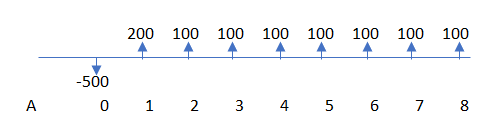
Time taken for A for net cash flows to equal 500 = 200*1 + 100*3,
therefore payback period is 4years
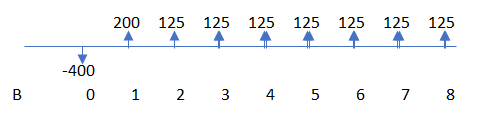
Time taken for B for net cash flows to equal 400 = 200*1 + 125*1 +
125 *3/5, therefore payback period is 2(3/5)years
Time taken for C for net cash flows to equal 300 = 200*1 + 100*1,
therefore payback period is 2years
Based on payback period, project C will be chosen as it has the
lowest payback.
To calculate benefit cost ratio, the net present value of costs and benefits is calculated and then the ratio is computed
| A | B | C | |
| Initial cost | -500 | -400 | -300 |
| 1st year benefit | 200 | 200 | 200 |
| Subsequent annual benefit | 100 | 125 | 100 |
| Life | 8 | 8 | 8 |
| Discounted Benefits in first year | 200+PV(0.1,7,100) | 200+PV(0.1,7,125) | 200+PV(0.1,7,100) |
| $686.84 | $808.55 | $686.84 | |
| PV of benefits | Benefits in first year/(1.1) | ||
| $624.40 | $735.05 | $624.40 | |
| B/C | 1.25 | 1.84 | 2.08 |
We choose the project with highest B/C, hence project C is chosen
For incremental benefit cost analysis, we start with the base project with the least cost, in this case project C, we compute the present value of additional benefits and costs of moving to any other project. In this case, only project B has some additional cash flows!
| Incremental cash flow | 25 |
| Benefits in first year | $121.71 |
| PV Benefits | $110.65 |
| Can also be computed by 735.05-624.40 | |
| Incremental cost | 100 |
| Incremental B/C | 1.11 |
Since the ratio is more than 1, we choose project B. There are
no incremental cash-flows while moving from B to A, hence B is
chosen!
Cash flow diagrams

Add Answer to:
Need cash flow diagram 04) Three mutually exclusive alternative are being considered Initial Cost Benefit at the end of the first Year Uniform Annual Benefits at end of subsequent years Useful Lif...
Three mutually exclusive alternatives are being considered: Initial cost Benefit at end of the first $500...
 Three mutually exclusive alternatives are being considered: Initial cost Benefit at end of the first $500 $400 $300 200 200 200 year Uniform benefit at end of 100 125 100 subsequent years Useful life, in years 4 At the end of its useful life, an alternative is not replaced. If the MARR is 10%, which alternative should be selected (a) Based on the payback period? (b) Based on benefit-cost ratio analysis?
9-54 Three mutually exclusive alternatives are beine A considered: $500 $400 $300 200 100 Initial...
 9-54 Three mutually exclusive alternatives are beine A considered: $500 $400 $300 200 100 Initial cost Benefit at end of the first 200 200 year Uniform benefit at end of 100 125 subsequent years Useful life, in years 4 At the end of its useful life, an alternative is not replaced. If the MARR is 10%, which alternative should be selected (a) Based on the payback period? (b) Based on benefit-cost ratio analysis?
9-54 Three mutually exclusive alternatives are beine...
9-54 Three mutually exclusive alternatives are beine A considered: $500 $400 $300 200 100 Initial cost Benefit at end of the first 200 200 year Uniform benefit at end of 100 125 subsequent years Useful life, in years 4 At the end of its useful life, an alternative is not replaced. If the MARR is 10%, which alternative should be selected (a) Based on the payback period? (b) Based on benefit-cost ratio analysis?
9-54 Three mutually exclusive alternatives are beine...
Do not use Excel or tables 9-54 Three mutually exclusive alternatives are being considered: Initial cost...
 Do not use Excel or tables
9-54 Three mutually exclusive alternatives are being considered: Initial cost Benefit at end of the first $500 $400 $300 200 200 200 100 4 year Uniform benefit at end of 100 125 subsequent years Useful life, in years At the end of its useful life, an alternative is not replaced. If the MARR is 10%, which alternative should be selected (a) Based on the payback period? (b) Based on benefit-cost ratio analysis?
Do not use Excel or tables
9-54 Three mutually exclusive alternatives are being considered: Initial cost Benefit at end of the first $500 $400 $300 200 200 200 100 4 year Uniform benefit at end of 100 125 subsequent years Useful life, in years At the end of its useful life, an alternative is not replaced. If the MARR is 10%, which alternative should be selected (a) Based on the payback period? (b) Based on benefit-cost ratio analysis?
international genetic technologies inc. (InGen) is examining the following three mutually exclusive alternatives. 3) Using benefit-cost...
 international genetic technologies inc. (InGen) is examining
the following three mutually exclusive alternatives.
3) Using benefit-cost ratio analysis, a 10-year useful life and a MARR of 25%, determine which of the following mutually exclusive models should be selected. А в C D E Initial Cost $100 $200 $300 $400 $500 $37 $60 $83 $137 $150 Annual Benefits 4) A big box company is using a benefit-cost ratio analysis to select which one of the 3 alternatives shown below should be...
international genetic technologies inc. (InGen) is examining
the following three mutually exclusive alternatives.
3) Using benefit-cost ratio analysis, a 10-year useful life and a MARR of 25%, determine which of the following mutually exclusive models should be selected. А в C D E Initial Cost $100 $200 $300 $400 $500 $37 $60 $83 $137 $150 Annual Benefits 4) A big box company is using a benefit-cost ratio analysis to select which one of the 3 alternatives shown below should be...
9- Two alternatives with identical benefits are being considered: 49 A B Initial cost $500 $800...
 9- Two alternatives with identical benefits are being considered: 49 A B Initial cost $500 $800 Uniform annual cost 200 150 Useful life, in years 8 8 (a) Compute the payback period if Alt. B is purchased rather than Alt. A (b) Use a MARR of 10% and benefit-cost ratio analysis to identify the alternative that should be selected
2. Consider the following two mutually exclusive alternatives: Cost, $ Uniform annual benefit, $ Useful life,...
 2. Consider the following two mutually exclusive alternatives: Cost, $ Uniform annual benefit, $ Useful life, years 100,000 16,000 150,000 24,000 Using a 10% interest rate, and an annual cash flow analysis, determine which alternative should be selected. Draw the CFD.
A small construction project having a useful life of 5 years has five mutually exclusive alternatives....
 A small construction project having a useful life of 5 years has five mutually exclusive alternatives. With an MARR of 6% and using incremental IRR which alternative should be selected? Note: First solve for the IRR for each alternative. You may use a spreadsheet to iterate to solve, but solve for the IRR for Alternative II 'by hand' by iterating between the interest rate tables in the back of the book. Alternatives III $400 $90 Initial Cost Uniform Annual Benefit...
8 pts Question 11 Consider the following two mutually exclusive alternatives: $ 20,000 Uniform amul benefit...
 8 pts Question 11 Consider the following two mutually exclusive alternatives: $ 20,000 Uniform amul benefit Useful life in years Alternative B may be replaced with an identical item every 20 years at the same $28,000 cost and will have the same $2.750 uniform annual benefit. Ata 7% interest rate, use the annual cash flow analysis method to find which alternative should be selected. ཀྱིས 12pt Paragraph Consider the following two mutually exclusive alternatives: $ 20,000 2.000 $28.000 2.750 Uniform...
Three mutually exclusive investment alternatives are being considered. The estimated cash flows for each wernative we...
 Three mutually exclusive investment alternatives are being considered. The estimated cash flows for each wernative we given below. The study period is 30 years and the firm's MARR is 6% per year. Assume repeatability and reinvestment of positive cash balances at 6 per year a. What is the simple payback period for Alternative 1? b. What is the annual worth of Alternative 2? c. What is the IRR of the incremental cash flows of Alternative 2 compared to Aheative 1?...
selected? urm is considering three mutually exclusive alter- atives as part of a production improvement program....
 selected? urm is considering three mutually exclusive alter- atives as part of a production improvement program. The alternatives are as follows: First cost $15,000 Maintenance 1,600 and operating Annual benefit 8,000 Salvage value 3,000 Useful life, in years4 Installed cost Uniform annual benefit Useful life, in years A B C $10,000 $15,000 $20,000 1.625 1.625 1,890 10 20 For each alternative, the salvage value at the end of useful life is zero. At the end of 10 years, Alt. A...
 Three mutually exclusive alternatives are being considered: Initial cost Benefit at end of the first $500 $400 $300 200 200 200 year Uniform benefit at end of 100 125 100 subsequent years Useful life, in years 4 At the end of its useful life, an alternative is not replaced. If the MARR is 10%, which alternative should be selected (a) Based on the payback period? (b) Based on benefit-cost ratio analysis?
 9-54 Three mutually exclusive alternatives are beine A considered: $500 $400 $300 200 100 Initial cost Benefit at end of the first 200 200 year Uniform benefit at end of 100 125 subsequent years Useful life, in years 4 At the end of its useful life, an alternative is not replaced. If the MARR is 10%, which alternative should be selected (a) Based on the payback period? (b) Based on benefit-cost ratio analysis?
9-54 Three mutually exclusive alternatives are beine...
9-54 Three mutually exclusive alternatives are beine A considered: $500 $400 $300 200 100 Initial cost Benefit at end of the first 200 200 year Uniform benefit at end of 100 125 subsequent years Useful life, in years 4 At the end of its useful life, an alternative is not replaced. If the MARR is 10%, which alternative should be selected (a) Based on the payback period? (b) Based on benefit-cost ratio analysis?
9-54 Three mutually exclusive alternatives are beine...
 Do not use Excel or tables
9-54 Three mutually exclusive alternatives are being considered: Initial cost Benefit at end of the first $500 $400 $300 200 200 200 100 4 year Uniform benefit at end of 100 125 subsequent years Useful life, in years At the end of its useful life, an alternative is not replaced. If the MARR is 10%, which alternative should be selected (a) Based on the payback period? (b) Based on benefit-cost ratio analysis?
Do not use Excel or tables
9-54 Three mutually exclusive alternatives are being considered: Initial cost Benefit at end of the first $500 $400 $300 200 200 200 100 4 year Uniform benefit at end of 100 125 subsequent years Useful life, in years At the end of its useful life, an alternative is not replaced. If the MARR is 10%, which alternative should be selected (a) Based on the payback period? (b) Based on benefit-cost ratio analysis?
 international genetic technologies inc. (InGen) is examining
the following three mutually exclusive alternatives.
3) Using benefit-cost ratio analysis, a 10-year useful life and a MARR of 25%, determine which of the following mutually exclusive models should be selected. А в C D E Initial Cost $100 $200 $300 $400 $500 $37 $60 $83 $137 $150 Annual Benefits 4) A big box company is using a benefit-cost ratio analysis to select which one of the 3 alternatives shown below should be...
international genetic technologies inc. (InGen) is examining
the following three mutually exclusive alternatives.
3) Using benefit-cost ratio analysis, a 10-year useful life and a MARR of 25%, determine which of the following mutually exclusive models should be selected. А в C D E Initial Cost $100 $200 $300 $400 $500 $37 $60 $83 $137 $150 Annual Benefits 4) A big box company is using a benefit-cost ratio analysis to select which one of the 3 alternatives shown below should be...
 9- Two alternatives with identical benefits are being considered: 49 A B Initial cost $500 $800 Uniform annual cost 200 150 Useful life, in years 8 8 (a) Compute the payback period if Alt. B is purchased rather than Alt. A (b) Use a MARR of 10% and benefit-cost ratio analysis to identify the alternative that should be selected
 2. Consider the following two mutually exclusive alternatives: Cost, $ Uniform annual benefit, $ Useful life, years 100,000 16,000 150,000 24,000 Using a 10% interest rate, and an annual cash flow analysis, determine which alternative should be selected. Draw the CFD.
 A small construction project having a useful life of 5 years has five mutually exclusive alternatives. With an MARR of 6% and using incremental IRR which alternative should be selected? Note: First solve for the IRR for each alternative. You may use a spreadsheet to iterate to solve, but solve for the IRR for Alternative II 'by hand' by iterating between the interest rate tables in the back of the book. Alternatives III $400 $90 Initial Cost Uniform Annual Benefit...
 8 pts Question 11 Consider the following two mutually exclusive alternatives: $ 20,000 Uniform amul benefit Useful life in years Alternative B may be replaced with an identical item every 20 years at the same $28,000 cost and will have the same $2.750 uniform annual benefit. Ata 7% interest rate, use the annual cash flow analysis method to find which alternative should be selected. ཀྱིས 12pt Paragraph Consider the following two mutually exclusive alternatives: $ 20,000 2.000 $28.000 2.750 Uniform...
 Three mutually exclusive investment alternatives are being considered. The estimated cash flows for each wernative we given below. The study period is 30 years and the firm's MARR is 6% per year. Assume repeatability and reinvestment of positive cash balances at 6 per year a. What is the simple payback period for Alternative 1? b. What is the annual worth of Alternative 2? c. What is the IRR of the incremental cash flows of Alternative 2 compared to Aheative 1?...
 selected? urm is considering three mutually exclusive alter- atives as part of a production improvement program. The alternatives are as follows: First cost $15,000 Maintenance 1,600 and operating Annual benefit 8,000 Salvage value 3,000 Useful life, in years4 Installed cost Uniform annual benefit Useful life, in years A B C $10,000 $15,000 $20,000 1.625 1.625 1,890 10 20 For each alternative, the salvage value at the end of useful life is zero. At the end of 10 years, Alt. A...
Most questions answered within 3 hours.
-
Where is the error in this code sequence?
String s1 = "Hello";
String s2 = "ello";...
asked 11 months ago -
Financial data for Joel de Paris, Inc., for last year
follow:
Joel de Paris, Inc.
Balance...
asked 11 months ago -
Consider this reaction:
Al2(SO4)3 (aq)+ BaCl3
(aq) Al2Cl6 (aq)- +
3BaSO4(s) . What is the...
asked 11 months ago -
Suppose that Savneet is considering increasing her
recent random sample from 20 car rentals to 40...
asked 11 months ago -
Trucks arrive at an unloading terminal at an average rate of 120
per hour.
Trucks arrive...
asked 11 months ago -
Why are methanol and ethanol completely soluble in water while
octanol is not very little soluble....
asked 11 months ago -
A facilities manager at a university reads in a research report
that the mean amount of...
asked 11 months ago -
When the CuSO4 is rehydrated by adding water to the anhydrous
compound, is this an endothermic...
asked 11 months ago -
A ray of sunlight is passing from diamond into crown glass; the
angle of incidence is...
asked 11 months ago -
A block of mass 0.249 kg is placed on top of a light, vertical
spring of...
asked 11 months ago -
how do the kidneys compensate in the presences of acidosis
a) trigger hyperventilate
b) reserve acid...
asked 11 months ago -
Question 501 pts
The rental rate of capital to the firm increases. Which of the
following...
asked 11 months ago