Consider the system simulation diagram of Figure 1. This figure shows a simulation diagram form used in the area of automatic control where x[n] is the input, y[n] is the output, and D is the unit shift (or delay) operator.
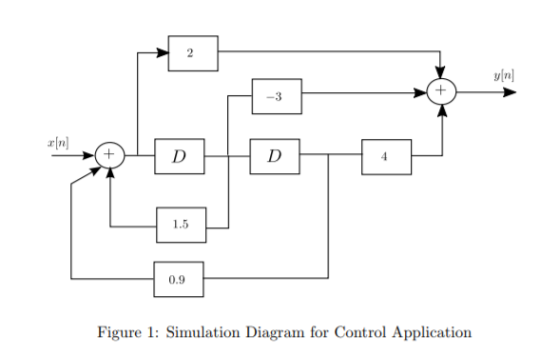
1. Suppose x[n] = 0.8 nµ[n] and assuming zero initial conditions (i.e y[−1] = y[−2] = 0), write a MATLAB program that solves for y[n], 0 ≤ n ≤ 10. Plot both the input signal x[n] and the output signal y[n] for the range 0 ≤ n ≤ 10 on different axes.
2. Translate the system into a state-space form and using SIMULINK, develop an alternative simulation diagram for the control system. Plot the system responses under the same conditions as above.
*Please answer with the actual code and the simulink design. I really can't figure this out and would appreciate the help.
Homework Answers


Add Answer to:
Consider the system simulation diagram of Figure 1. This figure shows a simulation diagram form used in the area of automatic control where x[n] is the input, y[n] is the output, and D is the unit shi...
A system (a plant) is represented as a state-space model in the form: dt (1) Deduce and draw a si...
 A system (a plant) is represented as a state-space model in the form: dt (1) Deduce and draw a simulation diagram for the system. Implement it afterwards in Simulink. For a unit stepin- put, simulate and plot the trajectories in the state space, and the output y(t) of the system, for a set of four different initial conditions: x(0)-[0 ofT,x(0-[1 o, x(0-0 IT,x(0-[0 I]T
A system (a plant) is represented as a state-space model in the form: dt (1) Deduce...
A system (a plant) is represented as a state-space model in the form: dt (1) Deduce and draw a simulation diagram for the system. Implement it afterwards in Simulink. For a unit stepin- put, simulate and plot the trajectories in the state space, and the output y(t) of the system, for a set of four different initial conditions: x(0)-[0 ofT,x(0-[1 o, x(0-0 IT,x(0-[0 I]T
A system (a plant) is represented as a state-space model in the form: dt (1) Deduce...
Consider the following system: -1-2-21 гг 1 0 1 L Where u is the system input and y is the measur...
 control system with observer
Consider the following system: -1-2-21 гг 1 0 1 L Where u is the system input and y is the measured output. 1. Find the transfer function of the system. 2. Design a state feedback controller with a full-state observer such that the step response of the closed loop system is second order dominant with an overshoot Mp settling time ts s 5 sec. Represent the observer-based control system in a compact state space form. 10%...
control system with observer
Consider the following system: -1-2-21 гг 1 0 1 L Where u is the system input and y is the measured output. 1. Find the transfer function of the system. 2. Design a state feedback controller with a full-state observer such that the step response of the closed loop system is second order dominant with an overshoot Mp settling time ts s 5 sec. Represent the observer-based control system in a compact state space form. 10%...
control system System Description: The figure 1 and 2 below show, respectively, components and block diagram...
 control system
System Description: The figure 1 and 2 below show, respectively, components and block diagram of a motor and the measurements of velocity (via the tacho unit) and position (via the potentiometer). n represents the gearbox ratio between the rotating shaft and the output shaft. The left-hand side of the diagram represents the controller. A reference set point for the rotating shaft is entered in degrees and this is equivalent voltage. The error is calculated by subtracting the measured...
control system
System Description: The figure 1 and 2 below show, respectively, components and block diagram of a motor and the measurements of velocity (via the tacho unit) and position (via the potentiometer). n represents the gearbox ratio between the rotating shaft and the output shaft. The left-hand side of the diagram represents the controller. A reference set point for the rotating shaft is entered in degrees and this is equivalent voltage. The error is calculated by subtracting the measured...
(2) Consider the causal discrete-time LTI system with an input r (n) and an output y(n)...
 (2) Consider the causal discrete-time LTI system with an input r (n) and an output y(n) as shown in Figure 1, where K 6 (constant), system #1 is described by its impulse response: h(n) = -36(n) + 0.48(n- 1)+8.26(n-2), and system # 2 has the difference equation given by: y(n)+0.1y(n-1)+0.3y(n-2)- 2a(n). (a) Determine the corresponding difference equation of the system #1. Hence, write its fre- quency response. (b) Find the frequency response of system #2. 1 system #1 system #2...
Consider three systems with the following input-output relationships 6. Consider three systems with the following input-output...
 Consider three systems with the following input-output
relationships
6. Consider three systems with the following input-output relationships: { 4 0, odd System 1: y[n n even r[n] 10ar(n 2]3r[n - 1 System 2: yn + + System 3: yn x[3n] The interconnection diagram is at follows: System 1 System 2 System 3 Find the input-output relationship of the interconnected system. State the properties of the system (linear, stable, time invariant, memoryless, and causal).
6. Consider three systems with the following...
Consider three systems with the following input-output
relationships
6. Consider three systems with the following input-output relationships: { 4 0, odd System 1: y[n n even r[n] 10ar(n 2]3r[n - 1 System 2: yn + + System 3: yn x[3n] The interconnection diagram is at follows: System 1 System 2 System 3 Find the input-output relationship of the interconnected system. State the properties of the system (linear, stable, time invariant, memoryless, and causal).
6. Consider three systems with the following...
(Convolution DT) consider the following LTI system with input x[n] and output y[n]: (a) sketchbthe input...
(Convolution DT) consider the following LTI system with input x[n] and output y[n]: (a) sketchbthe input signal x[n] = (1/2)^n(u[n])
Suppose the signal x[n] = δ[n-1] + cos(nn/6+ π/4) is input to the LTI system described by the equation y[n][n] +r|n - 0.5yn -. Determine a closed-form expression for yn] Suppose the signal x[n]...
 Suppose the signal x[n] = δ[n-1] + cos(nn/6+ π/4) is input to the LTI system described by the equation y[n][n] +r|n - 0.5yn -. Determine a closed-form expression for yn]
Suppose the signal x[n] = δ[n-1] + cos(nn/6+ π/4) is input to the LTI system described by the equation y[n][n] +r|n - 0.5yn -. Determine a closed-form expression for yn]
Suppose the signal x[n] = δ[n-1] + cos(nn/6+ π/4) is input to the LTI system described by the equation y[n][n] +r|n - 0.5yn -. Determine a closed-form expression for yn]
Q5: Consider the system in Figure 1. Assume that X (F) 0 for lfl> F /2 and that How is the output...
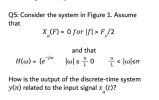 Q5: Consider the system in Figure 1. Assume that X (F) 0 for lfl> F /2 and that How is the output of the discrete-time system y(n) related to the input signal x (t)? LA
Q5: Consider the system in Figure 1. Assume that X (F) 0 for lfl> F /2 and that How is the output of the discrete-time system y(n) related to the input signal x (t)?
LA
Q5: Consider the system in Figure 1. Assume that X (F) 0 for lfl> F /2 and that How is the output of the discrete-time system y(n) related to the input signal x (t)? LA
Q5: Consider the system in Figure 1. Assume that X (F) 0 for lfl> F /2 and that How is the output of the discrete-time system y(n) related to the input signal x (t)?
LA
(20 pts.) Determine the response of the system described by the difference equation 7. 1 1 y(n) yn 1)n2)x(n) n for inpu...
 (20 pts.) Determine the response of the system described by the difference equation 7. 1 1 y(n) yn 1)n2)x(n) n for input signal x(n) = (;) u(n) under the following initial conditions y(-1) 1, y-2) 0.5
(20 pts.) Determine the response of the system described by the difference equation 7. 1 1 y(n) yn 1)n2)x(n) n for input signal x(n) = (;) u(n) under the following initial conditions y(-1) 1, y-2) 0.5
(20 pts.) Determine the response of the system described by the difference equation 7. 1 1 y(n) yn 1)n2)x(n) n for input signal x(n) = (;) u(n) under the following initial conditions y(-1) 1, y-2) 0.5
Name: 10. [8 points] Consider a discrete-time LTI system with input x[n] and out- put y[n]....
 Name: 10. [8 points] Consider a discrete-time LTI system with input x[n] and out- put y[n]. When the input signal x[n] = (6)" is applied to the system, the output signal is y[n] = 0 for all n When the input signal xn] (3)" u[n] is applied to the system, the output signal is y[n] = A 8[n] + 2 (5)" u[n] for all n, where A is a constant number a) Find A. b) Find the impulse response of...
 A system (a plant) is represented as a state-space model in the form: dt (1) Deduce and draw a simulation diagram for the system. Implement it afterwards in Simulink. For a unit stepin- put, simulate and plot the trajectories in the state space, and the output y(t) of the system, for a set of four different initial conditions: x(0)-[0 ofT,x(0-[1 o, x(0-0 IT,x(0-[0 I]T
A system (a plant) is represented as a state-space model in the form: dt (1) Deduce...
A system (a plant) is represented as a state-space model in the form: dt (1) Deduce and draw a simulation diagram for the system. Implement it afterwards in Simulink. For a unit stepin- put, simulate and plot the trajectories in the state space, and the output y(t) of the system, for a set of four different initial conditions: x(0)-[0 ofT,x(0-[1 o, x(0-0 IT,x(0-[0 I]T
A system (a plant) is represented as a state-space model in the form: dt (1) Deduce...
 control system with observer
Consider the following system: -1-2-21 гг 1 0 1 L Where u is the system input and y is the measured output. 1. Find the transfer function of the system. 2. Design a state feedback controller with a full-state observer such that the step response of the closed loop system is second order dominant with an overshoot Mp settling time ts s 5 sec. Represent the observer-based control system in a compact state space form. 10%...
control system with observer
Consider the following system: -1-2-21 гг 1 0 1 L Where u is the system input and y is the measured output. 1. Find the transfer function of the system. 2. Design a state feedback controller with a full-state observer such that the step response of the closed loop system is second order dominant with an overshoot Mp settling time ts s 5 sec. Represent the observer-based control system in a compact state space form. 10%...
 control system
System Description: The figure 1 and 2 below show, respectively, components and block diagram of a motor and the measurements of velocity (via the tacho unit) and position (via the potentiometer). n represents the gearbox ratio between the rotating shaft and the output shaft. The left-hand side of the diagram represents the controller. A reference set point for the rotating shaft is entered in degrees and this is equivalent voltage. The error is calculated by subtracting the measured...
control system
System Description: The figure 1 and 2 below show, respectively, components and block diagram of a motor and the measurements of velocity (via the tacho unit) and position (via the potentiometer). n represents the gearbox ratio between the rotating shaft and the output shaft. The left-hand side of the diagram represents the controller. A reference set point for the rotating shaft is entered in degrees and this is equivalent voltage. The error is calculated by subtracting the measured...
 (2) Consider the causal discrete-time LTI system with an input r (n) and an output y(n) as shown in Figure 1, where K 6 (constant), system #1 is described by its impulse response: h(n) = -36(n) + 0.48(n- 1)+8.26(n-2), and system # 2 has the difference equation given by: y(n)+0.1y(n-1)+0.3y(n-2)- 2a(n). (a) Determine the corresponding difference equation of the system #1. Hence, write its fre- quency response. (b) Find the frequency response of system #2. 1 system #1 system #2...
 Consider three systems with the following input-output
relationships
6. Consider three systems with the following input-output relationships: { 4 0, odd System 1: y[n n even r[n] 10ar(n 2]3r[n - 1 System 2: yn + + System 3: yn x[3n] The interconnection diagram is at follows: System 1 System 2 System 3 Find the input-output relationship of the interconnected system. State the properties of the system (linear, stable, time invariant, memoryless, and causal).
6. Consider three systems with the following...
Consider three systems with the following input-output
relationships
6. Consider three systems with the following input-output relationships: { 4 0, odd System 1: y[n n even r[n] 10ar(n 2]3r[n - 1 System 2: yn + + System 3: yn x[3n] The interconnection diagram is at follows: System 1 System 2 System 3 Find the input-output relationship of the interconnected system. State the properties of the system (linear, stable, time invariant, memoryless, and causal).
6. Consider three systems with the following...
 Suppose the signal x[n] = δ[n-1] + cos(nn/6+ π/4) is input to the LTI system described by the equation y[n][n] +r|n - 0.5yn -. Determine a closed-form expression for yn]
Suppose the signal x[n] = δ[n-1] + cos(nn/6+ π/4) is input to the LTI system described by the equation y[n][n] +r|n - 0.5yn -. Determine a closed-form expression for yn]
Suppose the signal x[n] = δ[n-1] + cos(nn/6+ π/4) is input to the LTI system described by the equation y[n][n] +r|n - 0.5yn -. Determine a closed-form expression for yn]
 Q5: Consider the system in Figure 1. Assume that X (F) 0 for lfl> F /2 and that How is the output of the discrete-time system y(n) related to the input signal x (t)? LA
Q5: Consider the system in Figure 1. Assume that X (F) 0 for lfl> F /2 and that How is the output of the discrete-time system y(n) related to the input signal x (t)?
LA
Q5: Consider the system in Figure 1. Assume that X (F) 0 for lfl> F /2 and that How is the output of the discrete-time system y(n) related to the input signal x (t)? LA
Q5: Consider the system in Figure 1. Assume that X (F) 0 for lfl> F /2 and that How is the output of the discrete-time system y(n) related to the input signal x (t)?
LA
 (20 pts.) Determine the response of the system described by the difference equation 7. 1 1 y(n) yn 1)n2)x(n) n for input signal x(n) = (;) u(n) under the following initial conditions y(-1) 1, y-2) 0.5
(20 pts.) Determine the response of the system described by the difference equation 7. 1 1 y(n) yn 1)n2)x(n) n for input signal x(n) = (;) u(n) under the following initial conditions y(-1) 1, y-2) 0.5
(20 pts.) Determine the response of the system described by the difference equation 7. 1 1 y(n) yn 1)n2)x(n) n for input signal x(n) = (;) u(n) under the following initial conditions y(-1) 1, y-2) 0.5
 Name: 10. [8 points] Consider a discrete-time LTI system with input x[n] and out- put y[n]. When the input signal x[n] = (6)" is applied to the system, the output signal is y[n] = 0 for all n When the input signal xn] (3)" u[n] is applied to the system, the output signal is y[n] = A 8[n] + 2 (5)" u[n] for all n, where A is a constant number a) Find A. b) Find the impulse response of...
Most questions answered within 3 hours.
-
Where is the error in this code sequence?
String s1 = "Hello";
String s2 = "ello";...
asked 10 months ago -
Financial data for Joel de Paris, Inc., for last year
follow:
Joel de Paris, Inc.
Balance...
asked 10 months ago -
Consider this reaction:
Al2(SO4)3 (aq)+ BaCl3
(aq) Al2Cl6 (aq)- +
3BaSO4(s) . What is the...
asked 10 months ago -
Suppose that Savneet is considering increasing her
recent random sample from 20 car rentals to 40...
asked 10 months ago -
Trucks arrive at an unloading terminal at an average rate of 120
per hour.
Trucks arrive...
asked 10 months ago -
Why are methanol and ethanol completely soluble in water while
octanol is not very little soluble....
asked 10 months ago -
A facilities manager at a university reads in a research report
that the mean amount of...
asked 10 months ago -
When the CuSO4 is rehydrated by adding water to the anhydrous
compound, is this an endothermic...
asked 10 months ago -
A ray of sunlight is passing from diamond into crown glass; the
angle of incidence is...
asked 10 months ago -
A block of mass 0.249 kg is placed on top of a light, vertical
spring of...
asked 10 months ago -
how do the kidneys compensate in the presences of acidosis
a) trigger hyperventilate
b) reserve acid...
asked 10 months ago -
Question 501 pts
The rental rate of capital to the firm increases. Which of the
following...
asked 10 months ago