
Homework Answers
Add Answer to:
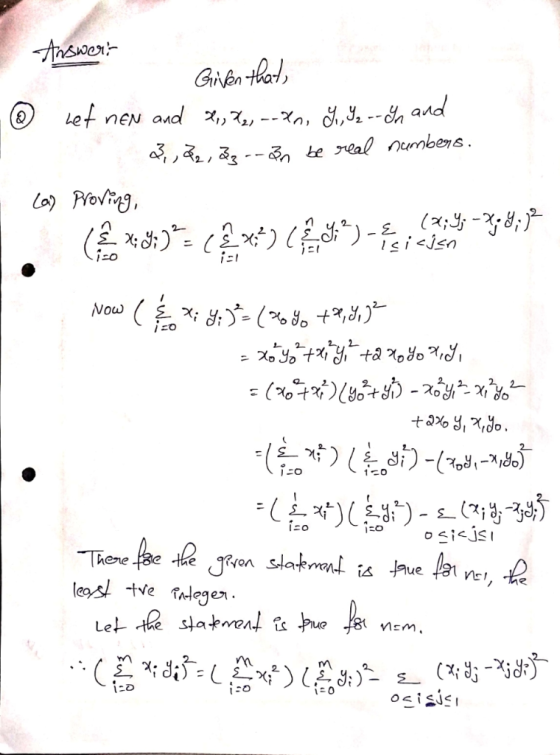
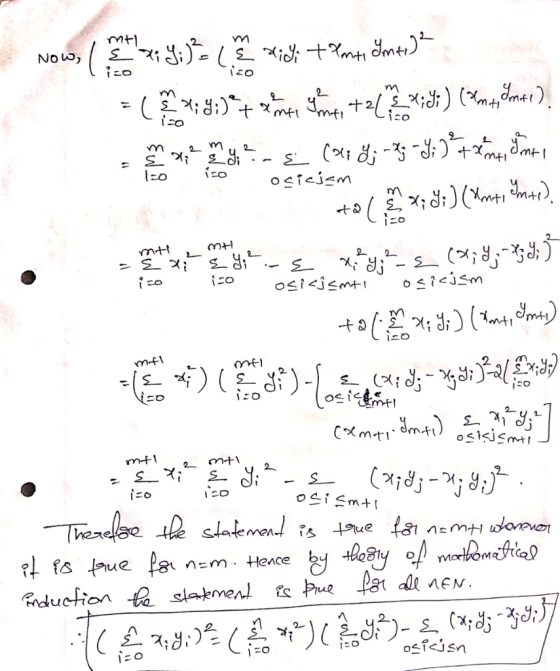
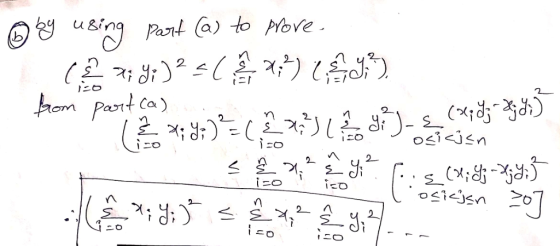
#2. Let n E N and X1,X2, ,yn, and zi,22, An be real numbers. ,An, yī,Y2, #a) Prove the identity #b) Use the identity in #a) to prove (the Cauchy-Schwartz inequality) that #1) Extend the result in...
#2. Let n E N and x1,x2,.., Xn, yı,y2,..,Ja, and zł,Zy, #a) Prove the identity An be real numbers #b) Use the identity in #a) to prove (the Cauchy-Schwartz inequality) that #1) Extend the result i...
 #2. Let n E N and x1,x2,.., Xn, yı,y2,..,Ja, and zł,Zy, #a) Prove the identity An be real numbers #b) Use the identity in #a) to prove (the Cauchy-Schwartz inequality) that #1) Extend the result in #b) to prove that 4 #d) Use the inequality in #b) to prove the inequality which is the triangle inequality
#2. Let n E N and x1,x2,.., Xn, yı,y2,..,Ja, and zł,Zy, #a) Prove the identity An be real numbers #b) Use the identity in...
#2. Let n E N and x1,x2,.., Xn, yı,y2,..,Ja, and zł,Zy, #a) Prove the identity An be real numbers #b) Use the identity in #a) to prove (the Cauchy-Schwartz inequality) that #1) Extend the result in #b) to prove that 4 #d) Use the inequality in #b) to prove the inequality which is the triangle inequality
#2. Let n E N and x1,x2,.., Xn, yı,y2,..,Ja, and zł,Zy, #a) Prove the identity An be real numbers #b) Use the identity in...
5. Let {xn} and {yn} be sequences of real numbers such that x1 = 2 and...
 5. Let {xn} and {yn} be sequences of real numbers such that x1 =
2 and y1 = 8 and for n = 1,2,3,···
x2nyn + xnyn2 x2n + yn2 xn+1 = x2 + y2 and yn+1 = x + y .
nn nn
(a) Prove that xn+1 − yn+1 = −(x3n − yn3 )(xn − yn) for all
positive integers n.
(xn +yn)(x2n +yn2) (b) Show that 0 < xn ≤ yn for all positive
integers n.
Hence, prove...
5. Let {xn} and {yn} be sequences of real numbers such that x1 =
2 and y1 = 8 and for n = 1,2,3,···
x2nyn + xnyn2 x2n + yn2 xn+1 = x2 + y2 and yn+1 = x + y .
nn nn
(a) Prove that xn+1 − yn+1 = −(x3n − yn3 )(xn − yn) for all
positive integers n.
(xn +yn)(x2n +yn2) (b) Show that 0 < xn ≤ yn for all positive
integers n.
Hence, prove...
let n be a positive integer and let x1,...,xn be real numbers. Prove that ( x1+...+xn)2...
 let n be a positive integer and let
x1,...,xn be real numbers. Prove that (
x1+...+xn)2
n(x12+ x22 +...+
xn2).
let n be a positive integer and let
x1,...,xn be real numbers. Prove that (
x1+...+xn)2
n(x12+ x22 +...+
xn2).
(3) Let XXnX1,X2,⋯,Xn be iidiid random variables with Cauchy(0,1)Cauchy(0,1) distribution. That is, the density of X1...
(3) Let XXnX1,X2,⋯,Xn be iidiid random variables with Cauchy(0,1)Cauchy(0,1) distribution. That is, the density of X1 is 1/(π(1+x2)) for x∈ℜ. Prove that (X1+X2+⋯+Xn)/n is again distributed as Cauchy(0,1). The following ``answers'' have been proposed. Please read the choices very carefully and pick the most complete and accurate choice. (a) By the last exercise, the characteristic function of X1, is e−|t|e−|t|. Therefore by the fact that the Xi are iid, the characteristic function of their average is the product of n...
4. (20 pts) Let {xn} be a Cauchy sequence. Show that a) (5 pts) {xn} is...
 4. (20 pts) Let {xn} be a Cauchy sequence. Show that a) (5 pts) {xn} is bounded. Hint: See Lecture 4 notes b) (5 pts) {Jxn} is a Cauchy sequence. Hint: Use the following inequality ||x| - |y|| < |x - y|, for all x, y E R. _ subsequence of {xn} and xn c) (5 pts) If {xnk} is a See Lecture 4 notes. as k - oo, then xn OO as n»oo. Hint: > d) (5 pts) If...
1. Let ơ E Aut(R), where R denotes the field of real numbers. a) Prove that if a > b then σ(a) > ...
 1. Let ơ E Aut(R), where R denotes the field of real numbers. a) Prove that if a > b then σ(a) > σ(b) ( . (b) Prove that o is a continuous function. (c) Prove that ơ must be the identity function. Therefore Aut(R)-(1). (see problem 7 on pg. 567 for more details for each step).
1. Let ơ E Aut(R), where R denotes the field of real numbers. a) Prove that if a > b then σ(a) >...
1. Let ơ E Aut(R), where R denotes the field of real numbers. a) Prove that if a > b then σ(a) > σ(b) ( . (b) Prove that o is a continuous function. (c) Prove that ơ must be the identity function. Therefore Aut(R)-(1). (see problem 7 on pg. 567 for more details for each step).
1. Let ơ E Aut(R), where R denotes the field of real numbers. a) Prove that if a > b then σ(a) >...
(2) Let F zi + xj+yk and consider the integral vx Fi n dS where S is the surface of the paraboloid z = 1-x2-y2 corr...
 (2) Let F zi + xj+yk and consider the integral vx Fi n dS where S is the surface of the paraboloid z = 1-x2-y2 corresponding to 0, and n is a unit normal vector to S in the positive z-direction. (a) Apply Stokes' theorem to evaluate the integral. b) Evaluate the integral directly over the surface S. (c) Evaluate the integral directly over the new surface S which is given by the disk
(2) Let F zi + xj+yk...
(2) Let F zi + xj+yk and consider the integral vx Fi n dS where S is the surface of the paraboloid z = 1-x2-y2 corresponding to 0, and n is a unit normal vector to S in the positive z-direction. (a) Apply Stokes' theorem to evaluate the integral. b) Evaluate the integral directly over the surface S. (c) Evaluate the integral directly over the new surface S which is given by the disk
(2) Let F zi + xj+yk...
Prove the Binomial Theorem, that is Exercises 173 (vi) x+y y for all n e N...
 Prove the Binomial Theorem, that is Exercises 173 (vi) x+y y for all n e N C) Recall that for all 0rS L is divisible by 8 when n is an odd natural number vii))Show that 2 (vin) Prove Leibniz's Theorem for repeated differentiation of a product: If ande are functions of x, then prove that d (uv) d + +Mat0 for all n e N, where u, and d'a d/v and dy da respectively denote (You will need to...
e) Use the triangle inequality to prove that (ac + bd)2 (a2 + b2)(c2 + d2) for all a, b, c, d e R. Total: [20 marks]...
 e) Use the triangle inequality to prove that (ac + bd)2 (a2 + b2)(c2 + d2) for all a, b, c, d e R. Total: [20 marks]
e) Use the triangle inequality to prove that (ac + bd)2 (a2 + b2)(c2 + d2) for all a, b, c, d e R. Total: [20 marks]
e) Use the triangle inequality to prove that (ac + bd)2 (a2 + b2)(c2 + d2) for all a, b, c, d e R. Total: [20 marks]
2. Let X1, X2, X3 ..., X, be iid b(1, p) random variables. Let Sn =...
 2. Let X1, X2, X3 ..., X, be iid b(1, p) random variables. Let Sn = 27-1Xthen prove that Sn-E(Sn) N(0,1) as n +00. (Sn)
 #2. Let n E N and x1,x2,.., Xn, yı,y2,..,Ja, and zł,Zy, #a) Prove the identity An be real numbers #b) Use the identity in #a) to prove (the Cauchy-Schwartz inequality) that #1) Extend the result in #b) to prove that 4 #d) Use the inequality in #b) to prove the inequality which is the triangle inequality
#2. Let n E N and x1,x2,.., Xn, yı,y2,..,Ja, and zł,Zy, #a) Prove the identity An be real numbers #b) Use the identity in...
#2. Let n E N and x1,x2,.., Xn, yı,y2,..,Ja, and zł,Zy, #a) Prove the identity An be real numbers #b) Use the identity in #a) to prove (the Cauchy-Schwartz inequality) that #1) Extend the result in #b) to prove that 4 #d) Use the inequality in #b) to prove the inequality which is the triangle inequality
#2. Let n E N and x1,x2,.., Xn, yı,y2,..,Ja, and zł,Zy, #a) Prove the identity An be real numbers #b) Use the identity in...
 5. Let {xn} and {yn} be sequences of real numbers such that x1 =
2 and y1 = 8 and for n = 1,2,3,···
x2nyn + xnyn2 x2n + yn2 xn+1 = x2 + y2 and yn+1 = x + y .
nn nn
(a) Prove that xn+1 − yn+1 = −(x3n − yn3 )(xn − yn) for all
positive integers n.
(xn +yn)(x2n +yn2) (b) Show that 0 < xn ≤ yn for all positive
integers n.
Hence, prove...
5. Let {xn} and {yn} be sequences of real numbers such that x1 =
2 and y1 = 8 and for n = 1,2,3,···
x2nyn + xnyn2 x2n + yn2 xn+1 = x2 + y2 and yn+1 = x + y .
nn nn
(a) Prove that xn+1 − yn+1 = −(x3n − yn3 )(xn − yn) for all
positive integers n.
(xn +yn)(x2n +yn2) (b) Show that 0 < xn ≤ yn for all positive
integers n.
Hence, prove...
 let n be a positive integer and let
x1,...,xn be real numbers. Prove that (
x1+...+xn)2
n(x12+ x22 +...+
xn2).
let n be a positive integer and let
x1,...,xn be real numbers. Prove that (
x1+...+xn)2
n(x12+ x22 +...+
xn2).
 4. (20 pts) Let {xn} be a Cauchy sequence. Show that a) (5 pts) {xn} is bounded. Hint: See Lecture 4 notes b) (5 pts) {Jxn} is a Cauchy sequence. Hint: Use the following inequality ||x| - |y|| < |x - y|, for all x, y E R. _ subsequence of {xn} and xn c) (5 pts) If {xnk} is a See Lecture 4 notes. as k - oo, then xn OO as n»oo. Hint: > d) (5 pts) If...
 1. Let ơ E Aut(R), where R denotes the field of real numbers. a) Prove that if a > b then σ(a) > σ(b) ( . (b) Prove that o is a continuous function. (c) Prove that ơ must be the identity function. Therefore Aut(R)-(1). (see problem 7 on pg. 567 for more details for each step).
1. Let ơ E Aut(R), where R denotes the field of real numbers. a) Prove that if a > b then σ(a) >...
1. Let ơ E Aut(R), where R denotes the field of real numbers. a) Prove that if a > b then σ(a) > σ(b) ( . (b) Prove that o is a continuous function. (c) Prove that ơ must be the identity function. Therefore Aut(R)-(1). (see problem 7 on pg. 567 for more details for each step).
1. Let ơ E Aut(R), where R denotes the field of real numbers. a) Prove that if a > b then σ(a) >...
 (2) Let F zi + xj+yk and consider the integral vx Fi n dS where S is the surface of the paraboloid z = 1-x2-y2 corresponding to 0, and n is a unit normal vector to S in the positive z-direction. (a) Apply Stokes' theorem to evaluate the integral. b) Evaluate the integral directly over the surface S. (c) Evaluate the integral directly over the new surface S which is given by the disk
(2) Let F zi + xj+yk...
(2) Let F zi + xj+yk and consider the integral vx Fi n dS where S is the surface of the paraboloid z = 1-x2-y2 corresponding to 0, and n is a unit normal vector to S in the positive z-direction. (a) Apply Stokes' theorem to evaluate the integral. b) Evaluate the integral directly over the surface S. (c) Evaluate the integral directly over the new surface S which is given by the disk
(2) Let F zi + xj+yk...
 Prove the Binomial Theorem, that is Exercises 173 (vi) x+y y for all n e N C) Recall that for all 0rS L is divisible by 8 when n is an odd natural number vii))Show that 2 (vin) Prove Leibniz's Theorem for repeated differentiation of a product: If ande are functions of x, then prove that d (uv) d + +Mat0 for all n e N, where u, and d'a d/v and dy da respectively denote (You will need to...
 e) Use the triangle inequality to prove that (ac + bd)2 (a2 + b2)(c2 + d2) for all a, b, c, d e R. Total: [20 marks]
e) Use the triangle inequality to prove that (ac + bd)2 (a2 + b2)(c2 + d2) for all a, b, c, d e R. Total: [20 marks]
e) Use the triangle inequality to prove that (ac + bd)2 (a2 + b2)(c2 + d2) for all a, b, c, d e R. Total: [20 marks]
 2. Let X1, X2, X3 ..., X, be iid b(1, p) random variables. Let Sn = 27-1Xthen prove that Sn-E(Sn) N(0,1) as n +00. (Sn)
Most questions answered within 3 hours.
-
Where is the error in this code sequence?
String s1 = "Hello";
String s2 = "ello";...
asked 11 months ago -
Financial data for Joel de Paris, Inc., for last year
follow:
Joel de Paris, Inc.
Balance...
asked 11 months ago -
Consider this reaction:
Al2(SO4)3 (aq)+ BaCl3
(aq) Al2Cl6 (aq)- +
3BaSO4(s) . What is the...
asked 11 months ago -
Suppose that Savneet is considering increasing her
recent random sample from 20 car rentals to 40...
asked 11 months ago -
Trucks arrive at an unloading terminal at an average rate of 120
per hour.
Trucks arrive...
asked 11 months ago -
Why are methanol and ethanol completely soluble in water while
octanol is not very little soluble....
asked 11 months ago -
A facilities manager at a university reads in a research report
that the mean amount of...
asked 11 months ago -
When the CuSO4 is rehydrated by adding water to the anhydrous
compound, is this an endothermic...
asked 11 months ago -
A ray of sunlight is passing from diamond into crown glass; the
angle of incidence is...
asked 11 months ago -
A block of mass 0.249 kg is placed on top of a light, vertical
spring of...
asked 11 months ago -
how do the kidneys compensate in the presences of acidosis
a) trigger hyperventilate
b) reserve acid...
asked 11 months ago -
Question 501 pts
The rental rate of capital to the firm increases. Which of the
following...
asked 11 months ago