
Model 1 (Contd.) Calculate the integral of f (x) 1 -x 4x2x5 between the limits of a2 and b 4 (a) Analytically (b) Using trapezoidal rie with n 4 divisions. (c) Use a single application of Simpson's 1/3 rule
Homework Answers


Add Answer to:
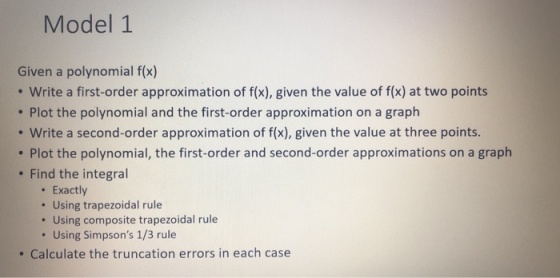
Show work by hand and also using MATLAB code. Model 1 Given a polynomial f(x) Write a first-order approximation of f(x), given the value of f(x) at two points Plot the polynomial and the first-or...
Paragraph Styles Voce Sraut Simpson's 1/3rd rule is an extension of Trapezoidal rule where the integrand...
 Paragraph Styles Voce Sraut Simpson's 1/3rd rule is an extension of Trapezoidal rule where the integrand is approximated by a second order polynomial instead of a first order polynomial. For a given function f(x) the integral of f(x) over an interval [a, b] using Simpson's 1/3rd rule is given by: S f(x)dx = odx =“ $(x)+4 ()+2 Ž f(x)+F(*,) a 1=1,3,5.... 1=2,4,6,... Where, n is the number of subintervals and h is the width of each subinterval. Write a complete...
Question 2. Consider the approximation of the definite integral () (a) Begin by using 2 points/nodes...
 Question 2. Consider the approximation of the definite integral () (a) Begin by using 2 points/nodes (i.e., n + 1 = 2, with the two points being x = a and r = b). Replace f(x) by the constant /(a+b)/2] on the entire interval a <<b. Show that this leads to the numerical integration formula M,()) = (b − a) ) Graphically illustrate this approximation. (b) In analogy with the derivation of the Trapezoidal rule and Simpson's rule, generalize part...
Use Matlab code Consider the following function sin(x) Using the following parameters in your functions: -func:...
 Use
Matlab code
Consider the following function sin(x) Using the following parameters in your functions: -func: the function/equation that you are required to integrate -a, b: the integration limits n: the number of points to be used for the integration I:Integral estimate a) Write a function capable of performing numerical integration of h(x) using the composite trapezoidal rule. Use your function to integration the equation with 9 points. Write a function capable of performing numerical integration of h(x) using the...
Use
Matlab code
Consider the following function sin(x) Using the following parameters in your functions: -func: the function/equation that you are required to integrate -a, b: the integration limits n: the number of points to be used for the integration I:Integral estimate a) Write a function capable of performing numerical integration of h(x) using the composite trapezoidal rule. Use your function to integration the equation with 9 points. Write a function capable of performing numerical integration of h(x) using the...
Exercise 6: Given the table of the function f(x)-2" 2 X 0 3 2 f(x) 1 2 4 8 a) Write down the Newton polynomial...
 Exercise 6: Given the table of the function f(x)-2" 2 X 0 3 2 f(x) 1 2 4 8 a) Write down the Newton polynomials P1(x), P2(x), Pa(x). b) Evaluate f(2.5) by using Pa(x). c) Obtain a bound for the errors E1(x), E2(x), Es(x) Exercise 7: Consider f(x)- In(x) use the following formula to answer the given questions '(x) +16-30f+16f,- 12h a) Derive the numerical differentiation formula using Taylor Series and find the truncation error b) Approximate f'(1.2) with h-0.05...
Question 1: Numerically integrate function f(x) given on the right from x=0 to x=10. Use the...
 Question 1: Numerically integrate function f(x) given on the right from x=0 to x=10. Use the f(x)= x2 - 6x + 16 Trapezoidal Rule and the Simpson's 1/3 Rule and compare the results. Use at least 4 50 + 15x - ye? decimal digits in your calculations and reporting. Organize and report each one of your solutions in a calculation table and identify your result clearly. a) Divide the interval into 5 subdivisions. Calculate the integral first using the Trapezoidal...
2 Problem 3 (25 points) Let I = ïrdz. a) [by hand] Use a composite trapezoidal rule to evaluate 1 using N = 3 subintervals. b) MATLAB] Use a composite trapezoidal rule to evaluate I using N - 6 subin...
 2 Problem 3 (25 points) Let I = ïrdz. a) [by hand] Use a composite trapezoidal rule to evaluate 1 using N = 3 subintervals. b) MATLAB] Use a composite trapezoidal rule to evaluate I using N - 6 subinterval:s c) by hand] Use Romberg extrapolation to combine your results from a) and b) and obtain an improved approximation (you may want to compare with a numerical approximation of the exact value of the integral
2 Problem 3 (25 points)...
2 Problem 3 (25 points) Let I = ïrdz. a) [by hand] Use a composite trapezoidal rule to evaluate 1 using N = 3 subintervals. b) MATLAB] Use a composite trapezoidal rule to evaluate I using N - 6 subinterval:s c) by hand] Use Romberg extrapolation to combine your results from a) and b) and obtain an improved approximation (you may want to compare with a numerical approximation of the exact value of the integral
2 Problem 3 (25 points)...
Please use matlab, post the code, and dont just write the code by hand. Thank you!...
 Please use matlab, post the code, and dont just write
the code by hand. Thank you!
4 [3 points] Use the function f(x on the interval [5, 5] and the 11 points below to find a N-10 Lagrange polynomial, using MATLAB. You will need to write code for and plot the polynomial as a function of x, but you do not have to write the polynomials down by hand 5 0 2 3 4 5 f(x) | 0.0399 | 00623...
Please use matlab, post the code, and dont just write
the code by hand. Thank you!
4 [3 points] Use the function f(x on the interval [5, 5] and the 11 points below to find a N-10 Lagrange polynomial, using MATLAB. You will need to write code for and plot the polynomial as a function of x, but you do not have to write the polynomials down by hand 5 0 2 3 4 5 f(x) | 0.0399 | 00623...
Consider the polynomial f(x,y)=ax^2+bxy+cy^2 (without using second derivative test) by identifying the graph as a paraboloid. ***Graph at least 9 DIFFERENT polynomials. Show graphs to accompany ac...
 Consider the polynomial
f(x,y)=ax^2+bxy+cy^2 (without using second derivative test) by
identifying the graph as a paraboloid.
***Graph at least 9 DIFFERENT
polynomials.
Show graphs to accompany actual
working. Would appreciate it dearly.
Quadratic Approximations and Critical Points Consider the polynomial f(x,y)+ ry+ c (without using the Second Derivative Tet) by identifying the graph as a paraboloid. 1. Graph f(x, y) for at least 9 different polynomials. (Specific choices of a, b and c.)
Quadratic Approximations and Critical Points Consider the...
Consider the polynomial
f(x,y)=ax^2+bxy+cy^2 (without using second derivative test) by
identifying the graph as a paraboloid.
***Graph at least 9 DIFFERENT
polynomials.
Show graphs to accompany actual
working. Would appreciate it dearly.
Quadratic Approximations and Critical Points Consider the polynomial f(x,y)+ ry+ c (without using the Second Derivative Tet) by identifying the graph as a paraboloid. 1. Graph f(x, y) for at least 9 different polynomials. (Specific choices of a, b and c.)
Quadratic Approximations and Critical Points Consider the...
Problem 5. Consider least squares polynomial approximation to f(x) = cos (nx) on x E [-1,1] using...
 Problem 5. Consider least squares polynomial approximation to f(x) = cos (nx) on x E [-1,1] using the inner product 1. In finding coefficients you will need to compute the integral By symmetry, an 0 for odd n, so we need only consider even n. (a) Make a change of variables and use appropriate identities to transform the integral for a to cos (Bcos 8)cos (ne) de (b) The Bessel function of even order, (x), can be defined by the...
1. Numerical Integration The integral of a function f(x) for a s x S b can be interpreted as the ...
 1. Numerical Integration The integral of a function f(x) for a s x S b can be interpreted as the area between the f(x) curve and the x axis, bounded by the limits x- a and x b. If we denote this area by A, then we can write A as A-f(x)dx A sophisticated method to find the area under a curve is to split the area into trapezoidal elements. Each trapezoid is called a panel. 1.2 0.2 1.2 13...
 Paragraph Styles Voce Sraut Simpson's 1/3rd rule is an extension of Trapezoidal rule where the integrand is approximated by a second order polynomial instead of a first order polynomial. For a given function f(x) the integral of f(x) over an interval [a, b] using Simpson's 1/3rd rule is given by: S f(x)dx = odx =“ $(x)+4 ()+2 Ž f(x)+F(*,) a 1=1,3,5.... 1=2,4,6,... Where, n is the number of subintervals and h is the width of each subinterval. Write a complete...
 Question 2. Consider the approximation of the definite integral () (a) Begin by using 2 points/nodes (i.e., n + 1 = 2, with the two points being x = a and r = b). Replace f(x) by the constant /(a+b)/2] on the entire interval a <<b. Show that this leads to the numerical integration formula M,()) = (b − a) ) Graphically illustrate this approximation. (b) In analogy with the derivation of the Trapezoidal rule and Simpson's rule, generalize part...
 Use
Matlab code
Consider the following function sin(x) Using the following parameters in your functions: -func: the function/equation that you are required to integrate -a, b: the integration limits n: the number of points to be used for the integration I:Integral estimate a) Write a function capable of performing numerical integration of h(x) using the composite trapezoidal rule. Use your function to integration the equation with 9 points. Write a function capable of performing numerical integration of h(x) using the...
Use
Matlab code
Consider the following function sin(x) Using the following parameters in your functions: -func: the function/equation that you are required to integrate -a, b: the integration limits n: the number of points to be used for the integration I:Integral estimate a) Write a function capable of performing numerical integration of h(x) using the composite trapezoidal rule. Use your function to integration the equation with 9 points. Write a function capable of performing numerical integration of h(x) using the...
 Exercise 6: Given the table of the function f(x)-2" 2 X 0 3 2 f(x) 1 2 4 8 a) Write down the Newton polynomials P1(x), P2(x), Pa(x). b) Evaluate f(2.5) by using Pa(x). c) Obtain a bound for the errors E1(x), E2(x), Es(x) Exercise 7: Consider f(x)- In(x) use the following formula to answer the given questions '(x) +16-30f+16f,- 12h a) Derive the numerical differentiation formula using Taylor Series and find the truncation error b) Approximate f'(1.2) with h-0.05...
 Question 1: Numerically integrate function f(x) given on the right from x=0 to x=10. Use the f(x)= x2 - 6x + 16 Trapezoidal Rule and the Simpson's 1/3 Rule and compare the results. Use at least 4 50 + 15x - ye? decimal digits in your calculations and reporting. Organize and report each one of your solutions in a calculation table and identify your result clearly. a) Divide the interval into 5 subdivisions. Calculate the integral first using the Trapezoidal...
 2 Problem 3 (25 points) Let I = ïrdz. a) [by hand] Use a composite trapezoidal rule to evaluate 1 using N = 3 subintervals. b) MATLAB] Use a composite trapezoidal rule to evaluate I using N - 6 subinterval:s c) by hand] Use Romberg extrapolation to combine your results from a) and b) and obtain an improved approximation (you may want to compare with a numerical approximation of the exact value of the integral
2 Problem 3 (25 points)...
2 Problem 3 (25 points) Let I = ïrdz. a) [by hand] Use a composite trapezoidal rule to evaluate 1 using N = 3 subintervals. b) MATLAB] Use a composite trapezoidal rule to evaluate I using N - 6 subinterval:s c) by hand] Use Romberg extrapolation to combine your results from a) and b) and obtain an improved approximation (you may want to compare with a numerical approximation of the exact value of the integral
2 Problem 3 (25 points)...
 Please use matlab, post the code, and dont just write
the code by hand. Thank you!
4 [3 points] Use the function f(x on the interval [5, 5] and the 11 points below to find a N-10 Lagrange polynomial, using MATLAB. You will need to write code for and plot the polynomial as a function of x, but you do not have to write the polynomials down by hand 5 0 2 3 4 5 f(x) | 0.0399 | 00623...
Please use matlab, post the code, and dont just write
the code by hand. Thank you!
4 [3 points] Use the function f(x on the interval [5, 5] and the 11 points below to find a N-10 Lagrange polynomial, using MATLAB. You will need to write code for and plot the polynomial as a function of x, but you do not have to write the polynomials down by hand 5 0 2 3 4 5 f(x) | 0.0399 | 00623...
 Consider the polynomial
f(x,y)=ax^2+bxy+cy^2 (without using second derivative test) by
identifying the graph as a paraboloid.
***Graph at least 9 DIFFERENT
polynomials.
Show graphs to accompany actual
working. Would appreciate it dearly.
Quadratic Approximations and Critical Points Consider the polynomial f(x,y)+ ry+ c (without using the Second Derivative Tet) by identifying the graph as a paraboloid. 1. Graph f(x, y) for at least 9 different polynomials. (Specific choices of a, b and c.)
Quadratic Approximations and Critical Points Consider the...
Consider the polynomial
f(x,y)=ax^2+bxy+cy^2 (without using second derivative test) by
identifying the graph as a paraboloid.
***Graph at least 9 DIFFERENT
polynomials.
Show graphs to accompany actual
working. Would appreciate it dearly.
Quadratic Approximations and Critical Points Consider the polynomial f(x,y)+ ry+ c (without using the Second Derivative Tet) by identifying the graph as a paraboloid. 1. Graph f(x, y) for at least 9 different polynomials. (Specific choices of a, b and c.)
Quadratic Approximations and Critical Points Consider the...
 Problem 5. Consider least squares polynomial approximation to f(x) = cos (nx) on x E [-1,1] using the inner product 1. In finding coefficients you will need to compute the integral By symmetry, an 0 for odd n, so we need only consider even n. (a) Make a change of variables and use appropriate identities to transform the integral for a to cos (Bcos 8)cos (ne) de (b) The Bessel function of even order, (x), can be defined by the...
 1. Numerical Integration The integral of a function f(x) for a s x S b can be interpreted as the area between the f(x) curve and the x axis, bounded by the limits x- a and x b. If we denote this area by A, then we can write A as A-f(x)dx A sophisticated method to find the area under a curve is to split the area into trapezoidal elements. Each trapezoid is called a panel. 1.2 0.2 1.2 13...
Most questions answered within 3 hours.
-
Where is the error in this code sequence?
String s1 = "Hello";
String s2 = "ello";...
asked 11 months ago -
Financial data for Joel de Paris, Inc., for last year
follow:
Joel de Paris, Inc.
Balance...
asked 11 months ago -
Consider this reaction:
Al2(SO4)3 (aq)+ BaCl3
(aq) Al2Cl6 (aq)- +
3BaSO4(s) . What is the...
asked 11 months ago -
Suppose that Savneet is considering increasing her
recent random sample from 20 car rentals to 40...
asked 11 months ago -
Trucks arrive at an unloading terminal at an average rate of 120
per hour.
Trucks arrive...
asked 11 months ago -
Why are methanol and ethanol completely soluble in water while
octanol is not very little soluble....
asked 11 months ago -
A facilities manager at a university reads in a research report
that the mean amount of...
asked 11 months ago -
When the CuSO4 is rehydrated by adding water to the anhydrous
compound, is this an endothermic...
asked 11 months ago -
A ray of sunlight is passing from diamond into crown glass; the
angle of incidence is...
asked 11 months ago -
A block of mass 0.249 kg is placed on top of a light, vertical
spring of...
asked 11 months ago -
how do the kidneys compensate in the presences of acidosis
a) trigger hyperventilate
b) reserve acid...
asked 11 months ago -
Question 501 pts
The rental rate of capital to the firm increases. Which of the
following...
asked 11 months ago