
Use the circuit below to answer the following question(s): R1c1 R2 )x(t) For the circuit shown above, if the output y(,)-v」(r), ie. the voltage across the capacitor c2, then what is the transfer function Hs) of the system when R I.R-2C-05,C-025?
Homework Answers

Add Answer to:
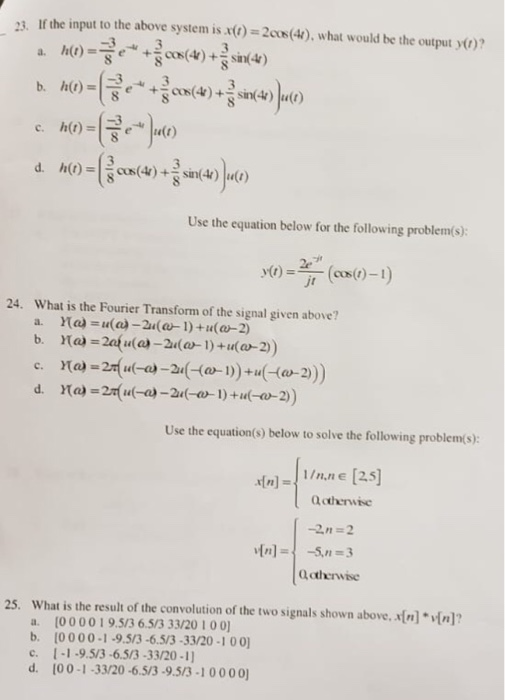
Answer 23, 24, and 25. thanks 23. If the input to the above system is a)2cus(4), what would be the output y0)? Use the equation below for the following problem(s): (cos(,)-1) y(t) = What is t...
Us the gragh below o anwer the following questionls): I'v" shecereua' .lowndarve, wh·is the inpulloutput differential equation when Xo loes the inductor 1 * (ou the voltage dyn R 23....
 Us the gragh below o anwer the following questionls): I'v" shecereua' .lowndarve, wh·is the inpulloutput differential equation when Xo loes the inductor 1 * (ou the voltage dyn R 23. If the input to the above system is xr)-200(4) what would be the output y0)? 8 8 Use the equation below for the following problems) (cos(,)-1) y(,) 24. What is the Fourier Transform of the signal given above?
Us the gragh below o anwer the following questionls): I'v" shecereua' .lowndarve,...
Us the gragh below o anwer the following questionls): I'v" shecereua' .lowndarve, wh·is the inpulloutput differential equation when Xo loes the inductor 1 * (ou the voltage dyn R 23. If the input to the above system is xr)-200(4) what would be the output y0)? 8 8 Use the equation below for the following problems) (cos(,)-1) y(,) 24. What is the Fourier Transform of the signal given above?
Us the gragh below o anwer the following questionls): I'v" shecereua' .lowndarve,...
Problem 1 Let's consider an LTI system with intput and output relatex through the equation y(t)...
 Problem 1 Let's consider an LTI system with intput and output relatex through the equation y(t) - --- (T 2) dr a) Find the impulse response h(t) for the given system (1). b) Is this system cansal or not? c) Determine the output of the system when the input x(t) is as shown below. Problem 2 Evaluate the following convolution where (t) and y(t) are plotted helow z(t) = z(t) * y(t) Hint. Expr the signals as a linear combination...
Use the equation below to answer the following question(s) x(t) = cos(a)t)u(t) 4. Using the definition...
 Use the equation below to answer the following question(s) x(t) = cos(a)t)u(t) 4. Using the definition of the Laplace Transform, what is the Laplace Transform of the function above? (Note Y ou must show all work in deriving the transform. You will get no points for picking the correct choice only!) ( +20) c. s2 +203 s2 +23 23
1. (Chapter I). A continuous-time system, with time t in seconds (s), input f(t), and output y(), is specified by the equation y(t) 1.5cos(250t) +0.8f(t) a. Is this system instantaneous (memoryle...
 1. (Chapter I). A continuous-time system, with time t in seconds (s), input f(t), and output y(), is specified by the equation y(t) 1.5cos(250t) +0.8f(t) a. Is this system instantaneous (memoryless) or dynamic (with memory)? Justify your answer b. Show that the system fails to satisfy the homogeneity or scaling property required for superposition to hold for inputs fi (0) = 2.0 and f(0) = 3 fi (0)-60. Clearly show and explain your work.
1. (Chapter I). A continuous-time system,...
1. (Chapter I). A continuous-time system, with time t in seconds (s), input f(t), and output y(), is specified by the equation y(t) 1.5cos(250t) +0.8f(t) a. Is this system instantaneous (memoryless) or dynamic (with memory)? Justify your answer b. Show that the system fails to satisfy the homogeneity or scaling property required for superposition to hold for inputs fi (0) = 2.0 and f(0) = 3 fi (0)-60. Clearly show and explain your work.
1. (Chapter I). A continuous-time system,...
Consider the unity-feedback system shown below: R(s) E(s) input: r(t), output: y(t) C(s) P(s) error: e()...
 Consider the unity-feedback system shown below: R(s) E(s) input: r(t), output: y(t) C(s) P(s) error: e() r(t) y(t) closed-loop transfer-function: Hyr(sD t the closed-loop transfer-function be Hyr(s) Y (s) R(s) Let the transfer-function of the plant be P(s) 10 s (s 1) (s 5) The open-loop transfer-function is G(s) P(s) C(s) DESIGN OBJECTIVES: Find a controller C(s) such that the following are satisfied i) The closed-loop system is stable. ii) The steady-state error ess due to a unit-ramp input r(t)...
Problem 1 Given the transfer function from input u(t) to output y(t), s2-4s +3 Y(s) U(s) (s2 + 6s + 8)(82 + 25) (a) Dev...
 Problem 1 Given the transfer function from input u(t) to output y(t), s2-4s +3 Y(s) U(s) (s2 + 6s + 8)(82 + 25) (a) Develop a state space model for this transfer function, in the standard form y=Cx + Du (b) Suppose that zero input is applied, such that u 0. Perform a modal analysis of the state response for this open-loop system. Your analysis should include the nature of the time response for each mode, as well as how...
A Digital Signal Processing system is taking at its input the following analogue signal s(t); s(t)...
 A Digital Signal Processing system is taking at its input the following analogue signal s(t); s(t) - 20+ 20 cos(24xt)cos(xt), Where time t is expressed in ms. Part 1 - Setting the sampling frequency: (11 Marks) As a start, the system comprises only a sampler and an ideal analogue reconstructor as follows: w(t) s(t) Sampler Analogue Reconstructor s,(t) Figure a) Find the frequency spectrum S(t) of s(t) and deduce its bandwidth. You may directly use the table provided at the...
Problem 1: The impulse response ht) for a particular LTI system is shown below hit) Be5e (4 cos(3...
 Problem 1: The impulse response ht) for a particular LTI system is shown below hit) Be5e (4 cos(3t)+ 6 sin(3t) e. u(t) 1. Plot the impulse response for h(t) directly from the above equation by creating a time vector 2. Use the residue function to determine the transfer function H(s). Determine the locations of the poles and zeros of H(s) with the roots function, and plot them in the s-plane (x for poles, o for zeros). Use the freas function...
s -3 +4i s 4+3i 1+0.707 1 b) What is the gain, K, associated with that point? Ans: Problem 3: A system is characteri...
 s -3 +4i s 4+3i 1+0.707 1 b) What is the gain, K, associated with that point? Ans: Problem 3: A system is characterized by the following differential equation: If the input is x sinSt, use the frequency response method to determine the steady-state response of the output, yss(t). In showing your work, clearly identify expressions for G(s) Y(s)/X(s), G(jo), [G(jo) l and ф(co).
s -3 +4i s 4+3i 1+0.707 1 b) What is the gain, K, associated with that...
s -3 +4i s 4+3i 1+0.707 1 b) What is the gain, K, associated with that point? Ans: Problem 3: A system is characterized by the following differential equation: If the input is x sinSt, use the frequency response method to determine the steady-state response of the output, yss(t). In showing your work, clearly identify expressions for G(s) Y(s)/X(s), G(jo), [G(jo) l and ф(co).
s -3 +4i s 4+3i 1+0.707 1 b) What is the gain, K, associated with that...
(a) x(t) undergoes impulse train sampling through the following system below: x(t) 20 n=-00 3 i. (5 pts) What is the s...
 (a) x(t) undergoes impulse train sampling through the following system below: x(t) 20 n=-00 3 i. (5 pts) What is the sampling frequency w used by this system? What is the equation for the output Fourier Transform X,(jw) in terms of X(jw)? ii. (5 pts) Using your equation from (i), sketch the output spectrum X, (jw) vs. w. Make sure to label all critical points iii. (5 pts) Using your sketch from (ii), determine if there is aliasing or not....
 Us the gragh below o anwer the following questionls): I'v" shecereua' .lowndarve, wh·is the inpulloutput differential equation when Xo loes the inductor 1 * (ou the voltage dyn R 23. If the input to the above system is xr)-200(4) what would be the output y0)? 8 8 Use the equation below for the following problems) (cos(,)-1) y(,) 24. What is the Fourier Transform of the signal given above?
Us the gragh below o anwer the following questionls): I'v" shecereua' .lowndarve,...
Us the gragh below o anwer the following questionls): I'v" shecereua' .lowndarve, wh·is the inpulloutput differential equation when Xo loes the inductor 1 * (ou the voltage dyn R 23. If the input to the above system is xr)-200(4) what would be the output y0)? 8 8 Use the equation below for the following problems) (cos(,)-1) y(,) 24. What is the Fourier Transform of the signal given above?
Us the gragh below o anwer the following questionls): I'v" shecereua' .lowndarve,...
 Problem 1 Let's consider an LTI system with intput and output relatex through the equation y(t) - --- (T 2) dr a) Find the impulse response h(t) for the given system (1). b) Is this system cansal or not? c) Determine the output of the system when the input x(t) is as shown below. Problem 2 Evaluate the following convolution where (t) and y(t) are plotted helow z(t) = z(t) * y(t) Hint. Expr the signals as a linear combination...
 Use the equation below to answer the following question(s) x(t) = cos(a)t)u(t) 4. Using the definition of the Laplace Transform, what is the Laplace Transform of the function above? (Note Y ou must show all work in deriving the transform. You will get no points for picking the correct choice only!) ( +20) c. s2 +203 s2 +23 23
 1. (Chapter I). A continuous-time system, with time t in seconds (s), input f(t), and output y(), is specified by the equation y(t) 1.5cos(250t) +0.8f(t) a. Is this system instantaneous (memoryless) or dynamic (with memory)? Justify your answer b. Show that the system fails to satisfy the homogeneity or scaling property required for superposition to hold for inputs fi (0) = 2.0 and f(0) = 3 fi (0)-60. Clearly show and explain your work.
1. (Chapter I). A continuous-time system,...
1. (Chapter I). A continuous-time system, with time t in seconds (s), input f(t), and output y(), is specified by the equation y(t) 1.5cos(250t) +0.8f(t) a. Is this system instantaneous (memoryless) or dynamic (with memory)? Justify your answer b. Show that the system fails to satisfy the homogeneity or scaling property required for superposition to hold for inputs fi (0) = 2.0 and f(0) = 3 fi (0)-60. Clearly show and explain your work.
1. (Chapter I). A continuous-time system,...
 Consider the unity-feedback system shown below: R(s) E(s) input: r(t), output: y(t) C(s) P(s) error: e() r(t) y(t) closed-loop transfer-function: Hyr(sD t the closed-loop transfer-function be Hyr(s) Y (s) R(s) Let the transfer-function of the plant be P(s) 10 s (s 1) (s 5) The open-loop transfer-function is G(s) P(s) C(s) DESIGN OBJECTIVES: Find a controller C(s) such that the following are satisfied i) The closed-loop system is stable. ii) The steady-state error ess due to a unit-ramp input r(t)...
 Problem 1 Given the transfer function from input u(t) to output y(t), s2-4s +3 Y(s) U(s) (s2 + 6s + 8)(82 + 25) (a) Develop a state space model for this transfer function, in the standard form y=Cx + Du (b) Suppose that zero input is applied, such that u 0. Perform a modal analysis of the state response for this open-loop system. Your analysis should include the nature of the time response for each mode, as well as how...
 A Digital Signal Processing system is taking at its input the following analogue signal s(t); s(t) - 20+ 20 cos(24xt)cos(xt), Where time t is expressed in ms. Part 1 - Setting the sampling frequency: (11 Marks) As a start, the system comprises only a sampler and an ideal analogue reconstructor as follows: w(t) s(t) Sampler Analogue Reconstructor s,(t) Figure a) Find the frequency spectrum S(t) of s(t) and deduce its bandwidth. You may directly use the table provided at the...
 Problem 1: The impulse response ht) for a particular LTI system is shown below hit) Be5e (4 cos(3t)+ 6 sin(3t) e. u(t) 1. Plot the impulse response for h(t) directly from the above equation by creating a time vector 2. Use the residue function to determine the transfer function H(s). Determine the locations of the poles and zeros of H(s) with the roots function, and plot them in the s-plane (x for poles, o for zeros). Use the freas function...
 s -3 +4i s 4+3i 1+0.707 1 b) What is the gain, K, associated with that point? Ans: Problem 3: A system is characterized by the following differential equation: If the input is x sinSt, use the frequency response method to determine the steady-state response of the output, yss(t). In showing your work, clearly identify expressions for G(s) Y(s)/X(s), G(jo), [G(jo) l and ф(co).
s -3 +4i s 4+3i 1+0.707 1 b) What is the gain, K, associated with that...
s -3 +4i s 4+3i 1+0.707 1 b) What is the gain, K, associated with that point? Ans: Problem 3: A system is characterized by the following differential equation: If the input is x sinSt, use the frequency response method to determine the steady-state response of the output, yss(t). In showing your work, clearly identify expressions for G(s) Y(s)/X(s), G(jo), [G(jo) l and ф(co).
s -3 +4i s 4+3i 1+0.707 1 b) What is the gain, K, associated with that...
 (a) x(t) undergoes impulse train sampling through the following system below: x(t) 20 n=-00 3 i. (5 pts) What is the sampling frequency w used by this system? What is the equation for the output Fourier Transform X,(jw) in terms of X(jw)? ii. (5 pts) Using your equation from (i), sketch the output spectrum X, (jw) vs. w. Make sure to label all critical points iii. (5 pts) Using your sketch from (ii), determine if there is aliasing or not....
Most questions answered within 3 hours.
-
Where is the error in this code sequence?
String s1 = "Hello";
String s2 = "ello";...
asked 11 months ago -
Financial data for Joel de Paris, Inc., for last year
follow:
Joel de Paris, Inc.
Balance...
asked 11 months ago -
Consider this reaction:
Al2(SO4)3 (aq)+ BaCl3
(aq) Al2Cl6 (aq)- +
3BaSO4(s) . What is the...
asked 11 months ago -
Suppose that Savneet is considering increasing her
recent random sample from 20 car rentals to 40...
asked 11 months ago -
Trucks arrive at an unloading terminal at an average rate of 120
per hour.
Trucks arrive...
asked 11 months ago -
Why are methanol and ethanol completely soluble in water while
octanol is not very little soluble....
asked 11 months ago -
A facilities manager at a university reads in a research report
that the mean amount of...
asked 11 months ago -
When the CuSO4 is rehydrated by adding water to the anhydrous
compound, is this an endothermic...
asked 11 months ago -
A ray of sunlight is passing from diamond into crown glass; the
angle of incidence is...
asked 11 months ago -
A block of mass 0.249 kg is placed on top of a light, vertical
spring of...
asked 11 months ago -
how do the kidneys compensate in the presences of acidosis
a) trigger hyperventilate
b) reserve acid...
asked 11 months ago -
Question 501 pts
The rental rate of capital to the firm increases. Which of the
following...
asked 11 months ago