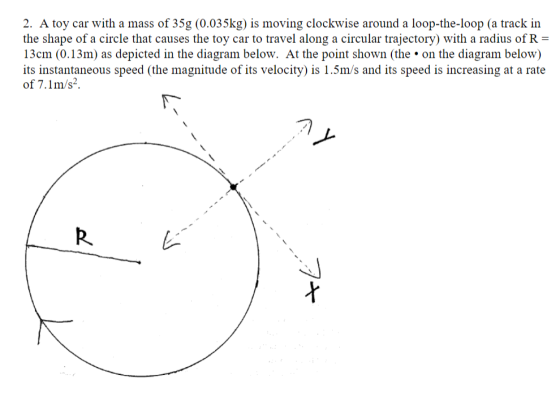
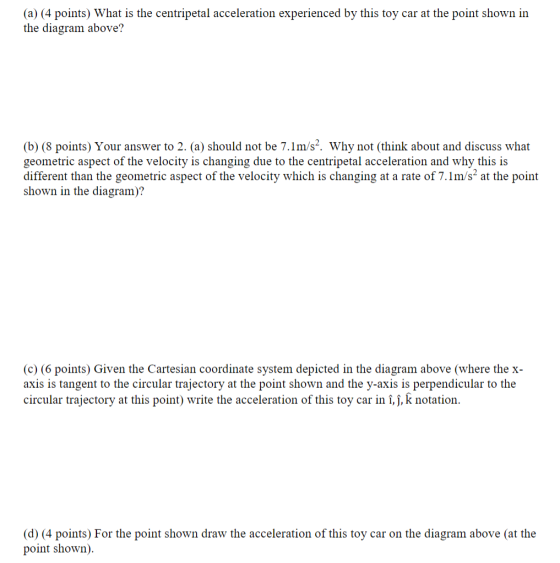
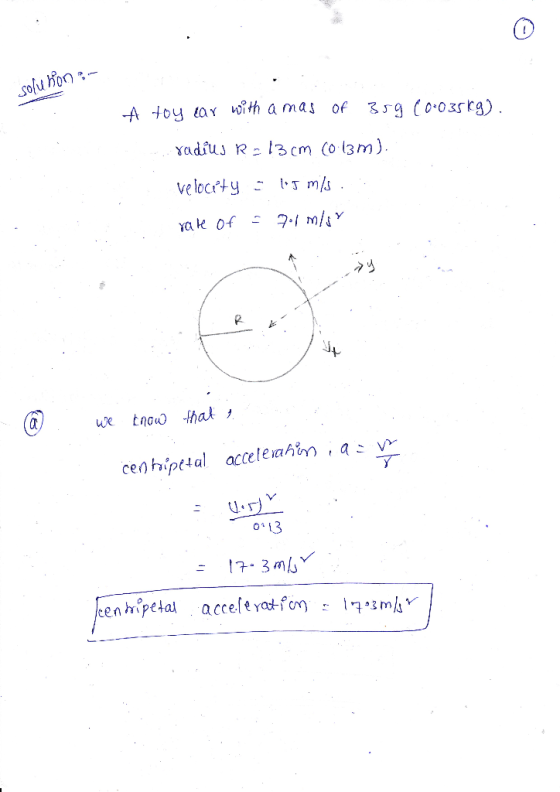
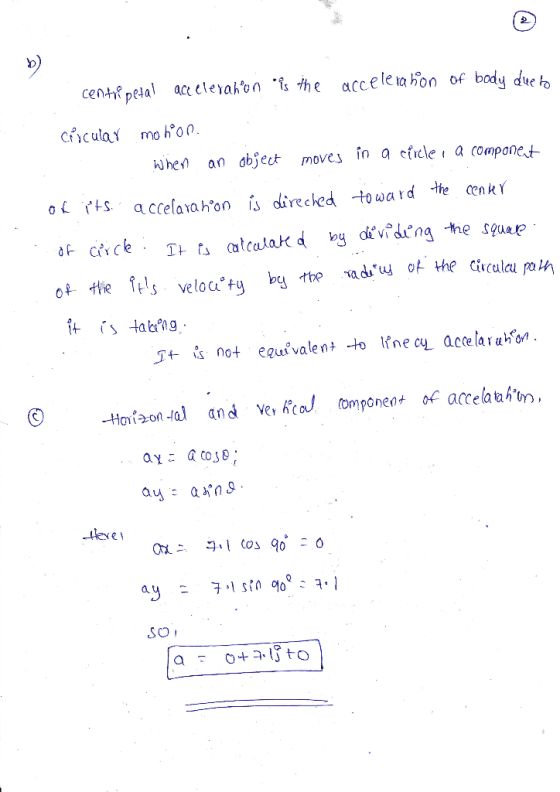
(a) (4 points) What is the centripetal acceleration experienced by this toy car at the point shown in the diagram above? (b) (8 points) Your answer to 2. (a) should not be 7.1m/s2. Why not (think about and discuss what geometric aspect of the velocity is changing due to the centripetal acceleration and why this is different than the geometric aspect of the velocity which is changing at a rate of 7.1m/s2 at the point shown in the diagram)? (c) (6 points) Given the Cartesian coordinate system depicted in the diagram above (where the x- axis is tangent to the circular trajectory at the point shown and the y-axis is perpendicular to the circular trajectory at this point) write the acceleration of this toy car in i,j, k notation. (d) (4 points) For the point shown draw the acceleration of this toy car on the diagram above (at the point shown
Homework Answers
Add Answer to:
2. A toy car with a mass of 35g (0.035kg) is moving clockwise around a loop-the-loop (a track in the shape of a circle that causes the toy car to travel along a circular trajectory) with a radius of...
1. An 800 kg car travels around the edge of a circular track of radius 400...
 1. An 800 kg car travels around the edge of a circular track of radius 400 m. At one point, the car accelerates around the track, increasing its speed from 40 m/s to 60 m/s over the course of 5 s. At the instant that the car reaches 50 m/s find (a) its angular velocity (b) its radial acceleration, (c) the centripetal force acting on the car, (d) the tangential acceleration of the car, and (e) the magnitude of the...
A student is riding their bike when they come across a turn in the form of a circular arc of radius R 3.0m as pictured in the diagram below and travel along this arc in the clockwise direction. At on...
 A student is riding their bike when they come across a turn in the form of a circular arc of radius R 3.0m as pictured in the diagram below and travel along this arc in the clockwise direction. At one point along this trajectory (the origin of the given coordinate system) it makes sense to define the Cartesian coordinate system shown where the x-axis is tangent to the trajectory and the y-axis is perpendicular to it. At this point the...
A toy car of mass 200 g is moving on a circular path of radius 20...
A toy car of mass 200 g is moving on a circular path of radius 20 cm at a constant speed v. It takes 8 s to complete one circle. What is the centripetal force, acting on the car? The answer is .024 N, I am only interested in the explanation of the problem. (if its just formulas its fine, just name each variable)
4. Two cars travel around a circular track, one on an inner lane of radius 12.0...
4. Two cars travel around a circular track, one on an inner lane of radius 12.0 m, and one on an outer lane of radius 16.0 m. The cars initially have the same speed of 15.0 m/s. (a) What are the centripetal accelerations of the two cars initially? (b) What speed would the car in the outer lane need so that it would complete one full loop in the same time as the car in the inner lane? (c) If...
A car is travelling around a horizontal circular track with radius r = 270 m. It...
A car is travelling around a horizontal circular track with radius r = 270 m. It takes the car t = 66 s to go around the track once. The angle theta A = 19 degrees above the x axis, and the angle theta B = 56 degrees below the x axis. 1) What is the magnitide of the car? 2) What is the x component of the car's velocity when it is at point A? 3) What is the...
A car is traveling around a horizontal circular track with radius r 190 m at a...
 A car is traveling around a horizontal circular track with radius r 190 m at a constant speed v angle θ' 29" above the x axis, and the angle es* 65° below the x axis. 15 m/s as shown. The 1) What is the magnitude of the car's acceleration? m/s Submit 2) What is the x component of the car's acceleration when it is at point A m/s Submit 3) What is the y component of the car's acceleration when...
A car starts from rest and moves around a circular track of radius 32.0 m. Its...
 A car starts from rest and moves around a circular track of
radius 32.0 m. Its speed increases at the constant rate of 0.550
m/s2. (a) What is the magnitude of its
net linear acceleration 19.0 s later? (b) What
angle does this net acceleration vector make with the car's
velocity at this time?
Question 6 A car starts from rest and moves around a circular track of radius 32.0 m. Its speed increases at the constant rate of 0.550...
A car starts from rest and moves around a circular track of
radius 32.0 m. Its speed increases at the constant rate of 0.550
m/s2. (a) What is the magnitude of its
net linear acceleration 19.0 s later? (b) What
angle does this net acceleration vector make with the car's
velocity at this time?
Question 6 A car starts from rest and moves around a circular track of radius 32.0 m. Its speed increases at the constant rate of 0.550...
please answer all A car is going with a constant tangential acceleration (i.e. increasing speed) in a circular path. As seen from above, the path is counter-clockwise. It crosses the point '...
 please answer all
A car is going with a constant tangential acceleration (i.e. increasing speed) in a circular path. As seen from above, the path is counter-clockwise. It crosses the point 'A' at time 0.00, at which point its speed is known. Find the direction of its centripetal acceleration at some time after it crosses the point A:Write your answer in degrees. Given: Speed when it crosses point 'A' - V-3.6 m/s, tangential acceleration a 3.6 m/s2, radius of path...
please answer all
A car is going with a constant tangential acceleration (i.e. increasing speed) in a circular path. As seen from above, the path is counter-clockwise. It crosses the point 'A' at time 0.00, at which point its speed is known. Find the direction of its centripetal acceleration at some time after it crosses the point A:Write your answer in degrees. Given: Speed when it crosses point 'A' - V-3.6 m/s, tangential acceleration a 3.6 m/s2, radius of path...
2. A car is driving at constant angular speed along a 20 m radius circular track....
2. A car is driving at constant angular speed along a 20 m radius circular track. The car completes one revolution of the track in 10 seconds. Calculate: (i) The (tangent) speed of the car. 12.6 m/s (ii) The angular speed of the car. 0.63 1/s or 0.63 rad/s (iii) The centripetal acceleration of the car. 7.9 m/s2 (iv) The RPM (i.e. revolutions per minute) of the car. 6 RPM THE ANSWERS ARE IN BOLD, COULD YOU PLEASE SHOW THE...
P6 A car travels around a circular track at constant speed, as shown. It is observed...
 P6 A car travels around a circular track at constant speed, as shown. It is observed that the car takes 15.71 seconds to go from point A to point B along the track (exactly a quarter circle). An accelerometer mounted on the car shows that its acceleration has a constant magnitude of 7.0 m/s2. Please answer each of the following questions. For answers that require vectors, refer to the instant shown in the figure. a) What is the radius of...
 1. An 800 kg car travels around the edge of a circular track of radius 400 m. At one point, the car accelerates around the track, increasing its speed from 40 m/s to 60 m/s over the course of 5 s. At the instant that the car reaches 50 m/s find (a) its angular velocity (b) its radial acceleration, (c) the centripetal force acting on the car, (d) the tangential acceleration of the car, and (e) the magnitude of the...
 A student is riding their bike when they come across a turn in the form of a circular arc of radius R 3.0m as pictured in the diagram below and travel along this arc in the clockwise direction. At one point along this trajectory (the origin of the given coordinate system) it makes sense to define the Cartesian coordinate system shown where the x-axis is tangent to the trajectory and the y-axis is perpendicular to it. At this point the...
 A car is traveling around a horizontal circular track with radius r 190 m at a constant speed v angle θ' 29" above the x axis, and the angle es* 65° below the x axis. 15 m/s as shown. The 1) What is the magnitude of the car's acceleration? m/s Submit 2) What is the x component of the car's acceleration when it is at point A m/s Submit 3) What is the y component of the car's acceleration when...
 A car starts from rest and moves around a circular track of
radius 32.0 m. Its speed increases at the constant rate of 0.550
m/s2. (a) What is the magnitude of its
net linear acceleration 19.0 s later? (b) What
angle does this net acceleration vector make with the car's
velocity at this time?
Question 6 A car starts from rest and moves around a circular track of radius 32.0 m. Its speed increases at the constant rate of 0.550...
A car starts from rest and moves around a circular track of
radius 32.0 m. Its speed increases at the constant rate of 0.550
m/s2. (a) What is the magnitude of its
net linear acceleration 19.0 s later? (b) What
angle does this net acceleration vector make with the car's
velocity at this time?
Question 6 A car starts from rest and moves around a circular track of radius 32.0 m. Its speed increases at the constant rate of 0.550...
 please answer all
A car is going with a constant tangential acceleration (i.e. increasing speed) in a circular path. As seen from above, the path is counter-clockwise. It crosses the point 'A' at time 0.00, at which point its speed is known. Find the direction of its centripetal acceleration at some time after it crosses the point A:Write your answer in degrees. Given: Speed when it crosses point 'A' - V-3.6 m/s, tangential acceleration a 3.6 m/s2, radius of path...
please answer all
A car is going with a constant tangential acceleration (i.e. increasing speed) in a circular path. As seen from above, the path is counter-clockwise. It crosses the point 'A' at time 0.00, at which point its speed is known. Find the direction of its centripetal acceleration at some time after it crosses the point A:Write your answer in degrees. Given: Speed when it crosses point 'A' - V-3.6 m/s, tangential acceleration a 3.6 m/s2, radius of path...
 P6 A car travels around a circular track at constant speed, as shown. It is observed that the car takes 15.71 seconds to go from point A to point B along the track (exactly a quarter circle). An accelerometer mounted on the car shows that its acceleration has a constant magnitude of 7.0 m/s2. Please answer each of the following questions. For answers that require vectors, refer to the instant shown in the figure. a) What is the radius of...
Most questions answered within 3 hours.
-
Where is the error in this code sequence?
String s1 = "Hello";
String s2 = "ello";...
asked 11 months ago -
Financial data for Joel de Paris, Inc., for last year
follow:
Joel de Paris, Inc.
Balance...
asked 11 months ago -
Consider this reaction:
Al2(SO4)3 (aq)+ BaCl3
(aq) Al2Cl6 (aq)- +
3BaSO4(s) . What is the...
asked 11 months ago -
Suppose that Savneet is considering increasing her
recent random sample from 20 car rentals to 40...
asked 11 months ago -
Trucks arrive at an unloading terminal at an average rate of 120
per hour.
Trucks arrive...
asked 11 months ago -
Why are methanol and ethanol completely soluble in water while
octanol is not very little soluble....
asked 11 months ago -
A facilities manager at a university reads in a research report
that the mean amount of...
asked 11 months ago -
When the CuSO4 is rehydrated by adding water to the anhydrous
compound, is this an endothermic...
asked 11 months ago -
A ray of sunlight is passing from diamond into crown glass; the
angle of incidence is...
asked 11 months ago -
A block of mass 0.249 kg is placed on top of a light, vertical
spring of...
asked 11 months ago -
how do the kidneys compensate in the presences of acidosis
a) trigger hyperventilate
b) reserve acid...
asked 11 months ago -
Question 501 pts
The rental rate of capital to the firm increases. Which of the
following...
asked 11 months ago