
Homework Answers

Add Answer to:
7. Consider the system 1 2 y (a) Show that the origin is a fixed point, and determine its stability (b) Show that the origin is the only fixed point. Hint: Argue using a theorem or result based on pr...
27.(a) State and prove Liapunov's theorem for a continuous-time dynamical system. (b) By finding a suitable Liapunov function show that the origin is a stable fixed point for the dynamical system...
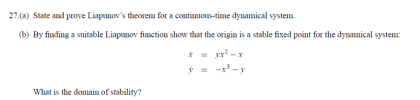 27.(a) State and prove Liapunov's theorem for a continuous-time dynamical system. (b) By finding a suitable Liapunov function show that the origin is a stable fixed point for the dynamical system What is the domain of stability?
27.(a) State and prove Liapunov's theorem for a continuous-time dynamical system. (b) By finding a suitable Liapunov function show that the origin is a stable fixed point for the dynamical system What is the domain of stability?
27.(a) State and prove Liapunov's theorem for a continuous-time dynamical system. (b) By finding a suitable Liapunov function show that the origin is a stable fixed point for the dynamical system What is the domain of stability?
Problem 9. Consider the discrete time dynamical system (a) Determine stability of the origin. (b)...
 Problem 9. Consider the discrete time dynamical system (a) Determine stability of the origin. (b) Describe dynamics of the system. (c) Sketch the phase portrait. y(k + 1)「L 3y(A)-42(k)
Problem 9. Consider the discrete time dynamical system (a) Determine stability of the origin. (b) Describe dynamics of the system. (c) Sketch the phase portrait. y(k + 1)「L 3y(A)-42(k)
Problem 9. Consider the discrete time dynamical system (a) Determine stability of the origin. (b) Describe dynamics of the system. (c) Sketch the phase portrait. y(k + 1)「L 3y(A)-42(k)
Consider the nonlinear system: - x + (x – 1) y y + 4x° (1 –...
 Consider the nonlinear system: - x + (x – 1) y y + 4x° (1 – x). (a) Show that the system has a unique fixed point at the origin (0, 0). (b) Use a linear approximation to determine the stability of the fixed point. (c) Apply the Liapunov direct method to determine the stability of the fixed point. Is your conclusion different form that of Part (a)? Why? (d) Can the system have closed orbits (trajectories)? Explain.
Given the system x'=y+ux and y'= -x + uy - x2y, with u representing the greek letter mu: a) Show that the origin is a fixed point b) Linearize the system near the fixed point and determine the...
Given the system x'=y+ux and y'= -x + uy - x2y, with u representing the greek letter mu: a) Show that the origin is a fixed point b) Linearize the system near the fixed point and determine the eigenvalues c) Show that a bifurcation exists at u=0 and determine the behavior of the fixed point for u<0, u=0, and u>0
Consider the system * =y j= +1. Find the fixed points and the linearisation of the...
 Consider the system * =y j= +1. Find the fixed points and the linearisation of the system at each. Identify the type and sketch a local phase portrait (i.e. a sketch of the orbits just around the fixed points) at each fixed point. Show that the system has a time reversal symmetry. Draw a sketch showing isoclines and the directions of orbits in all parts of phase space. Use this information, together with the symmetry, to show there exists a...
4. Consider the system ry(1 +) -(42 2) (a) Show that the origin is an equilibrium point and it is...
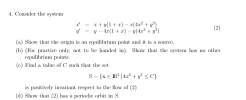 4. Consider the system ry(1 +) -(42 2) (a) Show that the origin is an equilibrium point and it is a source (b) (For practice only, not to be handed in). Show that the system has no other equilibrium points (c) Find a value of C such that the set is positively invariant respect to the flow of (2) (d) Show that (2) has a periodic orbit in S.
4. Consider the system ry(1 +) -(42 2) (a) Show that...
4. Consider the system ry(1 +) -(42 2) (a) Show that the origin is an equilibrium point and it is a source (b) (For practice only, not to be handed in). Show that the system has no other equilibrium points (c) Find a value of C such that the set is positively invariant respect to the flow of (2) (d) Show that (2) has a periodic orbit in S.
4. Consider the system ry(1 +) -(42 2) (a) Show that...
36. Show that the fixed point at the origin of the system 4 2,2,.2 is unstable by using the function for a suitable choice of the constants α and β. 36. Show that the fixed point at the origin o...
 36. Show that the fixed point at the origin of the system 4 2,2,.2 is unstable by using the function for a suitable choice of the constants α and β.
36. Show that the fixed point at the origin of the system 4 2,2,.2 is unstable by using the function for a suitable choice of the constants α and β.
36. Show that the fixed point at the origin of the system 4 2,2,.2 is unstable by using the function for a suitable choice of the constants α and β.
2. (25 pts) Consider the fixed point problem with g(x) 3 Use the fixed point theorem...
 2. (25 pts) Consider the fixed point problem with g(x) 3 Use the fixed point theorem to show fixed point iterations using g(r) converge to fixed point p E (0, 1] for all initial guesses po E [0, 1]. a Remember, the fixed point theorem: If g(x) is continuously differentiable in [a, b] and g [a, b g(x) converge to a fixed point p E [a, b] for all initial guesses po E [a, b. a, band g (x k...
3. (Existence/uniqueness theorem, Strogatz 6.2): Consider the system (a) Show by substitution tha...
 3. (Existence/uniqueness theorem, Strogatz 6.2): Consider the system (a) Show by substitution that (t) sin, () cost is an exact solution. (b) Now consider another solution, with initial condition a(0)-1/2, y(0) 0. Without doing any work, explain why this solution must satisfy y2 < 1 for all t < oo. For the systems in problems 4-7, find the fixed points, linearize about them, classify their stability, draw their local trajectories, and try to fill in the full phase portrait.
3....
3. (Existence/uniqueness theorem, Strogatz 6.2): Consider the system (a) Show by substitution that (t) sin, () cost is an exact solution. (b) Now consider another solution, with initial condition a(0)-1/2, y(0) 0. Without doing any work, explain why this solution must satisfy y2 < 1 for all t < oo. For the systems in problems 4-7, find the fixed points, linearize about them, classify their stability, draw their local trajectories, and try to fill in the full phase portrait.
3....
Consider the system of differential equations ; 1) Find the fixed points of the system , 2) Eval...
consider the system of differential equations ; 1) Find the fixed points of the system , 2) Evaluate the Jacobian Matrix at each fixed point, 3) Classify stability of each fixed point, 4) Sketch the graph of the phase portrait,
 27.(a) State and prove Liapunov's theorem for a continuous-time dynamical system. (b) By finding a suitable Liapunov function show that the origin is a stable fixed point for the dynamical system What is the domain of stability?
27.(a) State and prove Liapunov's theorem for a continuous-time dynamical system. (b) By finding a suitable Liapunov function show that the origin is a stable fixed point for the dynamical system What is the domain of stability?
27.(a) State and prove Liapunov's theorem for a continuous-time dynamical system. (b) By finding a suitable Liapunov function show that the origin is a stable fixed point for the dynamical system What is the domain of stability?
 Problem 9. Consider the discrete time dynamical system (a) Determine stability of the origin. (b) Describe dynamics of the system. (c) Sketch the phase portrait. y(k + 1)「L 3y(A)-42(k)
Problem 9. Consider the discrete time dynamical system (a) Determine stability of the origin. (b) Describe dynamics of the system. (c) Sketch the phase portrait. y(k + 1)「L 3y(A)-42(k)
Problem 9. Consider the discrete time dynamical system (a) Determine stability of the origin. (b) Describe dynamics of the system. (c) Sketch the phase portrait. y(k + 1)「L 3y(A)-42(k)
 Consider the nonlinear system: - x + (x – 1) y y + 4x° (1 – x). (a) Show that the system has a unique fixed point at the origin (0, 0). (b) Use a linear approximation to determine the stability of the fixed point. (c) Apply the Liapunov direct method to determine the stability of the fixed point. Is your conclusion different form that of Part (a)? Why? (d) Can the system have closed orbits (trajectories)? Explain.
 Consider the system * =y j= +1. Find the fixed points and the linearisation of the system at each. Identify the type and sketch a local phase portrait (i.e. a sketch of the orbits just around the fixed points) at each fixed point. Show that the system has a time reversal symmetry. Draw a sketch showing isoclines and the directions of orbits in all parts of phase space. Use this information, together with the symmetry, to show there exists a...
 4. Consider the system ry(1 +) -(42 2) (a) Show that the origin is an equilibrium point and it is a source (b) (For practice only, not to be handed in). Show that the system has no other equilibrium points (c) Find a value of C such that the set is positively invariant respect to the flow of (2) (d) Show that (2) has a periodic orbit in S.
4. Consider the system ry(1 +) -(42 2) (a) Show that...
4. Consider the system ry(1 +) -(42 2) (a) Show that the origin is an equilibrium point and it is a source (b) (For practice only, not to be handed in). Show that the system has no other equilibrium points (c) Find a value of C such that the set is positively invariant respect to the flow of (2) (d) Show that (2) has a periodic orbit in S.
4. Consider the system ry(1 +) -(42 2) (a) Show that...
 36. Show that the fixed point at the origin of the system 4 2,2,.2 is unstable by using the function for a suitable choice of the constants α and β.
36. Show that the fixed point at the origin of the system 4 2,2,.2 is unstable by using the function for a suitable choice of the constants α and β.
36. Show that the fixed point at the origin of the system 4 2,2,.2 is unstable by using the function for a suitable choice of the constants α and β.
 2. (25 pts) Consider the fixed point problem with g(x) 3 Use the fixed point theorem to show fixed point iterations using g(r) converge to fixed point p E (0, 1] for all initial guesses po E [0, 1]. a Remember, the fixed point theorem: If g(x) is continuously differentiable in [a, b] and g [a, b g(x) converge to a fixed point p E [a, b] for all initial guesses po E [a, b. a, band g (x k...
 3. (Existence/uniqueness theorem, Strogatz 6.2): Consider the system (a) Show by substitution that (t) sin, () cost is an exact solution. (b) Now consider another solution, with initial condition a(0)-1/2, y(0) 0. Without doing any work, explain why this solution must satisfy y2 < 1 for all t < oo. For the systems in problems 4-7, find the fixed points, linearize about them, classify their stability, draw their local trajectories, and try to fill in the full phase portrait.
3....
3. (Existence/uniqueness theorem, Strogatz 6.2): Consider the system (a) Show by substitution that (t) sin, () cost is an exact solution. (b) Now consider another solution, with initial condition a(0)-1/2, y(0) 0. Without doing any work, explain why this solution must satisfy y2 < 1 for all t < oo. For the systems in problems 4-7, find the fixed points, linearize about them, classify their stability, draw their local trajectories, and try to fill in the full phase portrait.
3....
Most questions answered within 3 hours.
-
Where is the error in this code sequence?
String s1 = "Hello";
String s2 = "ello";...
asked 10 months ago -
Financial data for Joel de Paris, Inc., for last year
follow:
Joel de Paris, Inc.
Balance...
asked 10 months ago -
Consider this reaction:
Al2(SO4)3 (aq)+ BaCl3
(aq) Al2Cl6 (aq)- +
3BaSO4(s) . What is the...
asked 10 months ago -
Suppose that Savneet is considering increasing her
recent random sample from 20 car rentals to 40...
asked 10 months ago -
Trucks arrive at an unloading terminal at an average rate of 120
per hour.
Trucks arrive...
asked 10 months ago -
Why are methanol and ethanol completely soluble in water while
octanol is not very little soluble....
asked 10 months ago -
A facilities manager at a university reads in a research report
that the mean amount of...
asked 10 months ago -
When the CuSO4 is rehydrated by adding water to the anhydrous
compound, is this an endothermic...
asked 10 months ago -
A ray of sunlight is passing from diamond into crown glass; the
angle of incidence is...
asked 10 months ago -
A block of mass 0.249 kg is placed on top of a light, vertical
spring of...
asked 10 months ago -
how do the kidneys compensate in the presences of acidosis
a) trigger hyperventilate
b) reserve acid...
asked 10 months ago -
Question 501 pts
The rental rate of capital to the firm increases. Which of the
following...
asked 10 months ago