 Im having problems
understanding whats happening and why.
Im having problems
understanding whats happening and why.
Homework Answers
Add Answer to:
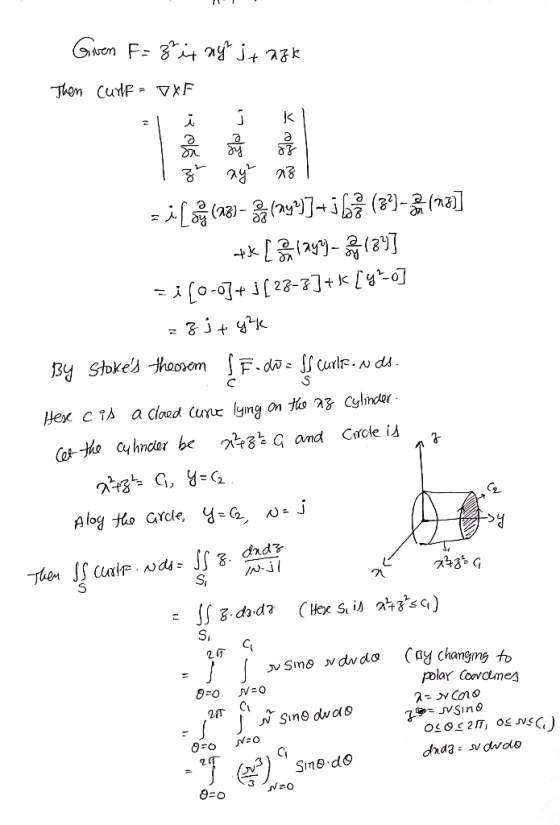
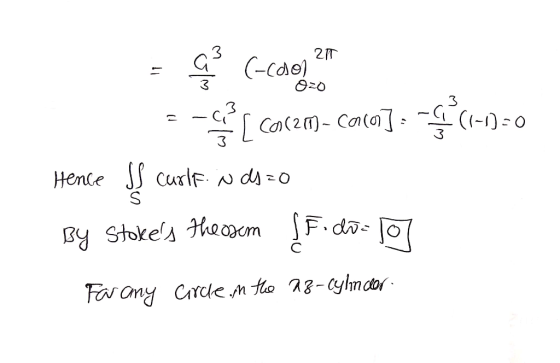
Im having problems understanding whats happening and why. 27. An xz-cylinder in 3-space is a surface given by an equation f(x,z) -0 in x and z alone; its section by any plane y -c perpendicular to the...
10. Stokes' Theorem and Surface Integrals of Vector Fields a. Stokes' Theorem: F dr- b. Let S be the surface of the paraboloid z 4-x2-y2 and C is the trace of S in the xy-plane. Draw a sk...
 10. Stokes' Theorem and Surface Integrals of Vector Fields a. Stokes' Theorem: F dr- b. Let S be the surface of the paraboloid z 4-x2-y2 and C is the trace of S in the xy-plane. Draw a sketch of curve C in the xy-plane. Let F(x,y,z) = <2z, x, y?». Compute the curl (F) c. d. Find a parametrization of the surface S: G(u,v)- Compute N(u,v) e. Use Stokes' Theorem to computec F dr
10. Stokes' Theorem and Surface Integrals...
10. Stokes' Theorem and Surface Integrals of Vector Fields a. Stokes' Theorem: F dr- b. Let S be the surface of the paraboloid z 4-x2-y2 and C is the trace of S in the xy-plane. Draw a sketch of curve C in the xy-plane. Let F(x,y,z) = <2z, x, y?». Compute the curl (F) c. d. Find a parametrization of the surface S: G(u,v)- Compute N(u,v) e. Use Stokes' Theorem to computec F dr
10. Stokes' Theorem and Surface Integrals...
10. Stokes Theorem and Surface Integrals of Vector Fields a Stokes Theorem:J F dr- b. Let S be the surface of the paraboloid z 4-x2-y2 and C is the trace of S in the xy-plane. Draw a sketch of cu...
 10. Stokes Theorem and Surface Integrals of Vector Fields a Stokes Theorem:J F dr- b. Let S be the surface of the paraboloid z 4-x2-y2 and C is the trace of S in the xy-plane. Draw a sketch of curve C in the xy-plane. Let F(x,y,z) = <2z, x, y, Compute the curl (F) c. d. Find a parametrization of the surface S: G(u,v)ーーーーーーーーーーーーー Compute N(u,v) e. Use Stokes' Theorem to compute Jc F dr
10. Stokes Theorem and Surface...
10. Stokes Theorem and Surface Integrals of Vector Fields a Stokes Theorem:J F dr- b. Let S be the surface of the paraboloid z 4-x2-y2 and C is the trace of S in the xy-plane. Draw a sketch of curve C in the xy-plane. Let F(x,y,z) = <2z, x, y, Compute the curl (F) c. d. Find a parametrization of the surface S: G(u,v)ーーーーーーーーーーーーー Compute N(u,v) e. Use Stokes' Theorem to compute Jc F dr
10. Stokes Theorem and Surface...
C is the curve of intersection of the paraboloid z (++y and the plane z 2x+2. 2. Evaluate [ F -dr using Stokes' Theorem. Choose the simplest surface with boundary curve C and orient it upward....
 C is the curve of intersection of the paraboloid z (++y and the plane z 2x+2. 2. Evaluate [ F -dr using Stokes' Theorem. Choose the simplest surface with boundary curve C and orient it upward.
C is the curve of intersection of the paraboloid z (++y and the plane z 2x+2. 2. Evaluate [ F -dr using Stokes' Theorem. Choose the simplest surface with boundary curve C and orient it upward.
C is the curve of intersection of the paraboloid z (++y and the plane z 2x+2. 2. Evaluate [ F -dr using Stokes' Theorem. Choose the simplest surface with boundary curve C and orient it upward.
1 Help Entering Answers 1 point) Use Stokes' Theorem to evaluateF.dr where F(x,y,z) 6yzi 3xzj +3e...
 1 Help Entering Answers 1 point) Use Stokes' Theorem to evaluateF.dr where F(x,y,z) 6yzi 3xzj +3e k and C is the circy4,z 5 oriented counterclockwise as viewed from above Since the circle is oriented counterclockwise as viewed from above the surface we attach to the circle is oriented upwards The easiest surface to attach to this curve is the disk x2 + y2 < 4, z-5. Using this surface in Stokes' Theorem evaluate the following. F-dr = where sqrt(4-xA2) sqrt(4-x^2)...
1 Use Stokes' theorem to evaluate the integrals: F(x, y, z) dr a) where F(r, y,z)(3yz,e, 22) and C is the boundary of the triangle i the plane y2 with vertices b) where F(x, y,z (-2,2,5xz) an...
 1 Use Stokes' theorem to evaluate the integrals: F(x, y, z) dr a) where F(r, y,z)(3yz,e, 22) and C is the boundary of the triangle i the plane y2 with vertices b) where F(x, y,z (-2,2,5xz) and C is in the plane 12- y and is the boundary of the region that lies above the square with vertices (3,5, 0), (3,7,0),(4,5,0), (4,7,0) c) where F(x, y,z(7ry, -z, 3ryz) and C is in the plane y d) where intersected with z...
the plane 7-1 with the cylinder Consider the vector field F(x, y, z) = (x²); +...
 the plane 7-1 with the cylinder Consider the vector field F(x, y, z) = (x²); + (x+y); + (4y2Z) K and the curve C defined by the intersection Counter clockwise as viewed from above. Evaluate the Work- SF. dr done by F along in the following ways (a) Directly, using parametrization of C (b) Using stakes theorem
Questions. Please show all work. 1. Consider the vector field F(x, y, z) (-y, x-z, 3x + z)and the surface S, which is the part of the sphere x2 + y2 + z2 = 25 above the plane z = 3. Let C be the...
 Questions. Please show all work. 1. Consider the vector field F(x, y, z) (-y, x-z, 3x + z)and the surface S, which is the part of the sphere x2 + y2 + z2 = 25 above the plane z = 3. Let C be the boundary of S with counterclockwise orientation when looking down from the z-axis. Verify Stokes' Theorem as follows. (a) (i) Sketch the surface S and the curve C. Indicate the orientation of C (ii) Use the...
7. (16pts) Use Stokes, Theorem to find ▽ × F . nd.S where s is the surface of the cube 0 < x < 1, 0Sy, and 0szS 1 with open bottom in the ry plane. F(x, y, z)-<y, -, z > and the normal fi...
 7. (16pts) Use Stokes, Theorem to find ▽ × F . nd.S where s is the surface of the cube 0 < x < 1, 0Sy, and 0szS 1 with open bottom in the ry plane. F(x, y, z)-<y, -, z > and the normal field n is oriented so that it points up on the top surface. T, zand
7. (16pts) Use Stokes, Theorem to find ▽ × F . nd.S where s is the surface of the cube...
7. (16pts) Use Stokes, Theorem to find ▽ × F . nd.S where s is the surface of the cube 0 < x < 1, 0Sy, and 0szS 1 with open bottom in the ry plane. F(x, y, z)-<y, -, z > and the normal field n is oriented so that it points up on the top surface. T, zand
7. (16pts) Use Stokes, Theorem to find ▽ × F . nd.S where s is the surface of the cube...
(c) Let F be the vector field on R given by F(x, y, z) = (2x...
 (c) Let F be the vector field on R given by F(x, y, z) = (2x +3y, z, 3y + z). (i) Calculate the divergence of F and the curl of F (ii) Let V be the region in IR enclosed by the plane I +2y +z S denote the closed surface that is the boundary of this region V. Sketch a picture of V and S. Then, using the Divergence Theorem, or otherwise, calculate 3 and the XY, YZ...
all questions are related and need help answering! rough the surface 4. o pm) What is the value of the flux of the vector field F(x,y)j+z ioriented with upward- pointing normal vector? (A) 0 (B)...
 all questions are related and need help answering!
rough the surface 4. o pm) What is the value of the flux of the vector field F(x,y)j+z ioriented with upward- pointing normal vector? (A) 0 (B) 2n/3 (C) π (D) 4T/3 (E) 2π Use Stokes, Theorem to evaluateⅡcurl F.dS, where F(x, y, z)-(x2 sin Theorem to evaluate Jceun F'.asS , where Fl.e)(', ») and 5. (5pts.) F,y, sin z, y', xy) and s is the part of the paraboloid : -...
all questions are related and need help answering!
rough the surface 4. o pm) What is the value of the flux of the vector field F(x,y)j+z ioriented with upward- pointing normal vector? (A) 0 (B) 2n/3 (C) π (D) 4T/3 (E) 2π Use Stokes, Theorem to evaluateⅡcurl F.dS, where F(x, y, z)-(x2 sin Theorem to evaluate Jceun F'.asS , where Fl.e)(', ») and 5. (5pts.) F,y, sin z, y', xy) and s is the part of the paraboloid : -...
 10. Stokes' Theorem and Surface Integrals of Vector Fields a. Stokes' Theorem: F dr- b. Let S be the surface of the paraboloid z 4-x2-y2 and C is the trace of S in the xy-plane. Draw a sketch of curve C in the xy-plane. Let F(x,y,z) = <2z, x, y?». Compute the curl (F) c. d. Find a parametrization of the surface S: G(u,v)- Compute N(u,v) e. Use Stokes' Theorem to computec F dr
10. Stokes' Theorem and Surface Integrals...
10. Stokes' Theorem and Surface Integrals of Vector Fields a. Stokes' Theorem: F dr- b. Let S be the surface of the paraboloid z 4-x2-y2 and C is the trace of S in the xy-plane. Draw a sketch of curve C in the xy-plane. Let F(x,y,z) = <2z, x, y?». Compute the curl (F) c. d. Find a parametrization of the surface S: G(u,v)- Compute N(u,v) e. Use Stokes' Theorem to computec F dr
10. Stokes' Theorem and Surface Integrals...
 10. Stokes Theorem and Surface Integrals of Vector Fields a Stokes Theorem:J F dr- b. Let S be the surface of the paraboloid z 4-x2-y2 and C is the trace of S in the xy-plane. Draw a sketch of curve C in the xy-plane. Let F(x,y,z) = <2z, x, y, Compute the curl (F) c. d. Find a parametrization of the surface S: G(u,v)ーーーーーーーーーーーーー Compute N(u,v) e. Use Stokes' Theorem to compute Jc F dr
10. Stokes Theorem and Surface...
10. Stokes Theorem and Surface Integrals of Vector Fields a Stokes Theorem:J F dr- b. Let S be the surface of the paraboloid z 4-x2-y2 and C is the trace of S in the xy-plane. Draw a sketch of curve C in the xy-plane. Let F(x,y,z) = <2z, x, y, Compute the curl (F) c. d. Find a parametrization of the surface S: G(u,v)ーーーーーーーーーーーーー Compute N(u,v) e. Use Stokes' Theorem to compute Jc F dr
10. Stokes Theorem and Surface...
 C is the curve of intersection of the paraboloid z (++y and the plane z 2x+2. 2. Evaluate [ F -dr using Stokes' Theorem. Choose the simplest surface with boundary curve C and orient it upward.
C is the curve of intersection of the paraboloid z (++y and the plane z 2x+2. 2. Evaluate [ F -dr using Stokes' Theorem. Choose the simplest surface with boundary curve C and orient it upward.
C is the curve of intersection of the paraboloid z (++y and the plane z 2x+2. 2. Evaluate [ F -dr using Stokes' Theorem. Choose the simplest surface with boundary curve C and orient it upward.
 1 Help Entering Answers 1 point) Use Stokes' Theorem to evaluateF.dr where F(x,y,z) 6yzi 3xzj +3e k and C is the circy4,z 5 oriented counterclockwise as viewed from above Since the circle is oriented counterclockwise as viewed from above the surface we attach to the circle is oriented upwards The easiest surface to attach to this curve is the disk x2 + y2 < 4, z-5. Using this surface in Stokes' Theorem evaluate the following. F-dr = where sqrt(4-xA2) sqrt(4-x^2)...
 1 Use Stokes' theorem to evaluate the integrals: F(x, y, z) dr a) where F(r, y,z)(3yz,e, 22) and C is the boundary of the triangle i the plane y2 with vertices b) where F(x, y,z (-2,2,5xz) and C is in the plane 12- y and is the boundary of the region that lies above the square with vertices (3,5, 0), (3,7,0),(4,5,0), (4,7,0) c) where F(x, y,z(7ry, -z, 3ryz) and C is in the plane y d) where intersected with z...
 the plane 7-1 with the cylinder Consider the vector field F(x, y, z) = (x²); + (x+y); + (4y2Z) K and the curve C defined by the intersection Counter clockwise as viewed from above. Evaluate the Work- SF. dr done by F along in the following ways (a) Directly, using parametrization of C (b) Using stakes theorem
 Questions. Please show all work. 1. Consider the vector field F(x, y, z) (-y, x-z, 3x + z)and the surface S, which is the part of the sphere x2 + y2 + z2 = 25 above the plane z = 3. Let C be the boundary of S with counterclockwise orientation when looking down from the z-axis. Verify Stokes' Theorem as follows. (a) (i) Sketch the surface S and the curve C. Indicate the orientation of C (ii) Use the...
 7. (16pts) Use Stokes, Theorem to find ▽ × F . nd.S where s is the surface of the cube 0 < x < 1, 0Sy, and 0szS 1 with open bottom in the ry plane. F(x, y, z)-<y, -, z > and the normal field n is oriented so that it points up on the top surface. T, zand
7. (16pts) Use Stokes, Theorem to find ▽ × F . nd.S where s is the surface of the cube...
7. (16pts) Use Stokes, Theorem to find ▽ × F . nd.S where s is the surface of the cube 0 < x < 1, 0Sy, and 0szS 1 with open bottom in the ry plane. F(x, y, z)-<y, -, z > and the normal field n is oriented so that it points up on the top surface. T, zand
7. (16pts) Use Stokes, Theorem to find ▽ × F . nd.S where s is the surface of the cube...
 (c) Let F be the vector field on R given by F(x, y, z) = (2x +3y, z, 3y + z). (i) Calculate the divergence of F and the curl of F (ii) Let V be the region in IR enclosed by the plane I +2y +z S denote the closed surface that is the boundary of this region V. Sketch a picture of V and S. Then, using the Divergence Theorem, or otherwise, calculate 3 and the XY, YZ...
 all questions are related and need help answering!
rough the surface 4. o pm) What is the value of the flux of the vector field F(x,y)j+z ioriented with upward- pointing normal vector? (A) 0 (B) 2n/3 (C) π (D) 4T/3 (E) 2π Use Stokes, Theorem to evaluateⅡcurl F.dS, where F(x, y, z)-(x2 sin Theorem to evaluate Jceun F'.asS , where Fl.e)(', ») and 5. (5pts.) F,y, sin z, y', xy) and s is the part of the paraboloid : -...
all questions are related and need help answering!
rough the surface 4. o pm) What is the value of the flux of the vector field F(x,y)j+z ioriented with upward- pointing normal vector? (A) 0 (B) 2n/3 (C) π (D) 4T/3 (E) 2π Use Stokes, Theorem to evaluateⅡcurl F.dS, where F(x, y, z)-(x2 sin Theorem to evaluate Jceun F'.asS , where Fl.e)(', ») and 5. (5pts.) F,y, sin z, y', xy) and s is the part of the paraboloid : -...
Most questions answered within 3 hours.
-
Where is the error in this code sequence?
String s1 = "Hello";
String s2 = "ello";...
asked 11 months ago -
Financial data for Joel de Paris, Inc., for last year
follow:
Joel de Paris, Inc.
Balance...
asked 11 months ago -
Consider this reaction:
Al2(SO4)3 (aq)+ BaCl3
(aq) Al2Cl6 (aq)- +
3BaSO4(s) . What is the...
asked 11 months ago -
Suppose that Savneet is considering increasing her
recent random sample from 20 car rentals to 40...
asked 11 months ago -
Trucks arrive at an unloading terminal at an average rate of 120
per hour.
Trucks arrive...
asked 11 months ago -
Why are methanol and ethanol completely soluble in water while
octanol is not very little soluble....
asked 11 months ago -
A facilities manager at a university reads in a research report
that the mean amount of...
asked 11 months ago -
When the CuSO4 is rehydrated by adding water to the anhydrous
compound, is this an endothermic...
asked 11 months ago -
A ray of sunlight is passing from diamond into crown glass; the
angle of incidence is...
asked 11 months ago -
A block of mass 0.249 kg is placed on top of a light, vertical
spring of...
asked 11 months ago -
how do the kidneys compensate in the presences of acidosis
a) trigger hyperventilate
b) reserve acid...
asked 11 months ago -
Question 501 pts
The rental rate of capital to the firm increases. Which of the
following...
asked 11 months ago