*thermal expansion of metal 1)we can assume that lattice of solid follows simple harmonic motion. how can we explain thermal expansion of solid? explain please (hint:consider statistical fact that a...
Homework Answers
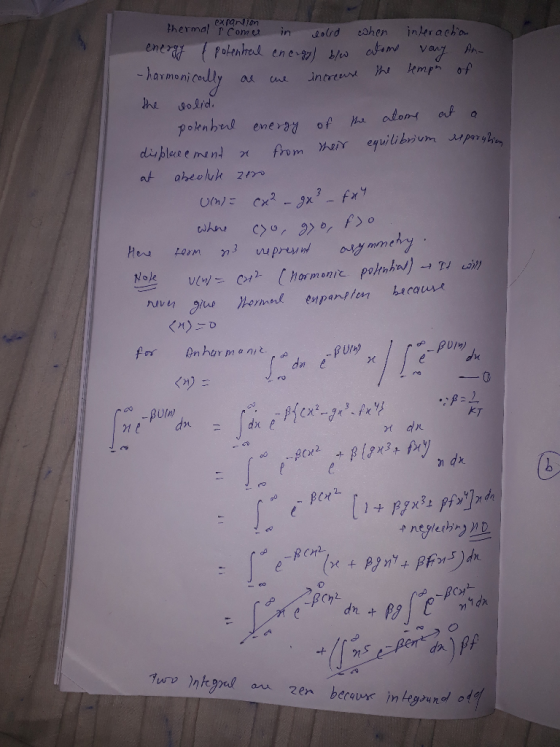
 for more information ,please
see charles kittel book .thank you
for more information ,please
see charles kittel book .thank you
Add Answer to:
*thermal expansion of metal 1)we can assume that lattice of solid follows simple harmonic motion. how can we explain thermal expansion of solid? explain please (hint:consider statistical fact that a...
Can someone explain how time was solved? An object in simple harmonic motion has an amplitude...
 Can someone explain how time was solved?
An object in simple harmonic motion has an amplitude of
4.0 cm, a frequency of 2.0 Hz, and a phase constant of 2pi/3
rad.
Draw a position graph showing two cycles of the motion.
The following table gives the position of the object at different times. x cm 2.0 0.083-4.0 0.3334.0 0.583-4.0 0.8.3334.0 1.083 -4.0
Can someone explain how time was solved?
An object in simple harmonic motion has an amplitude of
4.0 cm, a frequency of 2.0 Hz, and a phase constant of 2pi/3
rad.
Draw a position graph showing two cycles of the motion.
The following table gives the position of the object at different times. x cm 2.0 0.083-4.0 0.3334.0 0.583-4.0 0.8.3334.0 1.083 -4.0
ReviewI Constants TACTICS BOx 14.1 Identifying and analyzing simple harmonic motion Learning Goal: 1. If the...
 ReviewI Constants TACTICS BOx 14.1 Identifying and analyzing simple harmonic motion Learning Goal: 1. If the net force acting on a particle is a linear restoring force, the motion will be simple harmonic motion around the equilibriunm To practice Tactics Box 14.1 Identifying and analyzing simple harmonic motion. position. 2. The position, velocity, and acceleration as a function of time are given in Synthesis 14.1 (Page 447) x(t)- Acos(2ft) Ug (t) = -(2rf)A sin( 2rft), A complete description of simple...
can you help with a-f please This scenario is for questions 1-2 A simple harmonic oscillator...
 can you help with a-f please
This scenario is for questions 1-2 A simple harmonic oscillator at the position x-Ogenerates a wave on a string. The oscillator moves up and down at a frequency of 40.0 Hz and with an amplitude of 3.00 cm. At time t = 0, the oscillator is passing through the origin and moving down. The string has a linear mass density of 50,0 g/m and is stretched with a tension of 5.00 N. a) Find...
can you help with a-f please
This scenario is for questions 1-2 A simple harmonic oscillator at the position x-Ogenerates a wave on a string. The oscillator moves up and down at a frequency of 40.0 Hz and with an amplitude of 3.00 cm. At time t = 0, the oscillator is passing through the origin and moving down. The string has a linear mass density of 50,0 g/m and is stretched with a tension of 5.00 N. a) Find...
Simple Harmonic Motion. Effective Spring Constant: In Part I you measured the keffective of the two...
 Simple Harmonic Motion.
Effective Spring Constant: In Part I you
measured the keffective of the two springs acting
together. If the two springs had k1 and k2
individually, how would they combine to get keff?
Systemic Error: Leveling Air Track: We level
the air track in this lab because it's good lab procedure in
general, but in fact in this lab a not-level (but still straight)
air track shouldn't change any of our results. Explain why this is
true (for...
Simple Harmonic Motion.
Effective Spring Constant: In Part I you
measured the keffective of the two springs acting
together. If the two springs had k1 and k2
individually, how would they combine to get keff?
Systemic Error: Leveling Air Track: We level
the air track in this lab because it's good lab procedure in
general, but in fact in this lab a not-level (but still straight)
air track shouldn't change any of our results. Explain why this is
true (for...
1. An ideal (frictionless) simple harmonic oscillator is set into motion by releasing it from rest...
 1. An ideal (frictionless) simple harmonic oscillator is set into motion by releasing it from rest at X +0.750 m. The oscillator is set into motion once again from x=+0.750 m, except the oscillator now experiences a retarding force that is linear with respect to velocity. As a result, the oscillator does not return to its original starting position, but instead reaches = +0.700 m after one period. a. During the first full oscillation of motion, determine the fraction of...
need to solve the mathematical model to prove that we can get the equations i Q1...
 need to solve the mathematical model to prove
that we can get the equations i Q1 a methematically
please use only the weighted resedual and gerkins
methods to prove it
1. A metal bar of length, L = 100 mm, and a constant cross-sectional area of A = 10 mm? is shown in figure Q1. The bar material has an elastic modulus, E = 200,000 N/mm2 with an applied load P at one end. The governing equation for elastostatic problems...
need to solve the mathematical model to prove
that we can get the equations i Q1 a methematically
please use only the weighted resedual and gerkins
methods to prove it
1. A metal bar of length, L = 100 mm, and a constant cross-sectional area of A = 10 mm? is shown in figure Q1. The bar material has an elastic modulus, E = 200,000 N/mm2 with an applied load P at one end. The governing equation for elastostatic problems...
please answer all prelab questions, 1-4. This is the prelab manual, just in case you need...
 please answer all prelab questions, 1-4.
This is the prelab manual, just in case you need background
information to answer the questions. The prelab questions are in
the 3rd photo.
this where we put in the answers, just to give you an
idea.
Lab Manual Lab 9: Simple Harmonic Oscillation Before the lab, read the theory in Sections 1-3 and answer questions on Pre-lab Submit your Pre-lab at the beginning of the lab. During the lab, read Section 4 and...
please answer all prelab questions, 1-4.
This is the prelab manual, just in case you need background
information to answer the questions. The prelab questions are in
the 3rd photo.
this where we put in the answers, just to give you an
idea.
Lab Manual Lab 9: Simple Harmonic Oscillation Before the lab, read the theory in Sections 1-3 and answer questions on Pre-lab Submit your Pre-lab at the beginning of the lab. During the lab, read Section 4 and...
4. Use Kepler's Second Law and the fact that L-fxp to determine at which points in...
 4. Use Kepler's Second Law and the fact that L-fxp to determine at which points in an elliptical orbit around the Sun a planet has maximum and minimum speeds. (Section 13.5 will help.) 5. At the end of example 13.10, there's an "Evaluate" blurb about how inside the surface of the Earth the force of gravity varies proportionally to the distance from the center, and it makes reference to the next chapter. which is about oscillation. Model the motion of...
please answer all pre-lab questions 1 through 5. THANK YOU!!! this is the manual to give...
 please answer all pre-lab questions 1 through 5. THANK YOU!!!
this is the manual to give you some background.
the pre-lab questions..
the pre-lab sheet.
Lab Manual Lab 10: String Waves & Resonance Before the lab, read the theory in Sections 1-3 and answer questions on Pre-lab Submit your Pre-lab at the beginning of the lab. During the lab, read Section 4 and follow the procedure to do the experiment. You will record data sets, perform analyses, answer questions, and...
please answer all pre-lab questions 1 through 5. THANK YOU!!!
this is the manual to give you some background.
the pre-lab questions..
the pre-lab sheet.
Lab Manual Lab 10: String Waves & Resonance Before the lab, read the theory in Sections 1-3 and answer questions on Pre-lab Submit your Pre-lab at the beginning of the lab. During the lab, read Section 4 and follow the procedure to do the experiment. You will record data sets, perform analyses, answer questions, and...
Can you please explain in simple terms the methods of this experiment? I'm having difficulty visualizing...
Can you please explain in simple terms the methods of this experiment? I'm having difficulty visualizing and understanding what is being done. I have copied and pasted some of the text from the article. Thank you! Abstract : Obesity, high-fat diets, and subsequent type 2 diabetes (T2DM) are associated with cognitive impairment. Moreover, T2DM increases the risk of Alzheimer's disease (AD) and leads to abnormal elevation of brain beta-amyloid levels, one of the hallmarks of AD. The psychoactive alkaloid caffeine...
 Can someone explain how time was solved?
An object in simple harmonic motion has an amplitude of
4.0 cm, a frequency of 2.0 Hz, and a phase constant of 2pi/3
rad.
Draw a position graph showing two cycles of the motion.
The following table gives the position of the object at different times. x cm 2.0 0.083-4.0 0.3334.0 0.583-4.0 0.8.3334.0 1.083 -4.0
Can someone explain how time was solved?
An object in simple harmonic motion has an amplitude of
4.0 cm, a frequency of 2.0 Hz, and a phase constant of 2pi/3
rad.
Draw a position graph showing two cycles of the motion.
The following table gives the position of the object at different times. x cm 2.0 0.083-4.0 0.3334.0 0.583-4.0 0.8.3334.0 1.083 -4.0
 ReviewI Constants TACTICS BOx 14.1 Identifying and analyzing simple harmonic motion Learning Goal: 1. If the net force acting on a particle is a linear restoring force, the motion will be simple harmonic motion around the equilibriunm To practice Tactics Box 14.1 Identifying and analyzing simple harmonic motion. position. 2. The position, velocity, and acceleration as a function of time are given in Synthesis 14.1 (Page 447) x(t)- Acos(2ft) Ug (t) = -(2rf)A sin( 2rft), A complete description of simple...
 can you help with a-f please
This scenario is for questions 1-2 A simple harmonic oscillator at the position x-Ogenerates a wave on a string. The oscillator moves up and down at a frequency of 40.0 Hz and with an amplitude of 3.00 cm. At time t = 0, the oscillator is passing through the origin and moving down. The string has a linear mass density of 50,0 g/m and is stretched with a tension of 5.00 N. a) Find...
can you help with a-f please
This scenario is for questions 1-2 A simple harmonic oscillator at the position x-Ogenerates a wave on a string. The oscillator moves up and down at a frequency of 40.0 Hz and with an amplitude of 3.00 cm. At time t = 0, the oscillator is passing through the origin and moving down. The string has a linear mass density of 50,0 g/m and is stretched with a tension of 5.00 N. a) Find...
 Simple Harmonic Motion.
Effective Spring Constant: In Part I you
measured the keffective of the two springs acting
together. If the two springs had k1 and k2
individually, how would they combine to get keff?
Systemic Error: Leveling Air Track: We level
the air track in this lab because it's good lab procedure in
general, but in fact in this lab a not-level (but still straight)
air track shouldn't change any of our results. Explain why this is
true (for...
Simple Harmonic Motion.
Effective Spring Constant: In Part I you
measured the keffective of the two springs acting
together. If the two springs had k1 and k2
individually, how would they combine to get keff?
Systemic Error: Leveling Air Track: We level
the air track in this lab because it's good lab procedure in
general, but in fact in this lab a not-level (but still straight)
air track shouldn't change any of our results. Explain why this is
true (for...
 1. An ideal (frictionless) simple harmonic oscillator is set into motion by releasing it from rest at X +0.750 m. The oscillator is set into motion once again from x=+0.750 m, except the oscillator now experiences a retarding force that is linear with respect to velocity. As a result, the oscillator does not return to its original starting position, but instead reaches = +0.700 m after one period. a. During the first full oscillation of motion, determine the fraction of...
 need to solve the mathematical model to prove
that we can get the equations i Q1 a methematically
please use only the weighted resedual and gerkins
methods to prove it
1. A metal bar of length, L = 100 mm, and a constant cross-sectional area of A = 10 mm? is shown in figure Q1. The bar material has an elastic modulus, E = 200,000 N/mm2 with an applied load P at one end. The governing equation for elastostatic problems...
need to solve the mathematical model to prove
that we can get the equations i Q1 a methematically
please use only the weighted resedual and gerkins
methods to prove it
1. A metal bar of length, L = 100 mm, and a constant cross-sectional area of A = 10 mm? is shown in figure Q1. The bar material has an elastic modulus, E = 200,000 N/mm2 with an applied load P at one end. The governing equation for elastostatic problems...
 please answer all prelab questions, 1-4.
This is the prelab manual, just in case you need background
information to answer the questions. The prelab questions are in
the 3rd photo.
this where we put in the answers, just to give you an
idea.
Lab Manual Lab 9: Simple Harmonic Oscillation Before the lab, read the theory in Sections 1-3 and answer questions on Pre-lab Submit your Pre-lab at the beginning of the lab. During the lab, read Section 4 and...
please answer all prelab questions, 1-4.
This is the prelab manual, just in case you need background
information to answer the questions. The prelab questions are in
the 3rd photo.
this where we put in the answers, just to give you an
idea.
Lab Manual Lab 9: Simple Harmonic Oscillation Before the lab, read the theory in Sections 1-3 and answer questions on Pre-lab Submit your Pre-lab at the beginning of the lab. During the lab, read Section 4 and...
 4. Use Kepler's Second Law and the fact that L-fxp to determine at which points in an elliptical orbit around the Sun a planet has maximum and minimum speeds. (Section 13.5 will help.) 5. At the end of example 13.10, there's an "Evaluate" blurb about how inside the surface of the Earth the force of gravity varies proportionally to the distance from the center, and it makes reference to the next chapter. which is about oscillation. Model the motion of...
 please answer all pre-lab questions 1 through 5. THANK YOU!!!
this is the manual to give you some background.
the pre-lab questions..
the pre-lab sheet.
Lab Manual Lab 10: String Waves & Resonance Before the lab, read the theory in Sections 1-3 and answer questions on Pre-lab Submit your Pre-lab at the beginning of the lab. During the lab, read Section 4 and follow the procedure to do the experiment. You will record data sets, perform analyses, answer questions, and...
please answer all pre-lab questions 1 through 5. THANK YOU!!!
this is the manual to give you some background.
the pre-lab questions..
the pre-lab sheet.
Lab Manual Lab 10: String Waves & Resonance Before the lab, read the theory in Sections 1-3 and answer questions on Pre-lab Submit your Pre-lab at the beginning of the lab. During the lab, read Section 4 and follow the procedure to do the experiment. You will record data sets, perform analyses, answer questions, and...
Most questions answered within 3 hours.
-
Where is the error in this code sequence?
String s1 = "Hello";
String s2 = "ello";...
asked 11 months ago -
Financial data for Joel de Paris, Inc., for last year
follow:
Joel de Paris, Inc.
Balance...
asked 11 months ago -
Consider this reaction:
Al2(SO4)3 (aq)+ BaCl3
(aq) Al2Cl6 (aq)- +
3BaSO4(s) . What is the...
asked 11 months ago -
Suppose that Savneet is considering increasing her
recent random sample from 20 car rentals to 40...
asked 11 months ago -
Trucks arrive at an unloading terminal at an average rate of 120
per hour.
Trucks arrive...
asked 11 months ago -
Why are methanol and ethanol completely soluble in water while
octanol is not very little soluble....
asked 11 months ago -
A facilities manager at a university reads in a research report
that the mean amount of...
asked 11 months ago -
When the CuSO4 is rehydrated by adding water to the anhydrous
compound, is this an endothermic...
asked 11 months ago -
A ray of sunlight is passing from diamond into crown glass; the
angle of incidence is...
asked 11 months ago -
A block of mass 0.249 kg is placed on top of a light, vertical
spring of...
asked 11 months ago -
how do the kidneys compensate in the presences of acidosis
a) trigger hyperventilate
b) reserve acid...
asked 11 months ago -
Question 501 pts
The rental rate of capital to the firm increases. Which of the
following...
asked 11 months ago