
Homework Answers
Add Answer to:
Can't use Lagrange on this. Multiple Choice Practice- Show work or provide short explanation 4. Charlie's utility function for apples (A) and bananas (B) is U(AB)-AB. The price of apples used...
Charlie's utility function is xAxB. The price of apples used to be $1 per unit and...
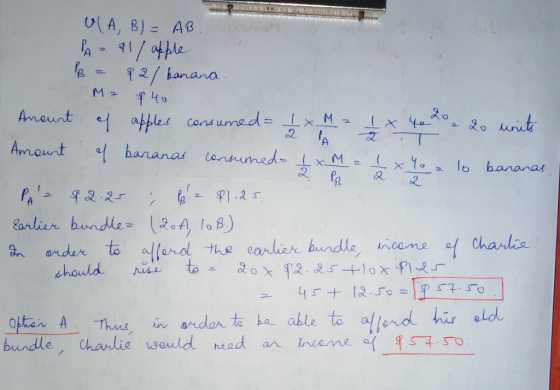
Charlie's utility function is xAxB. The price of apples used to be $1 per unit and the price of bananas was $2 per unit. His income was $40 per day. If the price of apples increased to $2.25 and the price of bananas fell to $1.25, a. compute the optimal consumption bundle for both goods before the price change; b. Compute the daily income after the price change in order to be able to just afford his old bundle.
Charlie's utility function for his consumption of apples xA and bananas xB is u(xA, xB) =...
Charlie's utility function for his consumption of apples xA and bananas xB is u(xA, xB) = xAxB. If the price of apples is pA = 3 and the price of bananas is pB = 1, and Charlie has $12 to spend on apples and/or bananas, then: The budget equation is 3 x A + x B = 12 And the optimization condition (to maximize Charlie's utility) is − x B x A = 3 Given these two conditions, find Charlie's...
Charlie consumes apples and bananas. His utility function is: U(xA; xB) xAxB. The price of apples...
 Charlie consumes apples and bananas. His utility function is: U(xA; xB) xAxB. The price of apples is $1, the price of bananas is $2, and Charlie's income is $40 a day. The price of bananas suddenly falls to $1. Find the substitution and income effect of the price change for apples and bananas.
4. Charlie likes both apples and bananas. He consumes nothing else. Charlie consumes x bushels of apples per year...
 4. Charlie likes both apples and bananas. He consumes nothing else. Charlie consumes x bushels of apples per year and x bushels of bananas per year. Suppose that Charlie's preference is represented in the following utility function: u(x,,Xy)-x,Xy . Suppose that the price of apples is S1, the price of bananas is S2, and Charlie's income is $40. (14 points) a. Draw Charlie's budget line. Plot a few points on the indifference curve that gives Charlie a utility of 150...
1. Charlie’s utility function for weekly consumption of bananas (B) and Apples (A) is given by...
1. Charlie’s utility function for weekly consumption of bananas (B) and Apples (A) is given by U = BA . a. Suppose Charlie consumes 20 bananas and 10 apples in a week. Sketch his indifference curve through that bundle on a diagram. (While it doesn’t really matter which good is on the horizontal axis, for consistency with our classwork, assume bananas are on the horizontal axis.) b. Use calculus (partial derivatives) to derive formulas for the marginal utilities (MU) of...
1. Charlotte loves apples and hates bananas. Her utility function is U (a,b) a-b2/4, where a...
 1. Charlotte loves apples and hates bananas. Her utility function is U (a,b) a-b2/4, where a is the number of apples she consumes and b is the num- ber of bananas she consumes. Assume that Charlotte's income is y • What are the demand functions for Charlotte ? • What are the Engel curves for Charlotte? 2. Wilbur likes both apples and bananas. His utility function is U(a,b) = ab1/2. Assume Wilbur's budget is m, the price of apple is...
 Charlie consumes apples and bananas. His utility function is: U(xA; xB) xAxB. The price of apples is $1, the price of bananas is $2, and Charlie's income is $40 a day. The price of bananas suddenly falls to $1. Find the substitution and income effect of the price change for apples and bananas.
 4. Charlie likes both apples and bananas. He consumes nothing else. Charlie consumes x bushels of apples per year and x bushels of bananas per year. Suppose that Charlie's preference is represented in the following utility function: u(x,,Xy)-x,Xy . Suppose that the price of apples is S1, the price of bananas is S2, and Charlie's income is $40. (14 points) a. Draw Charlie's budget line. Plot a few points on the indifference curve that gives Charlie a utility of 150...
 1. Charlotte loves apples and hates bananas. Her utility function is U (a,b) a-b2/4, where a is the number of apples she consumes and b is the num- ber of bananas she consumes. Assume that Charlotte's income is y • What are the demand functions for Charlotte ? • What are the Engel curves for Charlotte? 2. Wilbur likes both apples and bananas. His utility function is U(a,b) = ab1/2. Assume Wilbur's budget is m, the price of apple is...
Most questions answered within 3 hours.
-
Where is the error in this code sequence?
String s1 = "Hello";
String s2 = "ello";...
asked 10 months ago -
Financial data for Joel de Paris, Inc., for last year
follow:
Joel de Paris, Inc.
Balance...
asked 10 months ago -
Consider this reaction:
Al2(SO4)3 (aq)+ BaCl3
(aq) Al2Cl6 (aq)- +
3BaSO4(s) . What is the...
asked 10 months ago -
Suppose that Savneet is considering increasing her
recent random sample from 20 car rentals to 40...
asked 10 months ago -
Trucks arrive at an unloading terminal at an average rate of 120
per hour.
Trucks arrive...
asked 10 months ago -
Why are methanol and ethanol completely soluble in water while
octanol is not very little soluble....
asked 10 months ago -
A facilities manager at a university reads in a research report
that the mean amount of...
asked 10 months ago -
When the CuSO4 is rehydrated by adding water to the anhydrous
compound, is this an endothermic...
asked 10 months ago -
A ray of sunlight is passing from diamond into crown glass; the
angle of incidence is...
asked 10 months ago -
A block of mass 0.249 kg is placed on top of a light, vertical
spring of...
asked 10 months ago -
how do the kidneys compensate in the presences of acidosis
a) trigger hyperventilate
b) reserve acid...
asked 10 months ago -
Question 501 pts
The rental rate of capital to the firm increases. Which of the
following...
asked 10 months ago