
Where DV is Desired Value and OF is Objective Function
Homework Answers

Add Answer to:
Where DV is Desired Value and OF is Objective Function The DVs are x1 and x2, and the OF is -54x2-3x132 +22. What is the Hessian? The DVs are x1 and x2, and the OF is -54x2-3x132 +22. What is th...
Vertex x1 x2 1 2 3 x1 x2 optimal vertex optimal objective function value
 Vertex
x1
x2
1
2
3
x1
x2
optimal vertex
optimal objective function value
Vertex
x1
x2
1
2
3
x1
x2
optimal vertex
optimal objective function value
Consider a quadratic function h(x) =. What is its gradient and Hessian? where x is a...
Consider a quadratic function h(x) =. What is its gradient and Hessian? where x is a column matrix with n numbers, x = (x1, x2,....,xn)
2. Consider the following function: f (x1, x2) = x1 – 2V82 (a) Write down the...
 2. Consider the following function: f (x1, x2) = x1 – 2V82 (a) Write down the Hessian matrix. (b) Is the function convex at the point (x1 = 1, X2 = 2)?
Given: Objective function: maximize Z = 6x1+ 7x2 Constraints: x1 + 3 x2 30 4...
Given: Objective function: maximize Z = 6x1+ 7x2 Constraints: x1 + 3 x2 30 4 x1 + x2 32 x1 ≥ 0, x2 ≥ 0 a) Use graphical method to determine the optimal solution and the optimal value for Z.Use EXCEL to determine the optimal solution and the optimal value for Z.
Consider the following problem min f(x)=x1+x2 T2 Suppose that the logarithmic barrier method is used to...
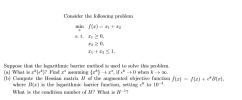 Consider the following problem min f(x)=x1+x2 T2 Suppose that the logarithmic barrier method is used to solve this problem. (a) What is 1k(ek)? Find x* assuming {rk}-> 1", įfek-> 0 when k-oo. (b) Compute the Hessian matrix H of the augmented objective function f(x) - f(x)*(x), where B(x) is the logarithmic barrier function, setting e* to 104 What is the condition number of H? What is H-1?
1. Consider a utility function u(x1, x2) = x1 + (x2)^a where a > 0. (a)...
1. Consider a utility function u(x1, x2) = x1 + (x2)^a where a > 0. (a) Show that if a < 1, then preferences are convex. (b) Show that if a = 1, then preferences have perfect substitutes form. (c) Show that if a > 1, then preferences are concave. (d) For each case, explain how you would solve for the optimal bundle.
uestion 3 (1 point) the production function is f(x1, x2) = x1/21x1/22. If the price of...
uestion 3 (1 point) the production function is f(x1, x2) = x1/21x1/22. If the price of factor 1 is $10 and the price of factor 2 is $20, in what proportions should the firm use factors 1 and 2 if it wants to maximize profits? Question 3 options: We can’t tell without knowing the price of output. x1 = 2x2. x1 = 0.50x2. x1 = x2. x1 = 20x2. Question 4 (1 point) A firm has the production function f(X,...
f(x1, x2) = -2(x1)(x2)+ (x1)^3 + (x2)^3 a) Find a maximum in the region where x1...
f(x1, x2) = -2(x1)(x2)+ (x1)^3 + (x2)^3 a) Find a maximum in the region where x1 ≤ 1 and x2 ≤ 1 (Hint: remember to check what happens when x1 = 1 and x2 = 1) b) Now consider (x1, x2) ∈ R 2 , that is, the entire two-dimensional space where x1 and x2 are in[−∞,+∞]. Is there a maximum?
22. Suppose that X1, X2,...,x, Fp, where F, is a discrete distribution with probability mass function...
 22. Suppose that X1, X2,...,x, Fp, where F, is a discrete distribution with probability mass function p(x) = p(1– p)* for x=0,1,2,.... (See Example 7.3.9.) The MLE Ộ=1/(1+X) has the asymptotic distribution below: VnCô–p) DY~N(0,(1 – p)p?). (8.54) Use the normal distribution in (8.54) to obtain, via a variance stabilizing transformation, an approximate 100(1 – a)% confidence interval for p.
Let X1 and X2 be two discrete random variables, where X1 can attain values 1, 2,...
 Let X1 and X2 be two discrete random variables, where X1 can
attain values 1, 2, and 3, and X2 can attain values 2, 3 and 4. The
joint probability mass function of these two random variables are
given in the table below: X2 X1 2 3 4 1 0.05 0.04 0.06 2 0.1 0.15
0.2 3 0.2 0.1 0.1 a. Find the marginal probability mass functions
fX1 (s) and fX2 (t). b. What is the expected values of X1...
Let X1 and X2 be two discrete random variables, where X1 can
attain values 1, 2, and 3, and X2 can attain values 2, 3 and 4. The
joint probability mass function of these two random variables are
given in the table below: X2 X1 2 3 4 1 0.05 0.04 0.06 2 0.1 0.15
0.2 3 0.2 0.1 0.1 a. Find the marginal probability mass functions
fX1 (s) and fX2 (t). b. What is the expected values of X1...
 Vertex
x1
x2
1
2
3
x1
x2
optimal vertex
optimal objective function value
Vertex
x1
x2
1
2
3
x1
x2
optimal vertex
optimal objective function value
 2. Consider the following function: f (x1, x2) = x1 – 2V82 (a) Write down the Hessian matrix. (b) Is the function convex at the point (x1 = 1, X2 = 2)?
 Consider the following problem min f(x)=x1+x2 T2 Suppose that the logarithmic barrier method is used to solve this problem. (a) What is 1k(ek)? Find x* assuming {rk}-> 1", įfek-> 0 when k-oo. (b) Compute the Hessian matrix H of the augmented objective function f(x) - f(x)*(x), where B(x) is the logarithmic barrier function, setting e* to 104 What is the condition number of H? What is H-1?
 22. Suppose that X1, X2,...,x, Fp, where F, is a discrete distribution with probability mass function p(x) = p(1– p)* for x=0,1,2,.... (See Example 7.3.9.) The MLE Ộ=1/(1+X) has the asymptotic distribution below: VnCô–p) DY~N(0,(1 – p)p?). (8.54) Use the normal distribution in (8.54) to obtain, via a variance stabilizing transformation, an approximate 100(1 – a)% confidence interval for p.
 Let X1 and X2 be two discrete random variables, where X1 can
attain values 1, 2, and 3, and X2 can attain values 2, 3 and 4. The
joint probability mass function of these two random variables are
given in the table below: X2 X1 2 3 4 1 0.05 0.04 0.06 2 0.1 0.15
0.2 3 0.2 0.1 0.1 a. Find the marginal probability mass functions
fX1 (s) and fX2 (t). b. What is the expected values of X1...
Let X1 and X2 be two discrete random variables, where X1 can
attain values 1, 2, and 3, and X2 can attain values 2, 3 and 4. The
joint probability mass function of these two random variables are
given in the table below: X2 X1 2 3 4 1 0.05 0.04 0.06 2 0.1 0.15
0.2 3 0.2 0.1 0.1 a. Find the marginal probability mass functions
fX1 (s) and fX2 (t). b. What is the expected values of X1...
Most questions answered within 3 hours.
-
Where is the error in this code sequence?
String s1 = "Hello";
String s2 = "ello";...
asked 10 months ago -
Financial data for Joel de Paris, Inc., for last year
follow:
Joel de Paris, Inc.
Balance...
asked 10 months ago -
Consider this reaction:
Al2(SO4)3 (aq)+ BaCl3
(aq) Al2Cl6 (aq)- +
3BaSO4(s) . What is the...
asked 10 months ago -
Suppose that Savneet is considering increasing her
recent random sample from 20 car rentals to 40...
asked 10 months ago -
Trucks arrive at an unloading terminal at an average rate of 120
per hour.
Trucks arrive...
asked 10 months ago -
Why are methanol and ethanol completely soluble in water while
octanol is not very little soluble....
asked 10 months ago -
A facilities manager at a university reads in a research report
that the mean amount of...
asked 10 months ago -
When the CuSO4 is rehydrated by adding water to the anhydrous
compound, is this an endothermic...
asked 10 months ago -
A ray of sunlight is passing from diamond into crown glass; the
angle of incidence is...
asked 10 months ago -
A block of mass 0.249 kg is placed on top of a light, vertical
spring of...
asked 10 months ago -
how do the kidneys compensate in the presences of acidosis
a) trigger hyperventilate
b) reserve acid...
asked 10 months ago -
Question 501 pts
The rental rate of capital to the firm increases. Which of the
following...
asked 10 months ago