
Homework Answers
Add Answer to:
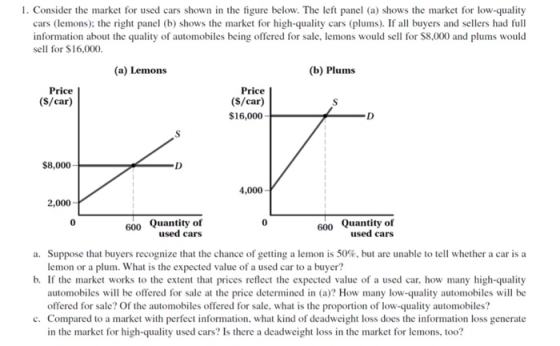
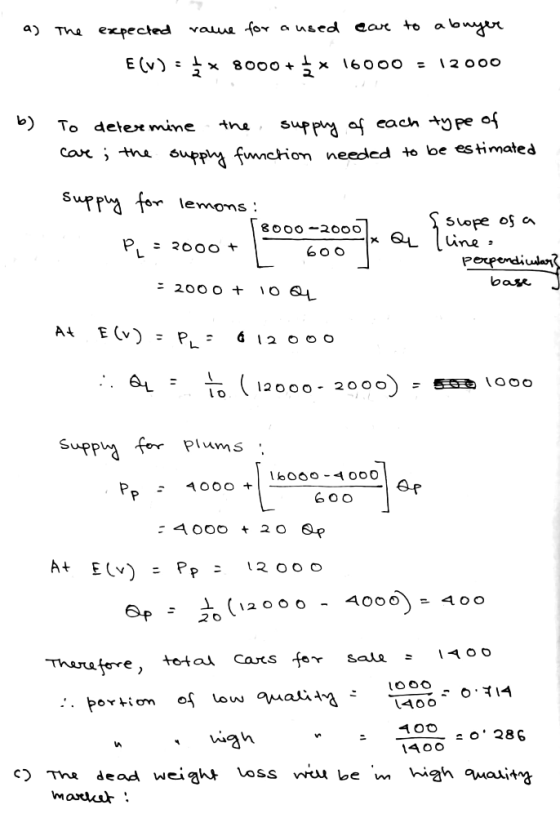
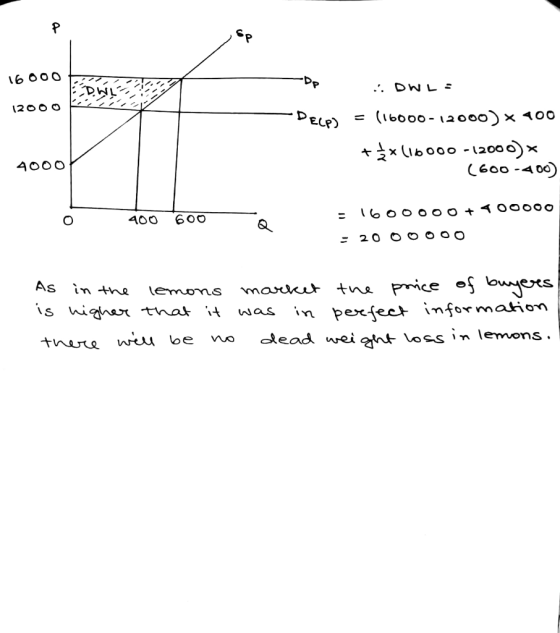
can someone explain how to work out part b *edit*: better picture 1. Consider the market for used cars shown in the figure below. The left panel (a) shows the market for low-quality cars (lemo...
Suppose there are 50 sellers of cars in a used car market who know the quality...
Suppose there are 50 sellers of cars in a used car market who know the quality of their car. Of these 50 sellers, 25 own plums. Each owner of a plum is willing to sell her car as long as she receives at least $4000 for it. The remaining sellers own lemons, which each would be willing to sell for at least $2000. There are also 50 potential buyers. a) Suppose that each buyer is willing to pay up to...
Drop down options only low-quality sellers no sellers all types of sellers only high quality sellers...
 Drop down options
only low-quality sellers
no sellers
all types of sellers
only high quality sellers
Consider a market in which there are many potential buyers and sellers of used cars. Each potential seller has one car, which is either of high quality (a plum) or low quality (a lemon). A seller with a low-quality car is willing to sell it for $3,500, whereas a seller with a high-quality car is willing to SALE sell it for $9,000. A buyer...
Drop down options
only low-quality sellers
no sellers
all types of sellers
only high quality sellers
Consider a market in which there are many potential buyers and sellers of used cars. Each potential seller has one car, which is either of high quality (a plum) or low quality (a lemon). A seller with a low-quality car is willing to sell it for $3,500, whereas a seller with a high-quality car is willing to SALE sell it for $9,000. A buyer...
Read Eye on the Market for Used Cars, and then explain how a warranty signals that...
 Read Eye on the Market for Used Cars, and then explain how a warranty signals that a car isn't a lemon and why it is in a used-car dealer's self-interest to offer a warranty. A warranty signals that a car isn't a lemon because A. giving warranties on lemons results in dealers bearing a high cost of repair O B. "lemon laws" require dealers to honor warranties O C. a warranty creates asymmetric information O D. private sellers, who sell...
Please help B. Asymmetric Information & Behavioral Economics 1. What is the equilibrium price and quantity in the u...
 Please help
B. Asymmetric Information & Behavioral Economics 1. What is the equilibrium price and quantity in the used car market below? Why aren't the other 2 points labeled considered equilibrium points? Supply of high-quality cars (plums) Supply of low-quality cars (lemons) Price (S) WTP with 50/60 expectations $10,000 WTP with pessimistic expectations $4,000 40 70 30 Number of used cars sold per day
B. Asymmetric Information & Behavioral Economics 1. What is the equilibrium price and quantity in the...
Please help
B. Asymmetric Information & Behavioral Economics 1. What is the equilibrium price and quantity in the used car market below? Why aren't the other 2 points labeled considered equilibrium points? Supply of high-quality cars (plums) Supply of low-quality cars (lemons) Price (S) WTP with 50/60 expectations $10,000 WTP with pessimistic expectations $4,000 40 70 30 Number of used cars sold per day
B. Asymmetric Information & Behavioral Economics 1. What is the equilibrium price and quantity in the...
Consider a used-car market with asymmetric information. The owners of used cars know what their vehicles...
 Consider a used-car market with asymmetric information. The owners of used cars know what their vehicles are worth but have no way of credibly demonstrating those values to potential buyers. Thus, potential buyers must always worry that the used car they are being offered may be a low-quality "lemon." Instructions: Enter your answers as whole numbers. a. Suppose that there are equal numbers of good and bad used cars in the market and that good used cars are worth $13,000 while bad...
What's the answer for both Qs There are many buyers who value high-quality used cars at...
 What's the answer for both Qs
There are many buyers who value high-quality used cars at the full-information market price of p, and lemons at P2. There are a limited number of potential sellers who value high-quality cars at V1 spand lemons at V2 =p2. Everyone is risk neutral. The share of lemons among all the used cars that might potentially be sold is 0. Assume P4 > P2, V7 > V2. Further, suppose that the buyers incur a transaction...
What's the answer for both Qs
There are many buyers who value high-quality used cars at the full-information market price of p, and lemons at P2. There are a limited number of potential sellers who value high-quality cars at V1 spand lemons at V2 =p2. Everyone is risk neutral. The share of lemons among all the used cars that might potentially be sold is 0. Assume P4 > P2, V7 > V2. Further, suppose that the buyers incur a transaction...
 Drop down options
only low-quality sellers
no sellers
all types of sellers
only high quality sellers
Consider a market in which there are many potential buyers and sellers of used cars. Each potential seller has one car, which is either of high quality (a plum) or low quality (a lemon). A seller with a low-quality car is willing to sell it for $3,500, whereas a seller with a high-quality car is willing to SALE sell it for $9,000. A buyer...
Drop down options
only low-quality sellers
no sellers
all types of sellers
only high quality sellers
Consider a market in which there are many potential buyers and sellers of used cars. Each potential seller has one car, which is either of high quality (a plum) or low quality (a lemon). A seller with a low-quality car is willing to sell it for $3,500, whereas a seller with a high-quality car is willing to SALE sell it for $9,000. A buyer...
 Read Eye on the Market for Used Cars, and then explain how a warranty signals that a car isn't a lemon and why it is in a used-car dealer's self-interest to offer a warranty. A warranty signals that a car isn't a lemon because A. giving warranties on lemons results in dealers bearing a high cost of repair O B. "lemon laws" require dealers to honor warranties O C. a warranty creates asymmetric information O D. private sellers, who sell...
 Please help
B. Asymmetric Information & Behavioral Economics 1. What is the equilibrium price and quantity in the used car market below? Why aren't the other 2 points labeled considered equilibrium points? Supply of high-quality cars (plums) Supply of low-quality cars (lemons) Price (S) WTP with 50/60 expectations $10,000 WTP with pessimistic expectations $4,000 40 70 30 Number of used cars sold per day
B. Asymmetric Information & Behavioral Economics 1. What is the equilibrium price and quantity in the...
Please help
B. Asymmetric Information & Behavioral Economics 1. What is the equilibrium price and quantity in the used car market below? Why aren't the other 2 points labeled considered equilibrium points? Supply of high-quality cars (plums) Supply of low-quality cars (lemons) Price (S) WTP with 50/60 expectations $10,000 WTP with pessimistic expectations $4,000 40 70 30 Number of used cars sold per day
B. Asymmetric Information & Behavioral Economics 1. What is the equilibrium price and quantity in the...
 Consider a used-car market with asymmetric information. The owners of used cars know what their vehicles are worth but have no way of credibly demonstrating those values to potential buyers. Thus, potential buyers must always worry that the used car they are being offered may be a low-quality "lemon." Instructions: Enter your answers as whole numbers. a. Suppose that there are equal numbers of good and bad used cars in the market and that good used cars are worth $13,000 while bad...
 What's the answer for both Qs
There are many buyers who value high-quality used cars at the full-information market price of p, and lemons at P2. There are a limited number of potential sellers who value high-quality cars at V1 spand lemons at V2 =p2. Everyone is risk neutral. The share of lemons among all the used cars that might potentially be sold is 0. Assume P4 > P2, V7 > V2. Further, suppose that the buyers incur a transaction...
What's the answer for both Qs
There are many buyers who value high-quality used cars at the full-information market price of p, and lemons at P2. There are a limited number of potential sellers who value high-quality cars at V1 spand lemons at V2 =p2. Everyone is risk neutral. The share of lemons among all the used cars that might potentially be sold is 0. Assume P4 > P2, V7 > V2. Further, suppose that the buyers incur a transaction...
Most questions answered within 3 hours.
-
Where is the error in this code sequence?
String s1 = "Hello";
String s2 = "ello";...
asked 11 months ago -
Financial data for Joel de Paris, Inc., for last year
follow:
Joel de Paris, Inc.
Balance...
asked 11 months ago -
Consider this reaction:
Al2(SO4)3 (aq)+ BaCl3
(aq) Al2Cl6 (aq)- +
3BaSO4(s) . What is the...
asked 11 months ago -
Suppose that Savneet is considering increasing her
recent random sample from 20 car rentals to 40...
asked 11 months ago -
Trucks arrive at an unloading terminal at an average rate of 120
per hour.
Trucks arrive...
asked 11 months ago -
Why are methanol and ethanol completely soluble in water while
octanol is not very little soluble....
asked 11 months ago -
A facilities manager at a university reads in a research report
that the mean amount of...
asked 11 months ago -
When the CuSO4 is rehydrated by adding water to the anhydrous
compound, is this an endothermic...
asked 11 months ago -
A ray of sunlight is passing from diamond into crown glass; the
angle of incidence is...
asked 11 months ago -
A block of mass 0.249 kg is placed on top of a light, vertical
spring of...
asked 11 months ago -
how do the kidneys compensate in the presences of acidosis
a) trigger hyperventilate
b) reserve acid...
asked 11 months ago -
Question 501 pts
The rental rate of capital to the firm increases. Which of the
following...
asked 11 months ago