
Homework Answers
If the Federal Reserve engages in contractionary monetary policy, it leads to a decrease in the money supply in the economy accompanied with an increase in interest rate, decrease in planned investment, and a decrease in output in the economy.
a. 
b. 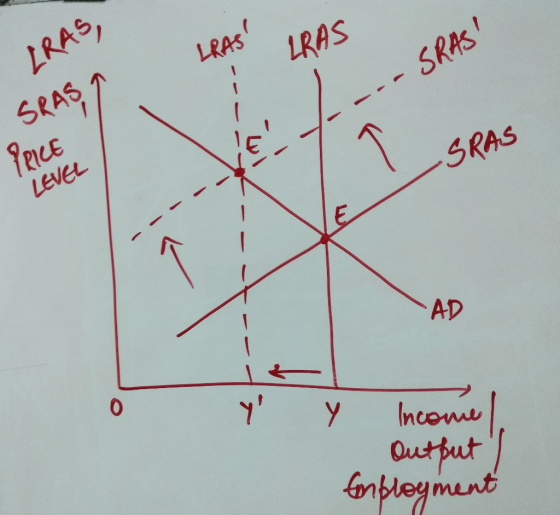
It leads to a decrease in output and a shift in AD from AD to AD'.
c. Due to the contactionary monetary policy, the Fed will decrease the money supply in the economy. This will lead to selling out bonds by Fed. As the interest rates have rise, it will lead to increase in the prices of bonds because people will want to hold less money.
d. Due to contractionary monetary policy, people will demand more of domestic currency ($) than foreign currency (euro). So this will lead to an increase in the exchange rate. Therefore, the price of domestic currency ($) will increase and that of foreign currency (euro) will decrease.
e. 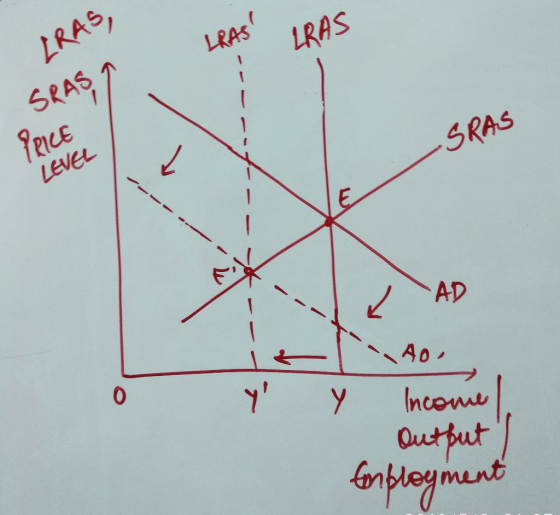
Add Answer to:
8 (12-13 pts) Assume the economy is at its full-employment level of output (at the LRAS). engages in contractionary monetary policy, what will be the effect If the Federal Reserve on the interest...
1. Starting at Full Employment, explain what happens to output, the price level, and employment )...
 1. Starting at Full Employment, explain what happens to output,
the price level, and
employment ) in each of these cases and use the AD/AS diagram
(use arrows and new
lines) to show the direction of changes
b. Consumers become more pessimistic about the economy
2. Describe the main tools of monetary policy the Federal
Reserve uses and how they would use
them if there were a financial crisis to stabilize the
economy
3. a) the federal government was required...
1. Starting at Full Employment, explain what happens to output,
the price level, and
employment ) in each of these cases and use the AD/AS diagram
(use arrows and new
lines) to show the direction of changes
b. Consumers become more pessimistic about the economy
2. Describe the main tools of monetary policy the Federal
Reserve uses and how they would use
them if there were a financial crisis to stabilize the
economy
3. a) the federal government was required...
Assume an economy operating below full employment. Draw a correctly labeled AD/AS graph showing: the problem...
Assume an economy operating below full employment. Draw a correctly labeled AD/AS graph showing: the problem in the economy current price level and output full employment output Identify an open market operation that the Fed could implement to resolve the problem. Using a correctly labeled money market graph with a side-by-side investment demand graph, show the effect of the policy you identified in part B on each of the following: nominal interest rates quantity of investment demanded On your graph...
I. The economy of Zarland is operating below the full-employment level of output with a balanced budget. (a) Draw a correctly labeled graph of short-run aggregate supply, long-run aggregate supply, a...
 I. The economy of Zarland is operating below the full-employment level of output with a balanced budget. (a) Draw a correctly labeled graph of short-run aggregate supply, long-run aggregate supply, and aggregate demand, and show each of the following. (Gi) The country's current equilibrium output and price level, labeled Yj and PL1. respectively (ii) The full-employment output, labeled Yf (b) Ir Zarland increases government expenditures and taxes by equal amounts, can aggregate demand increase? Explain. (c) If Zarland decides to...
(22) In the short run, contractionary monetary policy causes output to _______________ and prices to _______________....
 (22)
In the short run, contractionary monetary policy causes output
to _______________ and prices to _______________.
rise; rise
rise; fall
fall; rise
fall; fall
(23)
As the graph illustrates, consumers are worried about the
future and have begun saving more money. If the Fed does
not intervene in this situation, what will happen
to the price level in the long run?
Prices will increase.
Prices will stay the
same.
Prices will decrease.
There is insufficient
information to...
(22)
In the short run, contractionary monetary policy causes output
to _______________ and prices to _______________.
rise; rise
rise; fall
fall; rise
fall; fall
(23)
As the graph illustrates, consumers are worried about the
future and have begun saving more money. If the Fed does
not intervene in this situation, what will happen
to the price level in the long run?
Prices will increase.
Prices will stay the
same.
Prices will decrease.
There is insufficient
information to...
6. (Problem 6) An economy is facing the inflationary gap shown in the accompanying diagram. Aggregate...
 6. (Problem 6) An economy is facing the inflationary gap shown in the accompanying diagram. Aggregate price level LRAS SRAS Real GDP Potential —YpY output To eliminate the gap, should the central bank use expansionary or contractionary monetary policy? How will the interest rate, investment spending, consumer spending, real GDP, and the aggregate price level change as monetary policy closes the inflationary gap? The central bank can use contractionary monetary policy. The interest rate will rise, which would encourage a...
Which of the following are ways that the Federal Reserve influences the U.S. economy through its monetary policies?
 3. How the Fed influences the money supply Which of the following are ways that the Federal Reserve influences the U.S. economy through its monetary policies? Check all that apply. O Using open-market operations to sell securities, the Fed can increase the money supply, thereby increasing interest rates and subsequently reducing the rate of inflation. O Using open-market operations to buy securities, the Fed can increase the money supply, thereby increasing interest rates, which would cause security prices to decrease. Using open-market operations to sell...
1. Using a graph, show the impact of the contractionary monetary policy using Keynesian analysis. 2....
1. Using a graph, show the impact of the contractionary monetary policy using Keynesian analysis. 2. To create 3% growth in the economy, monetarists think the money supply should: a) increase by more than 3% yearly b) incr. less than 3% yearly c)incr. at 3% yearly d)decrease 3% yearly e) be constant 3. Use two graphs to depict what would happen If the fed buys a lot more T bonds than it sells, show the effect it will have in...
Write the answers to and explain the following: What action can the Federal Reserve take to...
Write the answers to and explain the following: What action can the Federal Reserve take to reduce unemployment? What is the primary tool used by the Federal Reserve to accomplish the action you listed in part (a)? Explain in detail how this tool works. Assuming the economy is currently operating at the natural rate of unemployment, what effect will the action you listed in part (a) have in the short-run on: output price level interest rates Use the AS/AD (Aggregate...
Suppose real output is initially at its full employment level. Using Aggregate Demand (AD)—Aggregate Supply (AS) framework, discuss the short-run and long-run effects of a decrease in government expe...
Suppose real output is initially at its full employment level. Using Aggregate Demand (AD)—Aggregate Supply (AS) framework, discuss the short-run and long-run effects of a decrease in government expenditure on the price level, real output, nominal wage rate and real wage rate under the following three alternative assumptions: nominal wages are fully flexible nominal wages are relatively slow to adjust nominal wages are completely rigid.
(c)? 2. The IS/LM diagram and AS/AD diagram below show the current equilibrium in an economy 79 13 13 12 LM AO Let the full-employment output be 200 (a) What are the current output, interest rate/...
 (c)?
2. The IS/LM diagram and AS/AD diagram below show the current equilibrium in an economy 79 13 13 12 LM AO Let the full-employment output be 200 (a) What are the current output, interest rate/and price level? cuhent ony (b) What will be the output, interest rate, and price level in the long run? \rCe.et vat _ 4./. c) What will be the output, interest rate, and price level in the long run if the government u iscalpoligg to...
(c)?
2. The IS/LM diagram and AS/AD diagram below show the current equilibrium in an economy 79 13 13 12 LM AO Let the full-employment output be 200 (a) What are the current output, interest rate/and price level? cuhent ony (b) What will be the output, interest rate, and price level in the long run? \rCe.et vat _ 4./. c) What will be the output, interest rate, and price level in the long run if the government u iscalpoligg to...
 1. Starting at Full Employment, explain what happens to output,
the price level, and
employment ) in each of these cases and use the AD/AS diagram
(use arrows and new
lines) to show the direction of changes
b. Consumers become more pessimistic about the economy
2. Describe the main tools of monetary policy the Federal
Reserve uses and how they would use
them if there were a financial crisis to stabilize the
economy
3. a) the federal government was required...
1. Starting at Full Employment, explain what happens to output,
the price level, and
employment ) in each of these cases and use the AD/AS diagram
(use arrows and new
lines) to show the direction of changes
b. Consumers become more pessimistic about the economy
2. Describe the main tools of monetary policy the Federal
Reserve uses and how they would use
them if there were a financial crisis to stabilize the
economy
3. a) the federal government was required...
 I. The economy of Zarland is operating below the full-employment level of output with a balanced budget. (a) Draw a correctly labeled graph of short-run aggregate supply, long-run aggregate supply, and aggregate demand, and show each of the following. (Gi) The country's current equilibrium output and price level, labeled Yj and PL1. respectively (ii) The full-employment output, labeled Yf (b) Ir Zarland increases government expenditures and taxes by equal amounts, can aggregate demand increase? Explain. (c) If Zarland decides to...
 (22)
In the short run, contractionary monetary policy causes output
to _______________ and prices to _______________.
rise; rise
rise; fall
fall; rise
fall; fall
(23)
As the graph illustrates, consumers are worried about the
future and have begun saving more money. If the Fed does
not intervene in this situation, what will happen
to the price level in the long run?
Prices will increase.
Prices will stay the
same.
Prices will decrease.
There is insufficient
information to...
(22)
In the short run, contractionary monetary policy causes output
to _______________ and prices to _______________.
rise; rise
rise; fall
fall; rise
fall; fall
(23)
As the graph illustrates, consumers are worried about the
future and have begun saving more money. If the Fed does
not intervene in this situation, what will happen
to the price level in the long run?
Prices will increase.
Prices will stay the
same.
Prices will decrease.
There is insufficient
information to...
 6. (Problem 6) An economy is facing the inflationary gap shown in the accompanying diagram. Aggregate price level LRAS SRAS Real GDP Potential —YpY output To eliminate the gap, should the central bank use expansionary or contractionary monetary policy? How will the interest rate, investment spending, consumer spending, real GDP, and the aggregate price level change as monetary policy closes the inflationary gap? The central bank can use contractionary monetary policy. The interest rate will rise, which would encourage a...
 (c)?
2. The IS/LM diagram and AS/AD diagram below show the current equilibrium in an economy 79 13 13 12 LM AO Let the full-employment output be 200 (a) What are the current output, interest rate/and price level? cuhent ony (b) What will be the output, interest rate, and price level in the long run? \rCe.et vat _ 4./. c) What will be the output, interest rate, and price level in the long run if the government u iscalpoligg to...
(c)?
2. The IS/LM diagram and AS/AD diagram below show the current equilibrium in an economy 79 13 13 12 LM AO Let the full-employment output be 200 (a) What are the current output, interest rate/and price level? cuhent ony (b) What will be the output, interest rate, and price level in the long run? \rCe.et vat _ 4./. c) What will be the output, interest rate, and price level in the long run if the government u iscalpoligg to...
Most questions answered within 3 hours.
-
Where is the error in this code sequence?
String s1 = "Hello";
String s2 = "ello";...
asked 11 months ago -
Financial data for Joel de Paris, Inc., for last year
follow:
Joel de Paris, Inc.
Balance...
asked 11 months ago -
Consider this reaction:
Al2(SO4)3 (aq)+ BaCl3
(aq) Al2Cl6 (aq)- +
3BaSO4(s) . What is the...
asked 11 months ago -
Suppose that Savneet is considering increasing her
recent random sample from 20 car rentals to 40...
asked 11 months ago -
Trucks arrive at an unloading terminal at an average rate of 120
per hour.
Trucks arrive...
asked 11 months ago -
Why are methanol and ethanol completely soluble in water while
octanol is not very little soluble....
asked 11 months ago -
A facilities manager at a university reads in a research report
that the mean amount of...
asked 11 months ago -
When the CuSO4 is rehydrated by adding water to the anhydrous
compound, is this an endothermic...
asked 11 months ago -
A ray of sunlight is passing from diamond into crown glass; the
angle of incidence is...
asked 11 months ago -
A block of mass 0.249 kg is placed on top of a light, vertical
spring of...
asked 11 months ago -
how do the kidneys compensate in the presences of acidosis
a) trigger hyperventilate
b) reserve acid...
asked 11 months ago -
Question 501 pts
The rental rate of capital to the firm increases. Which of the
following...
asked 11 months ago