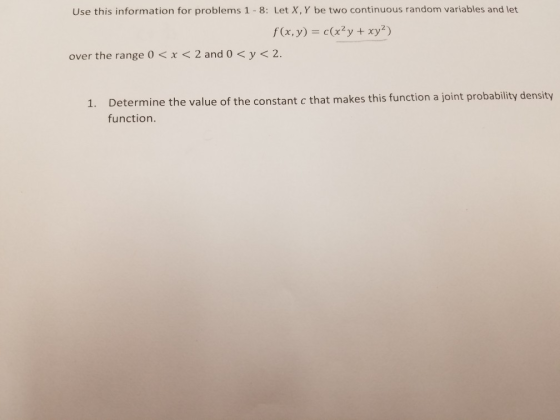
7. Find cov(X, Y)
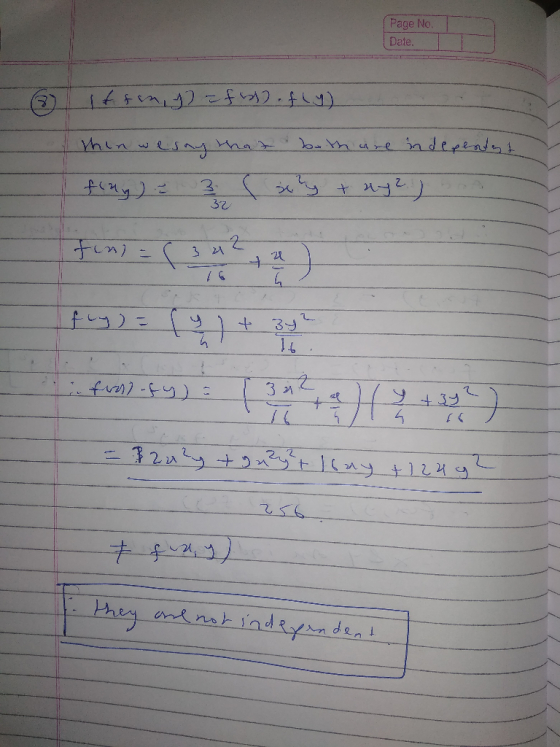
8. Are the random variables X, Y independent? Justify answer
Edit : do not solve number 1, I already solved. C=3/32
Homework Answers
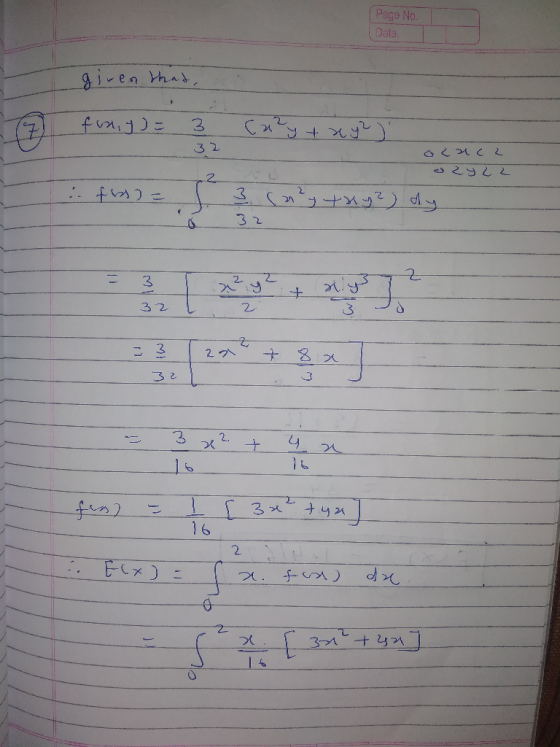
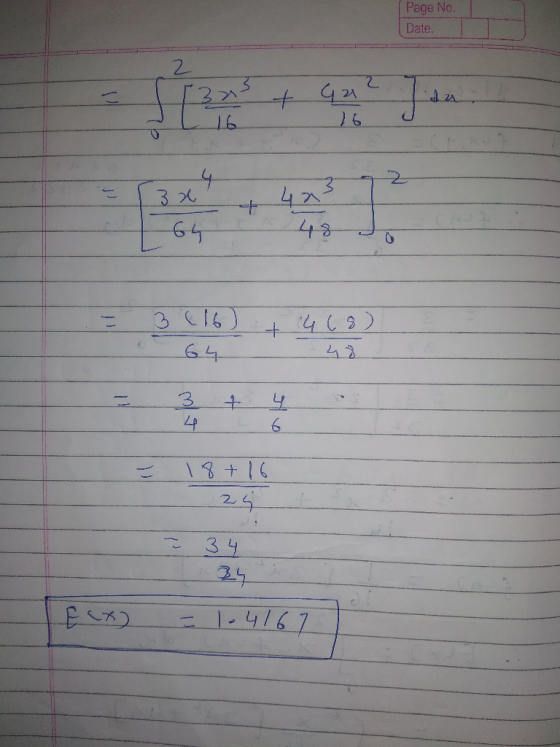
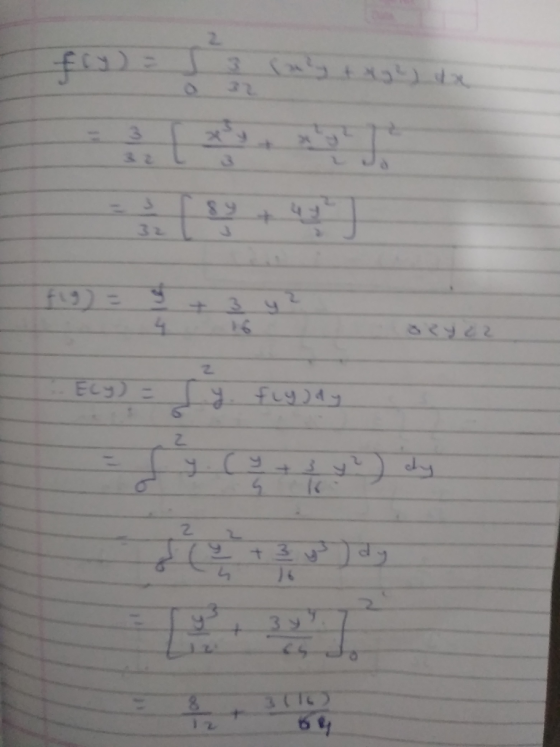
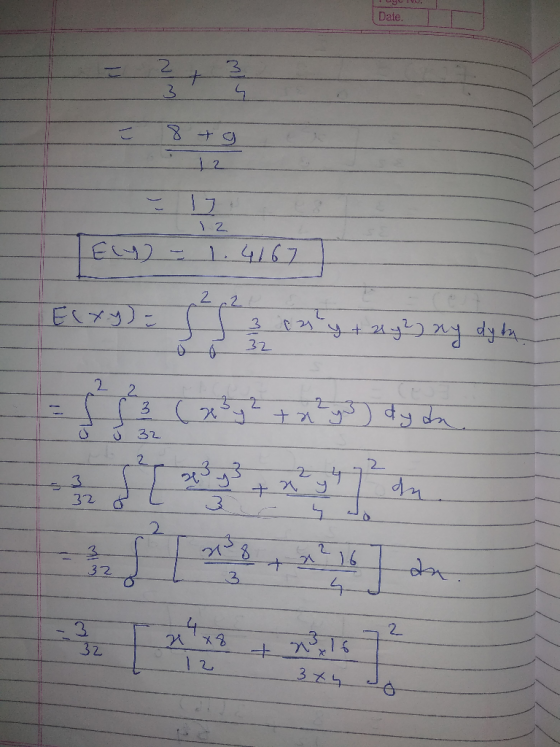
![Page No. Date: | 一ㄒㄧㄧㄧ-] 3 3 6 x2 (1 4167) ( ( 4バフ](http://img.homeworklib.com/images/8be359c0-bf27-4194-a44a-85b2e69efe6e.png?x-oss-process=image/resize,w_560)
Add Answer to:
7. Find cov(X, Y) 8. Are the random variables X, Y independent? Justify answer Edit : do not solve number 1, I already solved. C=3/32 Use this information for problems 1 -8: Let X, Y be two contin...
4. Let X and Y be continuous random variables with joint density function f(x, y) =...
 4. Let X and Y be continuous random variables with joint density function f(x, y) = { 4x for 0 <x<ys1 otherwise (a) Find the marginal density functions of X and Y, g(x) and h(y), respectively. (b) What are E[X], E[Y], and E[XY]? Find the value of Cov[X, Y]
Let X and Y be two independent random variables. Show that Cov (X, XY) = E(Y)...
 Let X and Y be two independent random variables. Show that Cov (X, XY) = E(Y) Var(X).
8), Let X and Y be continuous random variables with joint density function f(x,y)-4xy for 0...
 8), Let X and Y be continuous random variables with joint density function f(x,y)-4xy for 0 < x < y < 1 Otherwise What is the joint density of U and V Y
2. Suppose X and Y are continuous random variables with joint density function f(x, y) =...
 2. Suppose X and Y are continuous random variables with joint density function f(x, y) = 1x2 ye-xy for 1 < x < 2 and 0 < y < oo otherwise a. Calculate the (marginal) densities of X and Y. b. Calculate E[X] and E[Y]. c. Calculate Cov(X,Y).
2. Let X and Y be continuous random variables with joint probability density function fx,y(x,y) 0, otherwise (a) Compute the value of k that will make f(x, y) a legitimate joint probability density f...
 2. Let X and Y be continuous random variables with joint probability density function fx,y(x,y) 0, otherwise (a) Compute the value of k that will make f(x, y) a legitimate joint probability density function. Use f(x.y) with that value of k as the joint probability density function of X, Y in parts (b),(c).(d),(e (b) Find the probability density functions of X and Y. (c) Find the expected values of X, Y and XY (d) Compute the covariance Cov(X,Y) of X...
1.1 [Probability and Statistics] Let X and Y be jointly distributed normal random variables, where cov[X,...
 1.1 [Probability and Statistics] Let X and Y be jointly distributed normal random variables, where cov[X, Y]-2 In other words, the joint distribution of the pair (X, Y) ~N(,),where 1 |.and Σ := |.-2 9 What is the distribution of the random variable Z:-X -2Y?
Let X and Y be continuous random variables with joint distribution function F(x, y), and let...
Let X and Y be continuous random variables with joint distribution function F(x, y), and let g(X, Y ) and h(X, Y ) be functions of X and Y . Prove the following: (a) E[cg(X, Y )] = cE[g(X, Y )]. (b) E[g(X, Y ) + h(X, Y )] = E[g(X, Y )] + E[h(X, Y )]. (c) V ar(a + X) = V ar(X). (d) V ar(aX) = a 2V ar(X). (e) V ar(aX + bY ) = a...
Let X and Y be continuous random variables with following joint pdf f(x, y): y 0<1...
 Let X and Y be continuous random variables with following joint pdf f(x, y): y 0<1 and 0<y< 1 0 otherwise f(x,y) = Using the distribution method, find the pdf of Z = XY.
55. Let X and Y be jointly continuous random variables with joint density function fx.y(x,y) be-3y...
 55. Let X and Y be jointly continuous random variables with joint density function fx.y(x,y) be-3y -a < x < 2a, 0) < y < 00, otherwise. Assume that E[XY] = 1/6. (a) Find a and b such that fx,y is a valid joint pdf. You may want to use the fact that du = 1. u 6. и е (b) Find the conditional pdf of X given Y = y where 0 <y < . (c) Find Cov(X,Y). (d)...
3. Let the random variables X and Y have the joint probability density function 0 y...
 3. Let the random variables X and Y have the joint probability density function 0 y 1, 0 x < y fxy(x, y)y otherwise (a) Compute the joint expectation E(XY) (b) Compute the marginal expectations E(X) and E (Y) (c) Compute the covariance Cov(X, Y)
 4. Let X and Y be continuous random variables with joint density function f(x, y) = { 4x for 0 <x<ys1 otherwise (a) Find the marginal density functions of X and Y, g(x) and h(y), respectively. (b) What are E[X], E[Y], and E[XY]? Find the value of Cov[X, Y]
 Let X and Y be two independent random variables. Show that Cov (X, XY) = E(Y) Var(X).
 8), Let X and Y be continuous random variables with joint density function f(x,y)-4xy for 0 < x < y < 1 Otherwise What is the joint density of U and V Y
 2. Suppose X and Y are continuous random variables with joint density function f(x, y) = 1x2 ye-xy for 1 < x < 2 and 0 < y < oo otherwise a. Calculate the (marginal) densities of X and Y. b. Calculate E[X] and E[Y]. c. Calculate Cov(X,Y).
 2. Let X and Y be continuous random variables with joint probability density function fx,y(x,y) 0, otherwise (a) Compute the value of k that will make f(x, y) a legitimate joint probability density function. Use f(x.y) with that value of k as the joint probability density function of X, Y in parts (b),(c).(d),(e (b) Find the probability density functions of X and Y. (c) Find the expected values of X, Y and XY (d) Compute the covariance Cov(X,Y) of X...
 1.1 [Probability and Statistics] Let X and Y be jointly distributed normal random variables, where cov[X, Y]-2 In other words, the joint distribution of the pair (X, Y) ~N(,),where 1 |.and Σ := |.-2 9 What is the distribution of the random variable Z:-X -2Y?
 Let X and Y be continuous random variables with following joint pdf f(x, y): y 0<1 and 0<y< 1 0 otherwise f(x,y) = Using the distribution method, find the pdf of Z = XY.
 55. Let X and Y be jointly continuous random variables with joint density function fx.y(x,y) be-3y -a < x < 2a, 0) < y < 00, otherwise. Assume that E[XY] = 1/6. (a) Find a and b such that fx,y is a valid joint pdf. You may want to use the fact that du = 1. u 6. и е (b) Find the conditional pdf of X given Y = y where 0 <y < . (c) Find Cov(X,Y). (d)...
 3. Let the random variables X and Y have the joint probability density function 0 y 1, 0 x < y fxy(x, y)y otherwise (a) Compute the joint expectation E(XY) (b) Compute the marginal expectations E(X) and E (Y) (c) Compute the covariance Cov(X, Y)
Most questions answered within 3 hours.
-
Where is the error in this code sequence?
String s1 = "Hello";
String s2 = "ello";...
asked 10 months ago -
Financial data for Joel de Paris, Inc., for last year
follow:
Joel de Paris, Inc.
Balance...
asked 10 months ago -
Consider this reaction:
Al2(SO4)3 (aq)+ BaCl3
(aq) Al2Cl6 (aq)- +
3BaSO4(s) . What is the...
asked 10 months ago -
Suppose that Savneet is considering increasing her
recent random sample from 20 car rentals to 40...
asked 10 months ago -
Trucks arrive at an unloading terminal at an average rate of 120
per hour.
Trucks arrive...
asked 10 months ago -
Why are methanol and ethanol completely soluble in water while
octanol is not very little soluble....
asked 10 months ago -
A facilities manager at a university reads in a research report
that the mean amount of...
asked 10 months ago -
When the CuSO4 is rehydrated by adding water to the anhydrous
compound, is this an endothermic...
asked 10 months ago -
A ray of sunlight is passing from diamond into crown glass; the
angle of incidence is...
asked 10 months ago -
A block of mass 0.249 kg is placed on top of a light, vertical
spring of...
asked 10 months ago -
how do the kidneys compensate in the presences of acidosis
a) trigger hyperventilate
b) reserve acid...
asked 10 months ago -
Question 501 pts
The rental rate of capital to the firm increases. Which of the
following...
asked 10 months ago