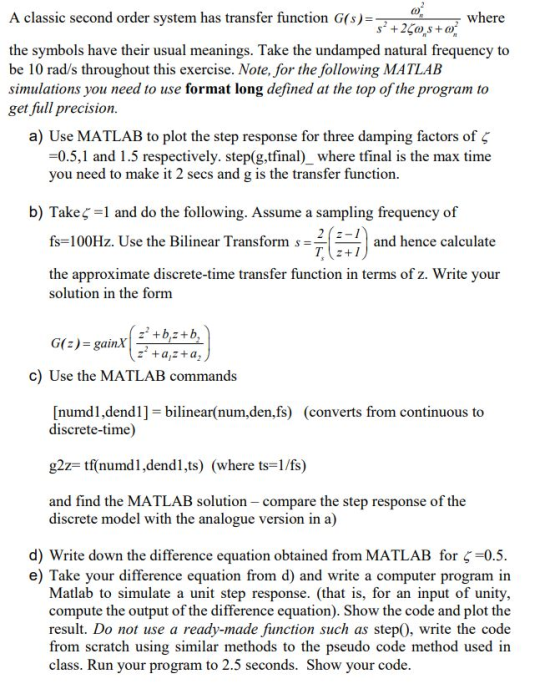
A classic second order system has transfer function
the undamped natural frequency to be 10 rad/s throughout this exercise. Note, for the following MATLAB simulations you need to use format long defined at the top of the program to get full precision.
a) Use MATLAB to plot the step response for three damping factors of ζ =0.5,1 and 1.5 respectively. step(g,tfinal)_ where tfinal is the max time you need to make it 2 secs and g is the
b) Takeζ =1 and do the following. Assume a sampling frequency of fs=100Hz. Use the Bilinear Transform s 2z1 s T z1 − = + and hence calculate the approximate discrete-time transfer function in terms of z. Write your solution in the form 2 1 2 2 1 2 z bz b G z gainX z az a ( ) + + = + +
c) Use the MATLAB commands [numd1,dend1] = bilinear(num,den,fs) (converts from continuous to discrete-time) g2z= tf(numd1,dend1,ts) (where ts=1/fs) and find the MATLAB solution – compare the step response of the discrete model with the analogue version in a) d) Write down the difference equation obtained from MATLAB for ζ =0.5. e) Take your difference equation from
d) and write a computer program in Matlab to simulate a unit step response. (that is, for an input of unity, compute the output of the difference equation). Show the code and plot the result. Do not use a ready-made function such as step(), write the code from scratch using similar methods to the pseudo code method used in class. Run your program to 2.5 seconds. Show your code.
Homework Answers
Part A
wn=10;
rho=[0.5 1 1.5];
for i=1:3
G(i)=tf([wn*wn],[1 2*rho(i)*wn wn*wn]);
end
step(G(1),G(2),G(3),2);legend('\rho=0.5','\rho=1','\rho=1.5');

Part B

PART C
rho1=1;
fs=100;
[numd1,dend1]=bilinear([wn*wn],[1 2*rho1*wn wn*wn],100);
g2z=tf(numd1,dend1,1/fs);
display(g2z);
display(G(2));
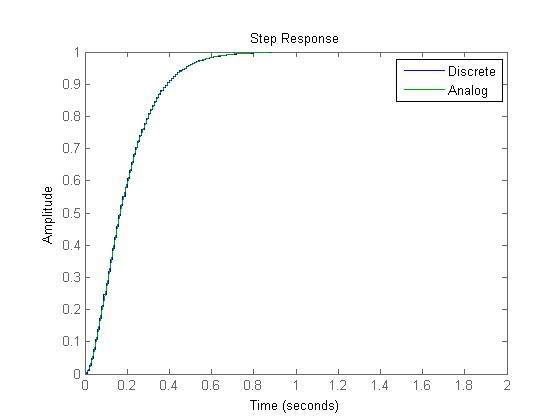
step(g2z,G(2),2);legend('Discrete','Analog');
The output is:
g2z =
0.002268 z^2 + 0.004535 z + 0.002268
------------------------------------
z^2 - 1.81 z + 0.8186
G(2)=
100
----------------
s^2 + 20 s + 100
===========================================================================
PART D

========================================================================
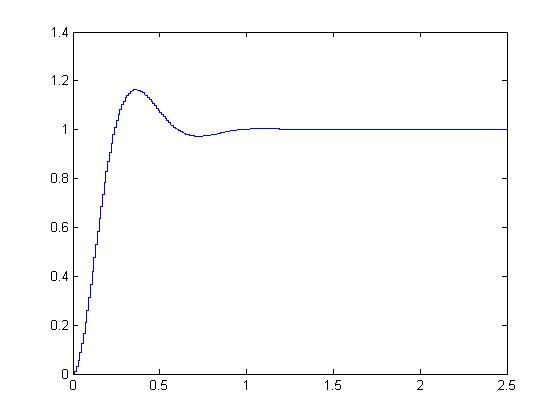
PART E
2.5 seconds stands for 251 samples
n=0:1:250;
t=0:(1/100):2.5;
x=ones(1,length(n)); %unit step input
y(1)=1/421;
y(2)=(3+798/421)*(1/421);
for i=3:length(n)
y(i)=(x(i)+2*x(i-1)+x(i-2)+798*y(i-1)-381*y(i-2))*(1/421);
end
figure;stairs(t,y);
Add Answer to:
A classic second order system has transfer function the undamped natural frequency to be 10 rad/s throughout this exercise. Note, for the following MATLAB simulations you need to use format long defi...
Thank you so much. 0O A classic second order system has transfer function G(s) where the symbols have their usual meanings. Take the undamped natural frequency to be 10 rad/s throughout this exercise...
 Thank you so much.
0O A classic second order system has transfer function G(s) where the symbols have their usual meanings. Take the undamped natural frequency to be 10 rad/s throughout this exercise. Note, for the following MATLAB simulations you need to use format long defined at the top of the program to get full precision d) Write down the difference equation obtained from MATLAB for Ç-0.5 e) Take your difference equation from d) and write a computer program in...
Thank you so much.
0O A classic second order system has transfer function G(s) where the symbols have their usual meanings. Take the undamped natural frequency to be 10 rad/s throughout this exercise. Note, for the following MATLAB simulations you need to use format long defined at the top of the program to get full precision d) Write down the difference equation obtained from MATLAB for Ç-0.5 e) Take your difference equation from d) and write a computer program in...
5. Consider a CT system with transfer function This system is called an integrutor because t by h...
 the subject is in digital signal processing
5. Consider a CT system with transfer function This system is called an integrutor because t by he d to the ingent t y)-x(r)dr. Discretize the above system using the bilinear transform. (a) What is the transfer function H'(:) of the resulting DT system b) If xin] is the input and yin] is the output of the resulting DT system, write the (c) Obtain an expression for the frequency response H'(o) of the...
the subject is in digital signal processing
5. Consider a CT system with transfer function This system is called an integrutor because t by he d to the ingent t y)-x(r)dr. Discretize the above system using the bilinear transform. (a) What is the transfer function H'(:) of the resulting DT system b) If xin] is the input and yin] is the output of the resulting DT system, write the (c) Obtain an expression for the frequency response H'(o) of the...
Use MATLAB to find the step response (plot) of a system with the following transfer function:...
 Use MATLAB to find the step response (plot) of a system with the following transfer function: G(S) = (s + 1) (s + 2) (s2 + 5s + 8) Copy and paste your MATLAB commands. Copy and paste the step response plot.
you can use matlab to solve 1. Given the plant model differential equation: y" + 6y'+ 12y 12u(t) Find: a) G(s) continuous transfer function he step response of the unity feedback system c) The...
 you can use matlab to solve
1. Given the plant model differential equation: y" + 6y'+ 12y 12u(t) Find: a) G(s) continuous transfer function he step response of the unity feedback system c) The appropriate sampling time d) G(z) pulse transfer function e) Continuous State Space, A, B, C, D f) Discrete State Space, A, B, C, D
1. Given the plant model differential equation: y" + 6y'+ 12y 12u(t) Find: a) G(s) continuous transfer function he step response of...
you can use matlab to solve
1. Given the plant model differential equation: y" + 6y'+ 12y 12u(t) Find: a) G(s) continuous transfer function he step response of the unity feedback system c) The appropriate sampling time d) G(z) pulse transfer function e) Continuous State Space, A, B, C, D f) Discrete State Space, A, B, C, D
1. Given the plant model differential equation: y" + 6y'+ 12y 12u(t) Find: a) G(s) continuous transfer function he step response of...
Do only parts C and D 1. A second-order system has the following transfer function that...
 Do only parts C and D
1. A second-order system has the following transfer function that describes its response: F(s)- s2 +as + 9 A. For a -3, calculate the following performance specifications of the system: Natural frequency (on) Damping ratio( Estimated rise time and settling time with ±5% change (tr, ts) Estimated overshoot (MP) . B. Label (a) ±5% range of steady state, (b) tr, (c) ts, and (d) MP on the step response curve below (You may also...
Do only parts C and D
1. A second-order system has the following transfer function that describes its response: F(s)- s2 +as + 9 A. For a -3, calculate the following performance specifications of the system: Natural frequency (on) Damping ratio( Estimated rise time and settling time with ±5% change (tr, ts) Estimated overshoot (MP) . B. Label (a) ±5% range of steady state, (b) tr, (c) ts, and (d) MP on the step response curve below (You may also...
only b and c please 1 Consider the system whose transfer function is given by: G(S)...
 only b and c please
1 Consider the system whose transfer function is given by: G(S) == (2s +1)(s+3) unction is given by: G(s) - (a) Use the root-locus design methodology to design a lead compensator that will provide a closed-loop damping 5 =0.4 and a natural frequency on =9 rad/sec. The general transfer function for lead compensation is given by D(5)=K (977), p>z, 2=2 (b) Use MATLAB to plot the root locus of the feed-forward transfer function, D(s)*G(s), and...
only b and c please
1 Consider the system whose transfer function is given by: G(S) == (2s +1)(s+3) unction is given by: G(s) - (a) Use the root-locus design methodology to design a lead compensator that will provide a closed-loop damping 5 =0.4 and a natural frequency on =9 rad/sec. The general transfer function for lead compensation is given by D(5)=K (977), p>z, 2=2 (b) Use MATLAB to plot the root locus of the feed-forward transfer function, D(s)*G(s), and...
SOLVE USING MATLAB A servomechanism position control has the plant transfer function 10 s(s +1) (s 10) You are to desig...
 SOLVE USING MATLAB
A servomechanism position control has the plant transfer function 10 s(s +1) (s 10) You are to design a series compensation transfer function D(s) in the unity feedback configuration to meet the following closed-loop specifications: . The response to a reference step input is to have no more than 16% overshoot. . The response to a reference step input is to have a rise time of no more than 0.4 sec. The steady-state error to a unit...
SOLVE USING MATLAB
A servomechanism position control has the plant transfer function 10 s(s +1) (s 10) You are to design a series compensation transfer function D(s) in the unity feedback configuration to meet the following closed-loop specifications: . The response to a reference step input is to have no more than 16% overshoot. . The response to a reference step input is to have a rise time of no more than 0.4 sec. The steady-state error to a unit...
Bode Diagram 10 10 Frequency (rad/s) Bode Diagram 100F 140 10 10 Frequency (rad/s) Figure Q4.2 4. The de servo system s...
 Bode Diagram 10 10 Frequency (rad/s) Bode Diagram 100F 140 10 10 Frequency (rad/s) Figure Q4.2 4. The de servo system shown in Figure Q4.1 is required to have a transient step response speci fication with a peak time of 0.58 seconds or better, and a +2% setting time of 1.7 seconds or better 01(s) K (s)G(s) s(s 1 (s 5) Figure Q4.1 The Bode diagram of the open-loop system is shown in Figure Q4.2 on page 8. This Bode...
Q4. 1 2 3 G 10 pts. Use MATLAB and plot the step response of the following systems G3 2s+1 figure. Gy on the same 2s+1...
 Q4. 1 2 3 G 10 pts. Use MATLAB and plot the step response of the following systems G3 2s+1 figure. Gy on the same 2s+1 2s+1 Explain the similarities (at least 1) and differences (at least 1) between these responses. E_ figure. G, G 3 10 pts. Use MATLAB and plot the impulse response of the following systems Explain the similarities and differences between these responses. on the same 25+1 10 pts. Find the time constant (Te), pole(s), DC...
Consider a system modelled by means of the following transfer function 10 G(s) s(s +1)(s +10)...
 Consider a system modelled by means of the following transfer function 10 G(s) s(s +1)(s +10) Given the standar negative feedback control structure, and the Bode plot of G(s): 1. Obtain (if possible) a lead compensator controller (C(s) Kc1+ts) that satisfies that the corresponding steady state error with respect to the ramp input is and that the overshoot is not greater than 15 per cent 2. Obtain (if possible) a lead compensator that satisfies that the correspond- ing steady state...
 Thank you so much.
0O A classic second order system has transfer function G(s) where the symbols have their usual meanings. Take the undamped natural frequency to be 10 rad/s throughout this exercise. Note, for the following MATLAB simulations you need to use format long defined at the top of the program to get full precision d) Write down the difference equation obtained from MATLAB for Ç-0.5 e) Take your difference equation from d) and write a computer program in...
Thank you so much.
0O A classic second order system has transfer function G(s) where the symbols have their usual meanings. Take the undamped natural frequency to be 10 rad/s throughout this exercise. Note, for the following MATLAB simulations you need to use format long defined at the top of the program to get full precision d) Write down the difference equation obtained from MATLAB for Ç-0.5 e) Take your difference equation from d) and write a computer program in...
 the subject is in digital signal processing
5. Consider a CT system with transfer function This system is called an integrutor because t by he d to the ingent t y)-x(r)dr. Discretize the above system using the bilinear transform. (a) What is the transfer function H'(:) of the resulting DT system b) If xin] is the input and yin] is the output of the resulting DT system, write the (c) Obtain an expression for the frequency response H'(o) of the...
the subject is in digital signal processing
5. Consider a CT system with transfer function This system is called an integrutor because t by he d to the ingent t y)-x(r)dr. Discretize the above system using the bilinear transform. (a) What is the transfer function H'(:) of the resulting DT system b) If xin] is the input and yin] is the output of the resulting DT system, write the (c) Obtain an expression for the frequency response H'(o) of the...
 Use MATLAB to find the step response (plot) of a system with the following transfer function: G(S) = (s + 1) (s + 2) (s2 + 5s + 8) Copy and paste your MATLAB commands. Copy and paste the step response plot.
 you can use matlab to solve
1. Given the plant model differential equation: y" + 6y'+ 12y 12u(t) Find: a) G(s) continuous transfer function he step response of the unity feedback system c) The appropriate sampling time d) G(z) pulse transfer function e) Continuous State Space, A, B, C, D f) Discrete State Space, A, B, C, D
1. Given the plant model differential equation: y" + 6y'+ 12y 12u(t) Find: a) G(s) continuous transfer function he step response of...
you can use matlab to solve
1. Given the plant model differential equation: y" + 6y'+ 12y 12u(t) Find: a) G(s) continuous transfer function he step response of the unity feedback system c) The appropriate sampling time d) G(z) pulse transfer function e) Continuous State Space, A, B, C, D f) Discrete State Space, A, B, C, D
1. Given the plant model differential equation: y" + 6y'+ 12y 12u(t) Find: a) G(s) continuous transfer function he step response of...
 Do only parts C and D
1. A second-order system has the following transfer function that describes its response: F(s)- s2 +as + 9 A. For a -3, calculate the following performance specifications of the system: Natural frequency (on) Damping ratio( Estimated rise time and settling time with ±5% change (tr, ts) Estimated overshoot (MP) . B. Label (a) ±5% range of steady state, (b) tr, (c) ts, and (d) MP on the step response curve below (You may also...
Do only parts C and D
1. A second-order system has the following transfer function that describes its response: F(s)- s2 +as + 9 A. For a -3, calculate the following performance specifications of the system: Natural frequency (on) Damping ratio( Estimated rise time and settling time with ±5% change (tr, ts) Estimated overshoot (MP) . B. Label (a) ±5% range of steady state, (b) tr, (c) ts, and (d) MP on the step response curve below (You may also...
 only b and c please
1 Consider the system whose transfer function is given by: G(S) == (2s +1)(s+3) unction is given by: G(s) - (a) Use the root-locus design methodology to design a lead compensator that will provide a closed-loop damping 5 =0.4 and a natural frequency on =9 rad/sec. The general transfer function for lead compensation is given by D(5)=K (977), p>z, 2=2 (b) Use MATLAB to plot the root locus of the feed-forward transfer function, D(s)*G(s), and...
only b and c please
1 Consider the system whose transfer function is given by: G(S) == (2s +1)(s+3) unction is given by: G(s) - (a) Use the root-locus design methodology to design a lead compensator that will provide a closed-loop damping 5 =0.4 and a natural frequency on =9 rad/sec. The general transfer function for lead compensation is given by D(5)=K (977), p>z, 2=2 (b) Use MATLAB to plot the root locus of the feed-forward transfer function, D(s)*G(s), and...
 SOLVE USING MATLAB
A servomechanism position control has the plant transfer function 10 s(s +1) (s 10) You are to design a series compensation transfer function D(s) in the unity feedback configuration to meet the following closed-loop specifications: . The response to a reference step input is to have no more than 16% overshoot. . The response to a reference step input is to have a rise time of no more than 0.4 sec. The steady-state error to a unit...
SOLVE USING MATLAB
A servomechanism position control has the plant transfer function 10 s(s +1) (s 10) You are to design a series compensation transfer function D(s) in the unity feedback configuration to meet the following closed-loop specifications: . The response to a reference step input is to have no more than 16% overshoot. . The response to a reference step input is to have a rise time of no more than 0.4 sec. The steady-state error to a unit...
 Bode Diagram 10 10 Frequency (rad/s) Bode Diagram 100F 140 10 10 Frequency (rad/s) Figure Q4.2 4. The de servo system shown in Figure Q4.1 is required to have a transient step response speci fication with a peak time of 0.58 seconds or better, and a +2% setting time of 1.7 seconds or better 01(s) K (s)G(s) s(s 1 (s 5) Figure Q4.1 The Bode diagram of the open-loop system is shown in Figure Q4.2 on page 8. This Bode...
 Q4. 1 2 3 G 10 pts. Use MATLAB and plot the step response of the following systems G3 2s+1 figure. Gy on the same 2s+1 2s+1 Explain the similarities (at least 1) and differences (at least 1) between these responses. E_ figure. G, G 3 10 pts. Use MATLAB and plot the impulse response of the following systems Explain the similarities and differences between these responses. on the same 25+1 10 pts. Find the time constant (Te), pole(s), DC...
 Consider a system modelled by means of the following transfer function 10 G(s) s(s +1)(s +10) Given the standar negative feedback control structure, and the Bode plot of G(s): 1. Obtain (if possible) a lead compensator controller (C(s) Kc1+ts) that satisfies that the corresponding steady state error with respect to the ramp input is and that the overshoot is not greater than 15 per cent 2. Obtain (if possible) a lead compensator that satisfies that the correspond- ing steady state...
Most questions answered within 3 hours.
-
Where is the error in this code sequence?
String s1 = "Hello";
String s2 = "ello";...
asked 10 months ago -
Financial data for Joel de Paris, Inc., for last year
follow:
Joel de Paris, Inc.
Balance...
asked 10 months ago -
Consider this reaction:
Al2(SO4)3 (aq)+ BaCl3
(aq) Al2Cl6 (aq)- +
3BaSO4(s) . What is the...
asked 10 months ago -
Suppose that Savneet is considering increasing her
recent random sample from 20 car rentals to 40...
asked 10 months ago -
Trucks arrive at an unloading terminal at an average rate of 120
per hour.
Trucks arrive...
asked 10 months ago -
Why are methanol and ethanol completely soluble in water while
octanol is not very little soluble....
asked 10 months ago -
A facilities manager at a university reads in a research report
that the mean amount of...
asked 10 months ago -
When the CuSO4 is rehydrated by adding water to the anhydrous
compound, is this an endothermic...
asked 10 months ago -
A ray of sunlight is passing from diamond into crown glass; the
angle of incidence is...
asked 10 months ago -
A block of mass 0.249 kg is placed on top of a light, vertical
spring of...
asked 10 months ago -
how do the kidneys compensate in the presences of acidosis
a) trigger hyperventilate
b) reserve acid...
asked 10 months ago -
Question 501 pts
The rental rate of capital to the firm increases. Which of the
following...
asked 10 months ago