Using words and graphs analyze the macroeconomic effects of expansionary fiscal policy in the short run. Provide as much detail as possible.
Using words and graphs analyze the macroeconomic effects of expansionary fiscal policy in the short run. Provide as much detail as possible.
Homework Answers
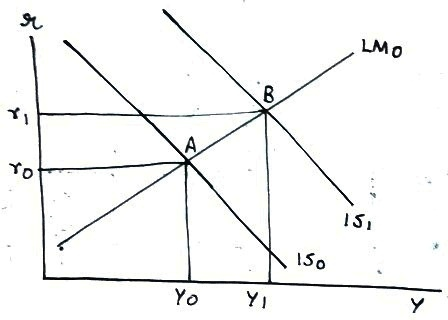
In IS-LM model, expansionary fiscal policy increases output, which shifts IS curve to right, increasing interest rate and increasing output. In following graph, IS0 and LM0 are initial IS and LM curves intersecting at point A with initial interest rate r0 and output Y0. As expansionary fiscal policy is implemented, IS0 shifts right to IS1, intersecting LM0 at point B with higher interest rate r1 and higher output Y1.
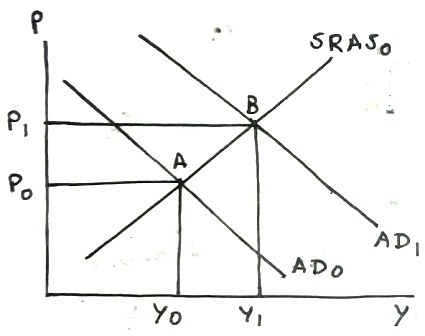
In AD-AS model, expansionary fiscal policy increases government spending or decreases taxes, both of which increase aggregate demand and shifts AD curve to right, increasing both price level and real GDP. In following graph, AD0 and SRAS0 are initial aggregate demand and short run aggregate supply curves intersecting at point A with initial price level P0 and real GDP Y0. As expansionary fiscal policy takes place, AD0 shifts right to AD1, intersecting SRAS0 at point B with higher price level P1 and higher real GDP Y1.
Add Answer to:
Using words and graphs analyze the macroeconomic effects of expansionary fiscal policy in the short run. Provide as much detail as possible.
The economy is in long-run macroeconomic equilibrium when the point of short-run macroeconomic equilibrium is on...
The economy is in long-run macroeconomic equilibrium when the point of short-run macroeconomic equilibrium is on the long-run aggregate supply curve. Using a graph, depict and explain the short-run versus long-run effects of: I. A contractionary monetary policy resulting in demand shock on the long-run macroeconomic equilibrium. Use one contractionary monetary policy to illustrate your analysis, explain the nature of the policy and clearly depict the direction of the shift and changes in the equilibrium point, where necessary. II. An...
Analyze new fiscal policy actions undertaken by the U.S. government throughout the 1990-1999 by describing their...
Analyze new fiscal policy actions undertaken by the U.S. government throughout the 1990-1999 by describing their intended effects, using macroeconomic principles to explain the actions. (can you provide citation if possible)
With a fixed exchange rate, what would increase output in the short run? Contractionary fiscal policy...
 With a fixed exchange rate, what would increase output in the short run? Contractionary fiscal policy Contractionary monetary policy Expansionary fiscal policy Expansionary monetary policy
In the short run, expansionary fiscal policy can cause la rise in real GDP 2: O...
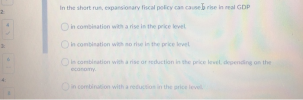 In the short run, expansionary fiscal policy can cause la rise in real GDP 2: O in combination with a rise in the price level. 3: O in combination with no rise in the price level. 6 in combination with a rise or reduction in the price level, depending on the economy 4: in combination with a reduction in the price level.
FISCAL POLICY IN-CLASS WORKSHEET 2 This question explores the role of expansionary and contractionary fiscal policy...
FISCAL POLICY IN-CLASS WORKSHEET 2 This question explores the role of expansionary and contractionary fiscal policy in the Aggregate Demand and Aggregate Supply model. You will use schedules for an aggregate demand line and an aggregate supply line to identify the equilibrium price level and real GDP in a macroeconomy. Additionally, you will compare the short-run equilibrium level of real GDP to the full employment level of real GDP to identify desirable fiscal policies. Below, you are provided the schedules...
Analyze new fiscal policy actions undertaken by the U.S. government throughout the 1990's by describing their...
Analyze new fiscal policy actions undertaken by the U.S. government throughout the 1990's by describing their intended effects, using macroeconomic principles to explain the actions.
The graph shows the effects of an expansionary monetary policy, which, over time, results in shifts of both the aggregate demand curve (AD1 to AD2) and the short-run aggregate supply curve (SRAS1 to SRAS2).
 The graph shows the effects of an expansionary monetary policy, which, over time, results in shifts of both the aggregate demand curve (AD1 to AD2) and the short-run aggregate supply curve (SRAS1 to SRAS2).If the dot indicates the economy's initial equilibrium state, place a second dot to show the economy's new equilibrium in the short run, given that the monetary policy move was completely expected.
6. The long-run effects of monetary policy Aa Aa The following graphs show an economy that is cur...
 6. The long-run effects of monetary policy The following graphs show an economy that is currently in long-run equilibrium. The first graph shows the aggregate demand (AD) and long-run aggregate supply (LRAS) curves. The second shows the long-run (LR) and short-run (SR) Phillips curves. The point on each graph shows the economy's current position. According to the graphs, potential output in this economy is _______ and the natural rate of unemployment is _______ .Suppose the central bank of the economy decreases the...
1. Some critics of expansionary fiscal policy believe that: A. helping poor people in a recession...
1. Some critics of expansionary fiscal policy believe that: A. helping poor people in a recession produces an incentive to look for a job. B. accumulating more government debt is more harmful than the short-run effects of a recession. C. a recession should be dealt with by increasing the size of government. D. such a policy should be pursued only to support excessive economic growth. 2. . A fiscal policy lag is the length of time it takes: A. the...
Analyze new fiscal policy actions undertaken by the U.S. government throughout 2000 - 2010 by describing...
Analyze new fiscal policy actions undertaken by the U.S. government throughout 2000 - 2010 by describing their intended effects, using macroeconomic principles to explain the actions. This rubric element wants you to examine what the fiscal policy initiatives were going forward, to respond to the changing economic landscape. You should specifically state what the intent of the actions were - for instance, it could be to decrease unemployment. Then, use our macroeconomic principles and models (like the AD-AS model or...
 With a fixed exchange rate, what would increase output in the short run? Contractionary fiscal policy Contractionary monetary policy Expansionary fiscal policy Expansionary monetary policy
 In the short run, expansionary fiscal policy can cause la rise in real GDP 2: O in combination with a rise in the price level. 3: O in combination with no rise in the price level. 6 in combination with a rise or reduction in the price level, depending on the economy 4: in combination with a reduction in the price level.
Most questions answered within 3 hours.
-
Where is the error in this code sequence?
String s1 = "Hello";
String s2 = "ello";...
asked 11 months ago -
Financial data for Joel de Paris, Inc., for last year
follow:
Joel de Paris, Inc.
Balance...
asked 11 months ago -
Consider this reaction:
Al2(SO4)3 (aq)+ BaCl3
(aq) Al2Cl6 (aq)- +
3BaSO4(s) . What is the...
asked 11 months ago -
Suppose that Savneet is considering increasing her
recent random sample from 20 car rentals to 40...
asked 11 months ago -
Trucks arrive at an unloading terminal at an average rate of 120
per hour.
Trucks arrive...
asked 11 months ago -
Why are methanol and ethanol completely soluble in water while
octanol is not very little soluble....
asked 11 months ago -
A facilities manager at a university reads in a research report
that the mean amount of...
asked 11 months ago -
When the CuSO4 is rehydrated by adding water to the anhydrous
compound, is this an endothermic...
asked 11 months ago -
A ray of sunlight is passing from diamond into crown glass; the
angle of incidence is...
asked 11 months ago -
A block of mass 0.249 kg is placed on top of a light, vertical
spring of...
asked 11 months ago -
how do the kidneys compensate in the presences of acidosis
a) trigger hyperventilate
b) reserve acid...
asked 11 months ago -
Question 501 pts
The rental rate of capital to the firm increases. Which of the
following...
asked 11 months ago