
Homework Answers
Add Answer to:
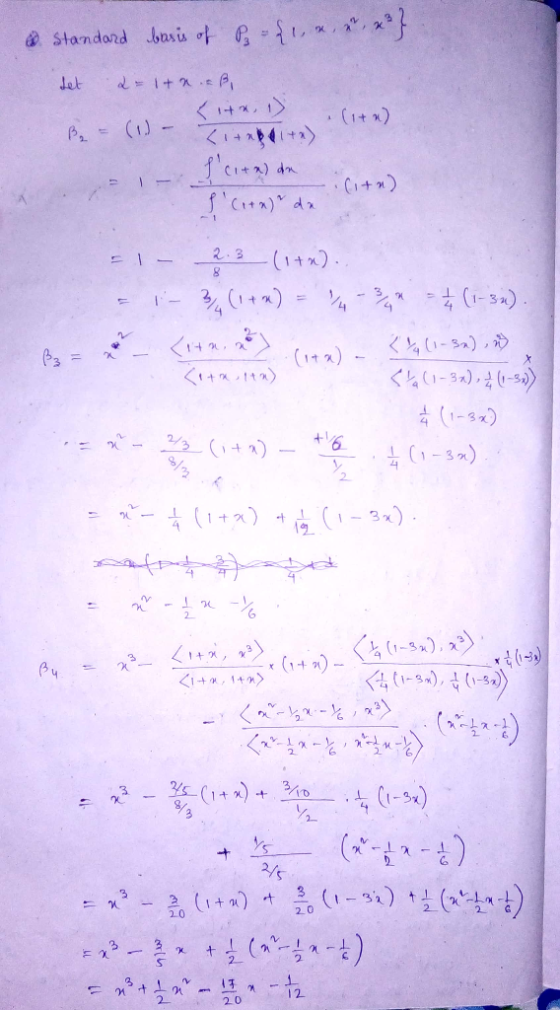
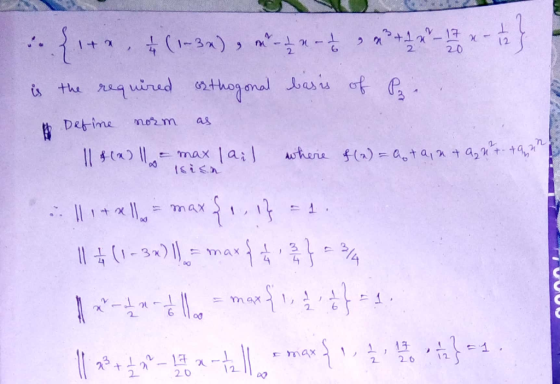
let P3 denote the vector space of polynomials of degree 3 or less, with an inner product defined by 14. Let Ps denote the vector space of polynomials of degree 3 or less, with an inner product def...
Let P2 be the real vector space of polynomials in a of degree at most 2, and let T be the real vector space of upper tr...
 Let P2 be the real vector space of polynomials in a of degree at most 2, and let T be the real vector space of upper triangular 2 x 2 matrica b,cERThe vector space P2 is equipped with the inner product 〈p(x), q(x)-1 p(z)q(z) dr, and the vector space T is equipped with the inner product 〈A.B)=tr(AB), where tr denotes trace. Let L: P2→T be 1.p(z)dr]. Find L 0 c given by L(p(z)):-17(1) .CE :J ) 1 2 0 p(-1)...
(1 point) Let Ps be the vector space of all polynomials of degree at most 3,...
 (1 point) Let Ps be the vector space of all polynomials of degree at most 3, and consider the subspace 11 = {r(z) e Pal p(1) = 0} of P3 a A basis for the subspace H is { 22x+12x^2-x-1 Enter your answer as a comma separated list of polynomials. b. The dimension of His 3 (1 point) Find a basis for the space of symmetric 2 x 2-matrices If you need fewer basis elements than there are blanks provided,...
Problem 1. Let the inner product (,) be defined by (u.v)xu (x)v (x) dx, and let the norm Iilbe de...
 Problem 1. Let the inner product (,) be defined by (u.v)xu (x)v (x) dx, and let the norm Iilbe defined by lIul-)Corhe target funtio), and work with the approximating space P4 Use Gram-Schmidt orthogonalization with this inner product to find orthogonal polynomials (x) through degree four. Standardize your polynomials such that p: (1) 1. (a) Form the five-by-five Gram matrix for this inner product with the basis functions p (x) degree 4 approximation o f (x) using the specified norm,...
(1 point) Let V be the vector space P3[x] of polynomials in x with degree less...
 (1 point) Let V be the vector space P3[x] of polynomials in x with degree less than 3 and W be the subspace a. Find a nonzero polynomial p(x) in W b. Find a polynomial q(x) in V\ W. q(x)-
E the vector space of polynomials over R of degree less than 3. Define a quadratic form on V by a...
 e the vector space of polynomials over R of degree less than 3. Define a quadratic form on V by a) Find the symmetric bilinear forma f such that q(p) = f(p, p). b) Consider the basis oy-(1,2-x U)o. c) Let R-(3,2-r, 4-2z +2.2} of V. Find the matrix {f}3: You may give your ,24 of V. Find the matrix answer as a product of matrices and/or their inverses.
e the vector space of polynomials over R of degree less...
e the vector space of polynomials over R of degree less than 3. Define a quadratic form on V by a) Find the symmetric bilinear forma f such that q(p) = f(p, p). b) Consider the basis oy-(1,2-x U)o. c) Let R-(3,2-r, 4-2z +2.2} of V. Find the matrix {f}3: You may give your ,24 of V. Find the matrix answer as a product of matrices and/or their inverses.
e the vector space of polynomials over R of degree less...
Let V be the vector space of all polynomials of degree at most 2 equipped with...
 Let V be the vector space of all polynomials of degree at most 2 equipped with the inner product defined by (p,q) = p(-1)q (-1) + p (0)g(0) +p(1)q(1),p(x),g(x) E V Find a nonzero polynomial that is orthogonal to both p(x) = 1 + x + x2, and q(x) = 1-2x + x2
Problem 1. Let the inner prodct )be deined by (u.v)xu (x) v (x) dx, and let the norm |I-ll be def...
 Problem 1. Let the inner prodct )be deined by (u.v)xu (x) v (x) dx, and let the norm |I-ll be defined by ull , ).Consider the target function f (x) with the approximating space P e', and work 2. Use Gram-Schmidt orthogonalization with this inner product to find orthogonal polynomials p (x) through degree four. Standardize your polynomials such that p, (1) 1 (b) Find the best degree 4 approximation to f(x) using the specified norm, and working with this...
7. Let V = Pa(R), the vector space of polynomials over R of degree less than 2, with inner product Define φ E p by φ(g)-g(-1) a) By direct calculation, find f e V such that (S)-dg). You are given...
 7. Let V = Pa(R), the vector space of polynomials over R of degree less than 2, with inner product Define φ E p by φ(g)-g(-1) a) By direct calculation, find f e V such that (S)-dg). You are given that A 1, V3-2v) is an orthonormal basis for V (you do not need to check this). b) Find the same f as in part a, using the formula for A(6) from class.
7. Let V = Pa(R), the vector...
7. Let V = Pa(R), the vector space of polynomials over R of degree less than 2, with inner product Define φ E p by φ(g)-g(-1) a) By direct calculation, find f e V such that (S)-dg). You are given that A 1, V3-2v) is an orthonormal basis for V (you do not need to check this). b) Find the same f as in part a, using the formula for A(6) from class.
7. Let V = Pa(R), the vector...
Q2 (10 points) Let V- Ps be the vector space of polynomials of degree 3. Let...
 Q2 (10 points) Let V- Ps be the vector space of polynomials of degree 3. Let C (1,x 2, 2)2 +2)3) be two ordered bases of V. () Find the change-of-basis matrices Pc-B and PB-c (ii) Find [y]в if [v]c- (1, 0, 0, 1). (iii) Find [y]c if [y]B-( 1, 0, 0, 1).
t Ps be the vector space of all polynomials of degree s 3. is a subspace...
 t Ps be the vector space of all polynomials of degree s 3. is a subspace of Ps (verify!). Find a basis for and the dimension of W.
 Let P2 be the real vector space of polynomials in a of degree at most 2, and let T be the real vector space of upper triangular 2 x 2 matrica b,cERThe vector space P2 is equipped with the inner product 〈p(x), q(x)-1 p(z)q(z) dr, and the vector space T is equipped with the inner product 〈A.B)=tr(AB), where tr denotes trace. Let L: P2→T be 1.p(z)dr]. Find L 0 c given by L(p(z)):-17(1) .CE :J ) 1 2 0 p(-1)...
 (1 point) Let Ps be the vector space of all polynomials of degree at most 3, and consider the subspace 11 = {r(z) e Pal p(1) = 0} of P3 a A basis for the subspace H is { 22x+12x^2-x-1 Enter your answer as a comma separated list of polynomials. b. The dimension of His 3 (1 point) Find a basis for the space of symmetric 2 x 2-matrices If you need fewer basis elements than there are blanks provided,...
 Problem 1. Let the inner product (,) be defined by (u.v)xu (x)v (x) dx, and let the norm Iilbe defined by lIul-)Corhe target funtio), and work with the approximating space P4 Use Gram-Schmidt orthogonalization with this inner product to find orthogonal polynomials (x) through degree four. Standardize your polynomials such that p: (1) 1. (a) Form the five-by-five Gram matrix for this inner product with the basis functions p (x) degree 4 approximation o f (x) using the specified norm,...
 (1 point) Let V be the vector space P3[x] of polynomials in x with degree less than 3 and W be the subspace a. Find a nonzero polynomial p(x) in W b. Find a polynomial q(x) in V\ W. q(x)-
 e the vector space of polynomials over R of degree less than 3. Define a quadratic form on V by a) Find the symmetric bilinear forma f such that q(p) = f(p, p). b) Consider the basis oy-(1,2-x U)o. c) Let R-(3,2-r, 4-2z +2.2} of V. Find the matrix {f}3: You may give your ,24 of V. Find the matrix answer as a product of matrices and/or their inverses.
e the vector space of polynomials over R of degree less...
e the vector space of polynomials over R of degree less than 3. Define a quadratic form on V by a) Find the symmetric bilinear forma f such that q(p) = f(p, p). b) Consider the basis oy-(1,2-x U)o. c) Let R-(3,2-r, 4-2z +2.2} of V. Find the matrix {f}3: You may give your ,24 of V. Find the matrix answer as a product of matrices and/or their inverses.
e the vector space of polynomials over R of degree less...
 Let V be the vector space of all polynomials of degree at most 2 equipped with the inner product defined by (p,q) = p(-1)q (-1) + p (0)g(0) +p(1)q(1),p(x),g(x) E V Find a nonzero polynomial that is orthogonal to both p(x) = 1 + x + x2, and q(x) = 1-2x + x2
 Problem 1. Let the inner prodct )be deined by (u.v)xu (x) v (x) dx, and let the norm |I-ll be defined by ull , ).Consider the target function f (x) with the approximating space P e', and work 2. Use Gram-Schmidt orthogonalization with this inner product to find orthogonal polynomials p (x) through degree four. Standardize your polynomials such that p, (1) 1 (b) Find the best degree 4 approximation to f(x) using the specified norm, and working with this...
 7. Let V = Pa(R), the vector space of polynomials over R of degree less than 2, with inner product Define φ E p by φ(g)-g(-1) a) By direct calculation, find f e V such that (S)-dg). You are given that A 1, V3-2v) is an orthonormal basis for V (you do not need to check this). b) Find the same f as in part a, using the formula for A(6) from class.
7. Let V = Pa(R), the vector...
7. Let V = Pa(R), the vector space of polynomials over R of degree less than 2, with inner product Define φ E p by φ(g)-g(-1) a) By direct calculation, find f e V such that (S)-dg). You are given that A 1, V3-2v) is an orthonormal basis for V (you do not need to check this). b) Find the same f as in part a, using the formula for A(6) from class.
7. Let V = Pa(R), the vector...
 Q2 (10 points) Let V- Ps be the vector space of polynomials of degree 3. Let C (1,x 2, 2)2 +2)3) be two ordered bases of V. () Find the change-of-basis matrices Pc-B and PB-c (ii) Find [y]в if [v]c- (1, 0, 0, 1). (iii) Find [y]c if [y]B-( 1, 0, 0, 1).
 t Ps be the vector space of all polynomials of degree s 3. is a subspace of Ps (verify!). Find a basis for and the dimension of W.
Most questions answered within 3 hours.
-
Where is the error in this code sequence?
String s1 = "Hello";
String s2 = "ello";...
asked 10 months ago -
Financial data for Joel de Paris, Inc., for last year
follow:
Joel de Paris, Inc.
Balance...
asked 10 months ago -
Consider this reaction:
Al2(SO4)3 (aq)+ BaCl3
(aq) Al2Cl6 (aq)- +
3BaSO4(s) . What is the...
asked 10 months ago -
Suppose that Savneet is considering increasing her
recent random sample from 20 car rentals to 40...
asked 10 months ago -
Trucks arrive at an unloading terminal at an average rate of 120
per hour.
Trucks arrive...
asked 10 months ago -
Why are methanol and ethanol completely soluble in water while
octanol is not very little soluble....
asked 10 months ago -
A facilities manager at a university reads in a research report
that the mean amount of...
asked 10 months ago -
When the CuSO4 is rehydrated by adding water to the anhydrous
compound, is this an endothermic...
asked 10 months ago -
A ray of sunlight is passing from diamond into crown glass; the
angle of incidence is...
asked 10 months ago -
A block of mass 0.249 kg is placed on top of a light, vertical
spring of...
asked 10 months ago -
how do the kidneys compensate in the presences of acidosis
a) trigger hyperventilate
b) reserve acid...
asked 10 months ago -
Question 501 pts
The rental rate of capital to the firm increases. Which of the
following...
asked 10 months ago