

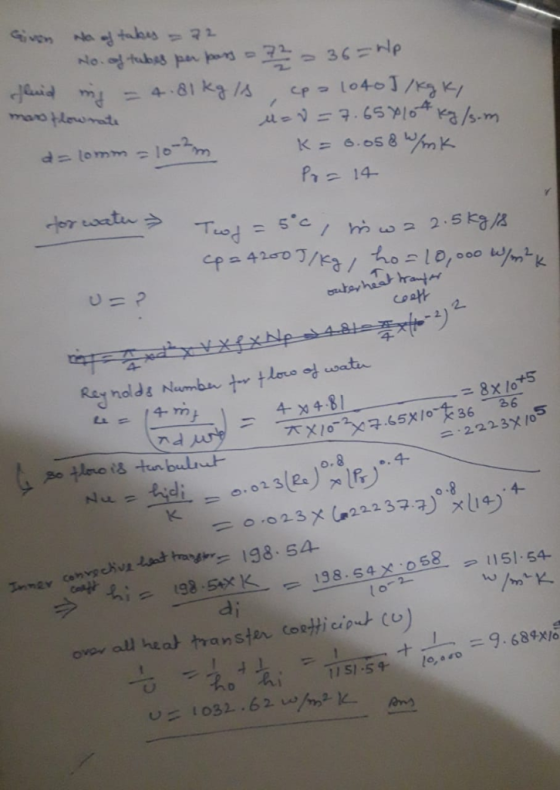
Page 5 of 12 Your Initials: Problem 3 (20 pts): Heat exchanger In a supercomputer, signal propagation delays are reduced by resorting to high-density circuit arrangements which are cooled by immersing them in a special dielectric liquid. The fluid is pumped in a closed loop through the computer and an adjoining shell-and-tube heat exchanger having one shell and two tube passes. During normal operation, heat generated within the computer of the heat exchanger and the heat is transferred to water In turn, the fluid passes through the tubes passing over the tubes. The dielectric fluid may be assumed to have 1040 J/kg K, v 7.65x 10⁴ kg/s m, k 0.058 W/m chilled water at a flow rate of m 2.5 kg's and an inlet tempeaeof TS tubes. The water has a specific heat of 4200 J/ kg K and provides an ay coefficient of 10,000 W/m2 K over the outer surface of the tubes. K, and Pr 14. During normal operation, rature of Tw. 5 °C passes over the
Homework Answers
Add Answer to:
Your Initials: Page 5 of 12 Problem 3 (20 pts): Heat exchanger In a supercomputer, signal propagation delays are redaced by resorting to high-density circuit arrangements which are cooled b...
PROBLEM 3 (45 points) The condenser of a large steam power plant is a heat exchanger...
 PROBLEM 3 (45 points) The condenser of a large steam power plant is a heat exchanger in which steam is condensed to liquid water. Assume the condenser to be a parallel flow shell-and-tube heat exchanger consisting of a single shell and 1x10 tubes, each executing two passes. The inner diameter of tubes is D = 50 mm and its thickness is 5 mm (Do not ignore the thickness). The steam condenses on their outer surface. Thermal conductivity of the tube...
The condenser of a large steam power plant is a heat exchanger in which steam is...
 The condenser of a large steam power plant is a heat exchanger in which steam is condensed to liquid water. Assume the condenser to be a shell-and-tube heat exchanger consisting of a single shell and 30,000 tubes, each executing two passes (see figure below). The tubes are of thin wall construction with D=25mm, and steam condenses on their outer surface with an associated convection coefficient ho=11,000W/ m K The heat transfer rate that must be effected by the heat exchanger...
Problem 2: Heat exchanger (25 points) Cold water (op 4179 J/kg K) enters the tubes of a heat exchanger at 20 °C at a rate of 3 kgs. while hot oil (cp 2200 J/kg.K) enters the shell at 130 C at the sam...
 Problem 2: Heat exchanger (25 points) Cold water (op 4179 J/kg K) enters the tubes of a heat exchanger at 20 °C at a rate of 3 kgs. while hot oil (cp 2200 J/kg.K) enters the shell at 130 C at the same mass flow rate and leaves at 60°C The heat exchanger consistsoftwo shells and 20 tubes, each executing four passes (two passes per shell). If the W/m2-K, assume the tube wall is very thin with convective heat transfer...
be clear Problem 3 (60 Points). A 1-2 shell-and-tube heat exchanger must be designed to heat...
 be clear
Problem 3 (60 Points). A 1-2 shell-and-tube heat exchanger must be designed to heat 2.5 kg/s of water from 15 to 85°C. The heating is to be accomplished by passing hot engine oil at a rate of 5.2 kg/s, which is available at 160°C, through the shell side of the exchanger. The oil is known to provide an average convection coefficient of 400 W/m2K on the outside of the tubes. Ten tubes passes the water through the shell....
be clear
Problem 3 (60 Points). A 1-2 shell-and-tube heat exchanger must be designed to heat 2.5 kg/s of water from 15 to 85°C. The heating is to be accomplished by passing hot engine oil at a rate of 5.2 kg/s, which is available at 160°C, through the shell side of the exchanger. The oil is known to provide an average convection coefficient of 400 W/m2K on the outside of the tubes. Ten tubes passes the water through the shell....
 PROBLEM 3 (45 points) The condenser of a large steam power plant is a heat exchanger in which steam is condensed to liquid water. Assume the condenser to be a parallel flow shell-and-tube heat exchanger consisting of a single shell and 1x10 tubes, each executing two passes. The inner diameter of tubes is D = 50 mm and its thickness is 5 mm (Do not ignore the thickness). The steam condenses on their outer surface. Thermal conductivity of the tube...
 The condenser of a large steam power plant is a heat exchanger in which steam is condensed to liquid water. Assume the condenser to be a shell-and-tube heat exchanger consisting of a single shell and 30,000 tubes, each executing two passes (see figure below). The tubes are of thin wall construction with D=25mm, and steam condenses on their outer surface with an associated convection coefficient ho=11,000W/ m K The heat transfer rate that must be effected by the heat exchanger...
 Problem 2: Heat exchanger (25 points) Cold water (op 4179 J/kg K) enters the tubes of a heat exchanger at 20 °C at a rate of 3 kgs. while hot oil (cp 2200 J/kg.K) enters the shell at 130 C at the same mass flow rate and leaves at 60°C The heat exchanger consistsoftwo shells and 20 tubes, each executing four passes (two passes per shell). If the W/m2-K, assume the tube wall is very thin with convective heat transfer...
 be clear
Problem 3 (60 Points). A 1-2 shell-and-tube heat exchanger must be designed to heat 2.5 kg/s of water from 15 to 85°C. The heating is to be accomplished by passing hot engine oil at a rate of 5.2 kg/s, which is available at 160°C, through the shell side of the exchanger. The oil is known to provide an average convection coefficient of 400 W/m2K on the outside of the tubes. Ten tubes passes the water through the shell....
be clear
Problem 3 (60 Points). A 1-2 shell-and-tube heat exchanger must be designed to heat 2.5 kg/s of water from 15 to 85°C. The heating is to be accomplished by passing hot engine oil at a rate of 5.2 kg/s, which is available at 160°C, through the shell side of the exchanger. The oil is known to provide an average convection coefficient of 400 W/m2K on the outside of the tubes. Ten tubes passes the water through the shell....
Most questions answered within 3 hours.
-
Where is the error in this code sequence?
String s1 = "Hello";
String s2 = "ello";...
asked 11 months ago -
Financial data for Joel de Paris, Inc., for last year
follow:
Joel de Paris, Inc.
Balance...
asked 11 months ago -
Consider this reaction:
Al2(SO4)3 (aq)+ BaCl3
(aq) Al2Cl6 (aq)- +
3BaSO4(s) . What is the...
asked 11 months ago -
Suppose that Savneet is considering increasing her
recent random sample from 20 car rentals to 40...
asked 11 months ago -
Trucks arrive at an unloading terminal at an average rate of 120
per hour.
Trucks arrive...
asked 11 months ago -
Why are methanol and ethanol completely soluble in water while
octanol is not very little soluble....
asked 11 months ago -
A facilities manager at a university reads in a research report
that the mean amount of...
asked 11 months ago -
When the CuSO4 is rehydrated by adding water to the anhydrous
compound, is this an endothermic...
asked 11 months ago -
A ray of sunlight is passing from diamond into crown glass; the
angle of incidence is...
asked 11 months ago -
A block of mass 0.249 kg is placed on top of a light, vertical
spring of...
asked 11 months ago -
how do the kidneys compensate in the presences of acidosis
a) trigger hyperventilate
b) reserve acid...
asked 11 months ago -
Question 501 pts
The rental rate of capital to the firm increases. Which of the
following...
asked 11 months ago