
Homework Answers

Add Answer to:
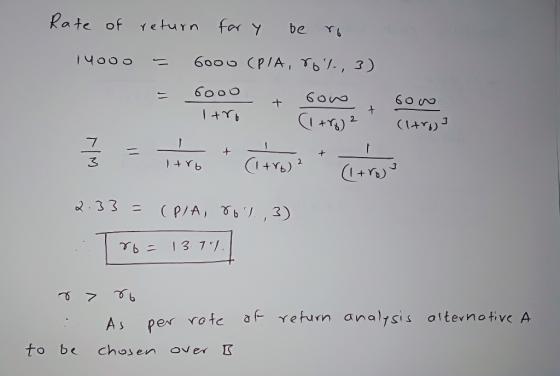
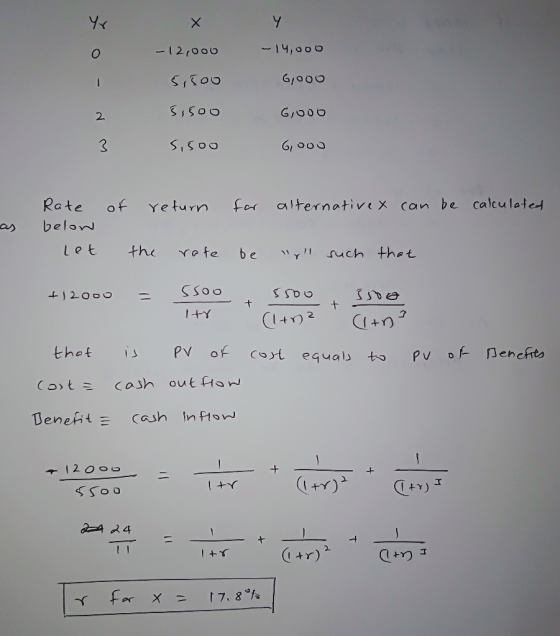
Question 7 (25 points) Consider two alternatives, X and Y, as shown below Year 0 -$12,000 -$14,000 6,000 5,500 6,000 6,000 5,500 5,500 a) What is the rate of return for alternative X? b) If the M...
1) Consider these two machines (alternatives): (12 Points) B A $5000 $1750 $700 $8200 $1850 $500...
 1) Consider these two machines (alternatives): (12 Points) B A $5000 $1750 $700 $8200 $1850 $500 First Cost Uniform annual benefit Salvage Value Useful Life, in Years 4 If the MARR (minimum attractive rate of return) -7 % , which alternative should be selected? Use the Present worth Analysis method.
1) Consider these two machines (alternatives): (12 Points) B A $5000 $1750 $700 $8200 $1850 $500 First Cost Uniform annual benefit Salvage Value Useful Life, in Years 4 If the...
1) Consider these two machines (alternatives): (12 Points) B A $5000 $1750 $700 $8200 $1850 $500 First Cost Uniform annual benefit Salvage Value Useful Life, in Years 4 If the MARR (minimum attractive rate of return) -7 % , which alternative should be selected? Use the Present worth Analysis method.
1) Consider these two machines (alternatives): (12 Points) B A $5000 $1750 $700 $8200 $1850 $500 First Cost Uniform annual benefit Salvage Value Useful Life, in Years 4 If the...
The four alternatives described below are evaluated by the rate of return method. Alternative Initial Investment, $ Ove...
The four alternatives described below are evaluated by the rate of return method. Alternative Initial Investment, $ Overall ROR, i*% Δi*% When Compared with Alternative A B C A −40,000 29 - - - B −75,000 15 1 - - C −100,000 16 7 20 - D −200,000 14 10 13 12 If the proposals are mutually exclusive, which one should be selected at an MARR of 9% per year? Alternative should be selected.
QUESTION 23 Two alternatives have the following cash flows: Alternative Year A B 0 -$10000 -$15000...
QUESTION 23 Two alternatives have the following cash flows: Alternative Year A B 0 -$10000 -$15000 1 +$3000 +$4400 2 +$3000 +$4400 3 +$3000 +$4400 4 +$3000 +$4400 Assuming a 5% MARR, use incremental analysis to determine which alternative should be selected?
20*The four revenue alternatives described below are being evaluated by the rate of return method. If...
20*The four revenue alternatives described below are being evaluated by the rate of return method. If the proposals are independent, which one(s) should be selected when the MARR is 16% per year? Alternative Initial Investment ($) Overall Rate of Return Incremental Rate of Return (%) When Compared with Alternative i* (%) A B C A -60,000 15 B -100,000 28 46 C -180,000 20 25 12 D -250,000 17 20 16 14
Given the financial data for four mutually exclusive alternatives in the table below, A B C D First cost $18,000 $40,000 $21,200 45,000 O &M Cost/ year 2,600 5,000...
Given the financial data for four mutually exclusive alternatives in the table below, A B C D First cost $18,000 $40,000 $21,200 45,000 O &M Cost/ year 2,600 5,000 3,900 11,000 Benefit/year 7,500 16,000 11,500 25,000 Salvage value 2,000 6,000 6,000 12,000 Life in years 4 Use a Rate of Return Analysis to solve for the following: Which alternative should be chosen using an MARR of 9%? Mathematical solution Create a choice table from 0 – 25%. Create a graphical...
Alternatives X and Y are described below. X involves using a CISC microprocessor while alternative Y...
 Alternatives X and Y are described below. X involves using a CISC microprocessor while alternative Y is about using ASIC microprocessor. Wh you select based on their Future Worth? Use an annual interest rate of 5% for both alternatives. All values are in $ 7. ich microprocessor would Alternative Initial Cost Yearly Operating Expenses 6,000 500 2,500 1,500 6 4,000 Annual Revenues Salvage Value Life (years 1,000 900
Consider three mutually exclusive alternatives, each with a 15-year useful life. If the MARR is 12%,...
Consider three mutually exclusive alternatives, each with a 15-year useful life. If the MARR is 12%, which alternative should be selected? Solve the problem by using benefit-cost ratio analysis, Net Present Value, and Internal Rate of Return. A B C Cost $800 $300 $150 Uniform Annual Benefit 130 60 35
Please write neatly. DO NOT USE EXCEL! Thank you. Question #4 (25 Points) Three alternatives are...
 Please write neatly. DO NOT USE EXCEL! Thank
you.
Question #4 (25 Points) Three alternatives are being considered. The table below shows the associated cash flows with each alternative The company uses MARR of 20% per year Alternative A $40,000 $38,000 $25,000 $10,000 6 vears 26% Alternative BAlternative C Capital investment Annual Revenu Annual Cost Salvage value Useful life IRR $60,000 $53,000 $30,000 $10,000 6 years 3390 $30,000 $28,000 $16,000 $10,000 6 vears 35% Using incremental analysis, determine which is...
Please write neatly. DO NOT USE EXCEL! Thank
you.
Question #4 (25 Points) Three alternatives are being considered. The table below shows the associated cash flows with each alternative The company uses MARR of 20% per year Alternative A $40,000 $38,000 $25,000 $10,000 6 vears 26% Alternative BAlternative C Capital investment Annual Revenu Annual Cost Salvage value Useful life IRR $60,000 $53,000 $30,000 $10,000 6 years 3390 $30,000 $28,000 $16,000 $10,000 6 vears 35% Using incremental analysis, determine which is...
0.6. Consider the following EOY cash flows for two mutually exclusive alternatives (one must be chosen):...
 0.6. Consider the following EOY cash flows for two mutually exclusive alternatives (one must be chosen): Solar Panel A Solar Panel B Capital investment, $ 7,000 13.000 Annual operating expenses, SL 2.200 2.000 Market value, $ 1.000 2.30) Useful life, years 12 The MARR is 12% per year. Determine (using FW method) which alternative should be selected if the analysis period is 18 years, the repeatability assumption does not apply, and a solar panel can be leased for $6,000 per...
The cash flow for two alternatives is shown in the table below. a) Determine which alternative...
 The cash flow for two alternatives is shown in the table below. a) Determine which alternative should be selected based on present worth comparison (use i=10%). b) If your analysis period (study period) is just 3 years, what should be the salvage value of alternative A2 at the end of year 3 to make the two alternatives economically indifferent? A1 Year 0 -900 -400 A2 -1800 -300 -300 1 2 -400 3 -400+200 -300 4 5 6 -300 -300 -300...
 1) Consider these two machines (alternatives): (12 Points) B A $5000 $1750 $700 $8200 $1850 $500 First Cost Uniform annual benefit Salvage Value Useful Life, in Years 4 If the MARR (minimum attractive rate of return) -7 % , which alternative should be selected? Use the Present worth Analysis method.
1) Consider these two machines (alternatives): (12 Points) B A $5000 $1750 $700 $8200 $1850 $500 First Cost Uniform annual benefit Salvage Value Useful Life, in Years 4 If the...
1) Consider these two machines (alternatives): (12 Points) B A $5000 $1750 $700 $8200 $1850 $500 First Cost Uniform annual benefit Salvage Value Useful Life, in Years 4 If the MARR (minimum attractive rate of return) -7 % , which alternative should be selected? Use the Present worth Analysis method.
1) Consider these two machines (alternatives): (12 Points) B A $5000 $1750 $700 $8200 $1850 $500 First Cost Uniform annual benefit Salvage Value Useful Life, in Years 4 If the...
 Alternatives X and Y are described below. X involves using a CISC microprocessor while alternative Y is about using ASIC microprocessor. Wh you select based on their Future Worth? Use an annual interest rate of 5% for both alternatives. All values are in $ 7. ich microprocessor would Alternative Initial Cost Yearly Operating Expenses 6,000 500 2,500 1,500 6 4,000 Annual Revenues Salvage Value Life (years 1,000 900
 Please write neatly. DO NOT USE EXCEL! Thank
you.
Question #4 (25 Points) Three alternatives are being considered. The table below shows the associated cash flows with each alternative The company uses MARR of 20% per year Alternative A $40,000 $38,000 $25,000 $10,000 6 vears 26% Alternative BAlternative C Capital investment Annual Revenu Annual Cost Salvage value Useful life IRR $60,000 $53,000 $30,000 $10,000 6 years 3390 $30,000 $28,000 $16,000 $10,000 6 vears 35% Using incremental analysis, determine which is...
Please write neatly. DO NOT USE EXCEL! Thank
you.
Question #4 (25 Points) Three alternatives are being considered. The table below shows the associated cash flows with each alternative The company uses MARR of 20% per year Alternative A $40,000 $38,000 $25,000 $10,000 6 vears 26% Alternative BAlternative C Capital investment Annual Revenu Annual Cost Salvage value Useful life IRR $60,000 $53,000 $30,000 $10,000 6 years 3390 $30,000 $28,000 $16,000 $10,000 6 vears 35% Using incremental analysis, determine which is...
 0.6. Consider the following EOY cash flows for two mutually exclusive alternatives (one must be chosen): Solar Panel A Solar Panel B Capital investment, $ 7,000 13.000 Annual operating expenses, SL 2.200 2.000 Market value, $ 1.000 2.30) Useful life, years 12 The MARR is 12% per year. Determine (using FW method) which alternative should be selected if the analysis period is 18 years, the repeatability assumption does not apply, and a solar panel can be leased for $6,000 per...
 The cash flow for two alternatives is shown in the table below. a) Determine which alternative should be selected based on present worth comparison (use i=10%). b) If your analysis period (study period) is just 3 years, what should be the salvage value of alternative A2 at the end of year 3 to make the two alternatives economically indifferent? A1 Year 0 -900 -400 A2 -1800 -300 -300 1 2 -400 3 -400+200 -300 4 5 6 -300 -300 -300...
Most questions answered within 3 hours.
-
Where is the error in this code sequence?
String s1 = "Hello";
String s2 = "ello";...
asked 11 months ago -
Financial data for Joel de Paris, Inc., for last year
follow:
Joel de Paris, Inc.
Balance...
asked 11 months ago -
Consider this reaction:
Al2(SO4)3 (aq)+ BaCl3
(aq) Al2Cl6 (aq)- +
3BaSO4(s) . What is the...
asked 11 months ago -
Suppose that Savneet is considering increasing her
recent random sample from 20 car rentals to 40...
asked 11 months ago -
Trucks arrive at an unloading terminal at an average rate of 120
per hour.
Trucks arrive...
asked 11 months ago -
Why are methanol and ethanol completely soluble in water while
octanol is not very little soluble....
asked 11 months ago -
A facilities manager at a university reads in a research report
that the mean amount of...
asked 11 months ago -
When the CuSO4 is rehydrated by adding water to the anhydrous
compound, is this an endothermic...
asked 11 months ago -
A ray of sunlight is passing from diamond into crown glass; the
angle of incidence is...
asked 11 months ago -
A block of mass 0.249 kg is placed on top of a light, vertical
spring of...
asked 11 months ago -
how do the kidneys compensate in the presences of acidosis
a) trigger hyperventilate
b) reserve acid...
asked 11 months ago -
Question 501 pts
The rental rate of capital to the firm increases. Which of the
following...
asked 11 months ago