
Homework Answers
syms y(t)
Dy = diff(y);
ode = diff(y,t,2)-6*diff(y,t)+9*y == t*exp(3*t);
cond1 = y(0) == 0;
cond2 = Dy(0) == 5;
conds = [cond1 cond2];
ySol(t) = dsolve(ode,conds)
ySol(t) = 5*t*exp(3*t) + (t^3*exp(3*t))/6
----------------------
syms y(t)
Dy = diff(y);
ode = diff(y,t,2)+16*y == 8*cos(4*t);
cond1 = y(0) == 0;
cond2 = Dy(0) == 0;
conds = [cond1 cond2];
ySol(t) = dsolve(ode,conds)
ySol(t) = cos(12*t)/16 - cos(4*t)/16 + sin(4*t)*(t + sin(8*t)/8)
---------------------------
syms y(t)
Dy = diff(y);
ode = diff(y,t,2)-4*diff(y,t)+4*y == 6*exp(2*t);
cond1 = y(0) == 0;
cond2 = Dy(0) == 0;
conds = [cond1 cond2];
ySol(t) = dsolve(ode,conds)
ySol(t) = 3*t^2*exp(2*t)
---------------------------------
syms y(t)
Dy = diff(y);
ode = diff(y,t,2)-4*diff(y,t) == -4*t*exp(2*t);
cond1 = y(0) == 0;
cond2 = Dy(0) == 1;
conds = [cond1 cond2];
ySol(t) = dsolve(ode,conds)
ySol(t) = t*exp(2*t)
Add Answer to:
please solve with mathlab and post screenshots of the code Circle your final answer. 2. y" +16y 8 cos(4t) y(o)-y'(O)- 2.У Circle your final answer. 2. y" +16y 8 cos(4t) y(o)-y'...
please solve with mathlab and post screenshots of the code 10.y" + 2y' +10y -6e sin(3t),y(0) 0,y'(0) 1 10.y" + 2y' +10y -6e sin(3t),y(0) 0,y'(0) 1
 please solve with mathlab and post screenshots of the code
10.y" + 2y' +10y -6e sin(3t),y(0) 0,y'(0) 1
10.y" + 2y' +10y -6e sin(3t),y(0) 0,y'(0) 1
please solve with mathlab and post screenshots of the code
10.y" + 2y' +10y -6e sin(3t),y(0) 0,y'(0) 1
10.y" + 2y' +10y -6e sin(3t),y(0) 0,y'(0) 1
cos 4t 1:[0,) 3. Solve for y(t): y” +16y = f(t) = { with y(0) =...
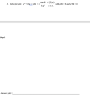 cos 4t 1:[0,) 3. Solve for y(t): y” +16y = f(t) = { with y(0) = 0 and y'(0) = 0. 0,if tn. Saleserstos se va posar este mai 90 -m70-e Stepl. Answer: y(t) =
Solve the initial value problem y" + 8y' + 16y = 0, y(-1) = 2, y'...
 Solve the initial value problem y" + 8y' + 16y = 0, y(-1) = 2, y' (-1) = 5. Equation Editor Common 2 Matrix o @ sin(a) seca) s in-(a) cos(a) csca) cosa tan(a) cota) tana) Va Va la U yt) =
Use MATHLAB to answer the following question. Post your full working code and a screenshot of...
 Use MATHLAB to answer the following question. Post your
full working code and a screenshot of the output!
1. Write a function sumsteps2 that calculates and returns the sum of 1 to n in steps of 2, where n is an argument passed to the function. For example, if 11 is passed, I will return 1+3+5+ 7 + 9 + 11. Do this using a for loop. Calling the function will look like this: >> sumsteps 2(11) ans = 36...
Use MATHLAB to answer the following question. Post your
full working code and a screenshot of the output!
1. Write a function sumsteps2 that calculates and returns the sum of 1 to n in steps of 2, where n is an argument passed to the function. For example, if 11 is passed, I will return 1+3+5+ 7 + 9 + 11. Do this using a for loop. Calling the function will look like this: >> sumsteps 2(11) ans = 36...
Please circle your final answer! Question 13 Not yet answered Marked out of 10.00 Solve the...
 Please circle your final
answer!
Question 13 Not yet answered Marked out of 10.00 Solve the following initial value problem. dy/dx + 3xy - 2x e^(-x) = 0 (first order linear DE) y(0) = 1000 Note that a b = ab. Flag question Select one: O a. y = (x2 + 1000)^{-x} O b. y = (x2 - 100)^{-x*} C. y =( X2 - 1000)^{-x*} d. y = (2x2 + 1000)^{-x}
Please circle your final
answer!
Question 13 Not yet answered Marked out of 10.00 Solve the following initial value problem. dy/dx + 3xy - 2x e^(-x) = 0 (first order linear DE) y(0) = 1000 Note that a b = ab. Flag question Select one: O a. y = (x2 + 1000)^{-x} O b. y = (x2 - 100)^{-x*} C. y =( X2 - 1000)^{-x*} d. y = (2x2 + 1000)^{-x}
SOLVE #3 AND #4 PLEASE Use the Laplace transformation to solve the IVP. 1. y"-6y' + 9y-24-9t, y(0)-2, y, (0)-0 2. 9y" - 12y'4y50ey(0)--1,y'(0)2 3. У"-2y'--. 1 2 cos(2t) +...
 SOLVE #3 AND #4 PLEASE
Use the Laplace transformation to solve the IVP. 1. y"-6y' + 9y-24-9t, y(0)-2, y, (0)-0 2. 9y" - 12y'4y50ey(0)--1,y'(0)2 3. У"-2y'--. 1 2 cos(2t) + 4 sin(2t),y(0)-4,y'(0)-0
Use the Laplace transformation to solve the IVP. 1. y"-6y' + 9y-24-9t, y(0)-2, y, (0)-0 2. 9y" - 12y'4y50ey(0)--1,y'(0)2 3. У"-2y'--. 1 2 cos(2t) + 4 sin(2t),y(0)-4,y'(0)-0
SOLVE #3 AND #4 PLEASE
Use the Laplace transformation to solve the IVP. 1. y"-6y' + 9y-24-9t, y(0)-2, y, (0)-0 2. 9y" - 12y'4y50ey(0)--1,y'(0)2 3. У"-2y'--. 1 2 cos(2t) + 4 sin(2t),y(0)-4,y'(0)-0
Use the Laplace transformation to solve the IVP. 1. y"-6y' + 9y-24-9t, y(0)-2, y, (0)-0 2. 9y" - 12y'4y50ey(0)--1,y'(0)2 3. У"-2y'--. 1 2 cos(2t) + 4 sin(2t),y(0)-4,y'(0)-0
Please solve in MATLAB and provide screenshots of the code and a copy of the code....
 Please solve in MATLAB and provide screenshots of the code and a
copy of the code. DO PART B ONLY.
Chapter 5, Problem 16P 12 Bookmarks Show all steps: OFF Problem Water is flowing in a trapezoidal channel at a rate of Q= 20 m3/s. The critical depth y for such a channel must satisfy the equation 0 = 1-2B - ZA? where g=9.81 m/s2, Ac = the cross-sectional area (m2), and B = the width of the channel at...
Please solve in MATLAB and provide screenshots of the code and a
copy of the code. DO PART B ONLY.
Chapter 5, Problem 16P 12 Bookmarks Show all steps: OFF Problem Water is flowing in a trapezoidal channel at a rate of Q= 20 m3/s. The critical depth y for such a channel must satisfy the equation 0 = 1-2B - ZA? where g=9.81 m/s2, Ac = the cross-sectional area (m2), and B = the width of the channel at...
You have not submitted your answer. Solve the initial value problem: 16y" + 10y = 0,...
 You have not submitted your answer. Solve the initial value problem: 16y" + 10y = 0, y(7/6) = -2, y' (/6) = 1. Give your answer as y=... . Use x as the independent variable. Answer: v=
1 VMware Horizon Sketch the region of integration. Vy cos(y) dy dx (1/8 у 2) 2...
 1 VMware Horizon Sketch the region of integration. Vy cos(y) dy dx (1/8 у 2) 2 6 8 2 4 6 O 8 8H 6 2 4 Eva uate the trated Integra, switching the order of integration if necessary COSTS sin 8-1 Type here to search o *
a. Find a particular solution to the nonhomogeneous differential equation y" + 16y = cos(4x) +...
 a. Find a particular solution to the nonhomogeneous differential equation y" + 16y = cos(4x) + sin(4x). Yo = (xsin(4x))/8-(xcos(4x))/8 help (formulas) b. Find the most general solution to the associated homogeneous differential equation. Use ci and C2 in your answer to denote arbitrary constants. Enter c1 as c1 and C2 as c2. Un = c1cos(4x)+c2sin(4x) help (formulas) c. Find the solution to the original nonhomogeneous differential equation satisfying the initial conditions y(0) = 3 and y'(0) = 2. y...
 please solve with mathlab and post screenshots of the code
10.y" + 2y' +10y -6e sin(3t),y(0) 0,y'(0) 1
10.y" + 2y' +10y -6e sin(3t),y(0) 0,y'(0) 1
please solve with mathlab and post screenshots of the code
10.y" + 2y' +10y -6e sin(3t),y(0) 0,y'(0) 1
10.y" + 2y' +10y -6e sin(3t),y(0) 0,y'(0) 1
 cos 4t 1:[0,) 3. Solve for y(t): y” +16y = f(t) = { with y(0) = 0 and y'(0) = 0. 0,if tn. Saleserstos se va posar este mai 90 -m70-e Stepl. Answer: y(t) =
 Solve the initial value problem y" + 8y' + 16y = 0, y(-1) = 2, y' (-1) = 5. Equation Editor Common 2 Matrix o @ sin(a) seca) s in-(a) cos(a) csca) cosa tan(a) cota) tana) Va Va la U yt) =
 Use MATHLAB to answer the following question. Post your
full working code and a screenshot of the output!
1. Write a function sumsteps2 that calculates and returns the sum of 1 to n in steps of 2, where n is an argument passed to the function. For example, if 11 is passed, I will return 1+3+5+ 7 + 9 + 11. Do this using a for loop. Calling the function will look like this: >> sumsteps 2(11) ans = 36...
Use MATHLAB to answer the following question. Post your
full working code and a screenshot of the output!
1. Write a function sumsteps2 that calculates and returns the sum of 1 to n in steps of 2, where n is an argument passed to the function. For example, if 11 is passed, I will return 1+3+5+ 7 + 9 + 11. Do this using a for loop. Calling the function will look like this: >> sumsteps 2(11) ans = 36...
 Please circle your final
answer!
Question 13 Not yet answered Marked out of 10.00 Solve the following initial value problem. dy/dx + 3xy - 2x e^(-x) = 0 (first order linear DE) y(0) = 1000 Note that a b = ab. Flag question Select one: O a. y = (x2 + 1000)^{-x} O b. y = (x2 - 100)^{-x*} C. y =( X2 - 1000)^{-x*} d. y = (2x2 + 1000)^{-x}
Please circle your final
answer!
Question 13 Not yet answered Marked out of 10.00 Solve the following initial value problem. dy/dx + 3xy - 2x e^(-x) = 0 (first order linear DE) y(0) = 1000 Note that a b = ab. Flag question Select one: O a. y = (x2 + 1000)^{-x} O b. y = (x2 - 100)^{-x*} C. y =( X2 - 1000)^{-x*} d. y = (2x2 + 1000)^{-x}
 SOLVE #3 AND #4 PLEASE
Use the Laplace transformation to solve the IVP. 1. y"-6y' + 9y-24-9t, y(0)-2, y, (0)-0 2. 9y" - 12y'4y50ey(0)--1,y'(0)2 3. У"-2y'--. 1 2 cos(2t) + 4 sin(2t),y(0)-4,y'(0)-0
Use the Laplace transformation to solve the IVP. 1. y"-6y' + 9y-24-9t, y(0)-2, y, (0)-0 2. 9y" - 12y'4y50ey(0)--1,y'(0)2 3. У"-2y'--. 1 2 cos(2t) + 4 sin(2t),y(0)-4,y'(0)-0
SOLVE #3 AND #4 PLEASE
Use the Laplace transformation to solve the IVP. 1. y"-6y' + 9y-24-9t, y(0)-2, y, (0)-0 2. 9y" - 12y'4y50ey(0)--1,y'(0)2 3. У"-2y'--. 1 2 cos(2t) + 4 sin(2t),y(0)-4,y'(0)-0
Use the Laplace transformation to solve the IVP. 1. y"-6y' + 9y-24-9t, y(0)-2, y, (0)-0 2. 9y" - 12y'4y50ey(0)--1,y'(0)2 3. У"-2y'--. 1 2 cos(2t) + 4 sin(2t),y(0)-4,y'(0)-0
 Please solve in MATLAB and provide screenshots of the code and a
copy of the code. DO PART B ONLY.
Chapter 5, Problem 16P 12 Bookmarks Show all steps: OFF Problem Water is flowing in a trapezoidal channel at a rate of Q= 20 m3/s. The critical depth y for such a channel must satisfy the equation 0 = 1-2B - ZA? where g=9.81 m/s2, Ac = the cross-sectional area (m2), and B = the width of the channel at...
Please solve in MATLAB and provide screenshots of the code and a
copy of the code. DO PART B ONLY.
Chapter 5, Problem 16P 12 Bookmarks Show all steps: OFF Problem Water is flowing in a trapezoidal channel at a rate of Q= 20 m3/s. The critical depth y for such a channel must satisfy the equation 0 = 1-2B - ZA? where g=9.81 m/s2, Ac = the cross-sectional area (m2), and B = the width of the channel at...
 You have not submitted your answer. Solve the initial value problem: 16y" + 10y = 0, y(7/6) = -2, y' (/6) = 1. Give your answer as y=... . Use x as the independent variable. Answer: v=
 1 VMware Horizon Sketch the region of integration. Vy cos(y) dy dx (1/8 у 2) 2 6 8 2 4 6 O 8 8H 6 2 4 Eva uate the trated Integra, switching the order of integration if necessary COSTS sin 8-1 Type here to search o *
 a. Find a particular solution to the nonhomogeneous differential equation y" + 16y = cos(4x) + sin(4x). Yo = (xsin(4x))/8-(xcos(4x))/8 help (formulas) b. Find the most general solution to the associated homogeneous differential equation. Use ci and C2 in your answer to denote arbitrary constants. Enter c1 as c1 and C2 as c2. Un = c1cos(4x)+c2sin(4x) help (formulas) c. Find the solution to the original nonhomogeneous differential equation satisfying the initial conditions y(0) = 3 and y'(0) = 2. y...
Most questions answered within 3 hours.
-
Where is the error in this code sequence?
String s1 = "Hello";
String s2 = "ello";...
asked 11 months ago -
Financial data for Joel de Paris, Inc., for last year
follow:
Joel de Paris, Inc.
Balance...
asked 11 months ago -
Consider this reaction:
Al2(SO4)3 (aq)+ BaCl3
(aq) Al2Cl6 (aq)- +
3BaSO4(s) . What is the...
asked 11 months ago -
Suppose that Savneet is considering increasing her
recent random sample from 20 car rentals to 40...
asked 11 months ago -
Trucks arrive at an unloading terminal at an average rate of 120
per hour.
Trucks arrive...
asked 11 months ago -
Why are methanol and ethanol completely soluble in water while
octanol is not very little soluble....
asked 11 months ago -
A facilities manager at a university reads in a research report
that the mean amount of...
asked 11 months ago -
When the CuSO4 is rehydrated by adding water to the anhydrous
compound, is this an endothermic...
asked 11 months ago -
A ray of sunlight is passing from diamond into crown glass; the
angle of incidence is...
asked 11 months ago -
A block of mass 0.249 kg is placed on top of a light, vertical
spring of...
asked 11 months ago -
how do the kidneys compensate in the presences of acidosis
a) trigger hyperventilate
b) reserve acid...
asked 11 months ago -
Question 501 pts
The rental rate of capital to the firm increases. Which of the
following...
asked 11 months ago