4way LRU MIPS that mark the hits Code for MIPS Mars
4way LRU MIPS that mark the hits

Code for MIPS Mars


Homework Answers
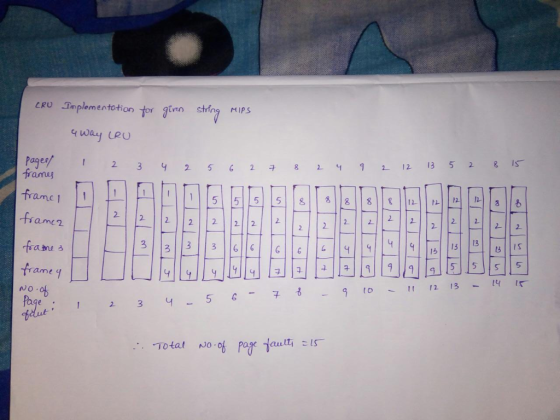
Code for implementation of this LRU MIPS
C language code
#include <stdio.h>
int findLRU(int time[],int n){
int i,min=time[0],pos = 0;
for(i=1;i<n;++i){
if (time[i]<min){
min=time[i];
pos=i;
}
}
return pos;
}
int main (){
int nf,np,frames[10],pages[30],counter=0,time[10],flag1,flag2,i,j,pos,faults=0;
printf ("enter num of frames");
scanf("%d",&nf);
printf("enter num of pages");
scanf("%d",&np);
printf ("enter the string");
for(i=0;i<np;++i)
scanf("%d",&pages[i]);
for(i=0;i<nf;++i)
frames[i]=-1;
for(i=0;i<np;++i){
flag1=flag2=0;
for(j=0;j<nf;++j){
if(frames[j]==pages[i]){
counter++;
time[j]=counter;
flag1=flag2 =1;
break;
}
}
if (flag1==0){
for(j=0;j<nf;++j){
if (frames[j]==-1){
counter++;
faults++;
frames[j]=pages[i];
time[j]=counter;
flag2=1;
break;
}
}
}
if (flag2 == 0){
pos=findLRU(time,nf);
counter++;
faults++;
frames[pos]=pages[i];
time[pos]=counter;
}
printf("\n");
for(j=0;j<nf;++j)
printf("%d\t",frames[j]);
}
}
printf("\n total number of page faults =%d",faults);
return 0;
}
MIPS (MARS CODE) Please covert this C++ code to MIPS code and leave comments on each...
MIPS (MARS CODE) Please covert this C++ code to MIPS code and leave comments on each line to what it does! int fib( int n ) { if ( n <= 1 ) return n; else return fib(n - 1 ) + fib( n - 2 ); }
Create a cache memory using mips in mars. The input of the simulator will be a file (or an array...
Create a cache memory using mips in mars. The input of the simulator will be a file (or an array) with integers that represent a sequence of accesses to memory blocks. Each number represents a block of memory. The output of the simulator will be the number of hits for each cache configuration as well as the number of instructions executed. The results must be presented with the sequence of memory blocks delivered. While you are implementing your cache, you...
MIPS 1(a): Using MARS (MIPS assembly simulator), write and debug a program with comments that will...
 MIPS 1(a): Using MARS (MIPS assembly simulator), write and debug a program with comments that will store words in a RAM array using the instruction sw and indirect addressing as specified in the data table below. Although the addresses and data are in given hexadecimal, your code will contain corresponding values in decimal. Use (268501056)_10 = (10010040)_16 as the base address of the array. Since the instruction sw and indirect addressing (using offsets) are needed to store the data in...
IN MIPS MACHINE LANGUAGE FOR MARS SIMULATOR Write your own short program that presents a RAW...
IN MIPS MACHINE LANGUAGE FOR MARS SIMULATOR Write your own short program that presents a RAW data dependence condition (2-5 instructions in MIPS that exhibits a data hazard). Document the hazard condition in your code comments.
For the following program code, write MIPS pipeline execution diagram (mark stall if there are hazards). 2 1 11 : D ← C...
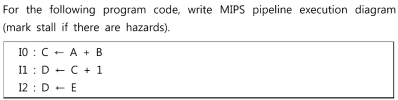 For the following program code, write MIPS pipeline execution diagram (mark stall if there are hazards). 2 1 11 : D ← C + 1 12 :D E
For the following program code, write MIPS pipeline execution diagram (mark stall if there are hazards). 2 1 11 : D ← C + 1 12 :D E
For the following program code, write MIPS pipeline execution diagram (mark stall if there are hazards). 2 1 11 : D ← C + 1 12 :D E
Objective Create a MIPS program in Mars to perform a sorting algorithm. Specification: 1) Download the...
Objective Create a MIPS program in Mars to perform a sorting algorithm. Specification: 1) Download the file Assign2.asm. Read it and make sure it can be compiled and executed in Mars. 2) Write code to finish all the tasks listed in Assign2.asm. In Assign2.asm, an array‘a’ of ‘n’=11 integers are given at the beginning (make sure do not change these integers): 43, -5, 11, 12, 64, -7, 14, 71, 70, 13, -27 The finished Assign2.asm should be filled with your...
CONVERT THE FOLLOWING FUNCTION IN MARS SIMULATOR (MIPS) This FUNCTION should be Runnable on MARS (MIPS...
CONVERT THE FOLLOWING FUNCTION IN MARS SIMULATOR (MIPS) This FUNCTION should be Runnable on MARS (MIPS Assembler and Runtime Simulator) IDE C FUNCTION WHICH NEEDS TO BE CONVERTED (ONLY USE MARS) void decrypt(int numberOfChar, int key, char * cipherText, char * plainText) { int j = 0; int i =0; int k = 0; int reverseOrderedKey[4]; int n =4; int c =0; int d =0; int orderedKey[4] = {0,0,0,0}; while(key) { reverseOrderedKey[k] = key %10; key /= 10; k++; }...
using MIPS MARS sort an array of n integers and print both the sorted and unsorted...
using MIPS MARS sort an array of n integers and print both the sorted and unsorted array. n should be greater than or equal to 10 and entered by the user. Reminder make sure to use MIPS MARS only
Least Recently Used (LRU) is the most favorable replacement policy for direct mapped caches in MIPS...
 Least Recently Used (LRU) is the most favorable replacement policy for direct mapped caches in MIPS architectures. True False L A Moving to another question will save this response. esc BO F2 FA # 3 $ % 5 2 4 6 w
using Mips assembly to work on Mars simulator write a program that outputs the maximum and...
using Mips assembly to work on Mars simulator write a program that outputs the maximum and minimum values of an entered array
 MIPS 1(a): Using MARS (MIPS assembly simulator), write and debug a program with comments that will store words in a RAM array using the instruction sw and indirect addressing as specified in the data table below. Although the addresses and data are in given hexadecimal, your code will contain corresponding values in decimal. Use (268501056)_10 = (10010040)_16 as the base address of the array. Since the instruction sw and indirect addressing (using offsets) are needed to store the data in...
 For the following program code, write MIPS pipeline execution diagram (mark stall if there are hazards). 2 1 11 : D ← C + 1 12 :D E
For the following program code, write MIPS pipeline execution diagram (mark stall if there are hazards). 2 1 11 : D ← C + 1 12 :D E
For the following program code, write MIPS pipeline execution diagram (mark stall if there are hazards). 2 1 11 : D ← C + 1 12 :D E
 Least Recently Used (LRU) is the most favorable replacement policy for direct mapped caches in MIPS architectures. True False L A Moving to another question will save this response. esc BO F2 FA # 3 $ % 5 2 4 6 w
Most questions answered within 3 hours.
-
Where is the error in this code sequence?
String s1 = "Hello";
String s2 = "ello";...
asked 11 months ago -
Financial data for Joel de Paris, Inc., for last year
follow:
Joel de Paris, Inc.
Balance...
asked 11 months ago -
Consider this reaction:
Al2(SO4)3 (aq)+ BaCl3
(aq) Al2Cl6 (aq)- +
3BaSO4(s) . What is the...
asked 11 months ago -
Suppose that Savneet is considering increasing her
recent random sample from 20 car rentals to 40...
asked 11 months ago -
Trucks arrive at an unloading terminal at an average rate of 120
per hour.
Trucks arrive...
asked 11 months ago -
Why are methanol and ethanol completely soluble in water while
octanol is not very little soluble....
asked 11 months ago -
A facilities manager at a university reads in a research report
that the mean amount of...
asked 11 months ago -
When the CuSO4 is rehydrated by adding water to the anhydrous
compound, is this an endothermic...
asked 11 months ago -
A ray of sunlight is passing from diamond into crown glass; the
angle of incidence is...
asked 11 months ago -
A block of mass 0.249 kg is placed on top of a light, vertical
spring of...
asked 11 months ago -
how do the kidneys compensate in the presences of acidosis
a) trigger hyperventilate
b) reserve acid...
asked 11 months ago -
Question 501 pts
The rental rate of capital to the firm increases. Which of the
following...
asked 11 months ago