
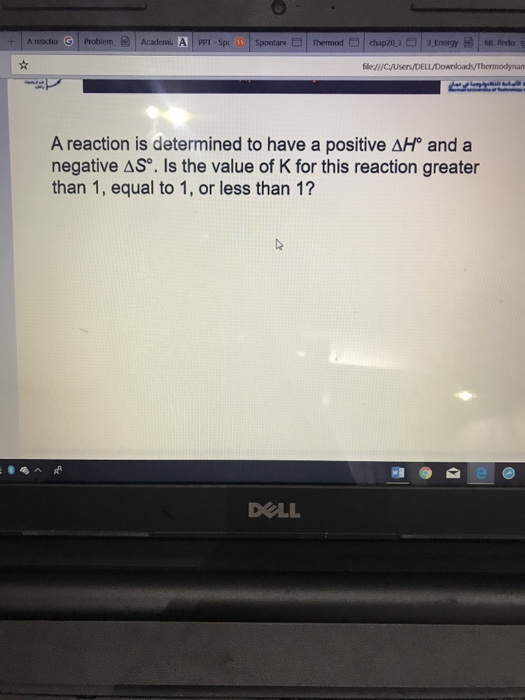
A reaclib filecl A reaction is determined to have a positive AH and a negative AS°. Is the value of K for this reaction greater than 1, equal to 1, or less than 1? DELL
Homework Answers
1st approach is determine delta G from Delta H and Delta S and then easily u will relate it from Delta G = - RTln(K)
As simple as that.
A spontaneous reaction will always occur when Delta H is negative and Delta S is positive
It's spontaneous so Delta G is less than zero so now u need to compare it with second equation
PLEASE PLEASE GIVE ME THE THUMB UP PLEASE ITS A REQUEST
Add Answer to:
how Pannotia formed and is there any fossil found in One mole of an ideal gas expanded isothermally at 298 K until its volume is tripled. Find the values of ASgas and ASotal under the follow...
1. a) One mole of an ideal gas at 298.15 K is expanded reversibly and isothermally...
1. a) One mole of an ideal gas at 298.15 K is expanded reversibly and isothermally from 1.0 L to 15 L. Determine the amount of work in Joules. b) Determine the work done in Joules when one mole of ideal gas is expanded irreversibly from 1.0 L to 15.0 L against a constant external pressure of 1.0 atm.
0.780 mol of an ideal gas, at 51.01 °C, is expanded isothermally from 1.94 L to...
0.780 mol of an ideal gas, at 51.01 °C, is expanded isothermally from 1.94 L to 3.14 L. 1. What is the initial pressure of the gas, in atm? 1.07×101 atm You are correct. 2. What is the final pressure of the gas, in atm? 3. How much work is done on the gas, (in J), if the expansion is carried out in two steps by changing the volume irreversibly from 1.94 L to 3.14 L against a constant pressure...
A sample of 70 mmol Kr(g) expands reversibly and isothermally at 373 K from 5.25 cm^3...
A sample of 70 mmol Kr(g) expands reversibly and isothermally at 373 K from 5.25 cm^3 to 6.29 cm^3, and the internal energy of the sample is known to increase by 83.5 J. For a given expansion, do you expect the heat absorbed by a real gas to be greater than or less than the heat absorbed by an ideal? Explain your answer. Use the virial equation of state up to the second coefficient B = -28.7 cm^3 mol-1 to...
An ideal gas is allowed to expand isothermally until it reaches its final volume. It is...
 An ideal gas is allowed to expand isothermally until it reaches its final volume. It is then heated at constant volume until it reaches its final pressure. The initial state of the gas is P1 = 2.93 atm, V1 = 1.00 L, and Eint 1 = 414 J, and its final state has volume V2 = 2.93 L and Eint 2 = 951 J. 1) Calculate the work done by the gas. Be careful with signs: if the work you...
One mole of an ideal monoatomic gas is initially at 300 K and 5 bar of...
One mole of an ideal monoatomic gas is initially at 300 K and 5 bar of pressure inside a cylinder with a frictionless piston. a) The cylinder is kept in a heat bath and the gas is allowed to expand under 1 bar of external pressure. Calculate the work and heat associated with this process. b) Calculate the change in enthalpy for isothermal expansion at constant pressure. c) Alternatively, the gas is allowed to expand isothermally under near-equilibrium conditions. Calculate...
answer asap please 2. (25 pts) One mole of a monoatomic ideal gas is initially at state i (P isobanic 150 kPa V-10.0L) and it is being expanded to 2.5 times its original volume along two different pro...
 answer asap please
2. (25 pts) One mole of a monoatomic ideal gas is initially at state i (P isobanic 150 kPa V-10.0L) and it is being expanded to 2.5 times its original volume along two different processes: £ d. #l isobaric and #2 isothermal. sothermal a) What are the final temperatures at the two different final states fi and fi? b) What is the amount of heat (Qi and ) absorbed by the gas in the two different processes?...
answer asap please
2. (25 pts) One mole of a monoatomic ideal gas is initially at state i (P isobanic 150 kPa V-10.0L) and it is being expanded to 2.5 times its original volume along two different processes: £ d. #l isobaric and #2 isothermal. sothermal a) What are the final temperatures at the two different final states fi and fi? b) What is the amount of heat (Qi and ) absorbed by the gas in the two different processes?...
just one example/demonstration! Data needed to be calculated is in highlighted in green boxes. And I...
 just one example/demonstration!
Data needed to be calculated is in highlighted in green boxes.
And I highlighted in red an equation (not sure if thats what you
use to calculate it) And ignore the lab instructions on completeing
a graph!! I already know how to do that in excel, just curious how
Ln (relative rate) and 1/T in K^-1 is calculated by hand*
here is the rest of that lab leading up to the question as I
know its typically...
just one example/demonstration!
Data needed to be calculated is in highlighted in green boxes.
And I highlighted in red an equation (not sure if thats what you
use to calculate it) And ignore the lab instructions on completeing
a graph!! I already know how to do that in excel, just curious how
Ln (relative rate) and 1/T in K^-1 is calculated by hand*
here is the rest of that lab leading up to the question as I
know its typically...
 An ideal gas is allowed to expand isothermally until it reaches its final volume. It is then heated at constant volume until it reaches its final pressure. The initial state of the gas is P1 = 2.93 atm, V1 = 1.00 L, and Eint 1 = 414 J, and its final state has volume V2 = 2.93 L and Eint 2 = 951 J. 1) Calculate the work done by the gas. Be careful with signs: if the work you...
 answer asap please
2. (25 pts) One mole of a monoatomic ideal gas is initially at state i (P isobanic 150 kPa V-10.0L) and it is being expanded to 2.5 times its original volume along two different processes: £ d. #l isobaric and #2 isothermal. sothermal a) What are the final temperatures at the two different final states fi and fi? b) What is the amount of heat (Qi and ) absorbed by the gas in the two different processes?...
answer asap please
2. (25 pts) One mole of a monoatomic ideal gas is initially at state i (P isobanic 150 kPa V-10.0L) and it is being expanded to 2.5 times its original volume along two different processes: £ d. #l isobaric and #2 isothermal. sothermal a) What are the final temperatures at the two different final states fi and fi? b) What is the amount of heat (Qi and ) absorbed by the gas in the two different processes?...
 just one example/demonstration!
Data needed to be calculated is in highlighted in green boxes.
And I highlighted in red an equation (not sure if thats what you
use to calculate it) And ignore the lab instructions on completeing
a graph!! I already know how to do that in excel, just curious how
Ln (relative rate) and 1/T in K^-1 is calculated by hand*
here is the rest of that lab leading up to the question as I
know its typically...
just one example/demonstration!
Data needed to be calculated is in highlighted in green boxes.
And I highlighted in red an equation (not sure if thats what you
use to calculate it) And ignore the lab instructions on completeing
a graph!! I already know how to do that in excel, just curious how
Ln (relative rate) and 1/T in K^-1 is calculated by hand*
here is the rest of that lab leading up to the question as I
know its typically...
Most questions answered within 3 hours.
-
Where is the error in this code sequence?
String s1 = "Hello";
String s2 = "ello";...
asked 11 months ago -
Financial data for Joel de Paris, Inc., for last year
follow:
Joel de Paris, Inc.
Balance...
asked 11 months ago -
Consider this reaction:
Al2(SO4)3 (aq)+ BaCl3
(aq) Al2Cl6 (aq)- +
3BaSO4(s) . What is the...
asked 11 months ago -
Suppose that Savneet is considering increasing her
recent random sample from 20 car rentals to 40...
asked 11 months ago -
Trucks arrive at an unloading terminal at an average rate of 120
per hour.
Trucks arrive...
asked 11 months ago -
Why are methanol and ethanol completely soluble in water while
octanol is not very little soluble....
asked 11 months ago -
A facilities manager at a university reads in a research report
that the mean amount of...
asked 11 months ago -
When the CuSO4 is rehydrated by adding water to the anhydrous
compound, is this an endothermic...
asked 11 months ago -
A ray of sunlight is passing from diamond into crown glass; the
angle of incidence is...
asked 11 months ago -
A block of mass 0.249 kg is placed on top of a light, vertical
spring of...
asked 11 months ago -
how do the kidneys compensate in the presences of acidosis
a) trigger hyperventilate
b) reserve acid...
asked 11 months ago -
Question 501 pts
The rental rate of capital to the firm increases. Which of the
following...
asked 11 months ago