Golden ratio method is recommended by the solution and the numerical solution is 4.493335656115932 (or anything accurate up to 2 dp)
Homework Answers


For maxima f'(x) must be zero.
![\small x\cos x - \sin x = 0\; \; \; \; \; \; ;\; \; \; \; \; x\epsilon [4,5]](http://img.homeworklib.com/images/5e806e6b-c03d-4b1b-b507-3caa15fb4dec.latex?%5Cdpi%7B100%7D%20%5Csmall%20x%5Ccos%20x%20-%20%5Csin%20x%20%3D%200%5C%3B%20%5C%3B%20%5C%3B%20%5C%3B%20%5C%3B%20%5C%3B%20%3B%5C%3B%20%5C%3B%20%5C%3B%20%5C%3B%20%5C%3B%20x%5Cepsilon%20%5B4%2C5%5D?x-oss-process=image/resize,w_560)
Let us use the bisection method, (I'm using f(x) instead of f '(x) from here on)


Proceeding further will guide you to the exact value of the answer. You can also use other numerical techniques.
***************************************************************************************************************************************
By plotting the function f '(x) also one can find the solution
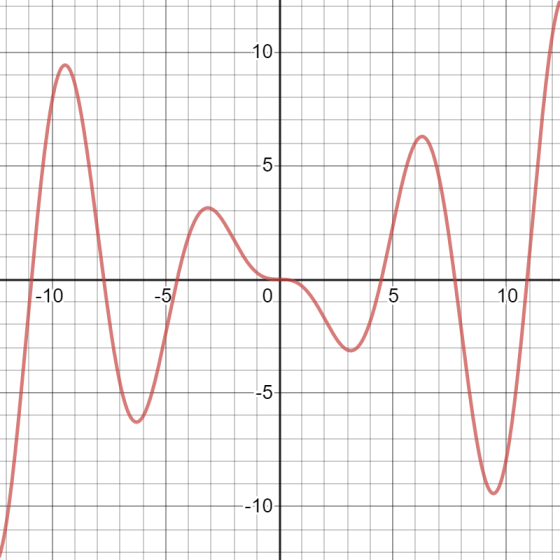
above is the graphical representation of f '(x)
Add Answer to:
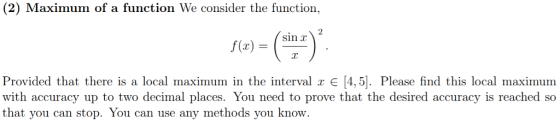
Golden ratio method is recommended by the solution and the numerical solution is 4.493335656115932 (or anything accurate up to 2 dp) (2) Maximum of a function We consider the function, f(x) = ( Sinar...
1. If a function f(x,y) has a local maximum then it is not necessary that it...
 1. If a function f(x,y) has a local maximum then it is not necessary that it has also a local minimum True False 2. If a vector field F is conservative then we can not find a potential functions. True False 3. Suppose that P and Q have continuous first-order partial derivatives on a domain D and consider the vector field F = Pi+Qj. Then F is conservative if op 80 True False 4. If D is a rectangle, then...
1. (a) We need to calculate accurate values of the function for very large values of x. However, it is found that ju...
 1. (a) We need to calculate accurate values of the function for very large values of x. However, it is found that just programming this formula into a computer gives very poor accuracy for large x Explain why this happens, and show how to re-write the function so that it can be used reliably, even when x is large. [6 points] (b) In diffraction theory, it is sometimes necessary to evaluate the function sin θ f(x) for small to moderate...
2. Consider the function f : R2 → R2 given by. (x,y) (a) Compute the Df(x, y) (b) List every vect...
 2. Consider the function f : R2 → R2 given by. (x,y) (a) Compute the Df(x, y) (b) List every vector r e R2 such that Df(ri, r2) 0. What can we say about the tangent plane to the surface of the graph at (ri,2,f(r1, r2))? (c) How do you know that the Hessian, Df(x, y) is necessarily symmetric? Recall that t,y D2 f(x,y) , y) (d) What are the eigenva of D2f(r1,r2) for each root of the gradient that...
Question 8 (6 marks) Consider the function f: [-2, 2] shown in the diagram. R whose...
 Question 8 (6 marks) Consider the function f: [-2, 2] shown in the diagram. R whose graph is (a) State the largest intervals on which f is injective f(z) (b) For each interval I you found in (a), sketch the graph of the inverse g of the restriction of f to I and state the domain and range of g (c) If we know that f(-x) = f(x) for all r e dom(f), what can we conclude about the relationship...
Consider the function f(x)=x22−9. (1 point) Consider the function f(x) = 9. 2 In this problem...
 Consider the function
f(x)=x22−9.
(1 point) Consider the function f(x) = 9. 2 In this problem you will calculate " ( - ) dx by using the definition Lira f(x) dx = lim f(x;)Ar i=1 The summation inside the brackets is R, which is the Riemann sum where the sample points are chosen to be the right-hand endpoints of each sub- interval. r2 Calculate R, for f(x) = -9 on the interval [0, 3] and write your answer as a...
Consider the function
f(x)=x22−9.
(1 point) Consider the function f(x) = 9. 2 In this problem you will calculate " ( - ) dx by using the definition Lira f(x) dx = lim f(x;)Ar i=1 The summation inside the brackets is R, which is the Riemann sum where the sample points are chosen to be the right-hand endpoints of each sub- interval. r2 Calculate R, for f(x) = -9 on the interval [0, 3] and write your answer as a...
3. Consider the following piecewise function (a) Draw an accurate graph of f(). (b) As always, f(...
 3. Consider the following piecewise function (a) Draw an accurate graph of f(). (b) As always, f(x), has an infinite number of antiderivatives. Consider an antiderivative F(r). Let us assume that F(r) is continuous (we don't usually have to specify this, but you will see in the bonus part of the question why we do in this case). Let us further assume that F(2) 1. Sketch an accurate graph of F(r). MATH 1203 Assignment #7-Integration Methods Due: Thurs., Apr. 4...
Consider the following graph of f(x) on the closed interval (0,5): 5 4 3 2 1...
 Consider the following graph of f(x) on the closed interval (0,5): 5 4 3 2 1 0 -1 0 1 2 3 5 6 (If the picture doesn't load, click here 95graph2) Use the graph of f(x) to answer the following: (a) On what interval(s) is f(x) increasing? (b) On what interval(s) is f(x) decreasing? (c) On what interval(s) is f(x) concave up? (d) On what interval(s) is f(x) concave down? (e) Where are the inflection points (both x and...
Question For this problem, consider the function y=f(x)= |x| + x 3 on the domain of...
 Question For this problem, consider the function
y=f(x)=
|x|
+
x
3
on the domain of all real numbers.
(a) The value of
limx→
∞f(x)
is
. (If you need to use -∞ or ∞, enter -infinity or
infinity.)
(b) The value of
limx→
−∞f(x)
is
. (If you need to use -∞ or ∞, enter -infinity or
infinity.)
(c) There are two x-intercepts; list these in increasing
order: s=
, t=
.
(d) The intercepts in part (c) divide...
Question For this problem, consider the function
y=f(x)=
|x|
+
x
3
on the domain of all real numbers.
(a) The value of
limx→
∞f(x)
is
. (If you need to use -∞ or ∞, enter -infinity or
infinity.)
(b) The value of
limx→
−∞f(x)
is
. (If you need to use -∞ or ∞, enter -infinity or
infinity.)
(c) There are two x-intercepts; list these in increasing
order: s=
, t=
.
(d) The intercepts in part (c) divide...
2. (a) We want to find the root x of the function f(x); that is, we need f(r) = 0 . This can be done using Newton...
 2. (a) We want to find the root x of the function f(x); that is, we need f(r) = 0 . This can be done using Newton's method, making use of the iterative formula f(xn) Show that the sequence ofiterates (%) converges quadratically if f'(x) 0 in some appropriate interval of x-values near the root χ 9 point b) We can get Newton's method to find the k-th root of some number a by making it solve the non-linear cquation...
We do not have the methods of integrating certain functions, such as 2π 1 sin (x) dr So we will approximate this value. (1) Sketch the graph of y -1 sin( (2) Break up the interval [0, 2T] into 8...
 We do not have the methods of integrating certain functions, such as 2π 1 sin (x) dr So we will approximate this value. (1) Sketch the graph of y -1 sin( (2) Break up the interval [0, 2T] into 8 pieces (3) Connect the points to form 8 trapezoids. (4) Find the value of the function V1 +sin (x) at each of the 9 points, using a calculator as necessary. (5) Find the area of each trapezoid, add them up....
 1. If a function f(x,y) has a local maximum then it is not necessary that it has also a local minimum True False 2. If a vector field F is conservative then we can not find a potential functions. True False 3. Suppose that P and Q have continuous first-order partial derivatives on a domain D and consider the vector field F = Pi+Qj. Then F is conservative if op 80 True False 4. If D is a rectangle, then...
 1. (a) We need to calculate accurate values of the function for very large values of x. However, it is found that just programming this formula into a computer gives very poor accuracy for large x Explain why this happens, and show how to re-write the function so that it can be used reliably, even when x is large. [6 points] (b) In diffraction theory, it is sometimes necessary to evaluate the function sin θ f(x) for small to moderate...
 2. Consider the function f : R2 → R2 given by. (x,y) (a) Compute the Df(x, y) (b) List every vector r e R2 such that Df(ri, r2) 0. What can we say about the tangent plane to the surface of the graph at (ri,2,f(r1, r2))? (c) How do you know that the Hessian, Df(x, y) is necessarily symmetric? Recall that t,y D2 f(x,y) , y) (d) What are the eigenva of D2f(r1,r2) for each root of the gradient that...
 Question 8 (6 marks) Consider the function f: [-2, 2] shown in the diagram. R whose graph is (a) State the largest intervals on which f is injective f(z) (b) For each interval I you found in (a), sketch the graph of the inverse g of the restriction of f to I and state the domain and range of g (c) If we know that f(-x) = f(x) for all r e dom(f), what can we conclude about the relationship...
 Consider the function
f(x)=x22−9.
(1 point) Consider the function f(x) = 9. 2 In this problem you will calculate " ( - ) dx by using the definition Lira f(x) dx = lim f(x;)Ar i=1 The summation inside the brackets is R, which is the Riemann sum where the sample points are chosen to be the right-hand endpoints of each sub- interval. r2 Calculate R, for f(x) = -9 on the interval [0, 3] and write your answer as a...
Consider the function
f(x)=x22−9.
(1 point) Consider the function f(x) = 9. 2 In this problem you will calculate " ( - ) dx by using the definition Lira f(x) dx = lim f(x;)Ar i=1 The summation inside the brackets is R, which is the Riemann sum where the sample points are chosen to be the right-hand endpoints of each sub- interval. r2 Calculate R, for f(x) = -9 on the interval [0, 3] and write your answer as a...
 3. Consider the following piecewise function (a) Draw an accurate graph of f(). (b) As always, f(x), has an infinite number of antiderivatives. Consider an antiderivative F(r). Let us assume that F(r) is continuous (we don't usually have to specify this, but you will see in the bonus part of the question why we do in this case). Let us further assume that F(2) 1. Sketch an accurate graph of F(r). MATH 1203 Assignment #7-Integration Methods Due: Thurs., Apr. 4...
 Consider the following graph of f(x) on the closed interval (0,5): 5 4 3 2 1 0 -1 0 1 2 3 5 6 (If the picture doesn't load, click here 95graph2) Use the graph of f(x) to answer the following: (a) On what interval(s) is f(x) increasing? (b) On what interval(s) is f(x) decreasing? (c) On what interval(s) is f(x) concave up? (d) On what interval(s) is f(x) concave down? (e) Where are the inflection points (both x and...
 Question For this problem, consider the function
y=f(x)=
|x|
+
x
3
on the domain of all real numbers.
(a) The value of
limx→
∞f(x)
is
. (If you need to use -∞ or ∞, enter -infinity or
infinity.)
(b) The value of
limx→
−∞f(x)
is
. (If you need to use -∞ or ∞, enter -infinity or
infinity.)
(c) There are two x-intercepts; list these in increasing
order: s=
, t=
.
(d) The intercepts in part (c) divide...
Question For this problem, consider the function
y=f(x)=
|x|
+
x
3
on the domain of all real numbers.
(a) The value of
limx→
∞f(x)
is
. (If you need to use -∞ or ∞, enter -infinity or
infinity.)
(b) The value of
limx→
−∞f(x)
is
. (If you need to use -∞ or ∞, enter -infinity or
infinity.)
(c) There are two x-intercepts; list these in increasing
order: s=
, t=
.
(d) The intercepts in part (c) divide...
 2. (a) We want to find the root x of the function f(x); that is, we need f(r) = 0 . This can be done using Newton's method, making use of the iterative formula f(xn) Show that the sequence ofiterates (%) converges quadratically if f'(x) 0 in some appropriate interval of x-values near the root χ 9 point b) We can get Newton's method to find the k-th root of some number a by making it solve the non-linear cquation...
 We do not have the methods of integrating certain functions, such as 2π 1 sin (x) dr So we will approximate this value. (1) Sketch the graph of y -1 sin( (2) Break up the interval [0, 2T] into 8 pieces (3) Connect the points to form 8 trapezoids. (4) Find the value of the function V1 +sin (x) at each of the 9 points, using a calculator as necessary. (5) Find the area of each trapezoid, add them up....
Most questions answered within 3 hours.
-
Where is the error in this code sequence?
String s1 = "Hello";
String s2 = "ello";...
asked 10 months ago -
Financial data for Joel de Paris, Inc., for last year
follow:
Joel de Paris, Inc.
Balance...
asked 10 months ago -
Consider this reaction:
Al2(SO4)3 (aq)+ BaCl3
(aq) Al2Cl6 (aq)- +
3BaSO4(s) . What is the...
asked 10 months ago -
Suppose that Savneet is considering increasing her
recent random sample from 20 car rentals to 40...
asked 10 months ago -
Trucks arrive at an unloading terminal at an average rate of 120
per hour.
Trucks arrive...
asked 10 months ago -
Why are methanol and ethanol completely soluble in water while
octanol is not very little soluble....
asked 10 months ago -
A facilities manager at a university reads in a research report
that the mean amount of...
asked 10 months ago -
When the CuSO4 is rehydrated by adding water to the anhydrous
compound, is this an endothermic...
asked 10 months ago -
A ray of sunlight is passing from diamond into crown glass; the
angle of incidence is...
asked 10 months ago -
A block of mass 0.249 kg is placed on top of a light, vertical
spring of...
asked 10 months ago -
how do the kidneys compensate in the presences of acidosis
a) trigger hyperventilate
b) reserve acid...
asked 10 months ago -
Question 501 pts
The rental rate of capital to the firm increases. Which of the
following...
asked 10 months ago