
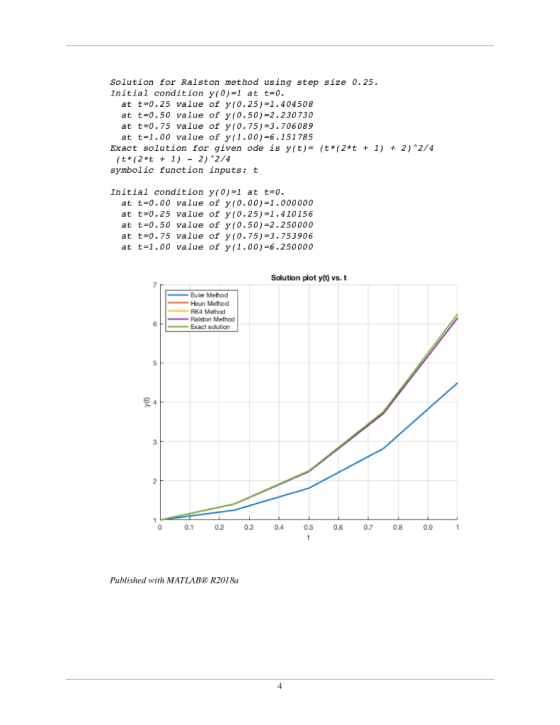
Display all methods listed below in ONE GRAPH:
1. Analytical method
2. Euler's method
3. Heun's method without iteration
4. Ralston's method
5. Fourth-order RK method
Metlab preferred
Homework Answers
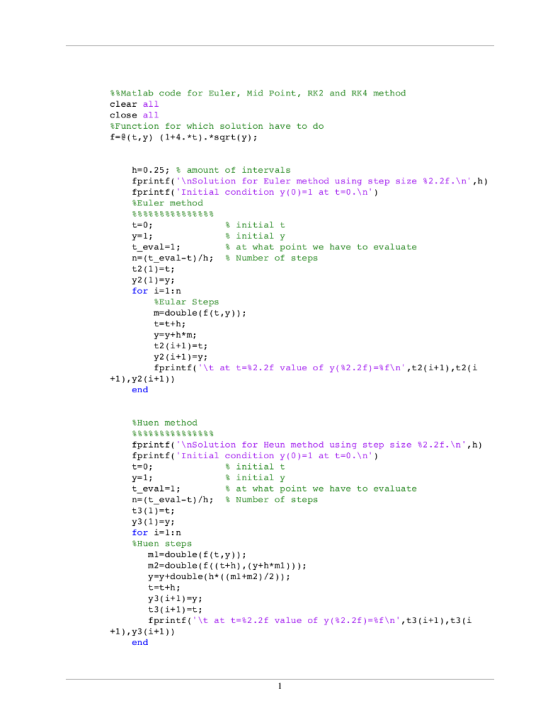
%%Matlab code for Euler, Mid Point, RK2 and RK4 method
clear all
close all
%Function for which solution have to do
f=@(t,y) (1+4.*t).*sqrt(y);
h=0.25; % amount of intervals
fprintf('\nSolution for Euler method using step
size %2.2f.\n',h)
fprintf('Initial condition y(0)=1 at
t=0.\n')
%Euler method
%%%%%%%%%%%%%%%
t=0;
% initial t
y=1;
% initial y
t_eval=1; % at what point
we have to evaluate
n=(t_eval-t)/h; % Number of steps
t2(1)=t;
y2(1)=y;
for i=1:n
%Eular Steps
m=double(f(t,y));
t=t+h;
y=y+h*m;
t2(i+1)=t;
y2(i+1)=y;
fprintf('\t at t=%2.2f
value of y(%2.2f)=%f\n',t2(i+1),t2(i+1),y2(i+1))
end
%Huen method
%%%%%%%%%%%%%%%
fprintf('\nSolution for Heun method using step
size %2.2f.\n',h)
fprintf('Initial condition y(0)=1 at
t=0.\n')
t=0;
% initial t
y=1;
% initial y
t_eval=1; % at what point
we have to evaluate
n=(t_eval-t)/h; % Number of steps
t3(1)=t;
y3(1)=y;
for i=1:n
%Huen steps
m1=double(f(t,y));
m2=double(f((t+h),(y+h*m1)));
y=y+double(h*((m1+m2)/2));
t=t+h;
y3(i+1)=y;
t3(i+1)=t;
fprintf('\t at t=%2.2f value
of y(%2.2f)=%f\n',t3(i+1),t3(i+1),y3(i+1))
end
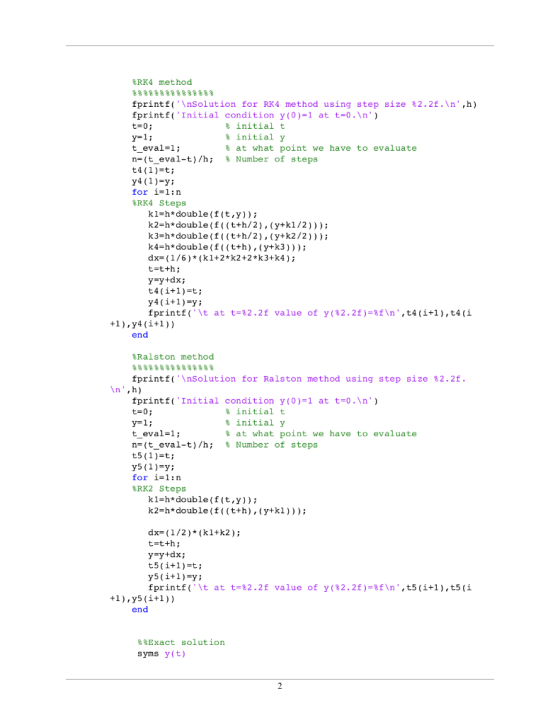
%RK4 method
%%%%%%%%%%%%%%%
fprintf('\nSolution for RK4 method using step
size %2.2f.\n',h)
fprintf('Initial condition y(0)=1 at
t=0.\n')
t=0;
% initial t
y=1;
% initial y
t_eval=1; % at what point
we have to evaluate
n=(t_eval-t)/h; % Number of steps
t4(1)=t;
y4(1)=y;
for i=1:n
%RK4 Steps
k1=h*double(f(t,y));
k2=h*double(f((t+h/2),(y+k1/2)));
k3=h*double(f((t+h/2),(y+k2/2)));
k4=h*double(f((t+h),(y+k3)));
dx=(1/6)*(k1+2*k2+2*k3+k4);
t=t+h;
y=y+dx;
t4(i+1)=t;
y4(i+1)=y;
fprintf('\t at t=%2.2f value
of y(%2.2f)=%f\n',t4(i+1),t4(i+1),y4(i+1))
end
%Ralston method
%%%%%%%%%%%%%%%
fprintf('\nSolution for Ralston method using
step size %2.2f.\n',h)
fprintf('Initial condition y(0)=1 at
t=0.\n')
t=0;
% initial t
y=1;
% initial y
t_eval=1; % at what point
we have to evaluate
n=(t_eval-t)/h; % Number of steps
t5(1)=t;
y5(1)=y;
for i=1:n
%RK2 Steps
k1=h*double(f(t,y));
k2=h*double(f((t+h),(y+k1)));
dx=(1/2)*(k1+k2);
t=t+h;
y=y+dx;
t5(i+1)=t;
y5(i+1)=y;
fprintf('\t at t=%2.2f value
of y(%2.2f)=%f\n',t5(i+1),t5(i+1),y5(i+1))
end
%%Exact solution
syms y(t)
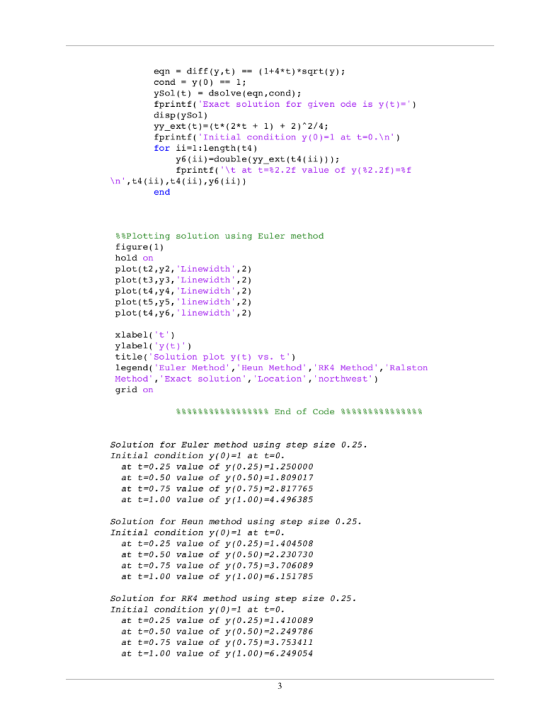
eqn = diff(y,t) ==
(1+4*t)*sqrt(y);
cond = y(0) == 1;
ySol(t) =
dsolve(eqn,cond);
fprintf('Exact solution
for given ode is y(t)=')
disp(ySol)
yy_ext(t)=(t*(2*t + 1) +
2)^2/4;
fprintf('Initial
condition y(0)=1 at t=0.\n')
for
ii=1:length(t4)
y6(ii)=double(yy_ext(t4(ii)));
fprintf('\t at t=%2.2f value of
y(%2.2f)=%f\n',t4(ii),t4(ii),y6(ii))
end
%%Plotting solution using Euler method
figure(1)
hold on
plot(t2,y2,'Linewidth',2)
plot(t3,y3,'Linewidth',2)
plot(t4,y4,'Linewidth',2)
plot(t5,y5,'linewidth',2)
plot(t4,y6,'linewidth',2)
xlabel('t')
ylabel('y(t)')
title('Solution plot y(t) vs. t')
legend('Euler Method','Heun Method','RK4 Method','Ralston
Method','Exact solution','Location','northwest')
grid on
%%%%%%%%%%%%%%%%% End of Code %%%%%%%%%%%%%%%
Add Answer to:
Display all methods listed below in ONE GRAPH: 1. Analytical method 2. Euler's method 3. Heun's method without iteration 4. Ralston's method 5. Fourth-order RK method Metlab preferred Sol...
I want Matlab code. 22.2 Solve the following problem over the interval from x = 0 to 1 using a step size of 0.25 whe...
 I want Matlab code.
22.2 Solve the following problem over the interval from x = 0 to 1 using a step size of 0.25 where y(0)-1. Display all your results on the same graph. r dV = (1 + 4x) (a) Analytically. (b) Using Euler's method. (c) Using Heun's method without iteration. (d) Using Ralston's method. (e) Using the fourth-order RK method.
22.2 Solve the following problem over the interval from x = 0 to 1 using a step size...
I want Matlab code.
22.2 Solve the following problem over the interval from x = 0 to 1 using a step size of 0.25 where y(0)-1. Display all your results on the same graph. r dV = (1 + 4x) (a) Analytically. (b) Using Euler's method. (c) Using Heun's method without iteration. (d) Using Ralston's method. (e) Using the fourth-order RK method.
22.2 Solve the following problem over the interval from x = 0 to 1 using a step size...
show all step please ((NOT in MATLAB)) except part d Ralston's method 22.2 Solve the following...
 show all step please ((NOT in MATLAB))
except part d
Ralston's method
22.2 Solve the following problem over the interval from x = 0 to 1 using a step size of 0.25 where y(0) = 1. Display all your results on the same graph. Bolo dy bolo moto = (1 + 2x)VÝ Viena no woliszt unigas og tog (a) Analytically. sanoi solist og (b) Using Euler's method. (c) Using Heun's method without iteration. (d) Using Ralston's method. (e) Using the...
show all step please ((NOT in MATLAB))
except part d
Ralston's method
22.2 Solve the following problem over the interval from x = 0 to 1 using a step size of 0.25 where y(0) = 1. Display all your results on the same graph. Bolo dy bolo moto = (1 + 2x)VÝ Viena no woliszt unigas og tog (a) Analytically. sanoi solist og (b) Using Euler's method. (c) Using Heun's method without iteration. (d) Using Ralston's method. (e) Using the...
Solve using MATLAB code 22.2 Solve the following problem over the interval from 0 to 1...
 Solve using MATLAB code
22.2 Solve the following problem over the interval from 0 to 1 using a step size of 0.25 where y(0) 1. Display all your results on the same graph. dy dx (a) Analytically (b) Using Euler's method. (c) Using Heun's method without iteration. (d) Using Ralston's method. (e) Using the fourth-order RK method. Note that using the midpoint method instead of Ralston's method in d). You can use my codes as reference.
Solve using MATLAB code
22.2 Solve the following problem over the interval from 0 to 1 using a step size of 0.25 where y(0) 1. Display all your results on the same graph. dy dx (a) Analytically (b) Using Euler's method. (c) Using Heun's method without iteration. (d) Using Ralston's method. (e) Using the fourth-order RK method. Note that using the midpoint method instead of Ralston's method in d). You can use my codes as reference.
Q2 Using Fourth-order RK method, solve the following initial value problem over the interval from t...
 Q2 Using Fourth-order RK method, solve the following initial value problem over the interval from t = 0 to 1. Take the initial condition of y(0) = 1 and a step size (h)=0.5. dy = f(t, y) = y t- 1.1 y dt
1.Solve the following problem over the interval from t 0 to 1 using a step size of 0.25 where y(0...
 1.Solve the following problem over the interval from t 0 to 1 using a step size of 0.25 where y(0) . Display your results on the same graph. dy dt (1 +4t)vy (a) Euler's method. (b) Ralston's method.
1.Solve the following problem over the interval from t 0 to 1 using a step size of 0.25 where y(0) . Display your results on the same graph. dy dt (1 +4t)vy (a) Euler's method. (b) Ralston's method.
1.Solve the following problem over the interval from t 0 to 1 using a step size of 0.25 where y(0) . Display your results on the same graph. dy dt (1 +4t)vy (a) Euler's method. (b) Ralston's method.
PROBLEMS 22.1 Solve the following initial value problem over the interval from 0to2 where yo) 1.Display all your results on the same graph. dy=vr2-1.ly dt (a) Analytically. (b) Using Euler'...
 PROBLEMS 22.1 Solve the following initial value problem over the interval from 0to2 where yo) 1.Display all your results on the same graph. dy=vr2-1.ly dt (a) Analytically. (b) Using Euler's method with h 0.5 and 0.25. (c) Using the midpoint method with h 0.5 (d) Using the fourth-order RK method with h 0.5.
PROBLEMS 22.1 Solve the following initial value problem over the interval from 0to2 where yo) 1.Display all your results on the same graph. dy=vr2-1.ly dt (a) Analytically....
PROBLEMS 22.1 Solve the following initial value problem over the interval from 0to2 where yo) 1.Display all your results on the same graph. dy=vr2-1.ly dt (a) Analytically. (b) Using Euler's method with h 0.5 and 0.25. (c) Using the midpoint method with h 0.5 (d) Using the fourth-order RK method with h 0.5.
PROBLEMS 22.1 Solve the following initial value problem over the interval from 0to2 where yo) 1.Display all your results on the same graph. dy=vr2-1.ly dt (a) Analytically....
(20 pts) 4. Solve the differential equation dy = yt? - 1.17 dt over the time...
 (20 pts) 4. Solve the differential equation dy = yt? - 1.17 dt over the time interval of [O, 1.5) with the step size of 0.5 and y(0=1. 1) Obtain the analytical result. 2) Use Euler's method. 3. Use Heun's method with iterating the corrector. Do two iterations in the corrector step.
O Solve the following initial value problems with your VBA code over the interval from t 0 to 2 w...
 I need the visual basic code that is supposed to be typed
through excel
o Solve the following initial value problems with your VBA code over the interval from t 0 to 2 where y(0)1. o Graph the results from each solution method on the same graph. Analytically Euler's method with h 0.5 and h 0.25 Huen's method with h 0.5 and h 0.25 Fourth-order RK with h 0.5
o Solve the following initial value problems with your VBA code...
I need the visual basic code that is supposed to be typed
through excel
o Solve the following initial value problems with your VBA code over the interval from t 0 to 2 where y(0)1. o Graph the results from each solution method on the same graph. Analytically Euler's method with h 0.5 and h 0.25 Huen's method with h 0.5 and h 0.25 Fourth-order RK with h 0.5
o Solve the following initial value problems with your VBA code...
Problem 3. Given the initial conditions, y(0) from t- 0 to 4: and y (0 0, solve the following initial-value problem...
 Problem 3. Given the initial conditions, y(0) from t- 0 to 4: and y (0 0, solve the following initial-value problem d2 dt Obtain your solution with (a) Euler's method and (b) the fourth-order RK method. In both cases, use a step size of 0.1. Plot both solutions on the same graph along with the exact solution y- cos(3t). Note: show the hand calculations for t-0.1 and 0.2, for remaining work use the MATLAB files provided in the lectures
Problem...
Problem 3. Given the initial conditions, y(0) from t- 0 to 4: and y (0 0, solve the following initial-value problem d2 dt Obtain your solution with (a) Euler's method and (b) the fourth-order RK method. In both cases, use a step size of 0.1. Plot both solutions on the same graph along with the exact solution y- cos(3t). Note: show the hand calculations for t-0.1 and 0.2, for remaining work use the MATLAB files provided in the lectures
Problem...
Problem 2. Solve the following pair of ODEs over the interval from 0 to 0.4 using...
 Problem 2. Solve the following pair of ODEs over the interval from 0 to 0.4 using a step size of 0.1. The initial conditions are (0)-2 and (0) 4. Obtain your solution with (a) Euler's method and (b) the fourth-order RK method. Display your results as a plot. dy =-2y+Sze dt dz dt 2
 I want Matlab code.
22.2 Solve the following problem over the interval from x = 0 to 1 using a step size of 0.25 where y(0)-1. Display all your results on the same graph. r dV = (1 + 4x) (a) Analytically. (b) Using Euler's method. (c) Using Heun's method without iteration. (d) Using Ralston's method. (e) Using the fourth-order RK method.
22.2 Solve the following problem over the interval from x = 0 to 1 using a step size...
I want Matlab code.
22.2 Solve the following problem over the interval from x = 0 to 1 using a step size of 0.25 where y(0)-1. Display all your results on the same graph. r dV = (1 + 4x) (a) Analytically. (b) Using Euler's method. (c) Using Heun's method without iteration. (d) Using Ralston's method. (e) Using the fourth-order RK method.
22.2 Solve the following problem over the interval from x = 0 to 1 using a step size...
 show all step please ((NOT in MATLAB))
except part d
Ralston's method
22.2 Solve the following problem over the interval from x = 0 to 1 using a step size of 0.25 where y(0) = 1. Display all your results on the same graph. Bolo dy bolo moto = (1 + 2x)VÝ Viena no woliszt unigas og tog (a) Analytically. sanoi solist og (b) Using Euler's method. (c) Using Heun's method without iteration. (d) Using Ralston's method. (e) Using the...
show all step please ((NOT in MATLAB))
except part d
Ralston's method
22.2 Solve the following problem over the interval from x = 0 to 1 using a step size of 0.25 where y(0) = 1. Display all your results on the same graph. Bolo dy bolo moto = (1 + 2x)VÝ Viena no woliszt unigas og tog (a) Analytically. sanoi solist og (b) Using Euler's method. (c) Using Heun's method without iteration. (d) Using Ralston's method. (e) Using the...
 Solve using MATLAB code
22.2 Solve the following problem over the interval from 0 to 1 using a step size of 0.25 where y(0) 1. Display all your results on the same graph. dy dx (a) Analytically (b) Using Euler's method. (c) Using Heun's method without iteration. (d) Using Ralston's method. (e) Using the fourth-order RK method. Note that using the midpoint method instead of Ralston's method in d). You can use my codes as reference.
Solve using MATLAB code
22.2 Solve the following problem over the interval from 0 to 1 using a step size of 0.25 where y(0) 1. Display all your results on the same graph. dy dx (a) Analytically (b) Using Euler's method. (c) Using Heun's method without iteration. (d) Using Ralston's method. (e) Using the fourth-order RK method. Note that using the midpoint method instead of Ralston's method in d). You can use my codes as reference.
 Q2 Using Fourth-order RK method, solve the following initial value problem over the interval from t = 0 to 1. Take the initial condition of y(0) = 1 and a step size (h)=0.5. dy = f(t, y) = y t- 1.1 y dt
 1.Solve the following problem over the interval from t 0 to 1 using a step size of 0.25 where y(0) . Display your results on the same graph. dy dt (1 +4t)vy (a) Euler's method. (b) Ralston's method.
1.Solve the following problem over the interval from t 0 to 1 using a step size of 0.25 where y(0) . Display your results on the same graph. dy dt (1 +4t)vy (a) Euler's method. (b) Ralston's method.
1.Solve the following problem over the interval from t 0 to 1 using a step size of 0.25 where y(0) . Display your results on the same graph. dy dt (1 +4t)vy (a) Euler's method. (b) Ralston's method.
 PROBLEMS 22.1 Solve the following initial value problem over the interval from 0to2 where yo) 1.Display all your results on the same graph. dy=vr2-1.ly dt (a) Analytically. (b) Using Euler's method with h 0.5 and 0.25. (c) Using the midpoint method with h 0.5 (d) Using the fourth-order RK method with h 0.5.
PROBLEMS 22.1 Solve the following initial value problem over the interval from 0to2 where yo) 1.Display all your results on the same graph. dy=vr2-1.ly dt (a) Analytically....
PROBLEMS 22.1 Solve the following initial value problem over the interval from 0to2 where yo) 1.Display all your results on the same graph. dy=vr2-1.ly dt (a) Analytically. (b) Using Euler's method with h 0.5 and 0.25. (c) Using the midpoint method with h 0.5 (d) Using the fourth-order RK method with h 0.5.
PROBLEMS 22.1 Solve the following initial value problem over the interval from 0to2 where yo) 1.Display all your results on the same graph. dy=vr2-1.ly dt (a) Analytically....
 (20 pts) 4. Solve the differential equation dy = yt? - 1.17 dt over the time interval of [O, 1.5) with the step size of 0.5 and y(0=1. 1) Obtain the analytical result. 2) Use Euler's method. 3. Use Heun's method with iterating the corrector. Do two iterations in the corrector step.
 I need the visual basic code that is supposed to be typed
through excel
o Solve the following initial value problems with your VBA code over the interval from t 0 to 2 where y(0)1. o Graph the results from each solution method on the same graph. Analytically Euler's method with h 0.5 and h 0.25 Huen's method with h 0.5 and h 0.25 Fourth-order RK with h 0.5
o Solve the following initial value problems with your VBA code...
I need the visual basic code that is supposed to be typed
through excel
o Solve the following initial value problems with your VBA code over the interval from t 0 to 2 where y(0)1. o Graph the results from each solution method on the same graph. Analytically Euler's method with h 0.5 and h 0.25 Huen's method with h 0.5 and h 0.25 Fourth-order RK with h 0.5
o Solve the following initial value problems with your VBA code...
 Problem 3. Given the initial conditions, y(0) from t- 0 to 4: and y (0 0, solve the following initial-value problem d2 dt Obtain your solution with (a) Euler's method and (b) the fourth-order RK method. In both cases, use a step size of 0.1. Plot both solutions on the same graph along with the exact solution y- cos(3t). Note: show the hand calculations for t-0.1 and 0.2, for remaining work use the MATLAB files provided in the lectures
Problem...
Problem 3. Given the initial conditions, y(0) from t- 0 to 4: and y (0 0, solve the following initial-value problem d2 dt Obtain your solution with (a) Euler's method and (b) the fourth-order RK method. In both cases, use a step size of 0.1. Plot both solutions on the same graph along with the exact solution y- cos(3t). Note: show the hand calculations for t-0.1 and 0.2, for remaining work use the MATLAB files provided in the lectures
Problem...
 Problem 2. Solve the following pair of ODEs over the interval from 0 to 0.4 using a step size of 0.1. The initial conditions are (0)-2 and (0) 4. Obtain your solution with (a) Euler's method and (b) the fourth-order RK method. Display your results as a plot. dy =-2y+Sze dt dz dt 2
Most questions answered within 3 hours.
-
Where is the error in this code sequence?
String s1 = "Hello";
String s2 = "ello";...
asked 11 months ago -
Financial data for Joel de Paris, Inc., for last year
follow:
Joel de Paris, Inc.
Balance...
asked 11 months ago -
Consider this reaction:
Al2(SO4)3 (aq)+ BaCl3
(aq) Al2Cl6 (aq)- +
3BaSO4(s) . What is the...
asked 11 months ago -
Suppose that Savneet is considering increasing her
recent random sample from 20 car rentals to 40...
asked 11 months ago -
Trucks arrive at an unloading terminal at an average rate of 120
per hour.
Trucks arrive...
asked 11 months ago -
Why are methanol and ethanol completely soluble in water while
octanol is not very little soluble....
asked 11 months ago -
A facilities manager at a university reads in a research report
that the mean amount of...
asked 11 months ago -
When the CuSO4 is rehydrated by adding water to the anhydrous
compound, is this an endothermic...
asked 11 months ago -
A ray of sunlight is passing from diamond into crown glass; the
angle of incidence is...
asked 11 months ago -
A block of mass 0.249 kg is placed on top of a light, vertical
spring of...
asked 11 months ago -
how do the kidneys compensate in the presences of acidosis
a) trigger hyperventilate
b) reserve acid...
asked 11 months ago -
Question 501 pts
The rental rate of capital to the firm increases. Which of the
following...
asked 11 months ago