
Homework Answers

Add Answer to:
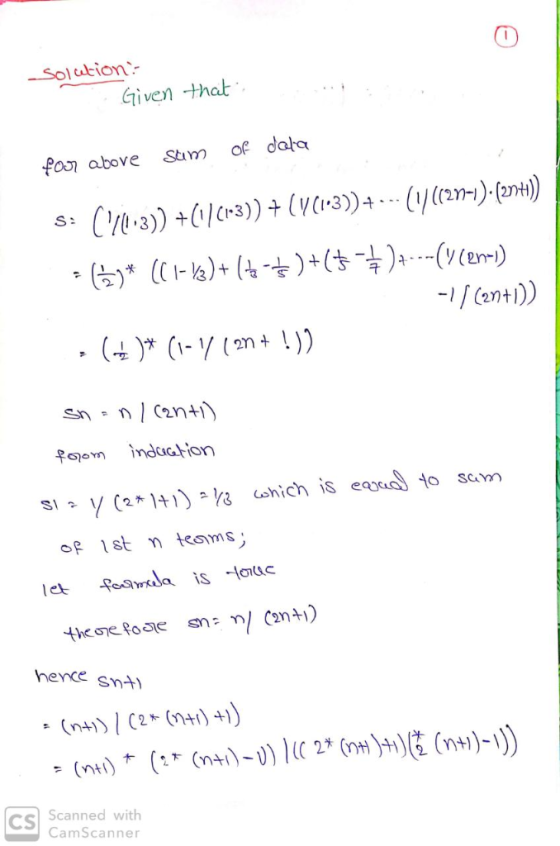
(4) Guess a formula for the sum (2n 1) (2n +1) 1.3 3.5 Prove your guess using induction (4) Guess a formula for the sum (2n 1) (2n +1) 1.3 3.5 Prove your guess using induction
Problem 8 Score: /25 a) (25 Points):Prove by induction the following partial sum equation: 1 1...
 Problem 8 Score: /25 a) (25 Points):Prove by induction the following partial sum equation: 1 1 1.3 3.5 5.7 (2n - 1)(2n +1) 1 1 n + + + 2n +1
Guess formula and prove by induction Σ(-1)-F2-1 1=1
 Guess formula and prove by induction
Σ(-1)-F2-1 1=1
Guess formula and prove by induction
Σ(-1)-F2-1 1=1
Induction proofs. a. Prove by induction: n sum i^3 = [n^2][(n+1)^2]/4 i=1 Note: sum is intended...
Induction proofs. a. Prove by induction: n sum i^3 = [n^2][(n+1)^2]/4 i=1 Note: sum is intended to be the summation symbol, and ^ means what follows is an exponent b. Prove by induction: n^2 - n is even for any n >= 1 10 points 6) Given: T(1) = 2 T(N) = T(N-1) + 3, N>1 What would the value of T(10) be? 7) For the problem above, is there a formula I could use that could directly calculate T(N)?...
please show by using the following version of induction: 2.3.28 Prove the formula for the sum...
 please show by using the following version of induction:
2.3.28 Prove the formula for the sum of a geometric series: Can - 1) an-1 +an-2 + ... +1 a-1 • BASIS STEP: Show that P(n) is true for n = no. • INDUCTIVE STEP: Assume that P(n) is true for some n no. (This is called inductive hypothesis). Then show that the inductive hypothesis implies that P(n + 1) is also true.
please show by using the following version of induction:
2.3.28 Prove the formula for the sum of a geometric series: Can - 1) an-1 +an-2 + ... +1 a-1 • BASIS STEP: Show that P(n) is true for n = no. • INDUCTIVE STEP: Assume that P(n) is true for some n no. (This is called inductive hypothesis). Then show that the inductive hypothesis implies that P(n + 1) is also true.
. 1. Prove by induction that for all integers n≥1, 4+8+12+...+4n = 2n^2+2n 2. A number...
. 1. Prove by induction that for all integers n≥1, 4+8+12+...+4n = 2n^2+2n 2. A number a is divisible by b if the remainder of dividing a by b is zero. For example 10 is divisible by 5 but 11 is not divisible by 5. Prove by induction that for all integers n≥1,11^n - 6 is divisible by 5. 3. Prove by induction that for all integers n ≥ 1, 3^n ≥ 2^n+n^2
prove each of the following theorems using weak induction 1 Weak Induction Prove each of the...
 prove each of the following theorems using weak
induction
1 Weak Induction Prove each of the following theorems using weak induction. Theorem 1. an = 10.4" is a closed form for an = 4an-1 with ao = 10. Theorem 2. an = (-3)"-1.15 is a closed form for an = -3an-1 with a1 = 15. Theorem 3. In E NU{0}, D, 21 = 2n+1 -1. Theorem 4. Vn e N, 2" <2n+1 - 2n-1 – 1. Theorem 5. In E...
prove each of the following theorems using weak
induction
1 Weak Induction Prove each of the following theorems using weak induction. Theorem 1. an = 10.4" is a closed form for an = 4an-1 with ao = 10. Theorem 2. an = (-3)"-1.15 is a closed form for an = -3an-1 with a1 = 15. Theorem 3. In E NU{0}, D, 21 = 2n+1 -1. Theorem 4. Vn e N, 2" <2n+1 - 2n-1 – 1. Theorem 5. In E...
Suppose you want to prove the following: 1/2 + 1/4 + 1/8 + . . ....
Suppose you want to prove the following: 1/2 + 1/4 + 1/8 + . . . + 1/2 n < 1 Try to prove this “directly,” using induction. I assume your attempt will fail. Describe the difficulty you run into. Now try another approach: (a) By experimenting with small values of n, guess an exact formula for the sum. (b) Prove that your guess is true. (c) As a corollary conclude: 1/2 + 1/4 + 1/8 + . . ....
1. Prove that 1.3....2n-1 1. Prove that-.-. ...--ㄑㄧ for any n E N 2n V2n+1
 1. Prove that 1.3....2n-1 1. Prove that-.-. ...--ㄑㄧ for any n E N 2n V2n+1
prove by mathematical induction Prove Ś m2 n(n+1)(2n+1)
 prove by mathematical induction
Prove Ś m2 n(n+1)(2n+1)
prove by mathematical induction
Prove Ś m2 n(n+1)(2n+1)
Prove using the Basic Principle of Mathematical Induction: For every positive integer n 24 | (5^(2n)-...
Prove using the Basic Principle of Mathematical Induction: For every positive integer n 24 | (5^(2n)- 1)
 Problem 8 Score: /25 a) (25 Points):Prove by induction the following partial sum equation: 1 1 1.3 3.5 5.7 (2n - 1)(2n +1) 1 1 n + + + 2n +1
 Guess formula and prove by induction
Σ(-1)-F2-1 1=1
Guess formula and prove by induction
Σ(-1)-F2-1 1=1
 please show by using the following version of induction:
2.3.28 Prove the formula for the sum of a geometric series: Can - 1) an-1 +an-2 + ... +1 a-1 • BASIS STEP: Show that P(n) is true for n = no. • INDUCTIVE STEP: Assume that P(n) is true for some n no. (This is called inductive hypothesis). Then show that the inductive hypothesis implies that P(n + 1) is also true.
please show by using the following version of induction:
2.3.28 Prove the formula for the sum of a geometric series: Can - 1) an-1 +an-2 + ... +1 a-1 • BASIS STEP: Show that P(n) is true for n = no. • INDUCTIVE STEP: Assume that P(n) is true for some n no. (This is called inductive hypothesis). Then show that the inductive hypothesis implies that P(n + 1) is also true.
 prove each of the following theorems using weak
induction
1 Weak Induction Prove each of the following theorems using weak induction. Theorem 1. an = 10.4" is a closed form for an = 4an-1 with ao = 10. Theorem 2. an = (-3)"-1.15 is a closed form for an = -3an-1 with a1 = 15. Theorem 3. In E NU{0}, D, 21 = 2n+1 -1. Theorem 4. Vn e N, 2" <2n+1 - 2n-1 – 1. Theorem 5. In E...
prove each of the following theorems using weak
induction
1 Weak Induction Prove each of the following theorems using weak induction. Theorem 1. an = 10.4" is a closed form for an = 4an-1 with ao = 10. Theorem 2. an = (-3)"-1.15 is a closed form for an = -3an-1 with a1 = 15. Theorem 3. In E NU{0}, D, 21 = 2n+1 -1. Theorem 4. Vn e N, 2" <2n+1 - 2n-1 – 1. Theorem 5. In E...
 1. Prove that 1.3....2n-1 1. Prove that-.-. ...--ㄑㄧ for any n E N 2n V2n+1
 prove by mathematical induction
Prove Ś m2 n(n+1)(2n+1)
prove by mathematical induction
Prove Ś m2 n(n+1)(2n+1)
Most questions answered within 3 hours.
-
Where is the error in this code sequence?
String s1 = "Hello";
String s2 = "ello";...
asked 11 months ago -
Financial data for Joel de Paris, Inc., for last year
follow:
Joel de Paris, Inc.
Balance...
asked 11 months ago -
Consider this reaction:
Al2(SO4)3 (aq)+ BaCl3
(aq) Al2Cl6 (aq)- +
3BaSO4(s) . What is the...
asked 11 months ago -
Suppose that Savneet is considering increasing her
recent random sample from 20 car rentals to 40...
asked 11 months ago -
Trucks arrive at an unloading terminal at an average rate of 120
per hour.
Trucks arrive...
asked 11 months ago -
Why are methanol and ethanol completely soluble in water while
octanol is not very little soluble....
asked 11 months ago -
A facilities manager at a university reads in a research report
that the mean amount of...
asked 11 months ago -
When the CuSO4 is rehydrated by adding water to the anhydrous
compound, is this an endothermic...
asked 11 months ago -
A ray of sunlight is passing from diamond into crown glass; the
angle of incidence is...
asked 11 months ago -
A block of mass 0.249 kg is placed on top of a light, vertical
spring of...
asked 11 months ago -
how do the kidneys compensate in the presences of acidosis
a) trigger hyperventilate
b) reserve acid...
asked 11 months ago -
Question 501 pts
The rental rate of capital to the firm increases. Which of the
following...
asked 11 months ago