

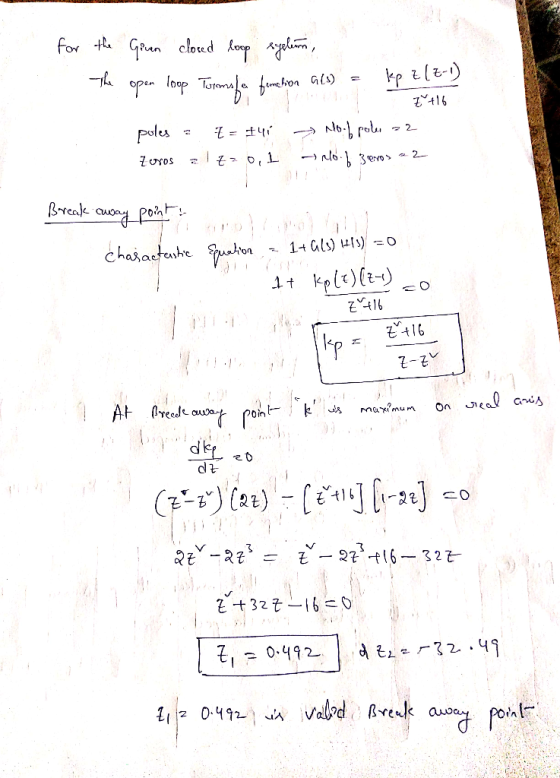
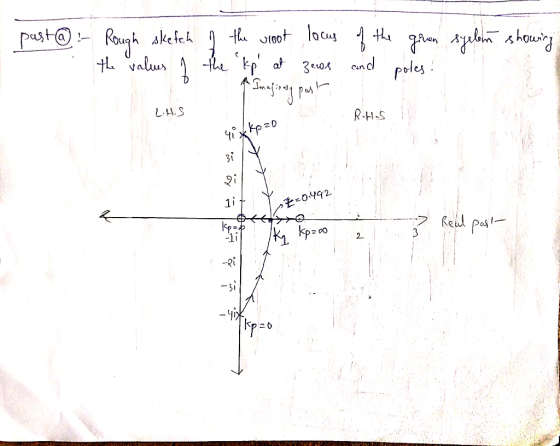
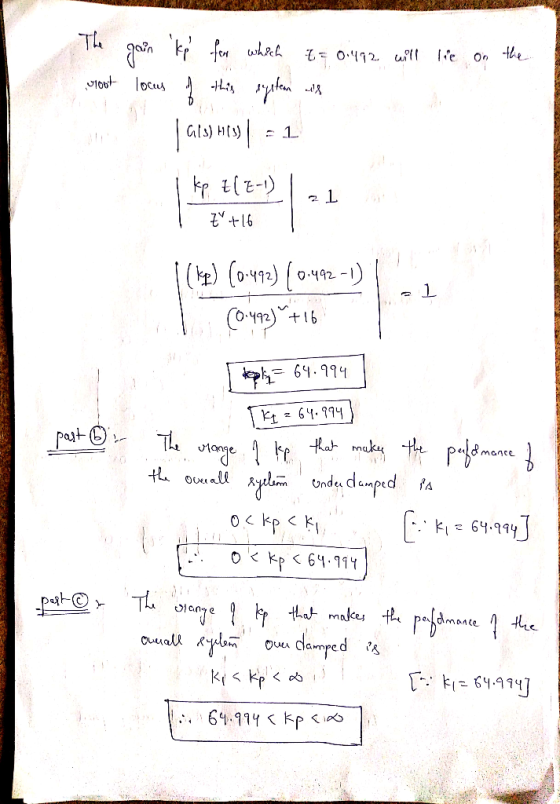
a) Draw a rough sketch of the root-locus of the above system showing only the values of Kp at zeros and poles. b) 10 points: Find the range of Kp that makes the performance of the overall system underdamped. c) 10 points: Find the range of Kp that makes the performance of the overall system overdamped.
Homework Answers
Add Answer to:
Prob. 3-25 points For this problem, use the root locus features to solve all parts: comp For: comp = a proportional controller = a positive gain Kp and z (z-1)/(z2 + 16) sys a) Draw a rough sket...
2. Consider the closed-loop system shown below Here Kp represents the gain of a proportional controller, and the proces...
 2. Consider the closed-loop system shown below
Here Kp represents the gain of a proportional controller, and
the process transfer function is given by
.
(a) Sketch the locus of the closed-loop poles as the
proportional gain, Kp, varies from 0 to ∞. Be sure to clearly mark
poles, zeros, asymptotes, angles of arrival/departure,
break-in/away points, and real axis portion of the locus.
(b) Using Routh's array, determine the range of the proportional
gain, Kp, for which the closed-loop system...
2. Consider the closed-loop system shown below
Here Kp represents the gain of a proportional controller, and
the process transfer function is given by
.
(a) Sketch the locus of the closed-loop poles as the
proportional gain, Kp, varies from 0 to ∞. Be sure to clearly mark
poles, zeros, asymptotes, angles of arrival/departure,
break-in/away points, and real axis portion of the locus.
(b) Using Routh's array, determine the range of the proportional
gain, Kp, for which the closed-loop system...
Problem 3: (30) Consider the following systen where K is a proportional gain (K>0). s-2 (a) Sketch the root locus us...
 Problem 3: (30) Consider the following systen where K is a proportional gain (K>0). s-2 (a) Sketch the root locus using the below procedures. (1) find poles and zeros and locate on complex domain (2) find number of branches (3) find asymptotes including centroid and angles of asymptotes (4) intersection at imaginary axis (5) find the angle of departure (6) draw the root migration (b) Find the range of K for which the feedback system is asymptotically stable.
Problem 3:...
Problem 3: (30) Consider the following systen where K is a proportional gain (K>0). s-2 (a) Sketch the root locus using the below procedures. (1) find poles and zeros and locate on complex domain (2) find number of branches (3) find asymptotes including centroid and angles of asymptotes (4) intersection at imaginary axis (5) find the angle of departure (6) draw the root migration (b) Find the range of K for which the feedback system is asymptotically stable.
Problem 3:...
Question 1 (60 points) Consider the following block diagram where G(s)- Controller R(s) G(s) (a) Sketch the root locus assuming a proportional controller is used. [25 points] (b) Design specifica...
 Question 1 (60 points) Consider the following block diagram where G(s)- Controller R(s) G(s) (a) Sketch the root locus assuming a proportional controller is used. [25 points] (b) Design specifications require a closed-loop pole at (-3+j1). Design a lead compensator to make sure the root locus goes through this point. For the design, pick the pole of the compensator at-23 and analytically find its zero. (Hint: Lead compensator transfer function will be Ge (s)$+23 First plot the poles and zeros...
 2. Consider the closed-loop system shown below
Here Kp represents the gain of a proportional controller, and
the process transfer function is given by
.
(a) Sketch the locus of the closed-loop poles as the
proportional gain, Kp, varies from 0 to ∞. Be sure to clearly mark
poles, zeros, asymptotes, angles of arrival/departure,
break-in/away points, and real axis portion of the locus.
(b) Using Routh's array, determine the range of the proportional
gain, Kp, for which the closed-loop system...
2. Consider the closed-loop system shown below
Here Kp represents the gain of a proportional controller, and
the process transfer function is given by
.
(a) Sketch the locus of the closed-loop poles as the
proportional gain, Kp, varies from 0 to ∞. Be sure to clearly mark
poles, zeros, asymptotes, angles of arrival/departure,
break-in/away points, and real axis portion of the locus.
(b) Using Routh's array, determine the range of the proportional
gain, Kp, for which the closed-loop system...
 Problem 3: (30) Consider the following systen where K is a proportional gain (K>0). s-2 (a) Sketch the root locus using the below procedures. (1) find poles and zeros and locate on complex domain (2) find number of branches (3) find asymptotes including centroid and angles of asymptotes (4) intersection at imaginary axis (5) find the angle of departure (6) draw the root migration (b) Find the range of K for which the feedback system is asymptotically stable.
Problem 3:...
Problem 3: (30) Consider the following systen where K is a proportional gain (K>0). s-2 (a) Sketch the root locus using the below procedures. (1) find poles and zeros and locate on complex domain (2) find number of branches (3) find asymptotes including centroid and angles of asymptotes (4) intersection at imaginary axis (5) find the angle of departure (6) draw the root migration (b) Find the range of K for which the feedback system is asymptotically stable.
Problem 3:...
 Question 1 (60 points) Consider the following block diagram where G(s)- Controller R(s) G(s) (a) Sketch the root locus assuming a proportional controller is used. [25 points] (b) Design specifications require a closed-loop pole at (-3+j1). Design a lead compensator to make sure the root locus goes through this point. For the design, pick the pole of the compensator at-23 and analytically find its zero. (Hint: Lead compensator transfer function will be Ge (s)$+23 First plot the poles and zeros...
Most questions answered within 3 hours.
-
Where is the error in this code sequence?
String s1 = "Hello";
String s2 = "ello";...
asked 11 months ago -
Financial data for Joel de Paris, Inc., for last year
follow:
Joel de Paris, Inc.
Balance...
asked 11 months ago -
Consider this reaction:
Al2(SO4)3 (aq)+ BaCl3
(aq) Al2Cl6 (aq)- +
3BaSO4(s) . What is the...
asked 11 months ago -
Suppose that Savneet is considering increasing her
recent random sample from 20 car rentals to 40...
asked 11 months ago -
Trucks arrive at an unloading terminal at an average rate of 120
per hour.
Trucks arrive...
asked 11 months ago -
Why are methanol and ethanol completely soluble in water while
octanol is not very little soluble....
asked 11 months ago -
A facilities manager at a university reads in a research report
that the mean amount of...
asked 11 months ago -
When the CuSO4 is rehydrated by adding water to the anhydrous
compound, is this an endothermic...
asked 11 months ago -
A ray of sunlight is passing from diamond into crown glass; the
angle of incidence is...
asked 11 months ago -
A block of mass 0.249 kg is placed on top of a light, vertical
spring of...
asked 11 months ago -
how do the kidneys compensate in the presences of acidosis
a) trigger hyperventilate
b) reserve acid...
asked 11 months ago -
Question 501 pts
The rental rate of capital to the firm increases. Which of the
following...
asked 11 months ago