
Homework Answers
Add Answer to:
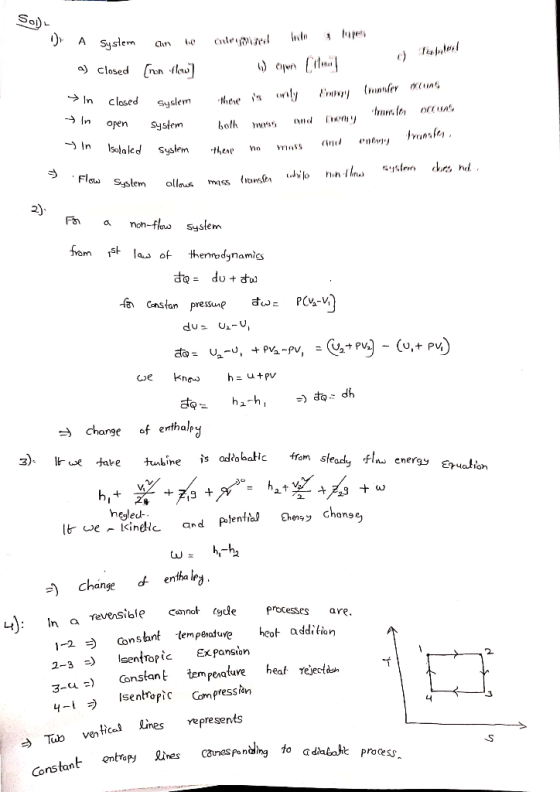
Q1: The difference between a nonflow (closed) and a filow (open) system is that Nonflow system allows mass transfer while flow system does not Nonflow system allows Flow system Flow energy transfer w...
True or False (Problems 1 through 10) 1. The change in entropy of a closed system...
 True or False (Problems 1 through 10) 1. The change in entropy of a closed system is the same for every process between two specified states 2. The entropy of a fixed amount of an incompressible substance increases in every process for which temperature increases 3. A process that violates the second law of thermodynamics violates the first law of thermodynamics. 4. When a net amount of work is done on a closed system undergoing an internally reversible process, a...
5. (15) A closed system undergoes a process where heat transfer is allowed along the system...
 5. (15) A closed system undergoes a process where heat transfer is allowed along the system boundary at constant temperature. For each case below, determine whether the change in entropy of the system is positive, negative, zero, or indeterminate. Explain your answer. a. Internally reversible process with heat transfer from the system to the surroundings b. Internally reversible process with heat transfer to the system from the surroundings; Internally reversible and adiabatic process; c. d. Internal irreversibilities present with heat...
Steam with the mass flow rate of 0.75 kg/s enters an adiabatic turbine steadily at 19 MPa, 600°C and 150 m/s
Steam with the mass flow rate of 0.75 kg/s enters an adiabatic turbine steadily at 19 MPa, 600°C and 150 m/s, and leaves at 150 kPa and 350 m/s. The isentropic efficiency of the turbine is 85%. Neglect potential energy. (I) Determine the exit temperature of the steam, and its quality (if saturated mixture) (ii) Calculate the actual power output of the turbine, in kW (iii) Illustrate a T-s diagram with respect to saturation lines for the isentropic process by clearly indicating all pressure, temperature,...
Problem 2_Skills: Setup, T-s, mass and energy balances A steam power plant operates on the reheat...
 Problem 2_Skills: Setup, T-s, mass and energy balances A steam power plant operates on the reheat regenerative Rankine cycle with a closed feedwater heater. Steam enters the turbine at 8 MPa and 500°C at a rate of 15 kg/s and is condensed in the condenser at a pressure of 20 kPa. Steam is reheated at 3 MPa to 500°C. Some steam is extracted from the low-pressure turbine at 1.0 MPa, is completely condensed in the closed feedwater heater (x3 0),...
Thermo one Question 5 A steam turbine generates energy in the form of work at the rate of 346.1...
Thermo one Question 5 A steam turbine generates energy in the form of work at the rate of 346.1 kJ/kg of steam. The steam at the inlet of the turbine is at 8 MPa, 480oC, and at a velocity of 163.5 m/s. The steam exits the turbine at 2 MPa, 240oC, and a velocity of 55.3 m/s. Heat transfer to the surroundings occurs where the outer surface (boundary) temperature is at 333.5oC. Determine the rate of entropy production (kJ/kg-K) within...
Provide an explanation as well for the following questions. 1 Both energy and entropy can be...
Provide an explanation as well for the following questions. 1 Both energy and entropy can be transferred between a system and surroundings by heat, work, and mass flow True or False 2. An actual turbine undergoes an adiabatic process generating entropy due to irreversibilities. The generated entropy a) causes the turbine’s exit temperature to be lower than if the turbine were reversible. b) causes the turbine’s exit temperature to be higher than if the turbine were reversible. c) causes the...
Which of the following statements does not apply to the definition of an ideal gas? Group...
Which of the following statements does not apply to the definition of an ideal gas? Group of answer choices a. Intermolecular interactions are negligible. b. The Gibbs free energy only depends upon the temperature. c. The enthalpy only depends upon the temperature. d. The internal energy only depends upon the temperature. e. None. The previous answers are all correct. Consider a solid substance. Which of the following expressions is wrong? Group of answer choices a. Internal energy increases when the...
How do i solve C??? Please details Steam enters a two stage steady state turbine at 8 MPa and 500 C. It expands in the first stage to a state of 2 MPa and 350°C. Steam is then reheated at constant...
 How do i solve C??? Please details
Steam enters a two stage steady state turbine at 8 MPa and 500 C. It expands in the first stage to a state of 2 MPa and 350°C. Steam is then reheated at constant pressure to a temperature of 500°C before it enters the second stage, where it exits at 30 kPa and a quality of 98%. The net power output of the turbine is 3 MW Assume the surroundings to be at...
How do i solve C??? Please details
Steam enters a two stage steady state turbine at 8 MPa and 500 C. It expands in the first stage to a state of 2 MPa and 350°C. Steam is then reheated at constant pressure to a temperature of 500°C before it enters the second stage, where it exits at 30 kPa and a quality of 98%. The net power output of the turbine is 3 MW Assume the surroundings to be at...
Obtain heat q and work w given to an ideal gas (1 moD system and the...
 Obtain heat q and work w given to an ideal gas (1 moD system and the ehange of the internal energy Au in the following processes. Heat capacity at constant volume, G, of the gas does not 1. AU in t A reversible isothermal expansion from (P. V.,T) to (P, V, r). reversibly at constant volume from (Pvv2,T) to (p,y, ) depend on temperature. a) b) A reversible adiabatic expansion from (P, V.T) to (P, V, T2) and then heating...
Question 3 (a) In a closed system, 0.93 kg of steam at 600 kPa and 200°C...
 Question 3 (a) In a closed system, 0.93 kg of steam at 600 kPa and 200°C undergoes an isothermal and reversible process until 0.76 kg of saturated liquid water is obtained in the system. (i) Determine the entropy change of the mass. (5 marks) (ii) Determine the amount of heat transfer of the system during the process. (3 marks) (b) A two-cylinder two-stroke diesel engine operates on an ideal Diesel cycle, of which compression ratio is 22.5 and cutoff ratio...
 True or False (Problems 1 through 10) 1. The change in entropy of a closed system is the same for every process between two specified states 2. The entropy of a fixed amount of an incompressible substance increases in every process for which temperature increases 3. A process that violates the second law of thermodynamics violates the first law of thermodynamics. 4. When a net amount of work is done on a closed system undergoing an internally reversible process, a...
 5. (15) A closed system undergoes a process where heat transfer is allowed along the system boundary at constant temperature. For each case below, determine whether the change in entropy of the system is positive, negative, zero, or indeterminate. Explain your answer. a. Internally reversible process with heat transfer from the system to the surroundings b. Internally reversible process with heat transfer to the system from the surroundings; Internally reversible and adiabatic process; c. d. Internal irreversibilities present with heat...
 Problem 2_Skills: Setup, T-s, mass and energy balances A steam power plant operates on the reheat regenerative Rankine cycle with a closed feedwater heater. Steam enters the turbine at 8 MPa and 500°C at a rate of 15 kg/s and is condensed in the condenser at a pressure of 20 kPa. Steam is reheated at 3 MPa to 500°C. Some steam is extracted from the low-pressure turbine at 1.0 MPa, is completely condensed in the closed feedwater heater (x3 0),...
 How do i solve C??? Please details
Steam enters a two stage steady state turbine at 8 MPa and 500 C. It expands in the first stage to a state of 2 MPa and 350°C. Steam is then reheated at constant pressure to a temperature of 500°C before it enters the second stage, where it exits at 30 kPa and a quality of 98%. The net power output of the turbine is 3 MW Assume the surroundings to be at...
How do i solve C??? Please details
Steam enters a two stage steady state turbine at 8 MPa and 500 C. It expands in the first stage to a state of 2 MPa and 350°C. Steam is then reheated at constant pressure to a temperature of 500°C before it enters the second stage, where it exits at 30 kPa and a quality of 98%. The net power output of the turbine is 3 MW Assume the surroundings to be at...
 Obtain heat q and work w given to an ideal gas (1 moD system and the ehange of the internal energy Au in the following processes. Heat capacity at constant volume, G, of the gas does not 1. AU in t A reversible isothermal expansion from (P. V.,T) to (P, V, r). reversibly at constant volume from (Pvv2,T) to (p,y, ) depend on temperature. a) b) A reversible adiabatic expansion from (P, V.T) to (P, V, T2) and then heating...
 Question 3 (a) In a closed system, 0.93 kg of steam at 600 kPa and 200°C undergoes an isothermal and reversible process until 0.76 kg of saturated liquid water is obtained in the system. (i) Determine the entropy change of the mass. (5 marks) (ii) Determine the amount of heat transfer of the system during the process. (3 marks) (b) A two-cylinder two-stroke diesel engine operates on an ideal Diesel cycle, of which compression ratio is 22.5 and cutoff ratio...
Most questions answered within 3 hours.
-
Where is the error in this code sequence?
String s1 = "Hello";
String s2 = "ello";...
asked 11 months ago -
Financial data for Joel de Paris, Inc., for last year
follow:
Joel de Paris, Inc.
Balance...
asked 11 months ago -
Consider this reaction:
Al2(SO4)3 (aq)+ BaCl3
(aq) Al2Cl6 (aq)- +
3BaSO4(s) . What is the...
asked 11 months ago -
Suppose that Savneet is considering increasing her
recent random sample from 20 car rentals to 40...
asked 11 months ago -
Trucks arrive at an unloading terminal at an average rate of 120
per hour.
Trucks arrive...
asked 11 months ago -
Why are methanol and ethanol completely soluble in water while
octanol is not very little soluble....
asked 11 months ago -
A facilities manager at a university reads in a research report
that the mean amount of...
asked 11 months ago -
When the CuSO4 is rehydrated by adding water to the anhydrous
compound, is this an endothermic...
asked 11 months ago -
A ray of sunlight is passing from diamond into crown glass; the
angle of incidence is...
asked 11 months ago -
A block of mass 0.249 kg is placed on top of a light, vertical
spring of...
asked 11 months ago -
how do the kidneys compensate in the presences of acidosis
a) trigger hyperventilate
b) reserve acid...
asked 11 months ago -
Question 501 pts
The rental rate of capital to the firm increases. Which of the
following...
asked 11 months ago