
Homework Answers

Add Answer to:
(2) Consider the following groups: Z24; Z3 x Z7 x Z2; Z2 x Z2 x S3; Zg x Z3; G-symmetries of the squareZ. Which of these groups are isomorphic to one another? (2) Consider the following groups:...
Show that the general linear group GL(2,Z2) is isomorphic to the symmetric group S3. (Hint. Write...
Show that the general linear group GL(2,Z2) is isomorphic to the symmetric group S3. (Hint. Write out the multiplication tables for both groups
4 -(1,5+1,5+2 marks) Explain why a) the groups z, and S, are not isomorphic b) the groups Z, x Z2 and Z, xZ, xZ, are no isomorphic; c) the function from ring R-a+b/2a,bEto ring S-abv3a,bE defined...
 4 -(1,5+1,5+2 marks) Explain why a) the groups z, and S, are not isomorphic b) the groups Z, x Z2 and Z, xZ, xZ, are no isomorphic; c) the function from ring R-a+b/2a,bEto ring S-abv3a,bE defined by fla+bv2abv3 is not an isomorphism.
4 -(1,5+1,5+2 marks) Explain why a) the groups z, and S, are not isomorphic b) the groups Z, x Z2 and Z, xZ, xZ, are no isomorphic; c) the function from ring R-a+b/2a,bEto ring S-abv3a,bE defined by fla+bv2abv3...
4 -(1,5+1,5+2 marks) Explain why a) the groups z, and S, are not isomorphic b) the groups Z, x Z2 and Z, xZ, xZ, are no isomorphic; c) the function from ring R-a+b/2a,bEto ring S-abv3a,bE defined by fla+bv2abv3 is not an isomorphism.
4 -(1,5+1,5+2 marks) Explain why a) the groups z, and S, are not isomorphic b) the groups Z, x Z2 and Z, xZ, xZ, are no isomorphic; c) the function from ring R-a+b/2a,bEto ring S-abv3a,bE defined by fla+bv2abv3...
3. Consider the four groups C2 X C3 C5, S3 x C5, C3 x D5, D15....
 3. Consider the four groups C2 X C3 C5, S3 x C5, C3 x D5, D15. (i) Show that each of them has a unique subgroup of order 3 and a unique subgroup of order 5, and they are both normal. (ii) Identify the normal subgroups and the quotients (without further justifications). (iii) Show that the four groups are not isomorphic. (iv) Give a presentation of each of them.
2. Compute all Xg and all G for each of the following permutation groups. a. X {1,2, 3). Ģ S3 b. ...
 Please answer #3 ... I have
the answer for #2 already
2. Compute all Xg and all G for each of the following permutation groups. a. X {1,2, 3). Ģ S3 b. X-f1,2,3,4,5,6, G {(1), (12), (13), (23), (123), (132)) (1), (12), (345), (354), (12)(345), (12)(354) 3. Compute the G-equivalence classes of X for each of the G-sets in Exercise 13.4.2. For each z є X verify that G--Ozl . Gal.
2. Compute all Xg and all G for each...
Please answer #3 ... I have
the answer for #2 already
2. Compute all Xg and all G for each of the following permutation groups. a. X {1,2, 3). Ģ S3 b. X-f1,2,3,4,5,6, G {(1), (12), (13), (23), (123), (132)) (1), (12), (345), (354), (12)(345), (12)(354) 3. Compute the G-equivalence classes of X for each of the G-sets in Exercise 13.4.2. For each z є X verify that G--Ozl . Gal.
2. Compute all Xg and all G for each...
(2) Consider the following groups of invertible elements For each group, list its elements. What is...
 (2) Consider the following groups of invertible elements For each group, list its elements. What is the order? Is it cyclic? If not, is it isomorphic to some other group you can describe explicitly, e.g. a product Z/nZ x Z/mZ?
Incorrect Question 5 0/5 pts S3 = [y/g(h(a,b))] Consider the following substitutions: S1 = [y/f(a,g(h(a,b)))] S2...
 Incorrect Question 5 0/5 pts S3 = [y/g(h(a,b))] Consider the following substitutions: S1 = [y/f(a,g(h(a,b)))] S2 = [x/f(a,y)] Which are legal ground substitutions? (A) S1 and S3 (B) S2 and 53 (C) S1 and 52 (D) All of above mentioned (A) (B) (C) (D)
✓ Saved Question 2 (1 point) Given that S3'! f(x) dx = 7, Si f(x) dx...
 ✓ Saved Question 2 (1 point) Given that S3'! f(x) dx = 7, Si f(x) dx = -2, and S31 g(x) dx = 4, which of the following integrals cannot be found? O S3+ f(x) · g(x) dx PS3? (f(x) + g(x)) dx O Si (f(x) + g(x)) dx ° 835 f(x) dx
Problem 1: Consider the following complex numbers: Z1 = 2 + j4 Z2 = 5e3 a)...
 Problem 1: Consider the following complex numbers: Z1 = 2 + j4 Z2 = 5e3 a) Write zi in polar form b) Write ze in rectangular form c) Plot the product of zı & z2 in the complex plane with x(0) = 0.3 Problem 2: Consider the system: dx/dt = -3x a) Solve the initial value problem b) Plot the resulting function
Consider the following closed economy: There are three sectors: S, S2, S3. Sector one consumes 90...
 Consider the following closed economy: There are three sectors: S, S2, S3. Sector one consumes 90 percent of it's own product, sells 10 percent to sector two and nothing to sector three. Sector two consumes 40 percent of it's own product, sells 40 percent to sector one and 2 percent to sector three. Sector three consumes 20 percent of it's own product, sells 40 percent to sector 1 and 40 percent to sector 2. 1. Write a se t of...
Consider the following reaction, for which Kc =0.0136 at 731 K. 2 HI(g) = H2(g) +1,...
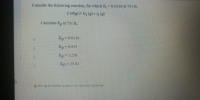 Consider the following reaction, for which Kc =0.0136 at 731 K. 2 HI(g) = H2(g) +1, () Calculate Kp at 731 K. Kp = 0.0136 Kp = 0.815 Kp = 1.236 Kp =3561 Movint to another questionsave this response
 4 -(1,5+1,5+2 marks) Explain why a) the groups z, and S, are not isomorphic b) the groups Z, x Z2 and Z, xZ, xZ, are no isomorphic; c) the function from ring R-a+b/2a,bEto ring S-abv3a,bE defined by fla+bv2abv3 is not an isomorphism.
4 -(1,5+1,5+2 marks) Explain why a) the groups z, and S, are not isomorphic b) the groups Z, x Z2 and Z, xZ, xZ, are no isomorphic; c) the function from ring R-a+b/2a,bEto ring S-abv3a,bE defined by fla+bv2abv3...
4 -(1,5+1,5+2 marks) Explain why a) the groups z, and S, are not isomorphic b) the groups Z, x Z2 and Z, xZ, xZ, are no isomorphic; c) the function from ring R-a+b/2a,bEto ring S-abv3a,bE defined by fla+bv2abv3 is not an isomorphism.
4 -(1,5+1,5+2 marks) Explain why a) the groups z, and S, are not isomorphic b) the groups Z, x Z2 and Z, xZ, xZ, are no isomorphic; c) the function from ring R-a+b/2a,bEto ring S-abv3a,bE defined by fla+bv2abv3...
 3. Consider the four groups C2 X C3 C5, S3 x C5, C3 x D5, D15. (i) Show that each of them has a unique subgroup of order 3 and a unique subgroup of order 5, and they are both normal. (ii) Identify the normal subgroups and the quotients (without further justifications). (iii) Show that the four groups are not isomorphic. (iv) Give a presentation of each of them.
 Please answer #3 ... I have
the answer for #2 already
2. Compute all Xg and all G for each of the following permutation groups. a. X {1,2, 3). Ģ S3 b. X-f1,2,3,4,5,6, G {(1), (12), (13), (23), (123), (132)) (1), (12), (345), (354), (12)(345), (12)(354) 3. Compute the G-equivalence classes of X for each of the G-sets in Exercise 13.4.2. For each z є X verify that G--Ozl . Gal.
2. Compute all Xg and all G for each...
Please answer #3 ... I have
the answer for #2 already
2. Compute all Xg and all G for each of the following permutation groups. a. X {1,2, 3). Ģ S3 b. X-f1,2,3,4,5,6, G {(1), (12), (13), (23), (123), (132)) (1), (12), (345), (354), (12)(345), (12)(354) 3. Compute the G-equivalence classes of X for each of the G-sets in Exercise 13.4.2. For each z є X verify that G--Ozl . Gal.
2. Compute all Xg and all G for each...
 (2) Consider the following groups of invertible elements For each group, list its elements. What is the order? Is it cyclic? If not, is it isomorphic to some other group you can describe explicitly, e.g. a product Z/nZ x Z/mZ?
 Incorrect Question 5 0/5 pts S3 = [y/g(h(a,b))] Consider the following substitutions: S1 = [y/f(a,g(h(a,b)))] S2 = [x/f(a,y)] Which are legal ground substitutions? (A) S1 and S3 (B) S2 and 53 (C) S1 and 52 (D) All of above mentioned (A) (B) (C) (D)
 ✓ Saved Question 2 (1 point) Given that S3'! f(x) dx = 7, Si f(x) dx = -2, and S31 g(x) dx = 4, which of the following integrals cannot be found? O S3+ f(x) · g(x) dx PS3? (f(x) + g(x)) dx O Si (f(x) + g(x)) dx ° 835 f(x) dx
 Problem 1: Consider the following complex numbers: Z1 = 2 + j4 Z2 = 5e3 a) Write zi in polar form b) Write ze in rectangular form c) Plot the product of zı & z2 in the complex plane with x(0) = 0.3 Problem 2: Consider the system: dx/dt = -3x a) Solve the initial value problem b) Plot the resulting function
 Consider the following closed economy: There are three sectors: S, S2, S3. Sector one consumes 90 percent of it's own product, sells 10 percent to sector two and nothing to sector three. Sector two consumes 40 percent of it's own product, sells 40 percent to sector one and 2 percent to sector three. Sector three consumes 20 percent of it's own product, sells 40 percent to sector 1 and 40 percent to sector 2. 1. Write a se t of...
 Consider the following reaction, for which Kc =0.0136 at 731 K. 2 HI(g) = H2(g) +1, () Calculate Kp at 731 K. Kp = 0.0136 Kp = 0.815 Kp = 1.236 Kp =3561 Movint to another questionsave this response
Most questions answered within 3 hours.
-
Where is the error in this code sequence?
String s1 = "Hello";
String s2 = "ello";...
asked 11 months ago -
Financial data for Joel de Paris, Inc., for last year
follow:
Joel de Paris, Inc.
Balance...
asked 11 months ago -
Consider this reaction:
Al2(SO4)3 (aq)+ BaCl3
(aq) Al2Cl6 (aq)- +
3BaSO4(s) . What is the...
asked 11 months ago -
Suppose that Savneet is considering increasing her
recent random sample from 20 car rentals to 40...
asked 11 months ago -
Trucks arrive at an unloading terminal at an average rate of 120
per hour.
Trucks arrive...
asked 11 months ago -
Why are methanol and ethanol completely soluble in water while
octanol is not very little soluble....
asked 11 months ago -
A facilities manager at a university reads in a research report
that the mean amount of...
asked 11 months ago -
When the CuSO4 is rehydrated by adding water to the anhydrous
compound, is this an endothermic...
asked 11 months ago -
A ray of sunlight is passing from diamond into crown glass; the
angle of incidence is...
asked 11 months ago -
A block of mass 0.249 kg is placed on top of a light, vertical
spring of...
asked 11 months ago -
how do the kidneys compensate in the presences of acidosis
a) trigger hyperventilate
b) reserve acid...
asked 11 months ago -
Question 501 pts
The rental rate of capital to the firm increases. Which of the
following...
asked 11 months ago