
Homework Answers
Add Answer to:
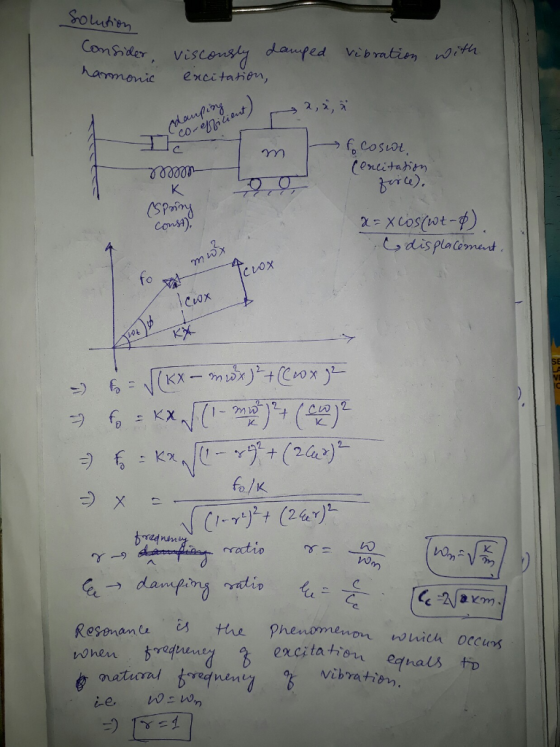
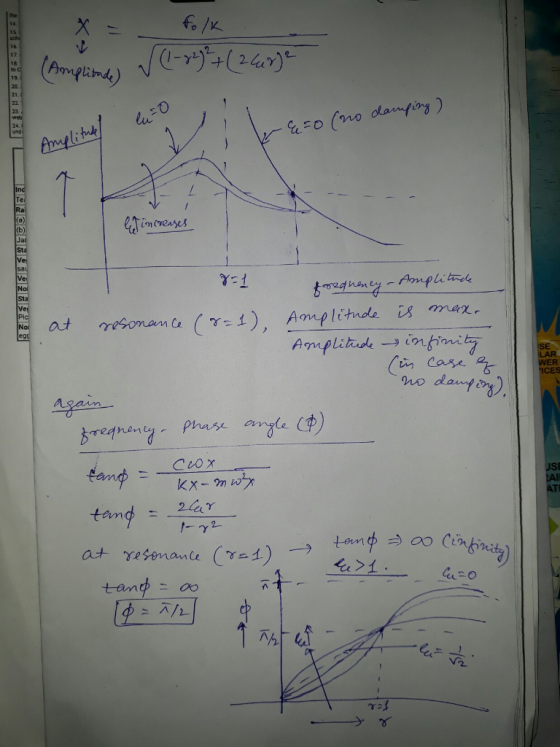
(b) Describe, with the aid of frequency-amplitude and frequency-phase angle charts the meaning of resonance: (7 marks) (b) Describe, with the aid of frequency-amplitude and frequency-phase a...
Determine resonant frequency, amplitude, impedance, and phase angle. (b) Suppose the circuit parameters in a series...
 Determine resonant frequency, amplitude, impedance,
and phase angle.
(b) Suppose the circuit parameters in a series RLC circuit are: L = 1.0 uH, C = 10.0 nF, R= 10092, and the source voltage is 220 V. Determine the resonant frequency of the circuit and the amplitude of the current at resonance. If the frequency of the input voltage source is 50 Hz, calculate the impedance and the phase angle. f = 1 / 2 x 5c = 1/2 X 511...
Determine resonant frequency, amplitude, impedance,
and phase angle.
(b) Suppose the circuit parameters in a series RLC circuit are: L = 1.0 uH, C = 10.0 nF, R= 10092, and the source voltage is 220 V. Determine the resonant frequency of the circuit and the amplitude of the current at resonance. If the frequency of the input voltage source is 50 Hz, calculate the impedance and the phase angle. f = 1 / 2 x 5c = 1/2 X 511...
1.) Angle Modulation can be subdivided into phase modulation (PM) and frequency modulation (FM). Highlight the...
 1.) Angle Modulation can be subdivided into phase modulation (PM) and frequency modulation (FM). Highlight the differences between FM and PM. What is meant by the term instantaneous frequency? 2.) Describe what is meant by the term "Zero-Crossings" of a FM or PM wave. 3.) Is PM and/or FM a linear modulation technique? Explain. 4.) Describe one important advantage that angle modulation has over amplitude modulation. Describe one distinct disadvantage that angle modulation has over amplitude modulation. 5.) Describe the...
[5 Marks] uestion 1 A high frequency carrier is frequency modulated by a sinusoidal modulating frequency...
 [5 Marks] uestion 1 A high frequency carrier is frequency modulated by a sinusoidal modulating frequency of 2 KHz, resulting in a frequency deviation of 7 Khz.Calculate the bandwidth of the modulated signal. a) [1 Mark] [1.Mark] 0.5 mark] 2.5 Marks] b) Explain how noise immunity is achieved in FM With aid of a neatly labelled illustration describe the Frequency Shift Keying c) Discuss the advantages and de merits of Frequency modulation d) [5 Marks] Question 2 n SSB transmitter...
a. For the following Bode diagram, determine: Bode Diagram (7 marks Magnitude (dB) Phase (deg! Frequency...
 a. For the following Bode diagram, determine: Bode Diagram (7 marks Magnitude (dB) Phase (deg! Frequency (rad/s! 1. The gain margin. 2. The phase margin. 3. Gain crossover frequency. 4. Phase crossover frequency. 5. Comment on the stability of this system.
Calculate the Period, Frequency, Vpp, Vp, and Vrms of VR1, and the phase angle between VR1...
 Calculate the Period, Frequency, Vpp, Vp, and Vrms of VR1, and the phase angle between VR1 and Vs of Figure 3, when the Sweep Time Setting is 0.1us/DIV, and Amplitude Setting is 0.2V/DIV. Show your calculations. MEASURING PHASE ANGLE CH1 = Vs CH2 = VR1 o 1 Cycle = 360 Figure 3
An angle-modulating described as sign ?(?)=40cos (233π106? + 24???3000??) a) Find the amplitude and frequency of...
An angle-modulating described as sign ?(?)=40cos (233π106? + 24???3000??) a) Find the amplitude and frequency of the carrier sign. b) Find the average transmitted power. c) Determine the maximum frequency shift. d) Determine the maximum phase shift. e) Find the bandwidth of the message sign. f) Find the modulation index. g) The tape of the FM sign based on the Carson rule Find the width. h) Possible ??, ?? constants and ? (?) message signal Find one of the values.
1-10) Equation: 1) a (amplitude) v) period ii) b (frequency) iii) c (phase shift) iv) d...
 1-10) Equation: 1) a (amplitude) v) period ii) b (frequency) iii) c (phase shift) iv) d (vertical shift)
That's all I was given. 6) A series LRC circuit has resistance 400 Ω, inductance 0.900...
 That's all I was given.
6) A series LRC circuit has resistance 400 Ω, inductance 0.900 H, and capacitance 2.50 μF The source voltage has a constant amplitude 90.0 V, but an adjustable frequency a) Determine the impedance of the circuit if the source has angular frequency (i) 1000 rad/s, (i) 750 rad/s, and (ii) 500 rad/s. b) Determine the resonance angular frequency c) Describe (qualitatively) the change in the current amplitude as the 2 angular frequency is slowly adjusted...
That's all I was given.
6) A series LRC circuit has resistance 400 Ω, inductance 0.900 H, and capacitance 2.50 μF The source voltage has a constant amplitude 90.0 V, but an adjustable frequency a) Determine the impedance of the circuit if the source has angular frequency (i) 1000 rad/s, (i) 750 rad/s, and (ii) 500 rad/s. b) Determine the resonance angular frequency c) Describe (qualitatively) the change in the current amplitude as the 2 angular frequency is slowly adjusted...
a. Describe how changing the amplitude changes the wave. b. Describe the effect of changing the...
 a. Describe how changing the amplitude changes the wave. b. Describe the effect of changing the wavelength. c. Describe the effect of changing the frequency.
The sinusoidal modulating wave is applied to a phase modulator with phase sensitivity kp. The unmodulated carrier wave has frequency fc and amplitude Ac. a) Determine the spectrum of the resulting ph...
 The sinusoidal modulating wave is applied to a phase modulator with phase sensitivity kp. The unmodulated carrier wave has frequency fc and amplitude Ac. a) Determine the spectrum of the resulting phase-modulated signal, assuming that the maximum phase deviationP4es not exceed 0.3 radians. b) Construct a phasor diagram for this modulated signal, and compare it with that of the corresponding narrow-band FM signal.
The sinusoidal modulating wave is applied to a phase modulator with phase sensitivity kp. The unmodulated carrier...
The sinusoidal modulating wave is applied to a phase modulator with phase sensitivity kp. The unmodulated carrier wave has frequency fc and amplitude Ac. a) Determine the spectrum of the resulting phase-modulated signal, assuming that the maximum phase deviationP4es not exceed 0.3 radians. b) Construct a phasor diagram for this modulated signal, and compare it with that of the corresponding narrow-band FM signal.
The sinusoidal modulating wave is applied to a phase modulator with phase sensitivity kp. The unmodulated carrier...
 Determine resonant frequency, amplitude, impedance,
and phase angle.
(b) Suppose the circuit parameters in a series RLC circuit are: L = 1.0 uH, C = 10.0 nF, R= 10092, and the source voltage is 220 V. Determine the resonant frequency of the circuit and the amplitude of the current at resonance. If the frequency of the input voltage source is 50 Hz, calculate the impedance and the phase angle. f = 1 / 2 x 5c = 1/2 X 511...
Determine resonant frequency, amplitude, impedance,
and phase angle.
(b) Suppose the circuit parameters in a series RLC circuit are: L = 1.0 uH, C = 10.0 nF, R= 10092, and the source voltage is 220 V. Determine the resonant frequency of the circuit and the amplitude of the current at resonance. If the frequency of the input voltage source is 50 Hz, calculate the impedance and the phase angle. f = 1 / 2 x 5c = 1/2 X 511...
 1.) Angle Modulation can be subdivided into phase modulation (PM) and frequency modulation (FM). Highlight the differences between FM and PM. What is meant by the term instantaneous frequency? 2.) Describe what is meant by the term "Zero-Crossings" of a FM or PM wave. 3.) Is PM and/or FM a linear modulation technique? Explain. 4.) Describe one important advantage that angle modulation has over amplitude modulation. Describe one distinct disadvantage that angle modulation has over amplitude modulation. 5.) Describe the...
 [5 Marks] uestion 1 A high frequency carrier is frequency modulated by a sinusoidal modulating frequency of 2 KHz, resulting in a frequency deviation of 7 Khz.Calculate the bandwidth of the modulated signal. a) [1 Mark] [1.Mark] 0.5 mark] 2.5 Marks] b) Explain how noise immunity is achieved in FM With aid of a neatly labelled illustration describe the Frequency Shift Keying c) Discuss the advantages and de merits of Frequency modulation d) [5 Marks] Question 2 n SSB transmitter...
 a. For the following Bode diagram, determine: Bode Diagram (7 marks Magnitude (dB) Phase (deg! Frequency (rad/s! 1. The gain margin. 2. The phase margin. 3. Gain crossover frequency. 4. Phase crossover frequency. 5. Comment on the stability of this system.
 Calculate the Period, Frequency, Vpp, Vp, and Vrms of VR1, and the phase angle between VR1 and Vs of Figure 3, when the Sweep Time Setting is 0.1us/DIV, and Amplitude Setting is 0.2V/DIV. Show your calculations. MEASURING PHASE ANGLE CH1 = Vs CH2 = VR1 o 1 Cycle = 360 Figure 3
 1-10) Equation: 1) a (amplitude) v) period ii) b (frequency) iii) c (phase shift) iv) d (vertical shift)
 That's all I was given.
6) A series LRC circuit has resistance 400 Ω, inductance 0.900 H, and capacitance 2.50 μF The source voltage has a constant amplitude 90.0 V, but an adjustable frequency a) Determine the impedance of the circuit if the source has angular frequency (i) 1000 rad/s, (i) 750 rad/s, and (ii) 500 rad/s. b) Determine the resonance angular frequency c) Describe (qualitatively) the change in the current amplitude as the 2 angular frequency is slowly adjusted...
That's all I was given.
6) A series LRC circuit has resistance 400 Ω, inductance 0.900 H, and capacitance 2.50 μF The source voltage has a constant amplitude 90.0 V, but an adjustable frequency a) Determine the impedance of the circuit if the source has angular frequency (i) 1000 rad/s, (i) 750 rad/s, and (ii) 500 rad/s. b) Determine the resonance angular frequency c) Describe (qualitatively) the change in the current amplitude as the 2 angular frequency is slowly adjusted...
 a. Describe how changing the amplitude changes the wave. b. Describe the effect of changing the wavelength. c. Describe the effect of changing the frequency.
 The sinusoidal modulating wave is applied to a phase modulator with phase sensitivity kp. The unmodulated carrier wave has frequency fc and amplitude Ac. a) Determine the spectrum of the resulting phase-modulated signal, assuming that the maximum phase deviationP4es not exceed 0.3 radians. b) Construct a phasor diagram for this modulated signal, and compare it with that of the corresponding narrow-band FM signal.
The sinusoidal modulating wave is applied to a phase modulator with phase sensitivity kp. The unmodulated carrier...
The sinusoidal modulating wave is applied to a phase modulator with phase sensitivity kp. The unmodulated carrier wave has frequency fc and amplitude Ac. a) Determine the spectrum of the resulting phase-modulated signal, assuming that the maximum phase deviationP4es not exceed 0.3 radians. b) Construct a phasor diagram for this modulated signal, and compare it with that of the corresponding narrow-band FM signal.
The sinusoidal modulating wave is applied to a phase modulator with phase sensitivity kp. The unmodulated carrier...
Most questions answered within 3 hours.
-
Where is the error in this code sequence?
String s1 = "Hello";
String s2 = "ello";...
asked 11 months ago -
Financial data for Joel de Paris, Inc., for last year
follow:
Joel de Paris, Inc.
Balance...
asked 11 months ago -
Consider this reaction:
Al2(SO4)3 (aq)+ BaCl3
(aq) Al2Cl6 (aq)- +
3BaSO4(s) . What is the...
asked 11 months ago -
Suppose that Savneet is considering increasing her
recent random sample from 20 car rentals to 40...
asked 11 months ago -
Trucks arrive at an unloading terminal at an average rate of 120
per hour.
Trucks arrive...
asked 11 months ago -
Why are methanol and ethanol completely soluble in water while
octanol is not very little soluble....
asked 11 months ago -
A facilities manager at a university reads in a research report
that the mean amount of...
asked 11 months ago -
When the CuSO4 is rehydrated by adding water to the anhydrous
compound, is this an endothermic...
asked 11 months ago -
A ray of sunlight is passing from diamond into crown glass; the
angle of incidence is...
asked 11 months ago -
A block of mass 0.249 kg is placed on top of a light, vertical
spring of...
asked 11 months ago -
how do the kidneys compensate in the presences of acidosis
a) trigger hyperventilate
b) reserve acid...
asked 11 months ago -
Question 501 pts
The rental rate of capital to the firm increases. Which of the
following...
asked 11 months ago