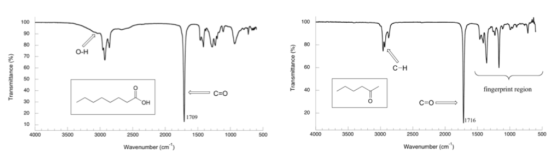
Using one of the plots of IR transmission shown below, calculate the bond strength of the C-O double bond (HINT: treat the complicated molecule as a diatomic one, with everything other than the O lumped into a single “atom”). Explain why the frequencies could be different for the two different molecules shown.
Homework Answers
- bond strength is calculated in terms of force constant and calculation for force constant is shown below:


Add Answer to:
Using one of the plots of IR transmission shown below, calculate the bond strength of the C-O double bond (HINT: treat the complicated molecule as a diatomic one, with everything other than the O lump...
Using one of the plots of IR transmission shown below, calculate the bond strength of the...
 Using one of the plots of IR transmission shown below, calculate
the bond strength of the C-O double bond (HINT: treat the
complicated molecule as a diatomic one, with everything other than
the O lumped into a single “atom”). Explain why the frequencies
could be different for the two different molecules shown.
C-H fingerprint region 40 0 1709 1716 3500 3000 2000 1500 1000 1500 Wavenumber (cm Wavenumber (cm')
Using one of the plots of IR transmission shown below, calculate
the bond strength of the C-O double bond (HINT: treat the
complicated molecule as a diatomic one, with everything other than
the O lumped into a single “atom”). Explain why the frequencies
could be different for the two different molecules shown.
C-H fingerprint region 40 0 1709 1716 3500 3000 2000 1500 1000 1500 Wavenumber (cm Wavenumber (cm')
4. Analyze the IR spectrum of your product, filling in the table below. You should utilize your c...
 If you could help
explain the chart above, that would be awesome.
4. Analyze the IR spectrum of your product, filling in the table below. You should utilize your course textbook (pp. 764-766), if you need assistance. Please note that the frequency given below should be exact (one number), not a range. Use the frequency of the center of the band at its strongest point. Then, on the spectrum itself, mark the characteristic bands at their strongest point with a...
If you could help
explain the chart above, that would be awesome.
4. Analyze the IR spectrum of your product, filling in the table below. You should utilize your course textbook (pp. 764-766), if you need assistance. Please note that the frequency given below should be exact (one number), not a range. Use the frequency of the center of the band at its strongest point. Then, on the spectrum itself, mark the characteristic bands at their strongest point with a...
**URGENT IR UNKNOWN: Please Identify the unknown molecule from the IR spectrum shown below. Pick one...
 **URGENT IR UNKNOWN: Please Identify the unknown molecule from
the IR spectrum shown below. Pick one from the following from the
list of of possibilities for the unknown molecule:
(1,2-dimethoxybenzene, 1,3-propanediol, 1-bromobutane,
1-octanol, 2,3-dimethyl-2-butanol, 2-cyclohexen-1-one,
2-cylopenten-1-one, 2-methylcyclohexanone, 3,3-dimethyl-2-butanone,
3-ethyltolulene, 3-methyl-1-butanol, 4-benzylpiperidine,
4-methylphenol, N,N-dimethylformamide, N-methylaniline, Acetic
anhydride, Acetone, Acetonitrile, Acetophenone, Acetyl chloride,
Allyl alcohol, Anisole, Benzaldehyde, Benzoic acid, Benzophenone,
Benzoyl chloride, Benzyl acetate, Bromobenzene, Cyclohexanone,
Cyclopentanone,Cyclopropyl methyl ketone, Diethylamine,Dimethyl
malonate, Ethyl cyanoacetate, Gamma-butyrolactone, Heptanoic acid,
Methyl benzoate, Methyl propionate, Napthalene,
Nitrobenzene,O-xylene,...
**URGENT IR UNKNOWN: Please Identify the unknown molecule from
the IR spectrum shown below. Pick one from the following from the
list of of possibilities for the unknown molecule:
(1,2-dimethoxybenzene, 1,3-propanediol, 1-bromobutane,
1-octanol, 2,3-dimethyl-2-butanol, 2-cyclohexen-1-one,
2-cylopenten-1-one, 2-methylcyclohexanone, 3,3-dimethyl-2-butanone,
3-ethyltolulene, 3-methyl-1-butanol, 4-benzylpiperidine,
4-methylphenol, N,N-dimethylformamide, N-methylaniline, Acetic
anhydride, Acetone, Acetonitrile, Acetophenone, Acetyl chloride,
Allyl alcohol, Anisole, Benzaldehyde, Benzoic acid, Benzophenone,
Benzoyl chloride, Benzyl acetate, Bromobenzene, Cyclohexanone,
Cyclopentanone,Cyclopropyl methyl ketone, Diethylamine,Dimethyl
malonate, Ethyl cyanoacetate, Gamma-butyrolactone, Heptanoic acid,
Methyl benzoate, Methyl propionate, Napthalene,
Nitrobenzene,O-xylene,...
Butanone is formed by oxidation of Butan-2-ol using acidified potassium dichromate (VI) as shown by the...
 Butanone is formed by oxidation of Butan-2-ol using acidified potassium dichromate (VI) as shown by the following equation. CH:CH-CH(OH)CH3 + [0] → CH3CH,COCH3 + H2O (a) Is butan-2-ol Primary, secondary or tertiary alcohol? Explain your answer. (2) (b) Look at the infrared spectrum below and see whether the compound is butanone or butan-2-ol. Use your knowledge of spectroscopy to identify and explain your answer(3) Table A Infrared absorption data Bond Wavenumber Icm-1 N-H 3300-3500 (amines) O-H 3230-3550 (alcohols) C-H 2850-3300...
3. (3 pts.) Shown below is the IR spectrum 2-acetylcyclohexanone (the structure is provided in the...
 3. (3 pts.) Shown below is the IR spectrum 2-acetylcyclohexanone (the structure is provided in the spectrum). 2- acetylcyclohexanone exists as an equilibrium mixture of diketone and two enol forms. Both the diketone and enol forms can be seen in the provide IR spectrum, although the 2 different enols cannot be distinguished. The IR spectra of both enols is essentially identical and so do not be concerned with distinguishing the enols, just assign peaks to a “generic" enol. On the...
3. shown below is the IR spectrum 2-acetylcyclohexanone (the structure is provided in the spectrum). 2-acetylcyclohexanone...
 3. shown below is the IR spectrum 2-acetylcyclohexanone (the
structure is provided in the spectrum). 2-acetylcyclohexanone
Exists as an equilibrium mixture of diketone and two enol forms.
Both the diketonr and enol forms can be seen in the provide IR
spectrum although the two different enols cannot be distinguished.
The IR spectra of both enols is essentially identical and so do not
be concerned with distinguishing the enols, just assign peaks to a
"generic" enol.
On the spectrum identify the...
3. shown below is the IR spectrum 2-acetylcyclohexanone (the
structure is provided in the spectrum). 2-acetylcyclohexanone
Exists as an equilibrium mixture of diketone and two enol forms.
Both the diketonr and enol forms can be seen in the provide IR
spectrum although the two different enols cannot be distinguished.
The IR spectra of both enols is essentially identical and so do not
be concerned with distinguishing the enols, just assign peaks to a
"generic" enol.
On the spectrum identify the...
URGENT IR UNKNOWN: Please Identify the unknown molecule from the IR spectrum shown below. Pick one...
 URGENT IR UNKNOWN: Please Identify the unknown molecule from the
IR spectrum shown below. Pick one from the following from the list
of of possibilities for the unknown molecule:
80 70 2109.74cm-1 3021.84cm-1 1598.19cm-1 60 3033.75cm-1 50 1070.67am-1 3058.02cm-1 3080 79am-1 40 30 1443.72cm-1 20 1488.33cm-1 1어 757.39cm-1 3291.90cm-1 -o- -2 4000 3500 3000 2000 2500 1500 1000 500450 cm-1 1,2-dimethoxybenzene (91-16-7) 1,3-propanediol (504-63-2) 1-bromobutane (109-65-9) 1-Octanol (111-87-5) 2,3-dimethyl-2-butanol (594-60-5) 2-cyclohexen-1-one (930-68-7) 2-cyclopenten-1-one (930-30-3) 2-methylcyclohexanone (583-60-8) 3,3-dimethyl-2-butanone (75-97-8) 3-ethyltoluene (620-14-4)...
URGENT IR UNKNOWN: Please Identify the unknown molecule from the
IR spectrum shown below. Pick one from the following from the list
of of possibilities for the unknown molecule:
80 70 2109.74cm-1 3021.84cm-1 1598.19cm-1 60 3033.75cm-1 50 1070.67am-1 3058.02cm-1 3080 79am-1 40 30 1443.72cm-1 20 1488.33cm-1 1어 757.39cm-1 3291.90cm-1 -o- -2 4000 3500 3000 2000 2500 1500 1000 500450 cm-1 1,2-dimethoxybenzene (91-16-7) 1,3-propanediol (504-63-2) 1-bromobutane (109-65-9) 1-Octanol (111-87-5) 2,3-dimethyl-2-butanol (594-60-5) 2-cyclohexen-1-one (930-68-7) 2-cyclopenten-1-one (930-30-3) 2-methylcyclohexanone (583-60-8) 3,3-dimethyl-2-butanone (75-97-8) 3-ethyltoluene (620-14-4)...
 Using one of the plots of IR transmission shown below, calculate
the bond strength of the C-O double bond (HINT: treat the
complicated molecule as a diatomic one, with everything other than
the O lumped into a single “atom”). Explain why the frequencies
could be different for the two different molecules shown.
C-H fingerprint region 40 0 1709 1716 3500 3000 2000 1500 1000 1500 Wavenumber (cm Wavenumber (cm')
Using one of the plots of IR transmission shown below, calculate
the bond strength of the C-O double bond (HINT: treat the
complicated molecule as a diatomic one, with everything other than
the O lumped into a single “atom”). Explain why the frequencies
could be different for the two different molecules shown.
C-H fingerprint region 40 0 1709 1716 3500 3000 2000 1500 1000 1500 Wavenumber (cm Wavenumber (cm')
 If you could help
explain the chart above, that would be awesome.
4. Analyze the IR spectrum of your product, filling in the table below. You should utilize your course textbook (pp. 764-766), if you need assistance. Please note that the frequency given below should be exact (one number), not a range. Use the frequency of the center of the band at its strongest point. Then, on the spectrum itself, mark the characteristic bands at their strongest point with a...
If you could help
explain the chart above, that would be awesome.
4. Analyze the IR spectrum of your product, filling in the table below. You should utilize your course textbook (pp. 764-766), if you need assistance. Please note that the frequency given below should be exact (one number), not a range. Use the frequency of the center of the band at its strongest point. Then, on the spectrum itself, mark the characteristic bands at their strongest point with a...
 **URGENT IR UNKNOWN: Please Identify the unknown molecule from
the IR spectrum shown below. Pick one from the following from the
list of of possibilities for the unknown molecule:
(1,2-dimethoxybenzene, 1,3-propanediol, 1-bromobutane,
1-octanol, 2,3-dimethyl-2-butanol, 2-cyclohexen-1-one,
2-cylopenten-1-one, 2-methylcyclohexanone, 3,3-dimethyl-2-butanone,
3-ethyltolulene, 3-methyl-1-butanol, 4-benzylpiperidine,
4-methylphenol, N,N-dimethylformamide, N-methylaniline, Acetic
anhydride, Acetone, Acetonitrile, Acetophenone, Acetyl chloride,
Allyl alcohol, Anisole, Benzaldehyde, Benzoic acid, Benzophenone,
Benzoyl chloride, Benzyl acetate, Bromobenzene, Cyclohexanone,
Cyclopentanone,Cyclopropyl methyl ketone, Diethylamine,Dimethyl
malonate, Ethyl cyanoacetate, Gamma-butyrolactone, Heptanoic acid,
Methyl benzoate, Methyl propionate, Napthalene,
Nitrobenzene,O-xylene,...
**URGENT IR UNKNOWN: Please Identify the unknown molecule from
the IR spectrum shown below. Pick one from the following from the
list of of possibilities for the unknown molecule:
(1,2-dimethoxybenzene, 1,3-propanediol, 1-bromobutane,
1-octanol, 2,3-dimethyl-2-butanol, 2-cyclohexen-1-one,
2-cylopenten-1-one, 2-methylcyclohexanone, 3,3-dimethyl-2-butanone,
3-ethyltolulene, 3-methyl-1-butanol, 4-benzylpiperidine,
4-methylphenol, N,N-dimethylformamide, N-methylaniline, Acetic
anhydride, Acetone, Acetonitrile, Acetophenone, Acetyl chloride,
Allyl alcohol, Anisole, Benzaldehyde, Benzoic acid, Benzophenone,
Benzoyl chloride, Benzyl acetate, Bromobenzene, Cyclohexanone,
Cyclopentanone,Cyclopropyl methyl ketone, Diethylamine,Dimethyl
malonate, Ethyl cyanoacetate, Gamma-butyrolactone, Heptanoic acid,
Methyl benzoate, Methyl propionate, Napthalene,
Nitrobenzene,O-xylene,...
 Butanone is formed by oxidation of Butan-2-ol using acidified potassium dichromate (VI) as shown by the following equation. CH:CH-CH(OH)CH3 + [0] → CH3CH,COCH3 + H2O (a) Is butan-2-ol Primary, secondary or tertiary alcohol? Explain your answer. (2) (b) Look at the infrared spectrum below and see whether the compound is butanone or butan-2-ol. Use your knowledge of spectroscopy to identify and explain your answer(3) Table A Infrared absorption data Bond Wavenumber Icm-1 N-H 3300-3500 (amines) O-H 3230-3550 (alcohols) C-H 2850-3300...
 3. (3 pts.) Shown below is the IR spectrum 2-acetylcyclohexanone (the structure is provided in the spectrum). 2- acetylcyclohexanone exists as an equilibrium mixture of diketone and two enol forms. Both the diketone and enol forms can be seen in the provide IR spectrum, although the 2 different enols cannot be distinguished. The IR spectra of both enols is essentially identical and so do not be concerned with distinguishing the enols, just assign peaks to a “generic" enol. On the...
 3. shown below is the IR spectrum 2-acetylcyclohexanone (the
structure is provided in the spectrum). 2-acetylcyclohexanone
Exists as an equilibrium mixture of diketone and two enol forms.
Both the diketonr and enol forms can be seen in the provide IR
spectrum although the two different enols cannot be distinguished.
The IR spectra of both enols is essentially identical and so do not
be concerned with distinguishing the enols, just assign peaks to a
"generic" enol.
On the spectrum identify the...
3. shown below is the IR spectrum 2-acetylcyclohexanone (the
structure is provided in the spectrum). 2-acetylcyclohexanone
Exists as an equilibrium mixture of diketone and two enol forms.
Both the diketonr and enol forms can be seen in the provide IR
spectrum although the two different enols cannot be distinguished.
The IR spectra of both enols is essentially identical and so do not
be concerned with distinguishing the enols, just assign peaks to a
"generic" enol.
On the spectrum identify the...
 URGENT IR UNKNOWN: Please Identify the unknown molecule from the
IR spectrum shown below. Pick one from the following from the list
of of possibilities for the unknown molecule:
80 70 2109.74cm-1 3021.84cm-1 1598.19cm-1 60 3033.75cm-1 50 1070.67am-1 3058.02cm-1 3080 79am-1 40 30 1443.72cm-1 20 1488.33cm-1 1어 757.39cm-1 3291.90cm-1 -o- -2 4000 3500 3000 2000 2500 1500 1000 500450 cm-1 1,2-dimethoxybenzene (91-16-7) 1,3-propanediol (504-63-2) 1-bromobutane (109-65-9) 1-Octanol (111-87-5) 2,3-dimethyl-2-butanol (594-60-5) 2-cyclohexen-1-one (930-68-7) 2-cyclopenten-1-one (930-30-3) 2-methylcyclohexanone (583-60-8) 3,3-dimethyl-2-butanone (75-97-8) 3-ethyltoluene (620-14-4)...
URGENT IR UNKNOWN: Please Identify the unknown molecule from the
IR spectrum shown below. Pick one from the following from the list
of of possibilities for the unknown molecule:
80 70 2109.74cm-1 3021.84cm-1 1598.19cm-1 60 3033.75cm-1 50 1070.67am-1 3058.02cm-1 3080 79am-1 40 30 1443.72cm-1 20 1488.33cm-1 1어 757.39cm-1 3291.90cm-1 -o- -2 4000 3500 3000 2000 2500 1500 1000 500450 cm-1 1,2-dimethoxybenzene (91-16-7) 1,3-propanediol (504-63-2) 1-bromobutane (109-65-9) 1-Octanol (111-87-5) 2,3-dimethyl-2-butanol (594-60-5) 2-cyclohexen-1-one (930-68-7) 2-cyclopenten-1-one (930-30-3) 2-methylcyclohexanone (583-60-8) 3,3-dimethyl-2-butanone (75-97-8) 3-ethyltoluene (620-14-4)...
Most questions answered within 3 hours.
-
Where is the error in this code sequence?
String s1 = "Hello";
String s2 = "ello";...
asked 11 months ago -
Financial data for Joel de Paris, Inc., for last year
follow:
Joel de Paris, Inc.
Balance...
asked 11 months ago -
Consider this reaction:
Al2(SO4)3 (aq)+ BaCl3
(aq) Al2Cl6 (aq)- +
3BaSO4(s) . What is the...
asked 11 months ago -
Suppose that Savneet is considering increasing her
recent random sample from 20 car rentals to 40...
asked 11 months ago -
Trucks arrive at an unloading terminal at an average rate of 120
per hour.
Trucks arrive...
asked 11 months ago -
Why are methanol and ethanol completely soluble in water while
octanol is not very little soluble....
asked 11 months ago -
A facilities manager at a university reads in a research report
that the mean amount of...
asked 11 months ago -
When the CuSO4 is rehydrated by adding water to the anhydrous
compound, is this an endothermic...
asked 11 months ago -
A ray of sunlight is passing from diamond into crown glass; the
angle of incidence is...
asked 11 months ago -
A block of mass 0.249 kg is placed on top of a light, vertical
spring of...
asked 11 months ago -
how do the kidneys compensate in the presences of acidosis
a) trigger hyperventilate
b) reserve acid...
asked 11 months ago -
Question 501 pts
The rental rate of capital to the firm increases. Which of the
following...
asked 11 months ago