![Problem 13 [3 points Determine whether the work done by the force field is positive, negative or zero a) [1 point] Positive.](http://img.homeworklib.com/images/0e1b023b-623a-435b-9e73-94cdfbce0fcf.png?x-oss-process=image/resize,w_560)
Problem 13
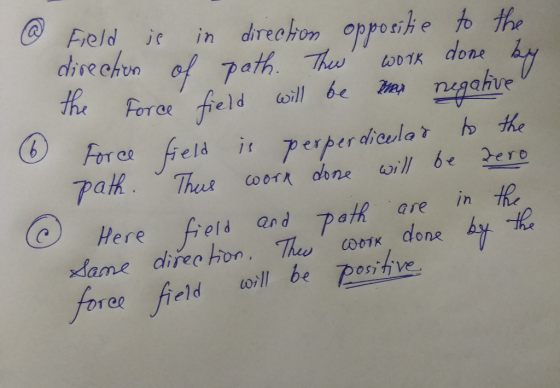
Determine whether the work done by the force field is positive, negative or zero
a) [1 point] Positive. Negative. Zero (see above, circle one)
b) [1 point] Positive. Negative. Zero (see above, circle one)
c) [1 point] Positive. Negative. Zero (see above, circle one)
Homework Answers


Add Answer to:
Determine whether the work done by the force field is positive, negative or zero
(1 point) Determine whether the line integral of each vector field (in blue) along the semicircular, oriented path (in red) is positive, negative, or zero Choose Choose v Choose (1 point) De...
 (1 point) Determine whether the line integral of each vector field (in blue) along the semicircular, oriented path (in red) is positive, negative, or zero Choose Choose v Choose
(1 point) Determine whether the line integral of each vector field (in blue) along the semicircular, oriented path (in red) is positive, negative, or zero Choose Choose v Choose
(1 point) Determine whether the line integral of each vector field (in blue) along the semicircular, oriented path (in red) is positive, negative, or zero Choose Choose v Choose
For the graph on the right, determine if the slope is positive, negative, or zero, and...
 For the graph on the right, determine if the slope is positive, negative, or zero, and whether the y-value of the y-intercept is positive, negative, or zero. The slope is O A. negative. O B. zero. O C. positive. The y-value of the y-intercept is OA. negative. 10 10 B. zero. O C. positive.
Problem 2 2. Determine the work done by force along the path C, that is, compute...
 Problem 2 2. Determine the work done by force along the path C, that is, compute the line integral SF.df from point A to point B. You need to find the parameterization of the curve C and use it to find the line integral: Work = [F.dř =[F(F(t)). F"(t)dt с Use F = (-yx) { +(x²) j in Newtons. and use a = 3 meters in the figure. Parameterization of a circle: Remember that for a circle: F(t)=[rcos(t) rsin(t) 0);...
Work done by gravity positive, negative, or zero (c) After the block reaches the bottom, and cont...
 please help with 8.5, 8.6, 8.7, 8.8
work done by gravity positive, negative, or zero (c) After the block reaches the bottom, and continues sliding back up the bowl until it comes to rest, is the additional work done by gravity positive, negative, or zero? (d) It the bowl is ot frictionless, will the block slide back up to the same height it (c) When friction is present, and after the block reaches the bottom, is the additional was released...
please help with 8.5, 8.6, 8.7, 8.8
work done by gravity positive, negative, or zero (c) After the block reaches the bottom, and continues sliding back up the bowl until it comes to rest, is the additional work done by gravity positive, negative, or zero? (d) It the bowl is ot frictionless, will the block slide back up to the same height it (c) When friction is present, and after the block reaches the bottom, is the additional was released...
Work Done by the Govtational Force bute the gravitational force G m./r into the integral equation...
 Work Done by the Govtational Force bute the gravitational force G m./r into the integral equation on the previous genith Y replacing and find the work done by this force df w is the work done by the gravitational for moves away from t he gravitational force positive, negative, or zero when an object in the Earth? When it moves toward the Earth? When it orbits the Earth in a circle? Part B: Conservative and Non-conservative Forces welop and understorence...
2. Determine the work done by force F along the path C, that is, compute the...
 2. Determine the work done by force F along the path C, that is, compute the line integral SF. dr from point A to point B. You need to find the parameterization of the curve C с and use it to find the line integral: Work = [F-di =[F(F(t).F"(t)dt Use F = (-yx) { +(x²) j in Newtons. and use a = 3 meters in the figure. Parameterization of a circle: Remember that for a circle: r(t) = [rcos(t) rsin(t)...
5. For each reaction determine whether AS for the reaction (ASsys) will be positive, negative, or...
 5. For each reaction determine whether AS for the reaction (ASsys) will be positive, negative, or approximately zero. (2 points, 1 point each) CH3 CH3
Decide (without calculation) whether the integrals are positive, negative, or zero. Let Tbe the top half of the unit ci...
 Decide (without calculation) whether the integrals are positive, negative, or zero. Let Tbe the top half of the unit circle centered at the origin. (a) ycostx) dA
Decide (without calculation) whether the integrals are positive, negative, or zero. Let Tbe the top half of the unit circle centered at the origin. (a) ycostx) dA
Decide (without calculation) whether the integrals are positive, negative, or zero. Let Tbe the top half of the unit circle centered at the origin. (a) ycostx) dA
2. (6 points) Determine whether the following reactions are expected to have positive or negative changes...
 2. (6 points) Determine whether the following reactions are expected to have positive or negative changes in entropy (circle one). Briefly justify each answer in words. a Br2g) 3Cl(g) 2BrCl(g) Justification: POSITIVE NEGATIVE b. CO2(g) H20) H2cO3(aq Justification: POSITIVE NEGATIVE SF&I) SFo(s) Justification POSITIVE NEGATIVE C.
The graph of z = f (x, y) is shown below. In each part, determine whether the given partial derivatives are positive, negative, or zero. (Note that the function is symmetric about 0 in both the x- and y- directions.)
Problem #7:The graph of z = f (x, y) is shown below. In each part, determine whether the given partial derivatives are positive, negative, or zero. (Note that the function is symmetric about 0 in both the x- and y- directions.)(a) fx(2, 2) and fxx(2, 2)(b) fy(2, 2) and fyy(2, 2)(c) fx(−2, 0) and fxx(−2, 0)(d) fy(−2, 0) and fyy(−2, 0)(A) zero, positive (B) negative, negative (C) negative, zero (D) zero, negative (E) positive, negative (F) zero, zero (G) positive, positive (H) positive, zero (I) negative, positive Problem...
 (1 point) Determine whether the line integral of each vector field (in blue) along the semicircular, oriented path (in red) is positive, negative, or zero Choose Choose v Choose
(1 point) Determine whether the line integral of each vector field (in blue) along the semicircular, oriented path (in red) is positive, negative, or zero Choose Choose v Choose
(1 point) Determine whether the line integral of each vector field (in blue) along the semicircular, oriented path (in red) is positive, negative, or zero Choose Choose v Choose
 For the graph on the right, determine if the slope is positive, negative, or zero, and whether the y-value of the y-intercept is positive, negative, or zero. The slope is O A. negative. O B. zero. O C. positive. The y-value of the y-intercept is OA. negative. 10 10 B. zero. O C. positive.
 Problem 2 2. Determine the work done by force along the path C, that is, compute the line integral SF.df from point A to point B. You need to find the parameterization of the curve C and use it to find the line integral: Work = [F.dř =[F(F(t)). F"(t)dt с Use F = (-yx) { +(x²) j in Newtons. and use a = 3 meters in the figure. Parameterization of a circle: Remember that for a circle: F(t)=[rcos(t) rsin(t) 0);...
 please help with 8.5, 8.6, 8.7, 8.8
work done by gravity positive, negative, or zero (c) After the block reaches the bottom, and continues sliding back up the bowl until it comes to rest, is the additional work done by gravity positive, negative, or zero? (d) It the bowl is ot frictionless, will the block slide back up to the same height it (c) When friction is present, and after the block reaches the bottom, is the additional was released...
please help with 8.5, 8.6, 8.7, 8.8
work done by gravity positive, negative, or zero (c) After the block reaches the bottom, and continues sliding back up the bowl until it comes to rest, is the additional work done by gravity positive, negative, or zero? (d) It the bowl is ot frictionless, will the block slide back up to the same height it (c) When friction is present, and after the block reaches the bottom, is the additional was released...
 Work Done by the Govtational Force bute the gravitational force G m./r into the integral equation on the previous genith Y replacing and find the work done by this force df w is the work done by the gravitational for moves away from t he gravitational force positive, negative, or zero when an object in the Earth? When it moves toward the Earth? When it orbits the Earth in a circle? Part B: Conservative and Non-conservative Forces welop and understorence...
 2. Determine the work done by force F along the path C, that is, compute the line integral SF. dr from point A to point B. You need to find the parameterization of the curve C с and use it to find the line integral: Work = [F-di =[F(F(t).F"(t)dt Use F = (-yx) { +(x²) j in Newtons. and use a = 3 meters in the figure. Parameterization of a circle: Remember that for a circle: r(t) = [rcos(t) rsin(t)...
 5. For each reaction determine whether AS for the reaction (ASsys) will be positive, negative, or approximately zero. (2 points, 1 point each) CH3 CH3
 Decide (without calculation) whether the integrals are positive, negative, or zero. Let Tbe the top half of the unit circle centered at the origin. (a) ycostx) dA
Decide (without calculation) whether the integrals are positive, negative, or zero. Let Tbe the top half of the unit circle centered at the origin. (a) ycostx) dA
Decide (without calculation) whether the integrals are positive, negative, or zero. Let Tbe the top half of the unit circle centered at the origin. (a) ycostx) dA
 2. (6 points) Determine whether the following reactions are expected to have positive or negative changes in entropy (circle one). Briefly justify each answer in words. a Br2g) 3Cl(g) 2BrCl(g) Justification: POSITIVE NEGATIVE b. CO2(g) H20) H2cO3(aq Justification: POSITIVE NEGATIVE SF&I) SFo(s) Justification POSITIVE NEGATIVE C.
Most questions answered within 3 hours.
-
Where is the error in this code sequence?
String s1 = "Hello";
String s2 = "ello";...
asked 11 months ago -
Financial data for Joel de Paris, Inc., for last year
follow:
Joel de Paris, Inc.
Balance...
asked 11 months ago -
Consider this reaction:
Al2(SO4)3 (aq)+ BaCl3
(aq) Al2Cl6 (aq)- +
3BaSO4(s) . What is the...
asked 11 months ago -
Suppose that Savneet is considering increasing her
recent random sample from 20 car rentals to 40...
asked 11 months ago -
Trucks arrive at an unloading terminal at an average rate of 120
per hour.
Trucks arrive...
asked 11 months ago -
Why are methanol and ethanol completely soluble in water while
octanol is not very little soluble....
asked 11 months ago -
A facilities manager at a university reads in a research report
that the mean amount of...
asked 11 months ago -
When the CuSO4 is rehydrated by adding water to the anhydrous
compound, is this an endothermic...
asked 11 months ago -
A ray of sunlight is passing from diamond into crown glass; the
angle of incidence is...
asked 11 months ago -
A block of mass 0.249 kg is placed on top of a light, vertical
spring of...
asked 11 months ago -
how do the kidneys compensate in the presences of acidosis
a) trigger hyperventilate
b) reserve acid...
asked 11 months ago -
Question 501 pts
The rental rate of capital to the firm increases. Which of the
following...
asked 11 months ago