An insulated tank has two compartments connected by a membrane. Initially, one compartment contains 0.4 kmol of CO2 at 150 ̊C, 600kPa and the other contains 0.3 kmol of N2 at 100 ̊C, 300kPa. The valve...
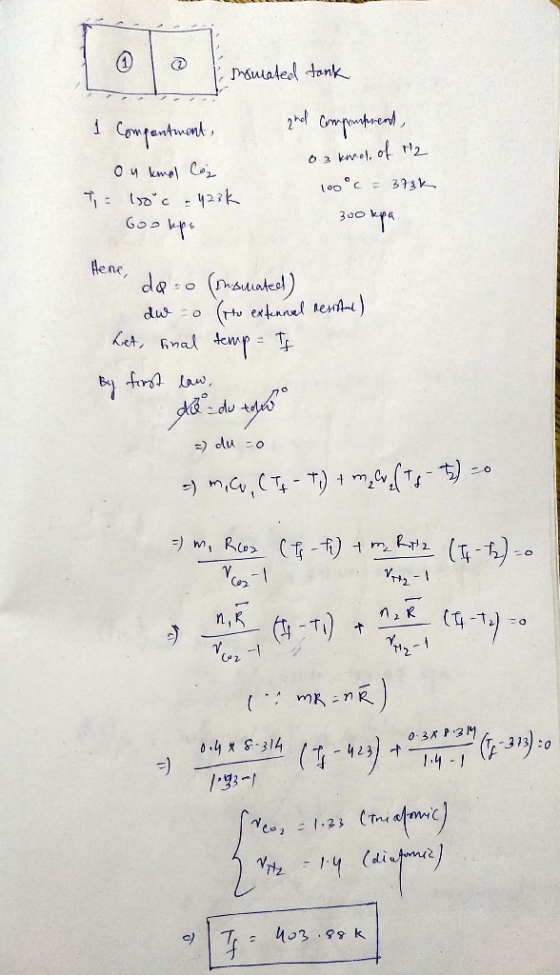
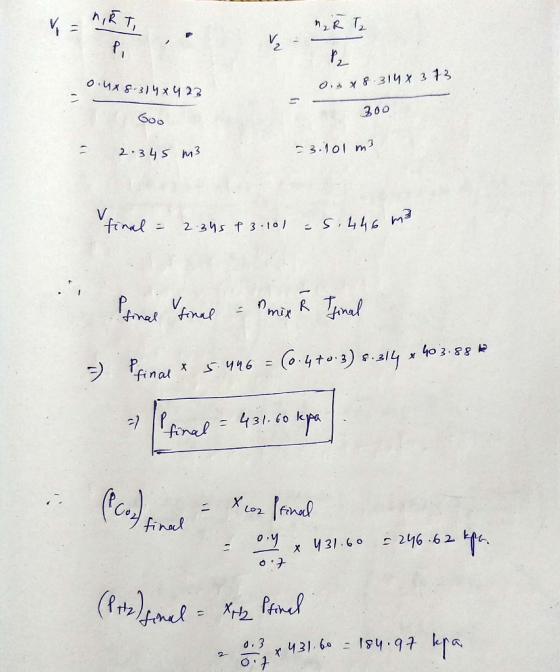
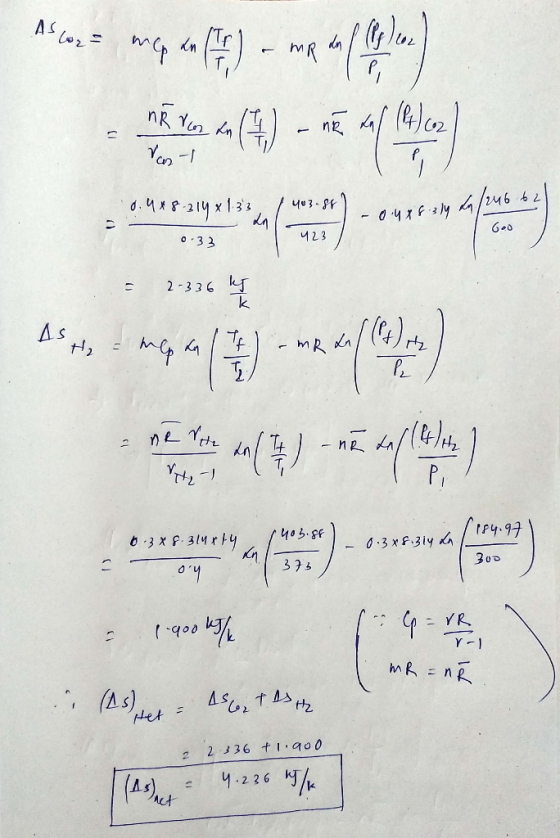
An insulated tank has two compartments connected by a membrane. Initially, one compartment contains 0.4 kmol of CO2 at 150 ̊C, 600kPa and the other contains 0.3 kmol of N2 at 100 ̊C, 300kPa. The valve is opened and the gases are allowed to mix until equilibrium is achieved. Determine the final temperature, pressure, and the amount of entropy generation.
Homework Answers
Add Answer to:
An insulated tank has two compartments connected by a membrane. Initially, one compartment contains 0.4 kmol of CO2 at 150 ̊C, 600kPa and the other contains 0.3 kmol of N2 at 100 ̊C, 300kPa. The valve...
Two rigid tanks are connected by a valve. Initially, one tank contains 10 mº of helium...
 Two rigid tanks are connected by a valve. Initially, one tank contains 10 mº of helium (He) gas at 220 kPa, 40°C? The other tank initially contains 4.0 R of neon (Ne) gas at 150 kPa, sot. Now the valve is opened, allowing the two gases to mix with each other. Heat transfer occurs during the mixing process. The final equilibrium temperature is 44'C. The specific heats of monatomic gases are independent of temperature. Determine: (a) the final volume of...
Consider 0.7 kg of N2 at 300 K, 1 bar contained in a rigid tank connected by a valve to another r...
 Consider 0.7 kg of N2 at 300 K, 1 bar contained in a
rigid tank connected by a valve to another rigid tank holding 0.3
kg of CO2 at 300 K, 1 bar. The valve is opened and gases
are allowed to mix, achieving an equilibrium state at 280 K.
Determine:
(a) the volume of each tank, in m3.
(b) the final pressure, in bar.
(c) the magnitude of the heat transfer to or from the gases during
the process,...
Consider 0.7 kg of N2 at 300 K, 1 bar contained in a
rigid tank connected by a valve to another rigid tank holding 0.3
kg of CO2 at 300 K, 1 bar. The valve is opened and gases
are allowed to mix, achieving an equilibrium state at 280 K.
Determine:
(a) the volume of each tank, in m3.
(b) the final pressure, in bar.
(c) the magnitude of the heat transfer to or from the gases during
the process,...
4-40 4.40 A rigid, insulated tank consists of two compartments of equal volume separated by a...
 4-40
4.40 A rigid, insulated tank consists of two compartments of equal volume separated by a valve. Initially, one compartment contains air at a pressure of 750 kPa and a temperature of 50°C, while the second compartment is completely empty. The valve is opened and it remains open until the two compartments reach pressure and temperature equilibrium. Determine the final pressure and temperature of the air, assuming each compartment has a volume of 0.65 m'.
4-40
4.40 A rigid, insulated tank consists of two compartments of equal volume separated by a valve. Initially, one compartment contains air at a pressure of 750 kPa and a temperature of 50°C, while the second compartment is completely empty. The valve is opened and it remains open until the two compartments reach pressure and temperature equilibrium. Determine the final pressure and temperature of the air, assuming each compartment has a volume of 0.65 m'.
Problem 3-2 A rigid, well-insulated tank consists of two compartments eparated by a valve, one being...
 Problem 3-2 A rigid, well-insulated tank consists of two compartments eparated by a valve, one being twice the volume of the other. Initially, the smaller compartment contains 10 kg of nitrogen at 6 bar and 100°C, while the larger one is evacuated. The valve is opened and the gas expands to fill the total volume, eventually achieving an equilibrium state. Calculate: a) The final temperature, in K. b) The final pressure, in bar, c) The total exergy destroyed, in kJ...
Consider 0.8 kg of N2 at 300 K, 1 bar contained in a rigid tank connected by a valve to another r...
Consider 0.8 kg of N2 at 300 K, 1 bar contained in a rigid tank connected by a valve to another rigid tank holding 0.3 kg of CO2 at 300 K, 1 bar. The valve is opened and gases are allowed to mix, achieving an equilibrium state at 280 K. Determine: (a) the volume of each tank, in m3. (Correct .7124 m^3 and .17 m^3) (b) the final pressure, in bar. (Correct 0.9331 bar) (c) the magnitude of the heat...
A composite system consists of two chambers connected by a short pipe with an insulated valve...
 A composite system consists of two chambers connected by a short pipe with an insulated valve in it. Each chamber has a volume of 0.5 m and the composite system is insulated so it is thermally isolated from the surroundings. Initially the valve is closed and one cham- ber contains 0.5 moles of N2 gas at 400 K while the other contains 0.5 moles of Br2 gas at 800 K. The valve is opened and the gases are allowed to...
An insulated 1.7 m3 rigid tank contains air at 500 kPa and 50oC. A valve connected...
An insulated 1.7 m3 rigid tank contains air at 500 kPa and 50oC. A valve connected to the tank is now opened and air is allowed to escape until the pressure inside drops to 200 kPa. The air temperature during this process is maintained constant by an electric resistance heater placed in the tank. a. Determine the mass of air initially, m1 in kg. b. How much air escaped from the tank, mout in kg. c. Determine the electrical work...
A rigid tank that contains 2.4 kg of N2 at 25°C and 550 kPa is connected...
 A rigid tank that contains 2.4 kg of N2 at 25°C and 550 kPa is connected to another rigid tank that contains 4.4 kg of O2 at 25°C and 150 kPa. The valve connecting the two tanks is opened, and the two gases are allowed to mix. If the final mixture temperature is 25°C, determine the volume of each tank and the final mixture pressure. The gas constants of N2 and O2 are 0.2968 and 0.2598 kPa.m3/kg.K, respectively. The universal...
Thermo1 (14marks) Problem (4) Two tanks are connected by a valve. One tank contains 3 kg...
 Thermo1
(14marks) Problem (4) Two tanks are connected by a valve. One tank contains 3 kg of carbon monoxide (C0) gas at contains 8 kg of the same gas at 27 °C and 120 KPa. The valve is opened and the gases are allowed to mix while receiving energy by heat transfer from the surroundings. The final equilibrium temperature is 42 °C. Determine: 97 °C and 60 KPa. The other tank (a)The final pressure. (b)The heat transfer for the process...
Thermo1
(14marks) Problem (4) Two tanks are connected by a valve. One tank contains 3 kg of carbon monoxide (C0) gas at contains 8 kg of the same gas at 27 °C and 120 KPa. The valve is opened and the gases are allowed to mix while receiving energy by heat transfer from the surroundings. The final equilibrium temperature is 42 °C. Determine: 97 °C and 60 KPa. The other tank (a)The final pressure. (b)The heat transfer for the process...
3. Similar to 13-42 A rigid tank that contains 1.57 kg of N2 at 25°C and...
 3. Similar to 13-42 A rigid tank that contains 1.57 kg of N2 at 25°C and 550 kPa is connected to another rigid tank that contains 3.71 kg of O2 at 25°C and 170 kPa. The valve connecting the two tanks is opened, and the two gases are allowed to mix. If the final mixture temperature is 25°C, determine the volume of each tank and the final mixture pressure
 Two rigid tanks are connected by a valve. Initially, one tank contains 10 mº of helium (He) gas at 220 kPa, 40°C? The other tank initially contains 4.0 R of neon (Ne) gas at 150 kPa, sot. Now the valve is opened, allowing the two gases to mix with each other. Heat transfer occurs during the mixing process. The final equilibrium temperature is 44'C. The specific heats of monatomic gases are independent of temperature. Determine: (a) the final volume of...
 Consider 0.7 kg of N2 at 300 K, 1 bar contained in a
rigid tank connected by a valve to another rigid tank holding 0.3
kg of CO2 at 300 K, 1 bar. The valve is opened and gases
are allowed to mix, achieving an equilibrium state at 280 K.
Determine:
(a) the volume of each tank, in m3.
(b) the final pressure, in bar.
(c) the magnitude of the heat transfer to or from the gases during
the process,...
Consider 0.7 kg of N2 at 300 K, 1 bar contained in a
rigid tank connected by a valve to another rigid tank holding 0.3
kg of CO2 at 300 K, 1 bar. The valve is opened and gases
are allowed to mix, achieving an equilibrium state at 280 K.
Determine:
(a) the volume of each tank, in m3.
(b) the final pressure, in bar.
(c) the magnitude of the heat transfer to or from the gases during
the process,...
 4-40
4.40 A rigid, insulated tank consists of two compartments of equal volume separated by a valve. Initially, one compartment contains air at a pressure of 750 kPa and a temperature of 50°C, while the second compartment is completely empty. The valve is opened and it remains open until the two compartments reach pressure and temperature equilibrium. Determine the final pressure and temperature of the air, assuming each compartment has a volume of 0.65 m'.
4-40
4.40 A rigid, insulated tank consists of two compartments of equal volume separated by a valve. Initially, one compartment contains air at a pressure of 750 kPa and a temperature of 50°C, while the second compartment is completely empty. The valve is opened and it remains open until the two compartments reach pressure and temperature equilibrium. Determine the final pressure and temperature of the air, assuming each compartment has a volume of 0.65 m'.
 Problem 3-2 A rigid, well-insulated tank consists of two compartments eparated by a valve, one being twice the volume of the other. Initially, the smaller compartment contains 10 kg of nitrogen at 6 bar and 100°C, while the larger one is evacuated. The valve is opened and the gas expands to fill the total volume, eventually achieving an equilibrium state. Calculate: a) The final temperature, in K. b) The final pressure, in bar, c) The total exergy destroyed, in kJ...
 A composite system consists of two chambers connected by a short pipe with an insulated valve in it. Each chamber has a volume of 0.5 m and the composite system is insulated so it is thermally isolated from the surroundings. Initially the valve is closed and one cham- ber contains 0.5 moles of N2 gas at 400 K while the other contains 0.5 moles of Br2 gas at 800 K. The valve is opened and the gases are allowed to...
 A rigid tank that contains 2.4 kg of N2 at 25°C and 550 kPa is connected to another rigid tank that contains 4.4 kg of O2 at 25°C and 150 kPa. The valve connecting the two tanks is opened, and the two gases are allowed to mix. If the final mixture temperature is 25°C, determine the volume of each tank and the final mixture pressure. The gas constants of N2 and O2 are 0.2968 and 0.2598 kPa.m3/kg.K, respectively. The universal...
 Thermo1
(14marks) Problem (4) Two tanks are connected by a valve. One tank contains 3 kg of carbon monoxide (C0) gas at contains 8 kg of the same gas at 27 °C and 120 KPa. The valve is opened and the gases are allowed to mix while receiving energy by heat transfer from the surroundings. The final equilibrium temperature is 42 °C. Determine: 97 °C and 60 KPa. The other tank (a)The final pressure. (b)The heat transfer for the process...
Thermo1
(14marks) Problem (4) Two tanks are connected by a valve. One tank contains 3 kg of carbon monoxide (C0) gas at contains 8 kg of the same gas at 27 °C and 120 KPa. The valve is opened and the gases are allowed to mix while receiving energy by heat transfer from the surroundings. The final equilibrium temperature is 42 °C. Determine: 97 °C and 60 KPa. The other tank (a)The final pressure. (b)The heat transfer for the process...
 3. Similar to 13-42 A rigid tank that contains 1.57 kg of N2 at 25°C and 550 kPa is connected to another rigid tank that contains 3.71 kg of O2 at 25°C and 170 kPa. The valve connecting the two tanks is opened, and the two gases are allowed to mix. If the final mixture temperature is 25°C, determine the volume of each tank and the final mixture pressure
Most questions answered within 3 hours.
-
Where is the error in this code sequence?
String s1 = "Hello";
String s2 = "ello";...
asked 11 months ago -
Financial data for Joel de Paris, Inc., for last year
follow:
Joel de Paris, Inc.
Balance...
asked 11 months ago -
Consider this reaction:
Al2(SO4)3 (aq)+ BaCl3
(aq) Al2Cl6 (aq)- +
3BaSO4(s) . What is the...
asked 11 months ago -
Suppose that Savneet is considering increasing her
recent random sample from 20 car rentals to 40...
asked 11 months ago -
Trucks arrive at an unloading terminal at an average rate of 120
per hour.
Trucks arrive...
asked 11 months ago -
Why are methanol and ethanol completely soluble in water while
octanol is not very little soluble....
asked 11 months ago -
A facilities manager at a university reads in a research report
that the mean amount of...
asked 11 months ago -
When the CuSO4 is rehydrated by adding water to the anhydrous
compound, is this an endothermic...
asked 11 months ago -
A ray of sunlight is passing from diamond into crown glass; the
angle of incidence is...
asked 11 months ago -
A block of mass 0.249 kg is placed on top of a light, vertical
spring of...
asked 11 months ago -
how do the kidneys compensate in the presences of acidosis
a) trigger hyperventilate
b) reserve acid...
asked 11 months ago -
Question 501 pts
The rental rate of capital to the firm increases. Which of the
following...
asked 11 months ago