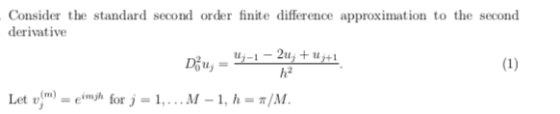
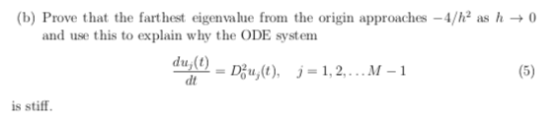
(b) Prove that the farthest eigenvalue from the origin approaches -/h2 as h0 and use this to explain why the ODE systenm du(t) is stiff
Homework Answers
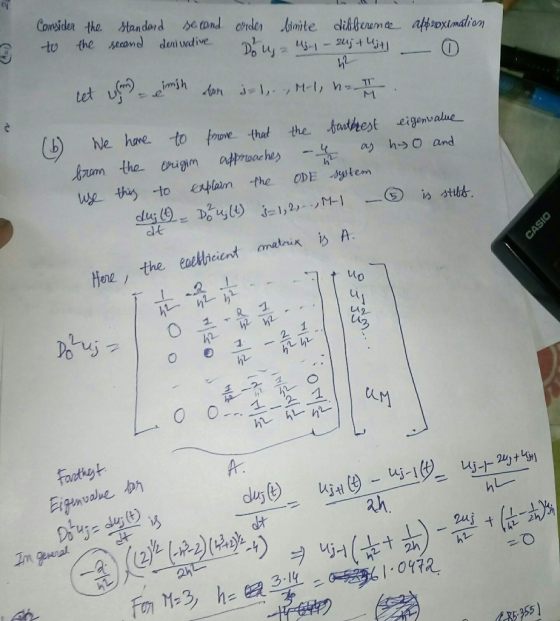
 Matlab Code
clc
clear all
M=3;
h=pi/M;
for i=1:M
A(i,i)=-2/h^2;
end
for i=2:M
A(i-1,i)=1/h^2-1/2*h;
end
for i=1:M-1
A(i+1,i)=1/h^2+1/2*h;
end
A
(eig(A))
Output
A =
-1.8238 0.3883 0
1.4355 -1.8238 0.3883
0 1.4355 -1.8238
ans =
-2.8796
-1.8238
-0.7680
Add Answer to:
Consider the standard second order finite difference approximation to the second derivative h2 Let;") =e.mjh for , = 1, M-1.h=r/M. (b) Prove that the farthest eigenvalue from the origin approach...
Question 1 15 Points) It is always desirable to have/ use the finite difference approximation wit...
 Question 1 15 Points) It is always desirable to have/ use the finite difference approximation with error term. Please using the Taylor Series: higher order of truncation sw(x) h" +R 2! 3! (I) Derive the following forward difference approximation of the 2nd orde 2) What is the order of error for this case? derivative of f(x). f" derivative off(x) h2
Question 1 15 Points) It is always desirable to have/ use the finite difference approximation with error term. Please using...
Question 1 15 Points) It is always desirable to have/ use the finite difference approximation with error term. Please using the Taylor Series: higher order of truncation sw(x) h" +R 2! 3! (I) Derive the following forward difference approximation of the 2nd orde 2) What is the order of error for this case? derivative of f(x). f" derivative off(x) h2
Question 1 15 Points) It is always desirable to have/ use the finite difference approximation with error term. Please using...
3. Consider the following second-order ODE: Using the central difference formula for approximating the second derivative,...
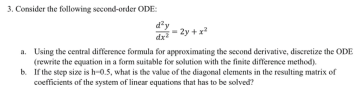 3. Consider the following second-order ODE: Using the central difference formula for approximating the second derivative, discretize the ODE (rewrite the equation in a form suitable for solution with the finite difference method) a. b. If the step size is h-0.5, what is the value of the diagonal elements in the resulting matrix of coefficients of the system of linear equations that has to be solved?
✓ 4. Derive an order h2 accurate one-sided finite difference approximation to the first derivative dø/dx...
 ✓ 4. Derive an order h2 accurate one-sided finite difference approximation to the first derivative dø/dx at the point x = tj. Suppose that the numerical solution di is available at the set of points {C;} and assume constant grid spacing, i.e. h = i+1 - Ti is the same for all i. The derivative must be calculated using ; and only points to its left (i.e. Xj, 2j-1, *;-2, ... use as many as you need). Hint: assume that...
Estimate the second derivative of the following function using stencils for the FORWARD and CENTRAL derivatives for an order of accuracy of O(h2) for each. Use a step size of h -1. fo)x-2x2...
 Estimate the second derivative of the following function using stencils for the FORWARD and CENTRAL derivatives for an order of accuracy of O(h2) for each. Use a step size of h -1. fo)x-2x2 +6 Second derivative, Forward Difference Approximation, o(h2)- Second derivative, Central Difference Approximation, O(h2) Which of the two methods is closer to the true value? (Forward/Central 12.5 points Differential Equation Estimate the second derivative of the following function using stencils for the FORWARD an derivatives for an order...
This is the question: 42 CHAPTER 2. BASICS Example 2.15 We consider the one-dimensional Sturm-Liouville eigenvalue...
 This is the question:
42 CHAPTER 2. BASICS Example 2.15 We consider the one-dimensional Sturm-Liouville eigenvalue problem (2.24) - u"(x) = \u()0<<<, (0) = u(T) = 0, that models the vibration of a homogeneous string of length that is fired at both ends. The eigenvalues and eigenvectors or eigenfunctions of (2.24) are x = k?, ux() = sin ka, KEN Let u" denote the approximation of an (eigen)function u at the grid point Ii, uiuti), Di=ih, 0<i<n +1, h =...
This is the question:
42 CHAPTER 2. BASICS Example 2.15 We consider the one-dimensional Sturm-Liouville eigenvalue problem (2.24) - u"(x) = \u()0<<<, (0) = u(T) = 0, that models the vibration of a homogeneous string of length that is fired at both ends. The eigenvalues and eigenvectors or eigenfunctions of (2.24) are x = k?, ux() = sin ka, KEN Let u" denote the approximation of an (eigen)function u at the grid point Ii, uiuti), Di=ih, 0<i<n +1, h =...
1. Consider a solid cone with uniform density p, height h, and circular base with radius R (hence mass M,sphR2). Let the vertex of the cone be the origin ofthe body frame. By symmetry, choose bas...
 1. Consider a solid cone with uniform density p, height h, and circular base with radius R (hence mass M,sphR2). Let the vertex of the cone be the origin ofthe body frame. By symmetry, choose basis vectors e for the body frame such that the inertia tensor I, is diagonal. Will this rigid body with this body origin be an asymmetric top, a symmetric top, or a spherical top? Calculate the inertia tensor in this basis How will the inertia...
solve problem #1 depending on the given information Consider the following 1D second order elliptic equation with Dirichlet boundary conditions du(x) (c(x)du ) = f(x) (a $15 b), u(a) = ga, u(b) = gb...
 solve problem #1 depending on the given information
Consider the following 1D second order elliptic equation with Dirichlet boundary conditions du(x) (c(x)du ) = f(x) (a $15 b), u(a) = ga, u(b) = gb dr: where u(x) is the unknown function, ga and gb are the Dirichlet boundary values, c(x) is a given coefficient function and f(x) is a given source function. See the theorem 10.1 in the textbook for the existence and uniqueness of the solution. 1.1 Weak Formulation...
solve problem #1 depending on the given information
Consider the following 1D second order elliptic equation with Dirichlet boundary conditions du(x) (c(x)du ) = f(x) (a $15 b), u(a) = ga, u(b) = gb dr: where u(x) is the unknown function, ga and gb are the Dirichlet boundary values, c(x) is a given coefficient function and f(x) is a given source function. See the theorem 10.1 in the textbook for the existence and uniqueness of the solution. 1.1 Weak Formulation...
CALCULUS Consider the function f : R2 → R, defined by ï. Exam 2018 (a) Find the first-order Taylor approximation at the point Xo-(1, -2) and use it to find an approximate value for f(1.1, -2.1 (b) Ca...
 CALCULUS Consider the function f : R2 → R, defined by ï. Exam 2018 (a) Find the first-order Taylor approximation at the point Xo-(1, -2) and use it to find an approximate value for f(1.1, -2.1 (b) Calculate the Hessian ã (x-xo)' (H/(%)) (x-xo) at xo (1,-2) (c) Find the second-order Taylor approximation at Xo (1,-2) and use it to find an approximate value for f(1.1, -2.1) Use the calculator to compute the exact value of the function f(1.1,-2.1) 2....
1. (30pt) LC Circuit and Simple Harmonic Oscillator (From $23.12 RLC Series AC Circuits) Let us...
 1. (30pt) LC Circuit and Simple Harmonic Oscillator (From $23.12 RLC Series AC Circuits) Let us first consider a point mass m > 0 with a spring k> 0 (see Figure 23.52). This system is sometimes called a simple harmonic oscillator. The equation of motion (EMI) is given by ma= -kr (1) where the acceleration a is given by the second derivative of the coordinate r with respect to time t, namely dr(t) (2) dt de(t) (6) at) (3) dt...
Value for transmissivity is 185,location is B,flow rate is 20 Question 1: No-flow boundary conditions are implemented by: Question 2: Flow Calculation with no abstraction or rech...
 Value for transmissivity is 185,location is B,flow rate is
20
Question 1: No-flow boundary conditions are implemented by: Question 2: Flow Calculation with no abstraction or recharge m2/day m/day Condition 1 flow is Condition 2 flow is Question 3: Recharge or abstraction at a node is calculated by: Question 4: Water Level and Flows for Condition 1 are: Water level at pumping/recharge node Flow accross boundary AB Flow accross boundary CD ..,..) is m3/dayFlow accross boundary BC m/dayFlow accross boundary...
Value for transmissivity is 185,location is B,flow rate is
20
Question 1: No-flow boundary conditions are implemented by: Question 2: Flow Calculation with no abstraction or recharge m2/day m/day Condition 1 flow is Condition 2 flow is Question 3: Recharge or abstraction at a node is calculated by: Question 4: Water Level and Flows for Condition 1 are: Water level at pumping/recharge node Flow accross boundary AB Flow accross boundary CD ..,..) is m3/dayFlow accross boundary BC m/dayFlow accross boundary...
 Question 1 15 Points) It is always desirable to have/ use the finite difference approximation with error term. Please using the Taylor Series: higher order of truncation sw(x) h" +R 2! 3! (I) Derive the following forward difference approximation of the 2nd orde 2) What is the order of error for this case? derivative of f(x). f" derivative off(x) h2
Question 1 15 Points) It is always desirable to have/ use the finite difference approximation with error term. Please using...
Question 1 15 Points) It is always desirable to have/ use the finite difference approximation with error term. Please using the Taylor Series: higher order of truncation sw(x) h" +R 2! 3! (I) Derive the following forward difference approximation of the 2nd orde 2) What is the order of error for this case? derivative of f(x). f" derivative off(x) h2
Question 1 15 Points) It is always desirable to have/ use the finite difference approximation with error term. Please using...
 3. Consider the following second-order ODE: Using the central difference formula for approximating the second derivative, discretize the ODE (rewrite the equation in a form suitable for solution with the finite difference method) a. b. If the step size is h-0.5, what is the value of the diagonal elements in the resulting matrix of coefficients of the system of linear equations that has to be solved?
 ✓ 4. Derive an order h2 accurate one-sided finite difference approximation to the first derivative dø/dx at the point x = tj. Suppose that the numerical solution di is available at the set of points {C;} and assume constant grid spacing, i.e. h = i+1 - Ti is the same for all i. The derivative must be calculated using ; and only points to its left (i.e. Xj, 2j-1, *;-2, ... use as many as you need). Hint: assume that...
 Estimate the second derivative of the following function using stencils for the FORWARD and CENTRAL derivatives for an order of accuracy of O(h2) for each. Use a step size of h -1. fo)x-2x2 +6 Second derivative, Forward Difference Approximation, o(h2)- Second derivative, Central Difference Approximation, O(h2) Which of the two methods is closer to the true value? (Forward/Central 12.5 points Differential Equation Estimate the second derivative of the following function using stencils for the FORWARD an derivatives for an order...
 This is the question:
42 CHAPTER 2. BASICS Example 2.15 We consider the one-dimensional Sturm-Liouville eigenvalue problem (2.24) - u"(x) = \u()0<<<, (0) = u(T) = 0, that models the vibration of a homogeneous string of length that is fired at both ends. The eigenvalues and eigenvectors or eigenfunctions of (2.24) are x = k?, ux() = sin ka, KEN Let u" denote the approximation of an (eigen)function u at the grid point Ii, uiuti), Di=ih, 0<i<n +1, h =...
This is the question:
42 CHAPTER 2. BASICS Example 2.15 We consider the one-dimensional Sturm-Liouville eigenvalue problem (2.24) - u"(x) = \u()0<<<, (0) = u(T) = 0, that models the vibration of a homogeneous string of length that is fired at both ends. The eigenvalues and eigenvectors or eigenfunctions of (2.24) are x = k?, ux() = sin ka, KEN Let u" denote the approximation of an (eigen)function u at the grid point Ii, uiuti), Di=ih, 0<i<n +1, h =...
 1. Consider a solid cone with uniform density p, height h, and circular base with radius R (hence mass M,sphR2). Let the vertex of the cone be the origin ofthe body frame. By symmetry, choose basis vectors e for the body frame such that the inertia tensor I, is diagonal. Will this rigid body with this body origin be an asymmetric top, a symmetric top, or a spherical top? Calculate the inertia tensor in this basis How will the inertia...
 solve problem #1 depending on the given information
Consider the following 1D second order elliptic equation with Dirichlet boundary conditions du(x) (c(x)du ) = f(x) (a $15 b), u(a) = ga, u(b) = gb dr: where u(x) is the unknown function, ga and gb are the Dirichlet boundary values, c(x) is a given coefficient function and f(x) is a given source function. See the theorem 10.1 in the textbook for the existence and uniqueness of the solution. 1.1 Weak Formulation...
solve problem #1 depending on the given information
Consider the following 1D second order elliptic equation with Dirichlet boundary conditions du(x) (c(x)du ) = f(x) (a $15 b), u(a) = ga, u(b) = gb dr: where u(x) is the unknown function, ga and gb are the Dirichlet boundary values, c(x) is a given coefficient function and f(x) is a given source function. See the theorem 10.1 in the textbook for the existence and uniqueness of the solution. 1.1 Weak Formulation...
 CALCULUS Consider the function f : R2 → R, defined by ï. Exam 2018 (a) Find the first-order Taylor approximation at the point Xo-(1, -2) and use it to find an approximate value for f(1.1, -2.1 (b) Calculate the Hessian ã (x-xo)' (H/(%)) (x-xo) at xo (1,-2) (c) Find the second-order Taylor approximation at Xo (1,-2) and use it to find an approximate value for f(1.1, -2.1) Use the calculator to compute the exact value of the function f(1.1,-2.1) 2....
 1. (30pt) LC Circuit and Simple Harmonic Oscillator (From $23.12 RLC Series AC Circuits) Let us first consider a point mass m > 0 with a spring k> 0 (see Figure 23.52). This system is sometimes called a simple harmonic oscillator. The equation of motion (EMI) is given by ma= -kr (1) where the acceleration a is given by the second derivative of the coordinate r with respect to time t, namely dr(t) (2) dt de(t) (6) at) (3) dt...
 Value for transmissivity is 185,location is B,flow rate is
20
Question 1: No-flow boundary conditions are implemented by: Question 2: Flow Calculation with no abstraction or recharge m2/day m/day Condition 1 flow is Condition 2 flow is Question 3: Recharge or abstraction at a node is calculated by: Question 4: Water Level and Flows for Condition 1 are: Water level at pumping/recharge node Flow accross boundary AB Flow accross boundary CD ..,..) is m3/dayFlow accross boundary BC m/dayFlow accross boundary...
Value for transmissivity is 185,location is B,flow rate is
20
Question 1: No-flow boundary conditions are implemented by: Question 2: Flow Calculation with no abstraction or recharge m2/day m/day Condition 1 flow is Condition 2 flow is Question 3: Recharge or abstraction at a node is calculated by: Question 4: Water Level and Flows for Condition 1 are: Water level at pumping/recharge node Flow accross boundary AB Flow accross boundary CD ..,..) is m3/dayFlow accross boundary BC m/dayFlow accross boundary...
Most questions answered within 3 hours.
-
Where is the error in this code sequence?
String s1 = "Hello";
String s2 = "ello";...
asked 11 months ago -
Financial data for Joel de Paris, Inc., for last year
follow:
Joel de Paris, Inc.
Balance...
asked 11 months ago -
Consider this reaction:
Al2(SO4)3 (aq)+ BaCl3
(aq) Al2Cl6 (aq)- +
3BaSO4(s) . What is the...
asked 11 months ago -
Suppose that Savneet is considering increasing her
recent random sample from 20 car rentals to 40...
asked 11 months ago -
Trucks arrive at an unloading terminal at an average rate of 120
per hour.
Trucks arrive...
asked 11 months ago -
Why are methanol and ethanol completely soluble in water while
octanol is not very little soluble....
asked 11 months ago -
A facilities manager at a university reads in a research report
that the mean amount of...
asked 11 months ago -
When the CuSO4 is rehydrated by adding water to the anhydrous
compound, is this an endothermic...
asked 11 months ago -
A ray of sunlight is passing from diamond into crown glass; the
angle of incidence is...
asked 11 months ago -
A block of mass 0.249 kg is placed on top of a light, vertical
spring of...
asked 11 months ago -
how do the kidneys compensate in the presences of acidosis
a) trigger hyperventilate
b) reserve acid...
asked 11 months ago -
Question 501 pts
The rental rate of capital to the firm increases. Which of the
following...
asked 11 months ago