I’m trying something new with these types of problems, so please provide feedback if you have any. If you work through the “Build a Trivia Game” problems throughout the course’s tutorials, by the end...
I’m trying something new with these types of problems, so please
provide feedback if
you have any. If you work through the “Build a Trivia Game”
problems throughout the
course’s tutorials, by the end of the course you will have created
a trivia game that
retrieves questions from the Internet, keeps track of a user’s
score throughout a game,
and remembers the high scores forever.
This week, we will start with a simplified version of a trivia game
(decomposition!) and
continue to add details in future weeks. For this week, write a
program that prints out a
single trivia question that you made up, gets an answer from the
user, and then tells
them if they were correct or not.
One thing you may want to consider is case sensitivity (e.g.,
“Ottawa” is not equal to
“ottawa”). We will talk about handling string data in more detail
later, but for now all you
need to know is that Python has a way to convert strings to
lower/upper case. If x is a
5
string variable, then x.upper() evaluates to the uppercase version
of x. There is also
x.lower(). So if x = “Ottawa” and y = “otTAwa”, x does not equal y,
but x.lower() equals
y.lower(). Like the int/float/str type conversions, this does not
actually change the value
of x but only evaluates to the lowercase representation of x.
Homework Answers
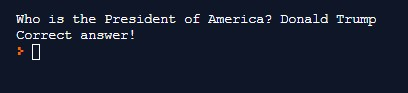
question = input("\nWho is the President of America? ")
answer = "donald trump"
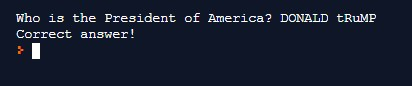
question = question.lower()
if(question == answer):
print("Correct answer!")
else:
print("Incorrect answer!")
******************************************************************* SCREENSHOT*********************************************************

Add Answer to:
I’m trying something new with these types of problems, so please provide feedback if you have any. If you work through the “Build a Trivia Game” problems throughout the course’s tutorials, by the end...
Most questions answered within 3 hours.
-
Where is the error in this code sequence?
String s1 = "Hello";
String s2 = "ello";...
asked 10 months ago -
Financial data for Joel de Paris, Inc., for last year
follow:
Joel de Paris, Inc.
Balance...
asked 10 months ago -
Consider this reaction:
Al2(SO4)3 (aq)+ BaCl3
(aq) Al2Cl6 (aq)- +
3BaSO4(s) . What is the...
asked 10 months ago -
Suppose that Savneet is considering increasing her
recent random sample from 20 car rentals to 40...
asked 10 months ago -
Trucks arrive at an unloading terminal at an average rate of 120
per hour.
Trucks arrive...
asked 10 months ago -
Why are methanol and ethanol completely soluble in water while
octanol is not very little soluble....
asked 10 months ago -
A facilities manager at a university reads in a research report
that the mean amount of...
asked 10 months ago -
When the CuSO4 is rehydrated by adding water to the anhydrous
compound, is this an endothermic...
asked 10 months ago -
A ray of sunlight is passing from diamond into crown glass; the
angle of incidence is...
asked 10 months ago -
A block of mass 0.249 kg is placed on top of a light, vertical
spring of...
asked 10 months ago -
how do the kidneys compensate in the presences of acidosis
a) trigger hyperventilate
b) reserve acid...
asked 10 months ago -
Question 501 pts
The rental rate of capital to the firm increases. Which of the
following...
asked 10 months ago