
Homework Answers
Add Answer to:
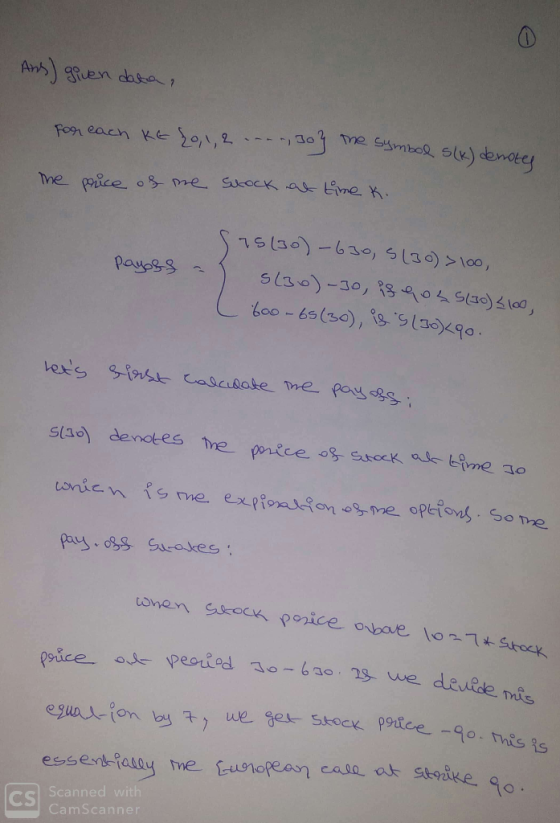
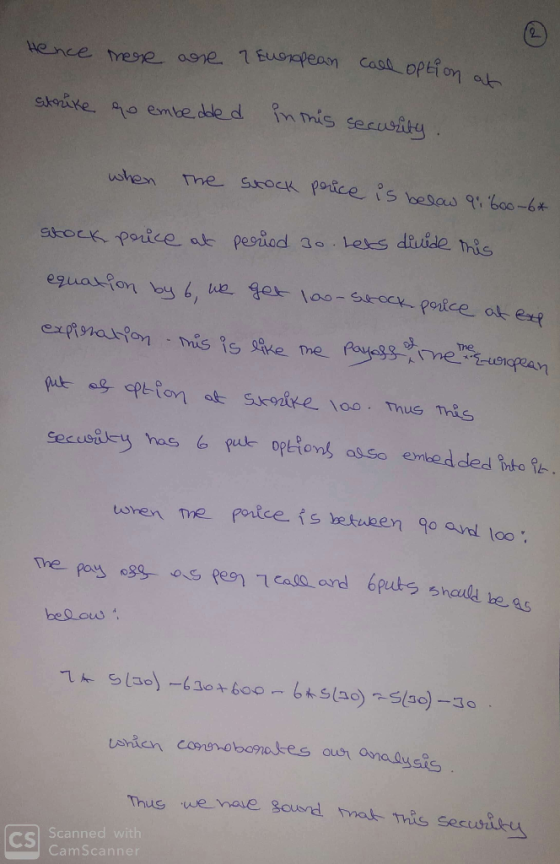
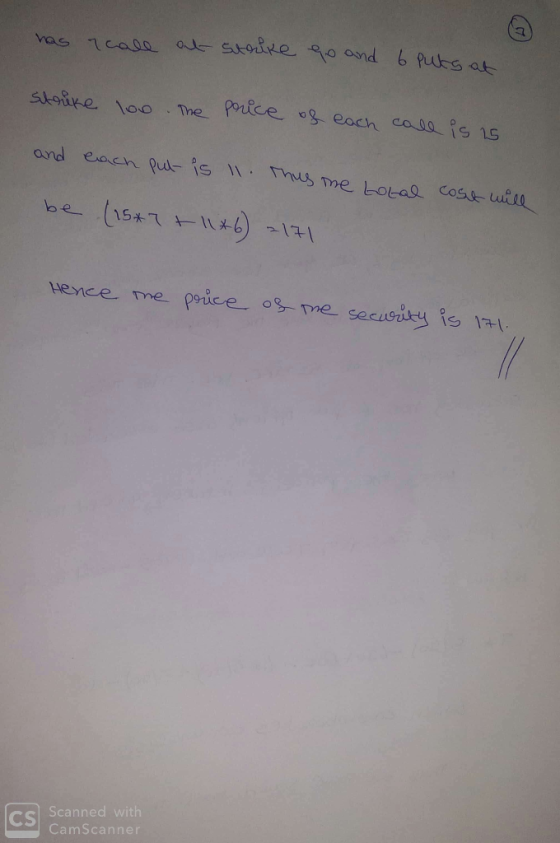
3. (10 pts) For each k e [0, 1,2,..., 301 the symbol S(k) denotes the price of the stock at time k. A European call option with strike 90 and expiration n- 30 costs 15. A European put option with...
g) European call with a strike price of $40 costs $7. European put with the same...
 g) European call with a strike price of $40 costs $7. European put with the same strike price and expiration date costs $6. Assume that you buy two calls and one put (strap strategy). Sketch the graph and write down functions of payoff and profit h) Consider a stock with a price of $50 and there is European put option on that stock with the strike of $55 and premium of $4. Assume that you buy 1/3 of a stock...
1 In this problem c(K,T) denotes the price of a European call option with strike price...
 1 In this problem c(K,T) denotes the price of a European call option with strike price K and strike time T, p(K,T) is the price of the identical put option, r is the risk-free rate and So is the current price of the underlying security. Which of the following are correct? i 0 <c(50,T) - c(55,T) <5e-rT ii 50e-rT <p(45, T) - c(50,T) + So < 55e-rT iii 45e-T <p(45, T) - c(50,T) + So < 50e-rT
Chapter 10 - Mechanics of Options Markets 1-Calculate the payoff at expiration for a call option...
 Chapter 10 - Mechanics of Options Markets 1-Calculate the payoff at expiration for a call option on the S&P 100 stock index in which the underlying price is 623.22 at expiration, the multiplier is 100, the strike price is: k a) 475 k b) 750
A European call option has a strike price of $20 and an expiration date in six...
A European call option has a strike price of $20 and an expiration date in six months. The premium for the call option is $5. The current stock price is $25. The risk-free rate is 2% per annum with continuous compounding. What is the payoff to the portfolio, short selling the stock, lending $19.80 and buying a call option? (Hint: fill in the table below.) Value of ST Payoff ST ≤ 20 ST > 20 How much do you pay...
A call option on a stock with a strike price of $60 costs $8. A put...
A call option on a stock with a strike price of $60 costs $8. A put option on the same stock with the same strike price costs $6. They both expire in 1 year. (a) How can these two options be used to create a straddle? (b) What is the initial investment? (c) Construct a table showing how the payoff and profit varies with ST in 1 year, for the straddle that you constructed. Whenever you need to refer to...
The diagram below represents the payoff of a European call option on the stock with a...
The diagram below represents the payoff of a European call option on the stock with a strike price (K)= $100, initial cost (option premium) =$10, and option life of 6 months. The market price of the underlying stock reaches ($115) at the maturity date of the option, explains in detail whether the holder of this option will exercise his option and achieve profit knowing that the profit is the final payoff minus the initial cost? 30 20 10 0 -10...
A 1-year European put option on a stock with strike price of $50 is quoted as...
A 1-year European put option on a stock with strike price of $50 is quoted as $7; a 1-year European call option on the same stock with strike price $30 is quoted as $5. Suppose you long one put and short one call (one option is on 100 share). a) Draw the payoff diagram for your put position and call position. (5 points) b) After 1-year, stock price turns out to be $45. What is your total payoff? What is...
A European call option and put option on a stock both have a strike price of...
A European call option and put option on a stock both have a strike price of $45 and an expiration date in six months. Both sell for $2. The risk-free interest rate is 5% p.a. The current stock price is $43. There is no dividend expected for the next six months. a) If the stock price in three months is $48, which option is in the money and which one is out of the money? b) As an arbitrageur, can...
You purchase a European put option on XYZ stock with strike price 50. What is the...
 You purchase a European put option on XYZ stock with strike price 50. What is the payoff to the option if XYZ stock is trading at 48 on the expiration day? You purchase a 1-year European call option on ABC stock with strike price 100. The option premium is $10. The effective annual interest rate is 10%, so that 100 dollars lent for 1 year will return 110 dollars. What is the PROFIT if ABC stock is trading at 111...
Consider a European call option on a non-dividend-paying stock. The strike price is K, the time...
 Consider a European call option on a non-dividend-paying stock. The strike price is K, the time to expiration is T, and the price of one unit of a zero-coupon bond (with face value one) maturing at T is B(T). Denote the price of the call by C. Show that C > max{0, So – KB(T)}, where So is the current stock price.
 g) European call with a strike price of $40 costs $7. European put with the same strike price and expiration date costs $6. Assume that you buy two calls and one put (strap strategy). Sketch the graph and write down functions of payoff and profit h) Consider a stock with a price of $50 and there is European put option on that stock with the strike of $55 and premium of $4. Assume that you buy 1/3 of a stock...
 1 In this problem c(K,T) denotes the price of a European call option with strike price K and strike time T, p(K,T) is the price of the identical put option, r is the risk-free rate and So is the current price of the underlying security. Which of the following are correct? i 0 <c(50,T) - c(55,T) <5e-rT ii 50e-rT <p(45, T) - c(50,T) + So < 55e-rT iii 45e-T <p(45, T) - c(50,T) + So < 50e-rT
 Chapter 10 - Mechanics of Options Markets 1-Calculate the payoff at expiration for a call option on the S&P 100 stock index in which the underlying price is 623.22 at expiration, the multiplier is 100, the strike price is: k a) 475 k b) 750
 You purchase a European put option on XYZ stock with strike price 50. What is the payoff to the option if XYZ stock is trading at 48 on the expiration day? You purchase a 1-year European call option on ABC stock with strike price 100. The option premium is $10. The effective annual interest rate is 10%, so that 100 dollars lent for 1 year will return 110 dollars. What is the PROFIT if ABC stock is trading at 111...
 Consider a European call option on a non-dividend-paying stock. The strike price is K, the time to expiration is T, and the price of one unit of a zero-coupon bond (with face value one) maturing at T is B(T). Denote the price of the call by C. Show that C > max{0, So – KB(T)}, where So is the current stock price.
Most questions answered within 3 hours.
-
Where is the error in this code sequence?
String s1 = "Hello";
String s2 = "ello";...
asked 10 months ago -
Financial data for Joel de Paris, Inc., for last year
follow:
Joel de Paris, Inc.
Balance...
asked 10 months ago -
Consider this reaction:
Al2(SO4)3 (aq)+ BaCl3
(aq) Al2Cl6 (aq)- +
3BaSO4(s) . What is the...
asked 10 months ago -
Suppose that Savneet is considering increasing her
recent random sample from 20 car rentals to 40...
asked 10 months ago -
Trucks arrive at an unloading terminal at an average rate of 120
per hour.
Trucks arrive...
asked 10 months ago -
Why are methanol and ethanol completely soluble in water while
octanol is not very little soluble....
asked 10 months ago -
A facilities manager at a university reads in a research report
that the mean amount of...
asked 10 months ago -
When the CuSO4 is rehydrated by adding water to the anhydrous
compound, is this an endothermic...
asked 10 months ago -
A ray of sunlight is passing from diamond into crown glass; the
angle of incidence is...
asked 10 months ago -
A block of mass 0.249 kg is placed on top of a light, vertical
spring of...
asked 10 months ago -
how do the kidneys compensate in the presences of acidosis
a) trigger hyperventilate
b) reserve acid...
asked 10 months ago -
Question 501 pts
The rental rate of capital to the firm increases. Which of the
following...
asked 10 months ago