![CSC1101 TakeHome Lab02 (1),docx - Compatibility Mode Saved to this PC s Review View Help ρ Search 3. [11] You have been hired](http://img.homeworklib.com/images/eb30b366-6c63-4805-ab46-b3699eb73d92.png?x-oss-process=image/resize,w_560)

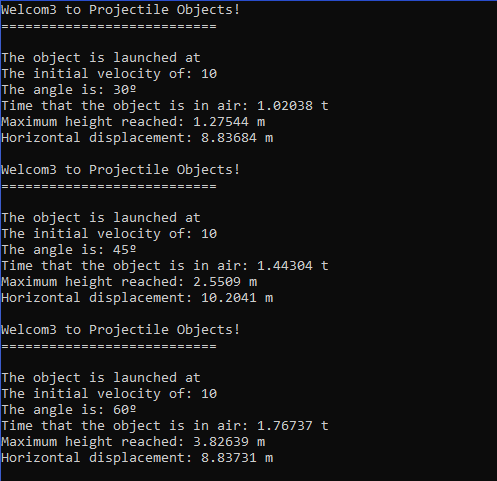
Welcome to Projectile 0bjects! The object is launched at an initial velocity of: 10 m/s The angle is: 300 Time that the object is in air: 1.02038 t Maximum height reached: 1.27544 m Horizontal displacement: 8.83684 m Welcome to Projectile Objects! The object is launched at an initial velocity of 10 m/s The angle is: 45° Time that the object is in air: 1.44304 1t Maximum height reached: 2.5509 Horizontal displacement: 10.2041 m Welcome to Projectile Objects! The object is launched at an initial velocity of: 10 m/s angle is: 60° Time that the object is in air: 1.76737 t Maximum height reached: 3.82639 m Horizontal displacement: 8.83731 m your program code here] If possible, format your oode 11ke this Font "Courier New" Bold
Homework Answers
#include<iostream>
#include<cmath>
using namespace std;
int main()
{
const double GRAVITY = 9.8,PI=3.1415;
char DEG = char(167);
int angles[3]={30,45,60};
double t, maxH,v0=10,range,vx,vy,angle;
for(int i=0;i<3;i++)
{
cout<<"Welcom3 to Projectile
Objects!\n";
cout<<"===========================\n\n";
angle = angles[i]*PI/180;
cout<<"The object is launched
at\n";
cout<<"The initial velocity
of: "<<v0<<endl;
cout<<"The angle is:
"<<angles[i]<<DEG<<endl;
vx=v0*cos(angle);
vy=v0*sin(angle);
t=vy/GRAVITY;
cout<<"Time that the object
is in air: "<<2*t<<" t\n";
maxH=.5*GRAVITY*t*t;
range=vx*2*t;
cout<<"Maximum height
reached: "<<maxH<<" m\n";
cout<<"Horizontal
displacement: "<<range<<" m\n\n";
}
return 0;
}
Add Answer to:
C++ should be used C++ should be used CSC1101 TakeHome Lab02 (1),docx - Compatibility Mode Saved to this PC s Review View Help ρ Search 3. [11] You have been hired by Projectile Objects to cre...
this is how output should look CSC1101 TakeHome Lab02 (1),docx - Compatibility Mode Saved to this PC S Review View. Help Search 3. [11] You have been hired by Projectile Objects to create a...
 this is how output should look
CSC1101 TakeHome Lab02 (1),docx - Compatibility Mode Saved to this PC S Review View. Help Search 3. [11] You have been hired by Projectile Objects to create a calculator for various equations from kinematics. Suppose someone shoots an object and it does projectile motion with an angle of 30, 45 and 60 degrees to the horizontal. Choose it's initial velocity (ex. 10 m/s) find the maximum height it can reach, horizontal displacement and total...
this is how output should look
CSC1101 TakeHome Lab02 (1),docx - Compatibility Mode Saved to this PC S Review View. Help Search 3. [11] You have been hired by Projectile Objects to create a calculator for various equations from kinematics. Suppose someone shoots an object and it does projectile motion with an angle of 30, 45 and 60 degrees to the horizontal. Choose it's initial velocity (ex. 10 m/s) find the maximum height it can reach, horizontal displacement and total...
THE VERTICAL DISPLACEMENT IS NOT ZERO BECAUSE THE PROJECTILE LANDS ON HEIGHT H Problem 1: Consider...
 THE VERTICAL DISPLACEMENT IS
NOT ZERO BECAUSE THE PROJECTILE LANDS ON HEIGHT H
Problem 1: Consider a projectile launched with an initial velocity of 120 f/s. Let us assume that the projectile lands on a a) Determine the range R as a function of time. b) Determine the initial launch angle, 8, such that the projectile achieves the maximum possible horizontal range Hint: think about how to compute maxima and minima from calculus. Once you have computed the launch angle...
THE VERTICAL DISPLACEMENT IS
NOT ZERO BECAUSE THE PROJECTILE LANDS ON HEIGHT H
Problem 1: Consider a projectile launched with an initial velocity of 120 f/s. Let us assume that the projectile lands on a a) Determine the range R as a function of time. b) Determine the initial launch angle, 8, such that the projectile achieves the maximum possible horizontal range Hint: think about how to compute maxima and minima from calculus. Once you have computed the launch angle...
ASSIGNMENT PROBLEMS 1: A projectile is fired with an initial speed of 60.0 m/s at an...
 ASSIGNMENT PROBLEMS 1: A projectile is fired with an initial speed of 60.0 m/s at an angle of 30.0°above the horizontal on a long flat field. Determine (a) The maximum height reached by the projectile. (b) The time it takes to get to the maximum height. (c) The total time in the air. (d) The total horizontal distance covered. (e) The velocity of the projectile 1.50 s after firing distance.
213 2.4 #3 Projectile Motion Problem (24 Points) A mortar round is fired at an angle...
 213 2.4 #3 Projectile Motion Problem (24 Points) A mortar round is fired at an angle of 60.0 deelative to the horizontal axis with an initial speed of 300 m/s at a height of 950 meters above a level surface? Neglect the effects of air resistance, etc. and take the gravitational acceleration to be 9.8 m/s vertically down- ward a. What are the horizontal and the vertical components of the mortar round's velocity immediately after being launched? 300 cos(60) 160...
EXPLORE A projectile is launched with a launch angle of 30° with respect to the horizontal...
EXPLORE A projectile is launched with a launch angle of 30° with respect to the horizontal direction and with an initial speed of 40 m/s. (A) How do the vertical and horizontal components of the projectile's velocity vary with time? (B) How long does it remain in flight? (C) For a given launch speed, what launch angle produces the longest time of flight? CONCEPTUALIZE Consider the projectile to be a point mass that starts with an initial velocity, upward and...
Dr. C. #1: Exploding Projectile: A projectile of mass 9.6 kg is shot from the ground with an init...
 Dr. C. #1: Exploding Projectile: A projectile of mass 9.6 kg is shot from the ground with an initial velocity of 12.4 m/s at an angle of 54° above the horizontal. A. Assuming the ground underneath the projectile's path is flat, what is the maximum height h the projectile reaches, its horizontal range R, and the time it spends in the air? Suppose that, at the peak of the projectile's motion, an explosion splits the projectile in half and one...
EXPLORE A projectile is launched with a launch angle of 30° with respect to the horizontal...
 EXPLORE A projectile is launched with a launch angle of 30° with respect to the horizontal direction and with an initial speed of 10 m/s. s0 (A) How do the vertical and horizontal components of the projectile's velocity vary with time? 40 35 (B) How long does it remain in flight? 25 (C) For a given launch speed, what launch angle produces the longest time of flight? 15 10 toy CONCEPTUALIZE Consider the projectile to be a point mass that...
Please help with Q1 a)b)c). Question 1: In the lectures we considered simple projectile motion. Here we extend the description to include air resistance. For macroscopic objects in air, the dynamics...
 Please help with Q1 a)b)c).
Question 1: In the lectures we considered simple projectile motion. Here we extend the description to include air resistance. For macroscopic objects in air, the dynamics equations including air resistance may be written V and ^- where m is the mass of the object, g is the acceleration due to gravity, y is the vertical direction, C is a dimensionless drag coefficient, A is the cross-sectional area of the object, pa 1.2kg/m3 is the density...
Please help with Q1 a)b)c).
Question 1: In the lectures we considered simple projectile motion. Here we extend the description to include air resistance. For macroscopic objects in air, the dynamics equations including air resistance may be written V and ^- where m is the mass of the object, g is the acceleration due to gravity, y is the vertical direction, C is a dimensionless drag coefficient, A is the cross-sectional area of the object, pa 1.2kg/m3 is the density...
7. Do the projectile motion General Motion with Unit Vectors and Components An object undergoes the...
 7. Do the projectile motion
General Motion with Unit Vectors and Components An object undergoes the following consecutive displacements: s (2i +3j +5k)m,s2 (6i- 9j + 2k)m, and s3 (10i 8j -k)m. a) Find the resultant displacement in terms of unit vectors and components. b) State the magnitude of the resultant displacement. 2. Suppose a hiker travels 5 km southwest from their camp. Then, the hiker travels 2 km 75° north of east. a) Find the displacement of the hiker...
7. Do the projectile motion
General Motion with Unit Vectors and Components An object undergoes the following consecutive displacements: s (2i +3j +5k)m,s2 (6i- 9j + 2k)m, and s3 (10i 8j -k)m. a) Find the resultant displacement in terms of unit vectors and components. b) State the magnitude of the resultant displacement. 2. Suppose a hiker travels 5 km southwest from their camp. Then, the hiker travels 2 km 75° north of east. a) Find the displacement of the hiker...
ENES 100 Due 11/14/2018 Homework #6 Submit all your work in a thumb drive or via...
 ENES 100 Due 11/14/2018 Homework #6 Submit all your work in a thumb drive or via email using the appropriate filenames 1. When an object is launched from the ground with an initial velocity of vo at an angle of 0o, the horizontal and vertical displacements of the object travel before it hits ground can be written as functions of time t: x(t) - vo t cos(e) Uo Figure 1: Projectile of an object. A baseball has been tossed with...
 this is how output should look
CSC1101 TakeHome Lab02 (1),docx - Compatibility Mode Saved to this PC S Review View. Help Search 3. [11] You have been hired by Projectile Objects to create a calculator for various equations from kinematics. Suppose someone shoots an object and it does projectile motion with an angle of 30, 45 and 60 degrees to the horizontal. Choose it's initial velocity (ex. 10 m/s) find the maximum height it can reach, horizontal displacement and total...
this is how output should look
CSC1101 TakeHome Lab02 (1),docx - Compatibility Mode Saved to this PC S Review View. Help Search 3. [11] You have been hired by Projectile Objects to create a calculator for various equations from kinematics. Suppose someone shoots an object and it does projectile motion with an angle of 30, 45 and 60 degrees to the horizontal. Choose it's initial velocity (ex. 10 m/s) find the maximum height it can reach, horizontal displacement and total...
 THE VERTICAL DISPLACEMENT IS
NOT ZERO BECAUSE THE PROJECTILE LANDS ON HEIGHT H
Problem 1: Consider a projectile launched with an initial velocity of 120 f/s. Let us assume that the projectile lands on a a) Determine the range R as a function of time. b) Determine the initial launch angle, 8, such that the projectile achieves the maximum possible horizontal range Hint: think about how to compute maxima and minima from calculus. Once you have computed the launch angle...
THE VERTICAL DISPLACEMENT IS
NOT ZERO BECAUSE THE PROJECTILE LANDS ON HEIGHT H
Problem 1: Consider a projectile launched with an initial velocity of 120 f/s. Let us assume that the projectile lands on a a) Determine the range R as a function of time. b) Determine the initial launch angle, 8, such that the projectile achieves the maximum possible horizontal range Hint: think about how to compute maxima and minima from calculus. Once you have computed the launch angle...
 ASSIGNMENT PROBLEMS 1: A projectile is fired with an initial speed of 60.0 m/s at an angle of 30.0°above the horizontal on a long flat field. Determine (a) The maximum height reached by the projectile. (b) The time it takes to get to the maximum height. (c) The total time in the air. (d) The total horizontal distance covered. (e) The velocity of the projectile 1.50 s after firing distance.
 213 2.4 #3 Projectile Motion Problem (24 Points) A mortar round is fired at an angle of 60.0 deelative to the horizontal axis with an initial speed of 300 m/s at a height of 950 meters above a level surface? Neglect the effects of air resistance, etc. and take the gravitational acceleration to be 9.8 m/s vertically down- ward a. What are the horizontal and the vertical components of the mortar round's velocity immediately after being launched? 300 cos(60) 160...
 Dr. C. #1: Exploding Projectile: A projectile of mass 9.6 kg is shot from the ground with an initial velocity of 12.4 m/s at an angle of 54° above the horizontal. A. Assuming the ground underneath the projectile's path is flat, what is the maximum height h the projectile reaches, its horizontal range R, and the time it spends in the air? Suppose that, at the peak of the projectile's motion, an explosion splits the projectile in half and one...
 EXPLORE A projectile is launched with a launch angle of 30° with respect to the horizontal direction and with an initial speed of 10 m/s. s0 (A) How do the vertical and horizontal components of the projectile's velocity vary with time? 40 35 (B) How long does it remain in flight? 25 (C) For a given launch speed, what launch angle produces the longest time of flight? 15 10 toy CONCEPTUALIZE Consider the projectile to be a point mass that...
 Please help with Q1 a)b)c).
Question 1: In the lectures we considered simple projectile motion. Here we extend the description to include air resistance. For macroscopic objects in air, the dynamics equations including air resistance may be written V and ^- where m is the mass of the object, g is the acceleration due to gravity, y is the vertical direction, C is a dimensionless drag coefficient, A is the cross-sectional area of the object, pa 1.2kg/m3 is the density...
Please help with Q1 a)b)c).
Question 1: In the lectures we considered simple projectile motion. Here we extend the description to include air resistance. For macroscopic objects in air, the dynamics equations including air resistance may be written V and ^- where m is the mass of the object, g is the acceleration due to gravity, y is the vertical direction, C is a dimensionless drag coefficient, A is the cross-sectional area of the object, pa 1.2kg/m3 is the density...
 7. Do the projectile motion
General Motion with Unit Vectors and Components An object undergoes the following consecutive displacements: s (2i +3j +5k)m,s2 (6i- 9j + 2k)m, and s3 (10i 8j -k)m. a) Find the resultant displacement in terms of unit vectors and components. b) State the magnitude of the resultant displacement. 2. Suppose a hiker travels 5 km southwest from their camp. Then, the hiker travels 2 km 75° north of east. a) Find the displacement of the hiker...
7. Do the projectile motion
General Motion with Unit Vectors and Components An object undergoes the following consecutive displacements: s (2i +3j +5k)m,s2 (6i- 9j + 2k)m, and s3 (10i 8j -k)m. a) Find the resultant displacement in terms of unit vectors and components. b) State the magnitude of the resultant displacement. 2. Suppose a hiker travels 5 km southwest from their camp. Then, the hiker travels 2 km 75° north of east. a) Find the displacement of the hiker...
 ENES 100 Due 11/14/2018 Homework #6 Submit all your work in a thumb drive or via email using the appropriate filenames 1. When an object is launched from the ground with an initial velocity of vo at an angle of 0o, the horizontal and vertical displacements of the object travel before it hits ground can be written as functions of time t: x(t) - vo t cos(e) Uo Figure 1: Projectile of an object. A baseball has been tossed with...
Most questions answered within 3 hours.
-
Where is the error in this code sequence?
String s1 = "Hello";
String s2 = "ello";...
asked 10 months ago -
Financial data for Joel de Paris, Inc., for last year
follow:
Joel de Paris, Inc.
Balance...
asked 10 months ago -
Consider this reaction:
Al2(SO4)3 (aq)+ BaCl3
(aq) Al2Cl6 (aq)- +
3BaSO4(s) . What is the...
asked 10 months ago -
Suppose that Savneet is considering increasing her
recent random sample from 20 car rentals to 40...
asked 10 months ago -
Trucks arrive at an unloading terminal at an average rate of 120
per hour.
Trucks arrive...
asked 10 months ago -
Why are methanol and ethanol completely soluble in water while
octanol is not very little soluble....
asked 10 months ago -
A facilities manager at a university reads in a research report
that the mean amount of...
asked 10 months ago -
When the CuSO4 is rehydrated by adding water to the anhydrous
compound, is this an endothermic...
asked 10 months ago -
A ray of sunlight is passing from diamond into crown glass; the
angle of incidence is...
asked 10 months ago -
A block of mass 0.249 kg is placed on top of a light, vertical
spring of...
asked 10 months ago -
how do the kidneys compensate in the presences of acidosis
a) trigger hyperventilate
b) reserve acid...
asked 10 months ago -
Question 501 pts
The rental rate of capital to the firm increases. Which of the
following...
asked 10 months ago