
Homework Answers

Add Answer to:
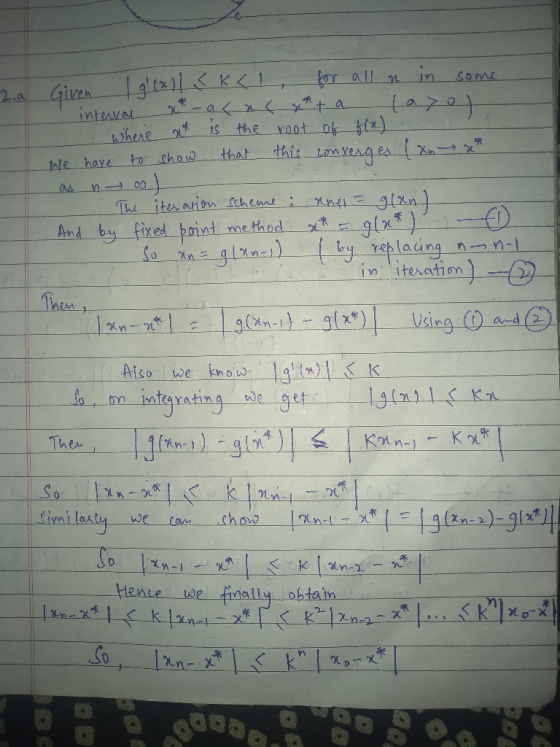
2. (a) Suppose we have to find the root xof x); that is, we have to solve )0. Fixed-point methods do this by re-writing the equation in the form x·= g(x*) , and then using the iteration scheme : g...
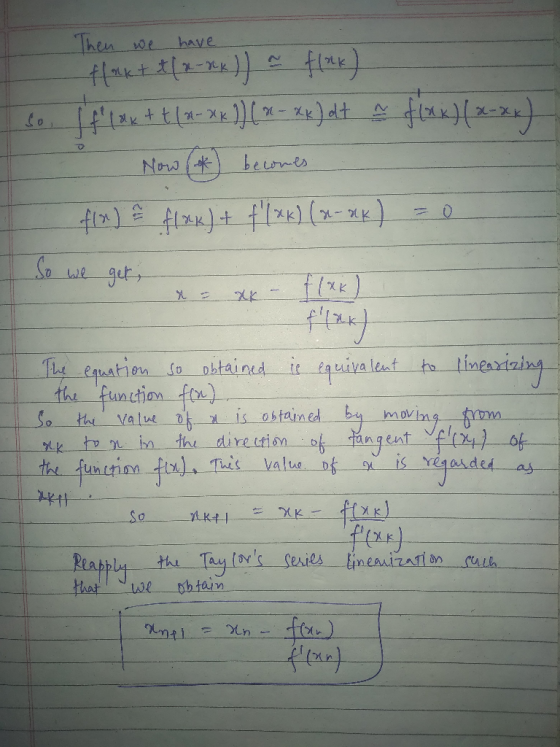
2. (a) We want to find the root x of the function f(x); that is, we need f(r) = 0 . This can be done using Newton...
 2. (a) We want to find the root x of the function f(x); that is, we need f(r) = 0 . This can be done using Newton's method, making use of the iterative formula f(xn) Show that the sequence ofiterates (%) converges quadratically if f'(x) 0 in some appropriate interval of x-values near the root χ 9 point b) We can get Newton's method to find the k-th root of some number a by making it solve the non-linear cquation...
Suppose you want to find a fixed point of a smooth function g(x) on the interval...
 Suppose you want to find a fixed point of a smooth function g(x)
on the interval [a,b]
a. Give conditions which would be sufficient to show that fixed
point iteration on g(x), starting with some
[a,b], will converge to the fixed point p.
b. When is this convergence only linear?
c. When is this convergence only quadratic?
d. Suppose a smooth function f(x) has a root p with f '(p) != 0.
Assuming you choose the initial guess close enough...
Suppose you want to find a fixed point of a smooth function g(x)
on the interval [a,b]
a. Give conditions which would be sufficient to show that fixed
point iteration on g(x), starting with some
[a,b], will converge to the fixed point p.
b. When is this convergence only linear?
c. When is this convergence only quadratic?
d. Suppose a smooth function f(x) has a root p with f '(p) != 0.
Assuming you choose the initial guess close enough...
gol The fixed-point iteration Pn+1 = g(P) converges to a fixed point p = 0 of...
 gol The fixed-point iteration Pn+1 = g(P) converges to a fixed point p = 0 of g(x) = x for all 0 < po < 1. The order of convergence of the sequence {n} is a > 0 if there exists > O such that lim Pn+1-pl =X. -00 P -plº Use the definition (6) to find the order of convergence of the sequence in (5).
2. Consider g(x) (2 -x). Show that for all starting point ro E (0,2), the Picard's fixed-point iteration converges...
 2. Consider g(x) (2 -x). Show that for all starting point ro E (0,2), the Picard's fixed-point iteration converges to the fixed point 1. Are sufficient conditions for convergence of Picard's iteration satisfied?
2. Consider g(x) (2 -x). Show that for all starting point ro E (0,2), the Picard's fixed-point iteration converges to the fixed point 1. Are sufficient conditions for convergence of Picard's iteration satisfied?
2. Consider g(x) (2 -x). Show that for all starting point ro E (0,2), the Picard's fixed-point iteration converges to the fixed point 1. Are sufficient conditions for convergence of Picard's iteration satisfied?
Please answer all questions Q2 2015 a) show that the function f(x) = pi/2-x-sin(x) has at...
 Please answer all questions
Q2 2015
a) show that the function f(x) = pi/2-x-sin(x)
has at least one root x* in the interval [0,pi/2]
b)in a fixed-point formulation of the root-finding problem, the
equation f(x) = 0 is rewritten in the equivalent form x = g(x).
thus the root x* satisfies the equation x* = g(x*), and then the
numerical iteration scheme takes the form x(n+1) = g(x(n))
prove that the iterations converge to the root, provided that
the starting...
Please answer all questions
Q2 2015
a) show that the function f(x) = pi/2-x-sin(x)
has at least one root x* in the interval [0,pi/2]
b)in a fixed-point formulation of the root-finding problem, the
equation f(x) = 0 is rewritten in the equivalent form x = g(x).
thus the root x* satisfies the equation x* = g(x*), and then the
numerical iteration scheme takes the form x(n+1) = g(x(n))
prove that the iterations converge to the root, provided that
the starting...
q = 4 Q2 Consider the equation x -3x'te0 (a) Write this equation as x =g(x) in three different forms. Apply convergence test to each of these forms. Which g(r) is more suitable for the fixed point...
 q = 4
Q2 Consider the equation x -3x'te0 (a) Write this equation as x =g(x) in three different forms. Apply convergence test to each of these forms. Which g(r) is more suitable for the fixed point iteration. (b) Compute first 4 iterations by taking x 1 and graph each value of x and g(x) to show convergence or divergence of the scheme. Find the fixed point of g(x) correct to 5 decimal digits using the following fixed point iteration...
q = 4
Q2 Consider the equation x -3x'te0 (a) Write this equation as x =g(x) in three different forms. Apply convergence test to each of these forms. Which g(r) is more suitable for the fixed point iteration. (b) Compute first 4 iterations by taking x 1 and graph each value of x and g(x) to show convergence or divergence of the scheme. Find the fixed point of g(x) correct to 5 decimal digits using the following fixed point iteration...
3 Newton and Secant Method [30 pts]. We want to solve the equation f(x) 0, where f(x) = (x-1 )4. ...
 Can you help me with parts A to D please? Thanks
3 Newton and Secant Method [30 pts]. We want to solve the equation f(x) 0, where f(x) = (x-1 )4. a) Write down Newton's iteration for solving f(x) 0. b) For the starting value xo 2, compute x c) What is the root ξ of f, i.e., f(5) = 0? Do you expect linear or quadratic order of convergence to 5 and why? d) Name one advantage of Newton's...
Can you help me with parts A to D please? Thanks
3 Newton and Secant Method [30 pts]. We want to solve the equation f(x) 0, where f(x) = (x-1 )4. a) Write down Newton's iteration for solving f(x) 0. b) For the starting value xo 2, compute x c) What is the root ξ of f, i.e., f(5) = 0? Do you expect linear or quadratic order of convergence to 5 and why? d) Name one advantage of Newton's...
Solve the Taylor Series. 1. (a) Use the root test to find the interval of convergence of-1)* に0 (b) Demonstrate that the above is the taylor series of f()- by writing a formula for f via taylor'...
 Solve the Taylor Series.
1. (a) Use the root test to find the interval of convergence of-1)* に0 (b) Demonstrate that the above is the taylor series of f()- by writing a formula for f via taylor's theorem at α-0. That is write f(x)-P(z) + R(x) where P(r) is the nth order taylor polynomial centered at a point a and the remainder term R(x) = ((r - a)n+1 for some c between z and a where here a 0. Show...
Solve the Taylor Series.
1. (a) Use the root test to find the interval of convergence of-1)* に0 (b) Demonstrate that the above is the taylor series of f()- by writing a formula for f via taylor's theorem at α-0. That is write f(x)-P(z) + R(x) where P(r) is the nth order taylor polynomial centered at a point a and the remainder term R(x) = ((r - a)n+1 for some c between z and a where here a 0. Show...
6. (a) Newton's method for approximating a root of an equation f(x) 0 (see Section 3.8) can be ad...
 6. (a) Newton's method for approximating a root of an equation f(x) 0 (see Section 3.8) can be adapted to approximating a solution of a system of equations f(x, y) 0 and gx, y) 0. The surfaces z f(x, y) and z g(x, y) intersect in a curve that intersects the xy-plane at the point (r, s), which is the solution of the system. If an initial approxi- mation (xi, yı) is close to this point, then the tangent planes...
2. (25 pts) Consider the fixed point problem with g(x) 3 Use the fixed point theorem...
 2. (25 pts) Consider the fixed point problem with g(x) 3 Use the fixed point theorem to show fixed point iterations using g(r) converge to fixed point p E (0, 1] for all initial guesses po E [0, 1]. a Remember, the fixed point theorem: If g(x) is continuously differentiable in [a, b] and g [a, b g(x) converge to a fixed point p E [a, b] for all initial guesses po E [a, b. a, band g (x k...
 2. (a) We want to find the root x of the function f(x); that is, we need f(r) = 0 . This can be done using Newton's method, making use of the iterative formula f(xn) Show that the sequence ofiterates (%) converges quadratically if f'(x) 0 in some appropriate interval of x-values near the root χ 9 point b) We can get Newton's method to find the k-th root of some number a by making it solve the non-linear cquation...
 Suppose you want to find a fixed point of a smooth function g(x)
on the interval [a,b]
a. Give conditions which would be sufficient to show that fixed
point iteration on g(x), starting with some
[a,b], will converge to the fixed point p.
b. When is this convergence only linear?
c. When is this convergence only quadratic?
d. Suppose a smooth function f(x) has a root p with f '(p) != 0.
Assuming you choose the initial guess close enough...
Suppose you want to find a fixed point of a smooth function g(x)
on the interval [a,b]
a. Give conditions which would be sufficient to show that fixed
point iteration on g(x), starting with some
[a,b], will converge to the fixed point p.
b. When is this convergence only linear?
c. When is this convergence only quadratic?
d. Suppose a smooth function f(x) has a root p with f '(p) != 0.
Assuming you choose the initial guess close enough...
 gol The fixed-point iteration Pn+1 = g(P) converges to a fixed point p = 0 of g(x) = x for all 0 < po < 1. The order of convergence of the sequence {n} is a > 0 if there exists > O such that lim Pn+1-pl =X. -00 P -plº Use the definition (6) to find the order of convergence of the sequence in (5).
 2. Consider g(x) (2 -x). Show that for all starting point ro E (0,2), the Picard's fixed-point iteration converges to the fixed point 1. Are sufficient conditions for convergence of Picard's iteration satisfied?
2. Consider g(x) (2 -x). Show that for all starting point ro E (0,2), the Picard's fixed-point iteration converges to the fixed point 1. Are sufficient conditions for convergence of Picard's iteration satisfied?
2. Consider g(x) (2 -x). Show that for all starting point ro E (0,2), the Picard's fixed-point iteration converges to the fixed point 1. Are sufficient conditions for convergence of Picard's iteration satisfied?
 Please answer all questions
Q2 2015
a) show that the function f(x) = pi/2-x-sin(x)
has at least one root x* in the interval [0,pi/2]
b)in a fixed-point formulation of the root-finding problem, the
equation f(x) = 0 is rewritten in the equivalent form x = g(x).
thus the root x* satisfies the equation x* = g(x*), and then the
numerical iteration scheme takes the form x(n+1) = g(x(n))
prove that the iterations converge to the root, provided that
the starting...
Please answer all questions
Q2 2015
a) show that the function f(x) = pi/2-x-sin(x)
has at least one root x* in the interval [0,pi/2]
b)in a fixed-point formulation of the root-finding problem, the
equation f(x) = 0 is rewritten in the equivalent form x = g(x).
thus the root x* satisfies the equation x* = g(x*), and then the
numerical iteration scheme takes the form x(n+1) = g(x(n))
prove that the iterations converge to the root, provided that
the starting...
 q = 4
Q2 Consider the equation x -3x'te0 (a) Write this equation as x =g(x) in three different forms. Apply convergence test to each of these forms. Which g(r) is more suitable for the fixed point iteration. (b) Compute first 4 iterations by taking x 1 and graph each value of x and g(x) to show convergence or divergence of the scheme. Find the fixed point of g(x) correct to 5 decimal digits using the following fixed point iteration...
q = 4
Q2 Consider the equation x -3x'te0 (a) Write this equation as x =g(x) in three different forms. Apply convergence test to each of these forms. Which g(r) is more suitable for the fixed point iteration. (b) Compute first 4 iterations by taking x 1 and graph each value of x and g(x) to show convergence or divergence of the scheme. Find the fixed point of g(x) correct to 5 decimal digits using the following fixed point iteration...
 Can you help me with parts A to D please? Thanks
3 Newton and Secant Method [30 pts]. We want to solve the equation f(x) 0, where f(x) = (x-1 )4. a) Write down Newton's iteration for solving f(x) 0. b) For the starting value xo 2, compute x c) What is the root ξ of f, i.e., f(5) = 0? Do you expect linear or quadratic order of convergence to 5 and why? d) Name one advantage of Newton's...
Can you help me with parts A to D please? Thanks
3 Newton and Secant Method [30 pts]. We want to solve the equation f(x) 0, where f(x) = (x-1 )4. a) Write down Newton's iteration for solving f(x) 0. b) For the starting value xo 2, compute x c) What is the root ξ of f, i.e., f(5) = 0? Do you expect linear or quadratic order of convergence to 5 and why? d) Name one advantage of Newton's...
 Solve the Taylor Series.
1. (a) Use the root test to find the interval of convergence of-1)* に0 (b) Demonstrate that the above is the taylor series of f()- by writing a formula for f via taylor's theorem at α-0. That is write f(x)-P(z) + R(x) where P(r) is the nth order taylor polynomial centered at a point a and the remainder term R(x) = ((r - a)n+1 for some c between z and a where here a 0. Show...
Solve the Taylor Series.
1. (a) Use the root test to find the interval of convergence of-1)* に0 (b) Demonstrate that the above is the taylor series of f()- by writing a formula for f via taylor's theorem at α-0. That is write f(x)-P(z) + R(x) where P(r) is the nth order taylor polynomial centered at a point a and the remainder term R(x) = ((r - a)n+1 for some c between z and a where here a 0. Show...
 6. (a) Newton's method for approximating a root of an equation f(x) 0 (see Section 3.8) can be adapted to approximating a solution of a system of equations f(x, y) 0 and gx, y) 0. The surfaces z f(x, y) and z g(x, y) intersect in a curve that intersects the xy-plane at the point (r, s), which is the solution of the system. If an initial approxi- mation (xi, yı) is close to this point, then the tangent planes...
 2. (25 pts) Consider the fixed point problem with g(x) 3 Use the fixed point theorem to show fixed point iterations using g(r) converge to fixed point p E (0, 1] for all initial guesses po E [0, 1]. a Remember, the fixed point theorem: If g(x) is continuously differentiable in [a, b] and g [a, b g(x) converge to a fixed point p E [a, b] for all initial guesses po E [a, b. a, band g (x k...
Most questions answered within 3 hours.
-
Where is the error in this code sequence?
String s1 = "Hello";
String s2 = "ello";...
asked 11 months ago -
Financial data for Joel de Paris, Inc., for last year
follow:
Joel de Paris, Inc.
Balance...
asked 11 months ago -
Consider this reaction:
Al2(SO4)3 (aq)+ BaCl3
(aq) Al2Cl6 (aq)- +
3BaSO4(s) . What is the...
asked 11 months ago -
Suppose that Savneet is considering increasing her
recent random sample from 20 car rentals to 40...
asked 11 months ago -
Trucks arrive at an unloading terminal at an average rate of 120
per hour.
Trucks arrive...
asked 11 months ago -
Why are methanol and ethanol completely soluble in water while
octanol is not very little soluble....
asked 11 months ago -
A facilities manager at a university reads in a research report
that the mean amount of...
asked 11 months ago -
When the CuSO4 is rehydrated by adding water to the anhydrous
compound, is this an endothermic...
asked 11 months ago -
A ray of sunlight is passing from diamond into crown glass; the
angle of incidence is...
asked 11 months ago -
A block of mass 0.249 kg is placed on top of a light, vertical
spring of...
asked 11 months ago -
how do the kidneys compensate in the presences of acidosis
a) trigger hyperventilate
b) reserve acid...
asked 11 months ago -
Question 501 pts
The rental rate of capital to the firm increases. Which of the
following...
asked 11 months ago