
Homework Answers
Add Answer to:
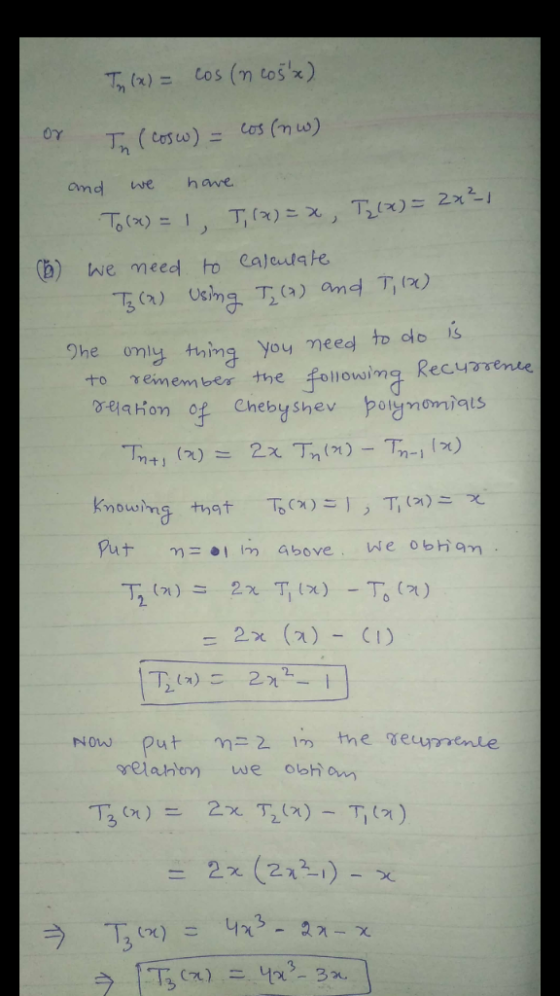
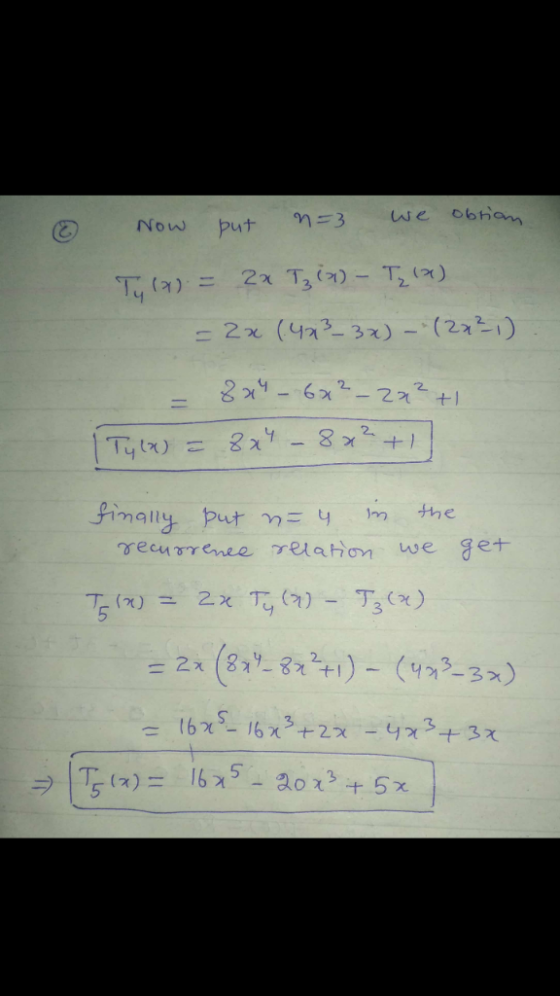
2. (Chebyshev Polynomials). Below is a guideline for finding the coefficients in T,l(x) = cos(n cos-1 x), Chebyshev polynomials equivalently or T,,(cosa.) = cos(na). For example, To(x)-1, T1(x)=x, T2...
2. The Chebyshev polynomials can be determined from T.(x) = cos(n cos-?x). (a) Find T-(x) from...
 2. The Chebyshev polynomials can be determined from T.(x) = cos(n cos-?x). (a) Find T-(x) from above formula. (b) Find Tn+1(x) + Tn-1(x) in terms of T,(x). (c) Show that In/2] n! Tn () = KO (2k)! (n – 2k);?"*2*(x2 – 1)". (Note: You need to prove it in detail. To do it, you may need to consider two cases: n=2p-1 (odd) and n=2p (even). )
The Chebyshev polynomials can be determined from Tn (2) = cos(n cos-1.). (c) Show that n!...
 The Chebyshev polynomials can be determined from Tn (2) = cos(n cos-1.). (c) Show that n! .n-2k [n/2] T(z) = 1 k= (2k)!(n – 2k)!" —2k (22 – 1)“. (Note: You need to prove it in detail. To do it, you may need to consider two cases: n=2p-1 (odd) and n=2p (even). )
(1 point) Solve the wave equation with fixed endpoints and the given initial displacement and velocity. a2 ,0<x<L, t > 0 a(0. t) = 0, u(L, t) = 0, t > 0 Ou Ot ηπα t) + B,, sin (m Now we c...
 (1 point) Solve the wave equation with fixed endpoints and the given initial displacement and velocity. a2 ,0<x<L, t > 0 a(0. t) = 0, u(L, t) = 0, t > 0 Ou Ot ηπα t) + B,, sin (m Now we can solve the PDE using the series solution u(r,t)-> An C computed many times: An example: t) ) sin (-1 ). The coefficients .An and i, are Fourier coefficients we have , cos n-1 sin(n pix/ L) dr...
how would you solve the last problem? R145 TE0,8SN Ag Ts= 1.21 N Ap A, CasB-t1-Cos-CY...
 how would you solve the last problem?
R145 TE0,8SN Ag Ts= 1.21 N Ap A, CasB-t1-Cos-CY Measure the y and a angles for each tension force and then calculate the angle B using the Pythagorean relationship: 1- cos2 (a) + cos2 (B) + cos2 (y). Make sure to keep track of the octant, as this sets the sign convention. (Please attach any work you do to get these values, check your work before you leave). Y T3-1.3 N TI-D.6 Magnitude...
how would you solve the last problem?
R145 TE0,8SN Ag Ts= 1.21 N Ap A, CasB-t1-Cos-CY Measure the y and a angles for each tension force and then calculate the angle B using the Pythagorean relationship: 1- cos2 (a) + cos2 (B) + cos2 (y). Make sure to keep track of the octant, as this sets the sign convention. (Please attach any work you do to get these values, check your work before you leave). Y T3-1.3 N TI-D.6 Magnitude...
(24%) Find the Fourier transform of the signals given below: 1) x() 4e U() x(t) = e-3,Cos(12m)U(t) 2) x(t) = 36(1 + 4) + 26(1) + 43(1-5) 3) x[n]=(0.7)"U(n) 4) (24%) Find the Fourier tran...
 (24%) Find the Fourier transform of the signals given below: 1) x() 4e U() x(t) = e-3,Cos(12m)U(t) 2) x(t) = 36(1 + 4) + 26(1) + 43(1-5) 3) x[n]=(0.7)"U(n) 4)
(24%) Find the Fourier transform of the signals given below: 1) x() 4e U() x(t) = e-3,Cos(12m)U(t) 2) x(t) = 36(1 + 4) + 26(1) + 43(1-5) 3) x[n]=(0.7)"U(n) 4)
(24%) Find the Fourier transform of the signals given below: 1) x() 4e U() x(t) = e-3,Cos(12m)U(t) 2) x(t) = 36(1 + 4) + 26(1) + 43(1-5) 3) x[n]=(0.7)"U(n) 4)
5 pts D Question 1 A system has the following impulse response: .2 Sample number, n From the choices below, select the frequency response of this system. H (eju)-e(1.5 ) (2 sin( 1.5ώ) +...
 5 pts D Question 1 A system has the following impulse response: .2 Sample number, n From the choices below, select the frequency response of this system. H (eju)-e(1.5 ) (2 sin( 1.5ώ) + 4 sin(0.δώ)) H (ee) = e-j(1.5e-5) (cos( 1.5 ) +2 cos(0.54)) @ H (ee)-e-n1.si) (sin( 1.54) t. 2 sin(0.δώ)) (sin(l.50) +4sin(0.0) H (ee)-e-j(1.5i) (2 cos( 1.5ώ) + 4 cos(0.5a)) H (efo)-e-n1.5u) (cos( 1.50) + 2 cos(0.50)) https://rmitinstructure.comcoursesy 5 pts DQuestion 2 A system has the following...
9. Using the reaction below and mixture 1 volumes, a student mixes Foon with KSON n c equilibrium concentrations at 5.71 x 10 M and 3.71 x10+ M, respectively net absorbance of mixture l at 0.090....
 9. Using the reaction below and mixture 1 volumes, a student mixes Foon with KSON n c equilibrium concentrations at 5.71 x 10 M and 3.71 x10+ M, respectively net absorbance of mixture l at 0.090. The calibration curve for the equilibrium reactions,-2635 x+0.014. Using the colormetet, she oin the Fe (aq SCN (aq)FescN (ad) a. Using the calibration curve, where y is equal to the absorbance Lapplying the Beer's Law: Absorbance slope (concentration), calaulate the eauilinium con b. Write...
This is the sequence 1,3,6,10,15 the pattern is addin 1 more than last time but what is the name for this pattern These are called the triangular numbers The sequence is 1 3=1+2 6=1+2+3 10=1+2+3+4 15=1+2+3+4+5 You can also observe this pattern
This is the sequence 1,3,6,10,15 the pattern is addin 1 more than last time but what is the name for this patternThese are called the triangular numbers The sequence is 1 3=1+2 6=1+2+3 10=1+2+3+4 15=1+2+3+4+5 You can also observe this pattern x _________ x xx __________ x xx xxx __________ x xx xxx xxxx to see why they're called triangular numbers. I think the Pythagoreans (around 700 B.C.E.) were the ones who gave them this name. I do know the...
1 L, as a dynamical system (Notes from Assignment #2) We take our definition of dynamical system ...
 1 L, as a dynamical system (Notes from Assignment #2) We take our definition of dynamical system to be an "object" along with a specific set of modifications that can be performed (dynamically) upon this object. In this case, the object is a bi-infinite straight road with a lamp post at every street corner and a marked lamp (the position of the lamplighter). There are two possible types of modifications: the lamplighter can walk any distance in either direction from...
just one example/demonstration! Data needed to be calculated is in highlighted in green boxes. And I...
 just one example/demonstration!
Data needed to be calculated is in highlighted in green boxes.
And I highlighted in red an equation (not sure if thats what you
use to calculate it) And ignore the lab instructions on completeing
a graph!! I already know how to do that in excel, just curious how
Ln (relative rate) and 1/T in K^-1 is calculated by hand*
here is the rest of that lab leading up to the question as I
know its typically...
just one example/demonstration!
Data needed to be calculated is in highlighted in green boxes.
And I highlighted in red an equation (not sure if thats what you
use to calculate it) And ignore the lab instructions on completeing
a graph!! I already know how to do that in excel, just curious how
Ln (relative rate) and 1/T in K^-1 is calculated by hand*
here is the rest of that lab leading up to the question as I
know its typically...
 2. The Chebyshev polynomials can be determined from T.(x) = cos(n cos-?x). (a) Find T-(x) from above formula. (b) Find Tn+1(x) + Tn-1(x) in terms of T,(x). (c) Show that In/2] n! Tn () = KO (2k)! (n – 2k);?"*2*(x2 – 1)". (Note: You need to prove it in detail. To do it, you may need to consider two cases: n=2p-1 (odd) and n=2p (even). )
 The Chebyshev polynomials can be determined from Tn (2) = cos(n cos-1.). (c) Show that n! .n-2k [n/2] T(z) = 1 k= (2k)!(n – 2k)!" —2k (22 – 1)“. (Note: You need to prove it in detail. To do it, you may need to consider two cases: n=2p-1 (odd) and n=2p (even). )
 (1 point) Solve the wave equation with fixed endpoints and the given initial displacement and velocity. a2 ,0<x<L, t > 0 a(0. t) = 0, u(L, t) = 0, t > 0 Ou Ot ηπα t) + B,, sin (m Now we can solve the PDE using the series solution u(r,t)-> An C computed many times: An example: t) ) sin (-1 ). The coefficients .An and i, are Fourier coefficients we have , cos n-1 sin(n pix/ L) dr...
 how would you solve the last problem?
R145 TE0,8SN Ag Ts= 1.21 N Ap A, CasB-t1-Cos-CY Measure the y and a angles for each tension force and then calculate the angle B using the Pythagorean relationship: 1- cos2 (a) + cos2 (B) + cos2 (y). Make sure to keep track of the octant, as this sets the sign convention. (Please attach any work you do to get these values, check your work before you leave). Y T3-1.3 N TI-D.6 Magnitude...
how would you solve the last problem?
R145 TE0,8SN Ag Ts= 1.21 N Ap A, CasB-t1-Cos-CY Measure the y and a angles for each tension force and then calculate the angle B using the Pythagorean relationship: 1- cos2 (a) + cos2 (B) + cos2 (y). Make sure to keep track of the octant, as this sets the sign convention. (Please attach any work you do to get these values, check your work before you leave). Y T3-1.3 N TI-D.6 Magnitude...
 (24%) Find the Fourier transform of the signals given below: 1) x() 4e U() x(t) = e-3,Cos(12m)U(t) 2) x(t) = 36(1 + 4) + 26(1) + 43(1-5) 3) x[n]=(0.7)"U(n) 4)
(24%) Find the Fourier transform of the signals given below: 1) x() 4e U() x(t) = e-3,Cos(12m)U(t) 2) x(t) = 36(1 + 4) + 26(1) + 43(1-5) 3) x[n]=(0.7)"U(n) 4)
(24%) Find the Fourier transform of the signals given below: 1) x() 4e U() x(t) = e-3,Cos(12m)U(t) 2) x(t) = 36(1 + 4) + 26(1) + 43(1-5) 3) x[n]=(0.7)"U(n) 4)
 5 pts D Question 1 A system has the following impulse response: .2 Sample number, n From the choices below, select the frequency response of this system. H (eju)-e(1.5 ) (2 sin( 1.5ώ) + 4 sin(0.δώ)) H (ee) = e-j(1.5e-5) (cos( 1.5 ) +2 cos(0.54)) @ H (ee)-e-n1.si) (sin( 1.54) t. 2 sin(0.δώ)) (sin(l.50) +4sin(0.0) H (ee)-e-j(1.5i) (2 cos( 1.5ώ) + 4 cos(0.5a)) H (efo)-e-n1.5u) (cos( 1.50) + 2 cos(0.50)) https://rmitinstructure.comcoursesy 5 pts DQuestion 2 A system has the following...
 9. Using the reaction below and mixture 1 volumes, a student mixes Foon with KSON n c equilibrium concentrations at 5.71 x 10 M and 3.71 x10+ M, respectively net absorbance of mixture l at 0.090. The calibration curve for the equilibrium reactions,-2635 x+0.014. Using the colormetet, she oin the Fe (aq SCN (aq)FescN (ad) a. Using the calibration curve, where y is equal to the absorbance Lapplying the Beer's Law: Absorbance slope (concentration), calaulate the eauilinium con b. Write...
 1 L, as a dynamical system (Notes from Assignment #2) We take our definition of dynamical system to be an "object" along with a specific set of modifications that can be performed (dynamically) upon this object. In this case, the object is a bi-infinite straight road with a lamp post at every street corner and a marked lamp (the position of the lamplighter). There are two possible types of modifications: the lamplighter can walk any distance in either direction from...
 just one example/demonstration!
Data needed to be calculated is in highlighted in green boxes.
And I highlighted in red an equation (not sure if thats what you
use to calculate it) And ignore the lab instructions on completeing
a graph!! I already know how to do that in excel, just curious how
Ln (relative rate) and 1/T in K^-1 is calculated by hand*
here is the rest of that lab leading up to the question as I
know its typically...
just one example/demonstration!
Data needed to be calculated is in highlighted in green boxes.
And I highlighted in red an equation (not sure if thats what you
use to calculate it) And ignore the lab instructions on completeing
a graph!! I already know how to do that in excel, just curious how
Ln (relative rate) and 1/T in K^-1 is calculated by hand*
here is the rest of that lab leading up to the question as I
know its typically...
Most questions answered within 3 hours.
-
Where is the error in this code sequence?
String s1 = "Hello";
String s2 = "ello";...
asked 11 months ago -
Financial data for Joel de Paris, Inc., for last year
follow:
Joel de Paris, Inc.
Balance...
asked 11 months ago -
Consider this reaction:
Al2(SO4)3 (aq)+ BaCl3
(aq) Al2Cl6 (aq)- +
3BaSO4(s) . What is the...
asked 11 months ago -
Suppose that Savneet is considering increasing her
recent random sample from 20 car rentals to 40...
asked 11 months ago -
Trucks arrive at an unloading terminal at an average rate of 120
per hour.
Trucks arrive...
asked 11 months ago -
Why are methanol and ethanol completely soluble in water while
octanol is not very little soluble....
asked 11 months ago -
A facilities manager at a university reads in a research report
that the mean amount of...
asked 11 months ago -
When the CuSO4 is rehydrated by adding water to the anhydrous
compound, is this an endothermic...
asked 11 months ago -
A ray of sunlight is passing from diamond into crown glass; the
angle of incidence is...
asked 11 months ago -
A block of mass 0.249 kg is placed on top of a light, vertical
spring of...
asked 11 months ago -
how do the kidneys compensate in the presences of acidosis
a) trigger hyperventilate
b) reserve acid...
asked 11 months ago -
Question 501 pts
The rental rate of capital to the firm increases. Which of the
following...
asked 11 months ago