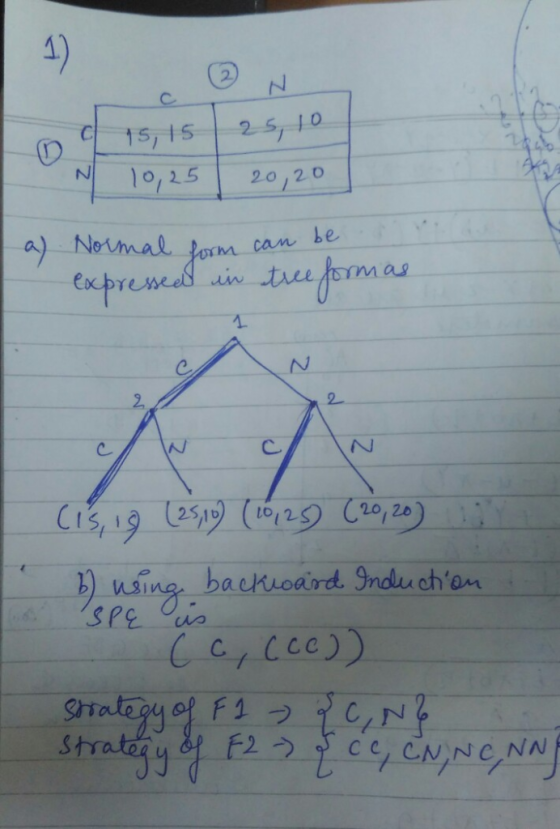
1. Consider the coupon game. But suppose that instead of decisions being made simultaneously, they are made sequentially, with Firm 1 choosing first, and its choice observed by Firm 2 before Firm 2 makes its choice.
a. Draw a game tree representing this game.
b. Use backward induction to find the solution. (Remember that your solution should include both firms’ strategies, and that Firm 2’s strategy should be complete!)

2. Two duopolists produce a homogeneous product, and each has a constant average cost of 2. The firms compete by choosing the quantities ( q1 and q2 ) they produce. Market demand is given by p = 50 - 4Q,
where Q = q1 + q2 . For this question, assume that each firm is restricted to producing quantities of 3, 4 and 6 only (no other quantities are possible).
a. Suppose the firms make their choices simultaneously. Draw a payoff matrix representing this game, and find all Nash equilibria. Also find the payoffs resulting from each Nash equilibrium.
b. Suppose the two firms choose their prices sequentially, with Firm 2 observing Firm 1’s price choice before making its own choice. Draw a game tree representing this game, and use backward induction to find the solution. Also find the payoffs resulting from this solution.
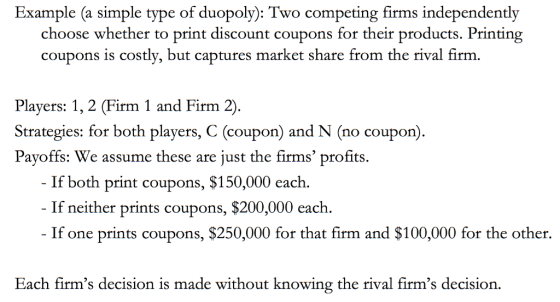
When there are only two players, and the number of strategies is small for both, it is easy to represent the game using a payoffmatrix. Firm 2 15, 15 25, 10 Firm 10, 25 20, 20 (payoffs expressed in 10,000s) Notes: One player's strategy determines a row; the other's determines a column. So, the strategy profile determines an cell of the matrix - Each cell of the matrix has two numbers. By convention, the first number is the payoff of the player who chose the row
Homework Answers
Add Answer to:
1. Consider the coupon game. But suppose that instead of decisions being made simultaneously, they are made sequentially, with Firm 1 choosing first, and its choice observed by Firm 2 before Firm 2 ma...
2. Consider the coupon game from the lecture slides. (Recall that the strategy C means "print coupons", and N m...
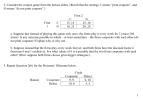 2. Consider the coupon game from the lecture slides. (Recall that the strategy C means "print coupons", and N means "do not print coupons".) Firm 2 15, 15 Firm 25, 10 20, 20 10, 25 a. Suppose that instead of playing this game only once, the firms play it every week for 2 years (104 times). Is any outcome possible in which - at least sometimes - the firms cooperate with each other (do not print coupons)? Explain why or...
The table below is the payoff marrix for a simple two-firm game Firms A and B...
 The table below is the payoff marrix for a simple two-firm game Firms A and B are bidding on a government contract and each f's bid is not known by the other form. Each firm can bid other $14.000 or 55.000 The cost of completing the project for each firm is 53.000 The low bid firm will win the contractat its stated price the high dem wilgot nothing the two bids are equal, the two firms wil split the price...
There are two firms, Cope and Peski, in an oligopolistic industry. Each firm must decide whether...
There are two firms, Cope and Peski, in an oligopolistic industry. Each firm must decide whether or not to advertise during the Super Bowl this year. The diagram below represents the matrix of expected profit payoffs for each firm depending on which of the four possible outcomes becomes reality. The first number in each cell represents the expected profit for Peski given the relevant combination of strategies for each firm. The second number in each cell represents the expected profit...
2. Suppos e there are two firms in an oligopoly, Firm A both firms charge a...
 2. Suppos e there are two firms in an oligopoly, Firm A both firms charge a low price, each earns and Firm B. If $2 million in profit. If both firms charge a high price, each earns $3 million in profit. If one firm charges a high price and one charges a low price, customers flock to the firm with the low price, and that firm earns $4 million in profit while the firm with the high price earns $1...
The following payoff matrix depicts two companies, Lowe's and Home Depot, in an advertising game. The companies will be playing the same game several times. Each company makes its decision without knowing what the other chooses. The payoffs for each firm
 The following payoff matrix depicts two companies, Lowe's and Home Depot, in an advertising game. The companies will be playing the same game several times. Each company makes its decision without knowing what the other chooses. The payoffs for each firm represent economic profits.Imagine that at the beginning of each week, Home Depot and Lowe's play the game described in the payoff matrix above. Assume there is no known end to the game, so Home Depot and Lowe's will effectively...
Identify the definition for each term listed below from the following list. 1. The study of...
 Identify the definition for each term listed below from the following list. 1. The study of how people make decisions where attaining goals depends on interactions with others. 2. A table that shows the payoffs each firm earns from every combination of firm strategies. 3. An agreement among firms to charge the same price or otherwise not to compete. 4. A strategy that is the best for a firm, no matter what strategies other firms use. 5. A situation in...
5. Consider a version of the Cournot duopoly game, which will be thoroughly analyzed in Chapter...
 5. Consider a version of the Cournot duopoly game, which will be thoroughly analyzed in Chapter 10. Two firms (1 and 2) compete in a homogeneous goods market, where the firms produce exactly the same good. The firms simultaneously and independently select quantities to produce. The quantity selected by firm i is denoted q, and must be greater than or equal to zero, for i - 1,2. The market price is given by p-2 - q1 -q2. For simplicity, as...
2. Consider a static game described by the following payoff matrix: LR a,1 2,6 3,0 2,c...
 2. Consider a static game described by the following payoff matrix: LR a,1 2,6 3,0 2,c B The two numbers in each cell is the payoffs to the row player and the column player, respectively. (a) [6] Find all parameter values of a, b, and c for which the strategy profile (T, L) is a weakly dominant strategy equilibrium. (b) [6] Find all parameter values of a, b, and c for which the strategy profile (T, L) is a pure...
1. Predatory pricing occurs when a firm? 2. A situation in which firms choose their best...
1. Predatory pricing occurs when a firm? 2. A situation in which firms choose their best strategy given the strategies chosen by the other firms in the market is called a. a socially-optimal solution. b. a Nash equilibrium. c. a competitive equilibrium. d. an open-market solution. 3. This table shows a game played between two players, A and B. The payoffs in the table are shown as (Payoff to A, Payoff to B). B Left Right A Up (4, 4)...
Declining Industry: Consider two competing firms in a declining industry that cannot support both firms profitably....
 Declining Industry: Consider two competing firms in a declining industry that cannot support both firms profitably. Each firm has three possible choices, as it must decide whether or not to exit the industry immediately, at the end of this quarter, or at the end of the next quarter. If a firm chooses to exit then its payoff is 0 from that point onward. Each quarter that both firms operate yields each a loss equal to -1, and each quarter that...
 2. Consider the coupon game from the lecture slides. (Recall that the strategy C means "print coupons", and N means "do not print coupons".) Firm 2 15, 15 Firm 25, 10 20, 20 10, 25 a. Suppose that instead of playing this game only once, the firms play it every week for 2 years (104 times). Is any outcome possible in which - at least sometimes - the firms cooperate with each other (do not print coupons)? Explain why or...
 The table below is the payoff marrix for a simple two-firm game Firms A and B are bidding on a government contract and each f's bid is not known by the other form. Each firm can bid other $14.000 or 55.000 The cost of completing the project for each firm is 53.000 The low bid firm will win the contractat its stated price the high dem wilgot nothing the two bids are equal, the two firms wil split the price...
 2. Suppos e there are two firms in an oligopoly, Firm A both firms charge a low price, each earns and Firm B. If $2 million in profit. If both firms charge a high price, each earns $3 million in profit. If one firm charges a high price and one charges a low price, customers flock to the firm with the low price, and that firm earns $4 million in profit while the firm with the high price earns $1...
 Identify the definition for each term listed below from the following list. 1. The study of how people make decisions where attaining goals depends on interactions with others. 2. A table that shows the payoffs each firm earns from every combination of firm strategies. 3. An agreement among firms to charge the same price or otherwise not to compete. 4. A strategy that is the best for a firm, no matter what strategies other firms use. 5. A situation in...
 5. Consider a version of the Cournot duopoly game, which will be thoroughly analyzed in Chapter 10. Two firms (1 and 2) compete in a homogeneous goods market, where the firms produce exactly the same good. The firms simultaneously and independently select quantities to produce. The quantity selected by firm i is denoted q, and must be greater than or equal to zero, for i - 1,2. The market price is given by p-2 - q1 -q2. For simplicity, as...
 2. Consider a static game described by the following payoff matrix: LR a,1 2,6 3,0 2,c B The two numbers in each cell is the payoffs to the row player and the column player, respectively. (a) [6] Find all parameter values of a, b, and c for which the strategy profile (T, L) is a weakly dominant strategy equilibrium. (b) [6] Find all parameter values of a, b, and c for which the strategy profile (T, L) is a pure...
 Declining Industry: Consider two competing firms in a declining industry that cannot support both firms profitably. Each firm has three possible choices, as it must decide whether or not to exit the industry immediately, at the end of this quarter, or at the end of the next quarter. If a firm chooses to exit then its payoff is 0 from that point onward. Each quarter that both firms operate yields each a loss equal to -1, and each quarter that...
Most questions answered within 3 hours.
-
Where is the error in this code sequence?
String s1 = "Hello";
String s2 = "ello";...
asked 11 months ago -
Financial data for Joel de Paris, Inc., for last year
follow:
Joel de Paris, Inc.
Balance...
asked 11 months ago -
Consider this reaction:
Al2(SO4)3 (aq)+ BaCl3
(aq) Al2Cl6 (aq)- +
3BaSO4(s) . What is the...
asked 11 months ago -
Suppose that Savneet is considering increasing her
recent random sample from 20 car rentals to 40...
asked 11 months ago -
Trucks arrive at an unloading terminal at an average rate of 120
per hour.
Trucks arrive...
asked 11 months ago -
Why are methanol and ethanol completely soluble in water while
octanol is not very little soluble....
asked 11 months ago -
A facilities manager at a university reads in a research report
that the mean amount of...
asked 11 months ago -
When the CuSO4 is rehydrated by adding water to the anhydrous
compound, is this an endothermic...
asked 11 months ago -
A ray of sunlight is passing from diamond into crown glass; the
angle of incidence is...
asked 11 months ago -
A block of mass 0.249 kg is placed on top of a light, vertical
spring of...
asked 11 months ago -
how do the kidneys compensate in the presences of acidosis
a) trigger hyperventilate
b) reserve acid...
asked 11 months ago -
Question 501 pts
The rental rate of capital to the firm increases. Which of the
following...
asked 11 months ago