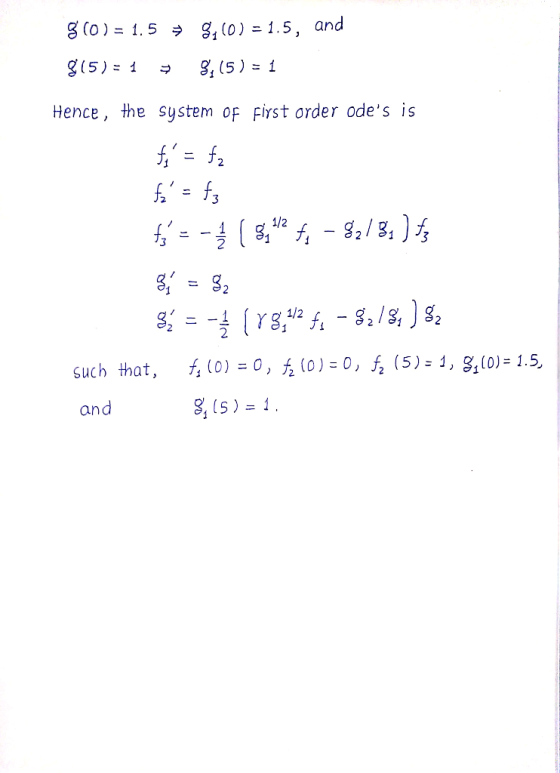
![L-8 29 -15 22] 111 4 3 2 1 10. The differential equations of high order: 2 And boundary conditions fo)-0, f (0)-0, f(5)-1,](http://img.homeworklib.com/images/e9fd93ab-7d85-49e0-b19a-7312c5130f5a.png?x-oss-process=image/resize,w_560)
Homework Answers

Add Answer to:
L-8 29 -15 22] 111 4 3 2 1 10. The differential equations of high order: 2 And boundary conditions fo)-0, f' (0)-0, f'(5)-1, g(o)-1.5, g(5)-1 Can be solved using The Shooting-Newton-Raphson a...
2. True (T) or False (F) a) Round-off errors increase with the number of calculations performed...
 2. True (T) or False (F) a) Round-off errors increase with the number of calculations performed b) Newton-Raphson method always converge c) Romberg formula is one of the most popular method for numerical integration d) The error of fourth order Runge-Kutta method is greater than the error of Heun method e) First order Runge-Kutta method is equivalent to the Euler method 1) A system of 2 ordinary differential equations requires 2 initial conditions to be solved g) Gauss quadrature formula...
Question 24 1 pts Using the shooting method for the following second-order differential equation governing the...
 Question 24 1 pts Using the shooting method for the following second-order differential equation governing the boundary value problem G.E: + EA (x) +u = L (x) € (0,L] B.C's: u () = 0 and EA (2) de Iz-L=F, the trapezoidal method is used to converts the problem into coupled integral equations solved at the quadrature points. None of the above. finite differences are used to convert the governing equation and boundary conditions of the problem into an analog set...
Problem 4. The higher order differential equation and initial conditions are shown as follows: = dy...
 Problem 4. The higher order differential equation and initial conditions are shown as follows: = dy dy +y?, y(0) = 1, y'(0) = -1, "(0) = 2 dt3 dt (a) [5pts. Transform the above initial value problem into an equivalent first order differential system, including initial conditions. (b) [2pts.] Express the system and the initial condition in (a) in vector form. (c) [4pts.] Using the second order Runge Kutta method as follows Ū* = Ūi + hĚ(ti, Ūi) h =...
write MATLAB scripts to solve differential equations. Computing 1: ELE1053 Project 3E:Solving Differential Equations Project Principle...
 write MATLAB scripts to solve differential equations.
Computing 1: ELE1053 Project 3E:Solving Differential Equations Project Principle Objective: Write MATLAB scripts to solve differential equations. Implementation: MatLab is an ideal environment for solving differential equations. Differential equations are a vital tool used by engineers to model, study and make predictions about the behavior of complex systems. It not only allows you to solve complex equations and systems of equations it also allows you to easily present the solutions in graphical form....
write MATLAB scripts to solve differential equations.
Computing 1: ELE1053 Project 3E:Solving Differential Equations Project Principle Objective: Write MATLAB scripts to solve differential equations. Implementation: MatLab is an ideal environment for solving differential equations. Differential equations are a vital tool used by engineers to model, study and make predictions about the behavior of complex systems. It not only allows you to solve complex equations and systems of equations it also allows you to easily present the solutions in graphical form....
Using the Runge-Kutta fourth-order method, obtain a solution to dx/dt=f(t,x,y)=xy^3+t^2; dy/dt=g(t,x,y)=ty+x^3 for t= 0 to t= 1 second. The initial conditions are given as x(0)=0, y(0) =1. Use a time...
Using the Runge-Kutta fourth-order method, obtain a solution to dx/dt=f(t,x,y)=xy^3+t^2; dy/dt=g(t,x,y)=ty+x^3 for t= 0 to t= 1 second. The initial conditions are given as x(0)=0, y(0) =1. Use a time increment of 0.2 seconds. Do hand calculations for t = 0.2 sec only.
solve problem #1 depending on the given information Consider the following 1D second order elliptic equation with Dirichlet boundary conditions du(x) (c(x)du ) = f(x) (a $15 b), u(a) = ga, u(b) = gb...
 solve problem #1 depending on the given information
Consider the following 1D second order elliptic equation with Dirichlet boundary conditions du(x) (c(x)du ) = f(x) (a $15 b), u(a) = ga, u(b) = gb dr: where u(x) is the unknown function, ga and gb are the Dirichlet boundary values, c(x) is a given coefficient function and f(x) is a given source function. See the theorem 10.1 in the textbook for the existence and uniqueness of the solution. 1.1 Weak Formulation...
solve problem #1 depending on the given information
Consider the following 1D second order elliptic equation with Dirichlet boundary conditions du(x) (c(x)du ) = f(x) (a $15 b), u(a) = ga, u(b) = gb dr: where u(x) is the unknown function, ga and gb are the Dirichlet boundary values, c(x) is a given coefficient function and f(x) is a given source function. See the theorem 10.1 in the textbook for the existence and uniqueness of the solution. 1.1 Weak Formulation...
 2. True (T) or False (F) a) Round-off errors increase with the number of calculations performed b) Newton-Raphson method always converge c) Romberg formula is one of the most popular method for numerical integration d) The error of fourth order Runge-Kutta method is greater than the error of Heun method e) First order Runge-Kutta method is equivalent to the Euler method 1) A system of 2 ordinary differential equations requires 2 initial conditions to be solved g) Gauss quadrature formula...
 Question 24 1 pts Using the shooting method for the following second-order differential equation governing the boundary value problem G.E: + EA (x) +u = L (x) € (0,L] B.C's: u () = 0 and EA (2) de Iz-L=F, the trapezoidal method is used to converts the problem into coupled integral equations solved at the quadrature points. None of the above. finite differences are used to convert the governing equation and boundary conditions of the problem into an analog set...
 Problem 4. The higher order differential equation and initial conditions are shown as follows: = dy dy +y?, y(0) = 1, y'(0) = -1, "(0) = 2 dt3 dt (a) [5pts. Transform the above initial value problem into an equivalent first order differential system, including initial conditions. (b) [2pts.] Express the system and the initial condition in (a) in vector form. (c) [4pts.] Using the second order Runge Kutta method as follows Ū* = Ūi + hĚ(ti, Ūi) h =...
 write MATLAB scripts to solve differential equations.
Computing 1: ELE1053 Project 3E:Solving Differential Equations Project Principle Objective: Write MATLAB scripts to solve differential equations. Implementation: MatLab is an ideal environment for solving differential equations. Differential equations are a vital tool used by engineers to model, study and make predictions about the behavior of complex systems. It not only allows you to solve complex equations and systems of equations it also allows you to easily present the solutions in graphical form....
write MATLAB scripts to solve differential equations.
Computing 1: ELE1053 Project 3E:Solving Differential Equations Project Principle Objective: Write MATLAB scripts to solve differential equations. Implementation: MatLab is an ideal environment for solving differential equations. Differential equations are a vital tool used by engineers to model, study and make predictions about the behavior of complex systems. It not only allows you to solve complex equations and systems of equations it also allows you to easily present the solutions in graphical form....
 solve problem #1 depending on the given information
Consider the following 1D second order elliptic equation with Dirichlet boundary conditions du(x) (c(x)du ) = f(x) (a $15 b), u(a) = ga, u(b) = gb dr: where u(x) is the unknown function, ga and gb are the Dirichlet boundary values, c(x) is a given coefficient function and f(x) is a given source function. See the theorem 10.1 in the textbook for the existence and uniqueness of the solution. 1.1 Weak Formulation...
solve problem #1 depending on the given information
Consider the following 1D second order elliptic equation with Dirichlet boundary conditions du(x) (c(x)du ) = f(x) (a $15 b), u(a) = ga, u(b) = gb dr: where u(x) is the unknown function, ga and gb are the Dirichlet boundary values, c(x) is a given coefficient function and f(x) is a given source function. See the theorem 10.1 in the textbook for the existence and uniqueness of the solution. 1.1 Weak Formulation...
Most questions answered within 3 hours.
-
Where is the error in this code sequence?
String s1 = "Hello";
String s2 = "ello";...
asked 11 months ago -
Financial data for Joel de Paris, Inc., for last year
follow:
Joel de Paris, Inc.
Balance...
asked 11 months ago -
Consider this reaction:
Al2(SO4)3 (aq)+ BaCl3
(aq) Al2Cl6 (aq)- +
3BaSO4(s) . What is the...
asked 11 months ago -
Suppose that Savneet is considering increasing her
recent random sample from 20 car rentals to 40...
asked 11 months ago -
Trucks arrive at an unloading terminal at an average rate of 120
per hour.
Trucks arrive...
asked 11 months ago -
Why are methanol and ethanol completely soluble in water while
octanol is not very little soluble....
asked 11 months ago -
A facilities manager at a university reads in a research report
that the mean amount of...
asked 11 months ago -
When the CuSO4 is rehydrated by adding water to the anhydrous
compound, is this an endothermic...
asked 11 months ago -
A ray of sunlight is passing from diamond into crown glass; the
angle of incidence is...
asked 11 months ago -
A block of mass 0.249 kg is placed on top of a light, vertical
spring of...
asked 11 months ago -
how do the kidneys compensate in the presences of acidosis
a) trigger hyperventilate
b) reserve acid...
asked 11 months ago -
Question 501 pts
The rental rate of capital to the firm increases. Which of the
following...
asked 11 months ago