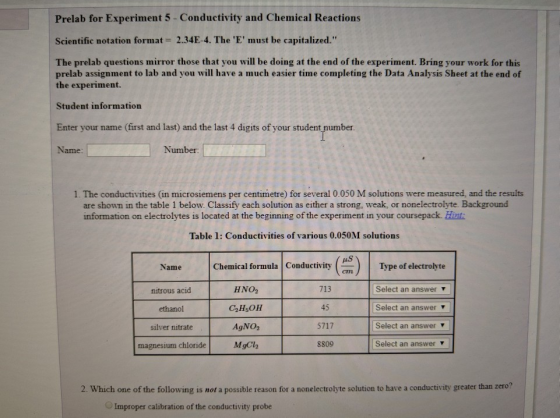
please show the work
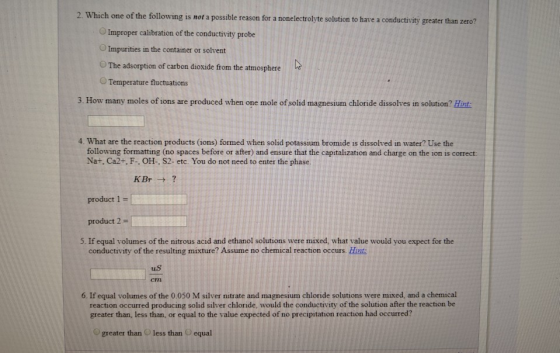
2. Which one of the following is not a possible reason for a nonelectrolyte solution to have a conductivity greater than zero? Improper calibration of the conductivity probe O Impurities in the container or solvent O The adsorption of carbon dioxide from the atmosphere Temperature fluctuations 3. How many moles of ions are produced when one mole of solid magnesium chloride dissolves in solution? Hint 4. What are the reaction products (ions) formed when solid potassium bromide is dissolved in water? Use the following formatting (no spaces before or after) and ensure that the capitalization and charge on the ion is correct Na+, Ca2+, F., OH-, S2-etc. You do not need to enter the phase. KBr → ? product 1 product 2- 5. If equal volumes of the nitrous acid and ethanol solutions were mixed, what value would you expect for the conductivity of the resulting mixture? Assume no chemical reaction occurs. Hin uS cm 6. If equal volumes of the 0.050 M silver nitrate and magnesium chloride solutions were mixed, and a chemical reaction occurred producing solid silver chloride, would the conductivity of the solution after the reaction be greater than, less than, or equal to the value expected of no precipitation reaction had occurred? Ogreater than Oless than Oequal
Homework Answers
1.)
- Strong Electrolytes : Those electrolytes, which ionize completely in aqueous solution. Strong acids and strong behaves as strong electrolytes.
- Weak Electrolytes : Those electrolytes which does-not ionize completely in aqueous solution. Weak acids and weak bases behaves as weak electrolyte
- Non- Electrolyte : Those electrolyte which does - not exist in ionic form in aqueous solution For example : Ethanol, glucose and many more such type of compounds.
Let us classify given compounds as strong weak or non electrolytes :
HNO2 : It has a medium conductivity value that is
713
C2H5OH : It has a low value of
conductivity that is 45
AgNO2 : It has higher value of conductivity that is
5717
MgCl2 : It has highest value of conductivity among
all other compounds that is 8809
2.)
- If the probe is not perfectly caliberated, it will not show accurate conductivity measurment. Accurate caliberation helps us to be sure that our solution is not contaminated. We should use fresh caliberation solution everytime we caliberate.
- Impurities in Container or Solvent : Because of the impurities present in the solution, solution will show some conductivity thus it could be the reason of a non- electrolyte solution of showing more then zero conductivity.
- Temperature fluctuations : More the temperature, faster will be the movement of ions present in the solution and hence more will be the conductivity.
Hence Adsorption of CO2 from the atmosphere could not be the reason of a non-electrolyte to have conductivity greater then zero
3.)
When solid Magnesium Chloride is dissolved in water, It dissociates itself into Mg2+ and Cl- ions as shown in the reaction given below :
MgCl2
Thus 1 Mg2+ and 2Cl- ions are formed, that is 1 mole of Magnesium ions are formed and 2 moles of chloride ions are formed , when 1 mole of MgCl2 is dissociated. Thus total 3 moles of ions are formed.
4)
When potassium bromide is dissolved in water, it dissociates into K+ and Br - ions and the reaction is shown below:
KBr 
thus product 1 = K+
and product 2 = Br -
5.)
Nitrous acid is the weak electrolyte and ethanol is a non- electrolyte, and from the unit of conductivity it is clear that the conductivity here is the specific conductivity.
Now as the solution of Nitrous acid is diluted with ethanol, then number of ions per unit volume that carry current in the aqueous solution decreases and hence the specific conductivity is decreased when equal volume of ethanol and Nitrous acid are mixed.
6.)
The reaction between silver nitrate and MgCl2 is shown below :
AgNO3 + MgCl2
Conductivity of the solution after the reaction will increase because Size of Mg2+ ions are lesser as compare to the size of Ag+ ions (more the charge, lesser will be the size of ion), here Mg2+ is replacing Ag+ from it's salt solution. Thus conductivity of the solution will increase.
Add Answer to:
please show the work Prelab for Experiment 5 - Conductivity and Chemical Reactions 2.34E-4. The 'E' must be capitalized." Scientific notation format The prelab questions mirror tho...
t in the orams ts. Conductivity Chem 113 Reading Assignment 1. Read sections 8.2-8.3 in your...
 t in the orams ts. Conductivity Chem 113 Reading Assignment 1. Read sections 8.2-8.3 in your lecture text. 2. Review Sample Exercise 8.4 on pages 326-327 of your lecture text. Introduction Properties of Solutions: Electrolytes and Non-Electrolytes In this experiment, you will discover some properties of strong electrolytes, weak electrolytes, and non- electrolytes by observing the behavior of these substances in aqueous solutions. You will determine these properties using a conductivity Probe. When the probe is placed in a solution...
EXPERIMENT 9 CHEMICAL REACTIONS: STOICHIOMETRY LABORATORY REPORT Your Name TA's Name You must rea...
 EXPERIMENT 9 CHEMICAL REACTIONS: STOICHIOMETRY LABORATORY REPORT Your Name TA's Name You must read pages 69 and 70 to complete the following calculations. Lab Section 1411. Date Trial #1 Trial #2 Trial #3 vol . 0.100 M K2CO, solution -1200 mL 12.00 mL mmole K2CrO vol. 0.100 M Pb(NO,), solution 10.00ml mmole Pb(NO) 12.00m 14.00 mL 20 g mass product+paper 0.579 g0.654 g mass dry filter paper 0266 mass PbCrO, collected precip. 9 mmole Pbcro, CALCULATIONS AND QUESTIONS (USE THE...
Experiment 8 Double Replacement Reactions Background: Some reactions have the net effect of causing the cation...
 Experiment 8 Double Replacement Reactions Background: Some reactions have the net effect of causing the cation of each reactant to trade places, forming a compound with the other anion. These reactions are known as double replacement reactions. In the example below (unbalanced equation), the barium and sodium cations switch places so that barium forms a product with sulfate while sodium forms a product with chloride. Note that the formula of each product is determined by the charges of the ions,...
Prelab questions 1,2, and 3 and Part E questions Also, write a flowchart of the experiments...
Prelab questions 1,2, and 3 and Part E questions Also, write a flowchart of the experiments process in each part. EXPERIMENT 3 DETERMINATION OF Δo The d orbitals of a metal ion in an octahedral ligand or crystal field are split into a higher energyset (eg) and a lower energy set (t2g) as shown in the following energy level diagram. 11 The energy difference between the upper and lower energy levels is Δo, the octahedral crystal field splitting. The degree...
please answer the prelab excercise:) I tried doing it but I did not get very far Experiment 7: Grignard Reactio...
 please answer the prelab excercise:) I tried doing it but I did not
get very far
Experiment 7: Grignard Reaction. Introduction Discovered by French chemist Victor Grignard, the reaction that now bears his name is an example of the preparation of an organometallic reagent. In this lab, phenylmagnesium bromide is the Grignard of interest, and it will be added to an aldehyde to produce an alcohol. Lab Objectives 1. To study organometallic reagents in general. benzophenone. 2. To prepare phenylmagnesium...
please answer the prelab excercise:) I tried doing it but I did not
get very far
Experiment 7: Grignard Reaction. Introduction Discovered by French chemist Victor Grignard, the reaction that now bears his name is an example of the preparation of an organometallic reagent. In this lab, phenylmagnesium bromide is the Grignard of interest, and it will be added to an aldehyde to produce an alcohol. Lab Objectives 1. To study organometallic reagents in general. benzophenone. 2. To prepare phenylmagnesium...
When you write the answers, please write the page number for which the question is located....
 When you write the answers, please write the page number for
which the question is located. Thank you!
Experiment 8 Name: Double Replacement Reactions Background: Some reactions have the net effect of causing the cation of cach reactant to trade places, forming a compound with the other anion. These reactions are known as double replacement reactions. In the example below (unbalanced equation), the barium and sodium cations switch places so that barium forms a product with sulfate while sodium forms...
When you write the answers, please write the page number for
which the question is located. Thank you!
Experiment 8 Name: Double Replacement Reactions Background: Some reactions have the net effect of causing the cation of cach reactant to trade places, forming a compound with the other anion. These reactions are known as double replacement reactions. In the example below (unbalanced equation), the barium and sodium cations switch places so that barium forms a product with sulfate while sodium forms...
 t in the orams ts. Conductivity Chem 113 Reading Assignment 1. Read sections 8.2-8.3 in your lecture text. 2. Review Sample Exercise 8.4 on pages 326-327 of your lecture text. Introduction Properties of Solutions: Electrolytes and Non-Electrolytes In this experiment, you will discover some properties of strong electrolytes, weak electrolytes, and non- electrolytes by observing the behavior of these substances in aqueous solutions. You will determine these properties using a conductivity Probe. When the probe is placed in a solution...
 EXPERIMENT 9 CHEMICAL REACTIONS: STOICHIOMETRY LABORATORY REPORT Your Name TA's Name You must read pages 69 and 70 to complete the following calculations. Lab Section 1411. Date Trial #1 Trial #2 Trial #3 vol . 0.100 M K2CO, solution -1200 mL 12.00 mL mmole K2CrO vol. 0.100 M Pb(NO,), solution 10.00ml mmole Pb(NO) 12.00m 14.00 mL 20 g mass product+paper 0.579 g0.654 g mass dry filter paper 0266 mass PbCrO, collected precip. 9 mmole Pbcro, CALCULATIONS AND QUESTIONS (USE THE...
 Experiment 8 Double Replacement Reactions Background: Some reactions have the net effect of causing the cation of each reactant to trade places, forming a compound with the other anion. These reactions are known as double replacement reactions. In the example below (unbalanced equation), the barium and sodium cations switch places so that barium forms a product with sulfate while sodium forms a product with chloride. Note that the formula of each product is determined by the charges of the ions,...
 please answer the prelab excercise:) I tried doing it but I did not
get very far
Experiment 7: Grignard Reaction. Introduction Discovered by French chemist Victor Grignard, the reaction that now bears his name is an example of the preparation of an organometallic reagent. In this lab, phenylmagnesium bromide is the Grignard of interest, and it will be added to an aldehyde to produce an alcohol. Lab Objectives 1. To study organometallic reagents in general. benzophenone. 2. To prepare phenylmagnesium...
please answer the prelab excercise:) I tried doing it but I did not
get very far
Experiment 7: Grignard Reaction. Introduction Discovered by French chemist Victor Grignard, the reaction that now bears his name is an example of the preparation of an organometallic reagent. In this lab, phenylmagnesium bromide is the Grignard of interest, and it will be added to an aldehyde to produce an alcohol. Lab Objectives 1. To study organometallic reagents in general. benzophenone. 2. To prepare phenylmagnesium...
 When you write the answers, please write the page number for
which the question is located. Thank you!
Experiment 8 Name: Double Replacement Reactions Background: Some reactions have the net effect of causing the cation of cach reactant to trade places, forming a compound with the other anion. These reactions are known as double replacement reactions. In the example below (unbalanced equation), the barium and sodium cations switch places so that barium forms a product with sulfate while sodium forms...
When you write the answers, please write the page number for
which the question is located. Thank you!
Experiment 8 Name: Double Replacement Reactions Background: Some reactions have the net effect of causing the cation of cach reactant to trade places, forming a compound with the other anion. These reactions are known as double replacement reactions. In the example below (unbalanced equation), the barium and sodium cations switch places so that barium forms a product with sulfate while sodium forms...
Most questions answered within 3 hours.
-
Where is the error in this code sequence?
String s1 = "Hello";
String s2 = "ello";...
asked 11 months ago -
Financial data for Joel de Paris, Inc., for last year
follow:
Joel de Paris, Inc.
Balance...
asked 11 months ago -
Consider this reaction:
Al2(SO4)3 (aq)+ BaCl3
(aq) Al2Cl6 (aq)- +
3BaSO4(s) . What is the...
asked 11 months ago -
Suppose that Savneet is considering increasing her
recent random sample from 20 car rentals to 40...
asked 11 months ago -
Trucks arrive at an unloading terminal at an average rate of 120
per hour.
Trucks arrive...
asked 11 months ago -
Why are methanol and ethanol completely soluble in water while
octanol is not very little soluble....
asked 11 months ago -
A facilities manager at a university reads in a research report
that the mean amount of...
asked 11 months ago -
When the CuSO4 is rehydrated by adding water to the anhydrous
compound, is this an endothermic...
asked 11 months ago -
A ray of sunlight is passing from diamond into crown glass; the
angle of incidence is...
asked 11 months ago -
A block of mass 0.249 kg is placed on top of a light, vertical
spring of...
asked 11 months ago -
how do the kidneys compensate in the presences of acidosis
a) trigger hyperventilate
b) reserve acid...
asked 11 months ago -
Question 501 pts
The rental rate of capital to the firm increases. Which of the
following...
asked 11 months ago