
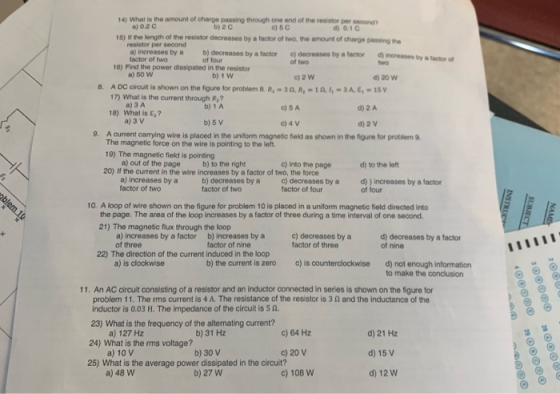
14) What is the amount of charge passing through one end of the resistor per secona? a)02 С c) 5C d 0.1C 15) lfrie length of the resistor decreases by a factor of two, the armourvt of charge passing บาย resistor per second a)increases by a b) decreases by a factor c) decreases by a factor dinoeam by stator factor of two 16) Find the power dissipated in the resistor a)50W of four of two two b) 1 W d) 20 w 8. A DC circuit is shown on the figure for problem &.R-30, R-1,1-3A,,-15 17) What is the current through R? a) 3 A 18) What is E,? a) 3 v b) 1 A c) 5 A d) 2 A b) 5 V c) 4 V d) 2 V 9. A current carmrying wire is placed in the uniform magnetic field as shown in the figure for problem 9 The magnetic force on the wire is pointing to the let 19) The magnetic field is pointing a) out of the pageb)to the right 20) If the current in the wire increases by a factor of two, the force a) increases by a factor of two c) into the page d) to the left b) decreases by a factor of two c) decreases by ad)) increases by a factor factor of four of four 10. A loop of wire shown on the figure for problem 10 is placed in a uniform magnetic field directed into the page. The area of the loop increases by a factor of three during a time interval of one second. 21) The magnetic flux through the loop a) increases by a factor b) increases by a of three c) decreases by a factor of three d) decreases by a factor of nine factor of nine 22) The direction of the current induced in the loop a) is clockwise b) the current is zero c) is counterolockwise d) not enough information to make the conclusion 11. An AC circuit consisting of a resistor and an inductor connected in series is shown on the figure for problem 11. The rms current is 4 A. The resistance of the resistor is 3 n and the inductance of the inductor is 0.03 H. The impedance of the circuit is 5 23) What is the frequency of the alternating current? a) 127 Hz 24) What is the rms voltage? a) 10 V 25) What is the average power dissipated in the circuit? a)48w d) 21 Hz c) 64 Hz b) 30 V d) 15 V C) 20 V b) 27 W c)108 W d) 12 W
Homework Answers


Add Answer to:
of an electromagnetic wave propagating in a vacuum is 65 x 10 Hz. See the table for problem 1 1) To what part of the electromagnetic spectrum does this wave a) blue light 2) The electromag a)per...
pgtual and inverted 6. The charge on each plate of a parallel-plate capacitor is 20 uC. The capacitance of the capacitor is C. 1 HF 10-6 F. 12) What is the magnitude of the electric field betwee...
 pgtual and inverted 6. The charge on each plate of a parallel-plate capacitor is 20 uC. The capacitance of the capacitor is C. 1 HF 10-6 F. 12) What is the magnitude of the electric field between the plates of the capacitor? a) 80 V/m 13) If the area of each plate remains the same but the distance between the plates increases by a factor of three, thern a) the capacitance b) the capacitance c) the capacitance decreases by a...
factor of tW 10. A loop of wire shown on the figure for problem 10 is...
 factor of tW 10. A loop of wire shown on the figure for problem 10 is placed in a uniform magnetic field directed into the page. The area of the loop decreases by a factor of three during a time interval of one second. 21) The magnetic flux through the loop a) increases by a factor b) increases by a of three c) decreases by a factor of three d) decreases by a f of nine factor of nine 22)...
9. A current carrying wire is placed in the uniform magnetic field as shown in the...
 9. A current carrying wire is placed in the uniform magnetic field as shown in the figure for problem! The magnetic force on the wire is pointing to the left 19) The magnetic field is pointing a) out of the page b) to the left 20) If the current in the wire decreases by a factor of two, the force a) increases by a b) decreases by a c) decreases by a factor of two d) into the page c)...
Problem 3: A sinusoidal plane electromagnetic wave travels in a vacuum in the x direction as...
 Problem 3: A sinusoidal plane
electromagnetic wave travels in a vacuum in the x direction as
shown in the graph. The period of the wave is T = 2.5 ×
10-8 s.
Randomized VariablesT = 2.5 ×
10-8 s
Part (a) Express the wavelength of the wave,
λ, in terms of T and the speed of light,
c.
Part (b) Solve for the numerical value of
λ in m.
Part (c) Write the equation of the frequency,
f, in terms...
Problem 3: A sinusoidal plane
electromagnetic wave travels in a vacuum in the x direction as
shown in the graph. The period of the wave is T = 2.5 ×
10-8 s.
Randomized VariablesT = 2.5 ×
10-8 s
Part (a) Express the wavelength of the wave,
λ, in terms of T and the speed of light,
c.
Part (b) Solve for the numerical value of
λ in m.
Part (c) Write the equation of the frequency,
f, in terms...
Part A: An electromagnetic wave is propagating in the positive x direction. At a given moment...
 Part A:
An electromagnetic wave is propagating in the positive
x direction. At a given moment in time, the magnetic field
at the origin points in the positive y direction. In what
direction does the electric field at the origin point at that same
moment?
Positive x
Negative x
Positive y
Negative y
Positive z
Negative z
Part B:
The figure shows the electromagnetic field as a function of
position for two electromagnetic waves traveling in a vacuum at a...
Part A:
An electromagnetic wave is propagating in the positive
x direction. At a given moment in time, the magnetic field
at the origin points in the positive y direction. In what
direction does the electric field at the origin point at that same
moment?
Positive x
Negative x
Positive y
Negative y
Positive z
Negative z
Part B:
The figure shows the electromagnetic field as a function of
position for two electromagnetic waves traveling in a vacuum at a...
A plane electromagnetic wave traveling in the positive direction of an x axis in vacuum has...
 A plane electromagnetic wave
traveling in the positive direction of an x axis in vacuum has
components Ex = Ey = 0 and Ez = (4.2 V/m) cos[(? × 1015 s-1)(t -
x/c)].(a) What is the amplitude of the magnetic field component?
(b) Parallel to which axis does the magnetic field oscillate? (c)
When the electric field component is in the positive direction of
the z axis at a certain point P, what is the direction of the
magnetic field...
A plane electromagnetic wave
traveling in the positive direction of an x axis in vacuum has
components Ex = Ey = 0 and Ez = (4.2 V/m) cos[(? × 1015 s-1)(t -
x/c)].(a) What is the amplitude of the magnetic field component?
(b) Parallel to which axis does the magnetic field oscillate? (c)
When the electric field component is in the positive direction of
the z axis at a certain point P, what is the direction of the
magnetic field...
13. A metal bar of height 20cm lying in the plane of the page is moved...
 13. A metal bar of height 20cm lying in the plane of the page is moved through a magnetic field at a speed of 0.2m/s towards the right (see the figure below). The field has magnitude 0.5T and points out of the page. The charge separation induced in the bar is the same as would be caused by an EMF: a. 0.004 V upward b. 0.0004 V downward c. 0.02 V upward d. 0.02 V downward 0.2 m/s B-0.5T 4....
The figure below shows a plane electromagnetic sinusoidal wave propagating in the x direction. Suppose the...
 The figure below shows a plane electromagnetic sinusoidal wave propagating in the x direction. Suppose the wavelength is 48.0 m and the e field vibrates in the xy plane with an amplitude of 18.0 V/m. (a) Calculate the frequency of the wave. 6.25 MHz (b) Calculate the magnetic field B when the electric field has its maximum value in the negative y direction, magnitude. 0.13 What is the relationship between the amplitudes of the magnetic and electric fields in a...
A plane electromagnetic wave traveling in the positive direction of an x axis in vacuum has...
 A plane electromagnetic wave traveling in the positive direction of an x axis in vacuum has components E_x = E_y = 0 and E_z = (4.3 V/m) cos[(pi times 10^15 s^-1)(t - x/c)].(a) What is the amplitude of the magnetic field component? (b) Parallel to which axis does the magnetic field oscillate? (c) When the electric field component is in the positive direction of the z axis at a certain point P, what is the direction of the magnetic field...
A plane electromagnetic wave, with wavelength 2.4 m, travels in vacuum in the positive direction ...
 A plane electromagnetic wave, with wavelength 2.4 m, travels in
vacuum in the positive direction of an x axis. The electric field,
of amplitude 390 V/m, oscillates parallel to the y axis. What are
the (a) frequency, (b) angular frequency, and (c) angular wave
number of the wave? (d) What is the amplitude of the magnetic field
component? (e) Parallel to which axis does the magnetic field
oscillate? (f) What is the time-averaged rate of energy flow
associated with this...
A plane electromagnetic wave, with wavelength 2.4 m, travels in
vacuum in the positive direction of an x axis. The electric field,
of amplitude 390 V/m, oscillates parallel to the y axis. What are
the (a) frequency, (b) angular frequency, and (c) angular wave
number of the wave? (d) What is the amplitude of the magnetic field
component? (e) Parallel to which axis does the magnetic field
oscillate? (f) What is the time-averaged rate of energy flow
associated with this...
 pgtual and inverted 6. The charge on each plate of a parallel-plate capacitor is 20 uC. The capacitance of the capacitor is C. 1 HF 10-6 F. 12) What is the magnitude of the electric field between the plates of the capacitor? a) 80 V/m 13) If the area of each plate remains the same but the distance between the plates increases by a factor of three, thern a) the capacitance b) the capacitance c) the capacitance decreases by a...
 factor of tW 10. A loop of wire shown on the figure for problem 10 is placed in a uniform magnetic field directed into the page. The area of the loop decreases by a factor of three during a time interval of one second. 21) The magnetic flux through the loop a) increases by a factor b) increases by a of three c) decreases by a factor of three d) decreases by a f of nine factor of nine 22)...
 9. A current carrying wire is placed in the uniform magnetic field as shown in the figure for problem! The magnetic force on the wire is pointing to the left 19) The magnetic field is pointing a) out of the page b) to the left 20) If the current in the wire decreases by a factor of two, the force a) increases by a b) decreases by a c) decreases by a factor of two d) into the page c)...
 Problem 3: A sinusoidal plane
electromagnetic wave travels in a vacuum in the x direction as
shown in the graph. The period of the wave is T = 2.5 ×
10-8 s.
Randomized VariablesT = 2.5 ×
10-8 s
Part (a) Express the wavelength of the wave,
λ, in terms of T and the speed of light,
c.
Part (b) Solve for the numerical value of
λ in m.
Part (c) Write the equation of the frequency,
f, in terms...
Problem 3: A sinusoidal plane
electromagnetic wave travels in a vacuum in the x direction as
shown in the graph. The period of the wave is T = 2.5 ×
10-8 s.
Randomized VariablesT = 2.5 ×
10-8 s
Part (a) Express the wavelength of the wave,
λ, in terms of T and the speed of light,
c.
Part (b) Solve for the numerical value of
λ in m.
Part (c) Write the equation of the frequency,
f, in terms...
 Part A:
An electromagnetic wave is propagating in the positive
x direction. At a given moment in time, the magnetic field
at the origin points in the positive y direction. In what
direction does the electric field at the origin point at that same
moment?
Positive x
Negative x
Positive y
Negative y
Positive z
Negative z
Part B:
The figure shows the electromagnetic field as a function of
position for two electromagnetic waves traveling in a vacuum at a...
Part A:
An electromagnetic wave is propagating in the positive
x direction. At a given moment in time, the magnetic field
at the origin points in the positive y direction. In what
direction does the electric field at the origin point at that same
moment?
Positive x
Negative x
Positive y
Negative y
Positive z
Negative z
Part B:
The figure shows the electromagnetic field as a function of
position for two electromagnetic waves traveling in a vacuum at a...
 A plane electromagnetic wave
traveling in the positive direction of an x axis in vacuum has
components Ex = Ey = 0 and Ez = (4.2 V/m) cos[(? × 1015 s-1)(t -
x/c)].(a) What is the amplitude of the magnetic field component?
(b) Parallel to which axis does the magnetic field oscillate? (c)
When the electric field component is in the positive direction of
the z axis at a certain point P, what is the direction of the
magnetic field...
A plane electromagnetic wave
traveling in the positive direction of an x axis in vacuum has
components Ex = Ey = 0 and Ez = (4.2 V/m) cos[(? × 1015 s-1)(t -
x/c)].(a) What is the amplitude of the magnetic field component?
(b) Parallel to which axis does the magnetic field oscillate? (c)
When the electric field component is in the positive direction of
the z axis at a certain point P, what is the direction of the
magnetic field...
 13. A metal bar of height 20cm lying in the plane of the page is moved through a magnetic field at a speed of 0.2m/s towards the right (see the figure below). The field has magnitude 0.5T and points out of the page. The charge separation induced in the bar is the same as would be caused by an EMF: a. 0.004 V upward b. 0.0004 V downward c. 0.02 V upward d. 0.02 V downward 0.2 m/s B-0.5T 4....
 The figure below shows a plane electromagnetic sinusoidal wave propagating in the x direction. Suppose the wavelength is 48.0 m and the e field vibrates in the xy plane with an amplitude of 18.0 V/m. (a) Calculate the frequency of the wave. 6.25 MHz (b) Calculate the magnetic field B when the electric field has its maximum value in the negative y direction, magnitude. 0.13 What is the relationship between the amplitudes of the magnetic and electric fields in a...
 A plane electromagnetic wave traveling in the positive direction of an x axis in vacuum has components E_x = E_y = 0 and E_z = (4.3 V/m) cos[(pi times 10^15 s^-1)(t - x/c)].(a) What is the amplitude of the magnetic field component? (b) Parallel to which axis does the magnetic field oscillate? (c) When the electric field component is in the positive direction of the z axis at a certain point P, what is the direction of the magnetic field...
 A plane electromagnetic wave, with wavelength 2.4 m, travels in
vacuum in the positive direction of an x axis. The electric field,
of amplitude 390 V/m, oscillates parallel to the y axis. What are
the (a) frequency, (b) angular frequency, and (c) angular wave
number of the wave? (d) What is the amplitude of the magnetic field
component? (e) Parallel to which axis does the magnetic field
oscillate? (f) What is the time-averaged rate of energy flow
associated with this...
A plane electromagnetic wave, with wavelength 2.4 m, travels in
vacuum in the positive direction of an x axis. The electric field,
of amplitude 390 V/m, oscillates parallel to the y axis. What are
the (a) frequency, (b) angular frequency, and (c) angular wave
number of the wave? (d) What is the amplitude of the magnetic field
component? (e) Parallel to which axis does the magnetic field
oscillate? (f) What is the time-averaged rate of energy flow
associated with this...
Most questions answered within 3 hours.
-
Where is the error in this code sequence?
String s1 = "Hello";
String s2 = "ello";...
asked 10 months ago -
Financial data for Joel de Paris, Inc., for last year
follow:
Joel de Paris, Inc.
Balance...
asked 10 months ago -
Consider this reaction:
Al2(SO4)3 (aq)+ BaCl3
(aq) Al2Cl6 (aq)- +
3BaSO4(s) . What is the...
asked 10 months ago -
Suppose that Savneet is considering increasing her
recent random sample from 20 car rentals to 40...
asked 10 months ago -
Trucks arrive at an unloading terminal at an average rate of 120
per hour.
Trucks arrive...
asked 10 months ago -
Why are methanol and ethanol completely soluble in water while
octanol is not very little soluble....
asked 10 months ago -
A facilities manager at a university reads in a research report
that the mean amount of...
asked 10 months ago -
When the CuSO4 is rehydrated by adding water to the anhydrous
compound, is this an endothermic...
asked 10 months ago -
A ray of sunlight is passing from diamond into crown glass; the
angle of incidence is...
asked 10 months ago -
A block of mass 0.249 kg is placed on top of a light, vertical
spring of...
asked 10 months ago -
how do the kidneys compensate in the presences of acidosis
a) trigger hyperventilate
b) reserve acid...
asked 10 months ago -
Question 501 pts
The rental rate of capital to the firm increases. Which of the
following...
asked 10 months ago