Please answer each question by identifying the correct issue , the rule , analysis , and conclusion , ) Rule , Analysis , Conclusion

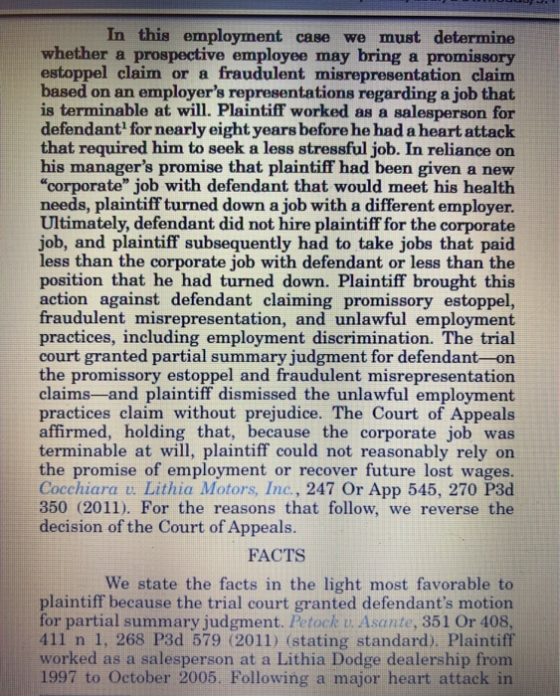

In this employment case we must determine whether a prospective employee may bring a promissory estoppel claim or a fraudulent misrepresentation claim based on an employer's representations regarding a job that is terminable at will. Plaintiff worked as a salesperson for defendant1 for nearly eight years before he had a heart attaclk that required him to seek a less stressful job. In reliance on his manager's promise that plaintiff had been given a new "corporate" job with defendant that would meet his health needs, plaintiff turned down a job with a different employer. Ultimately, defendant did not hire plaintiff for the corporate job, and plaintiff subsequently had to take jobs that paid less than the corporate job with defendant or less than the position that he had turned down. Plaintiff brought this action against defendant claiming promissory estoppel, audulent misrepresentation, and unlawful employment practices, including employment discrimination. The trial court granted partial summary judgment for defendant-on the promissory estoppel and fraudulent misrepresentation claims-and plaintiff dismissed the unlawful employment practices claim without prejudice. The Court of Appeals affirmed, holding that, because the corporate job was terminable at will, plaintiff could not reasonably rely on the promise of employment or recover future lost wages. Cocchiara v. Lithia Motors, Inc, 247 Or App 545, 270 P3d 350 (2011). For the reasons that follow, we reverse the decision of the Court of Appeals. FACTS We state the facts in the light most favorable to plaintiff because the trial court granted defendant's motion for partial summary judgment. Petock v. Asante, 351 Or 408, l n 1, 268 P3d 579 (2011) (stating standard). Plaintiff worked as a salesperson at a Lithia Dodge dealership fronm 1997 to October 2005. Following a major heart attack in
2004, plaintiff's doctors recommended that he find a less stressful job that would allow him to work shorter hours and avoid working on the weekends. Plaintiff discussed those needs with Summers, his General Sales Manager at the dealership, but he also pursued other employment because his sales job could not meet his health needs. Plaintiffreceived an offer to be a sales representative for the Medford Mail Tribune, a position that satisfied his health requirements. Plaintiff went to Summers to tell him that he planned to take the Medford Mail Tribune job, and he told Summers that that job would be less stressful and would provide compensation that was comparable to his current position. Summers responded that plaintiff should not accept the Medford Mail Tribune position because he was "too valuable" to defendant. Summers then told plaintiff that there was a new "corporate" job available with defendant that would meet his health needs. After placing a call to defendant's corporate offices, Summers advised plaintiff that he had been given the corporate position and that he would be contacted the next day to come in to finalize the paperwork. Plaintiff then asked Summers to confirm that the offer was definite, given plaintiff's outstanding offer from the Medford Mail Tribune Summers confirmed that plaintiff had been given the job and that the meeting the next day was a "mere formality Plaintiff acknowledges that there was no discussion as to whether or not the corporate job would be terminable at will. After his discussion with Summers, plaintiff told the Medford Mail Tribune that he had decided not to accept its offer because he had received another job with defendant. When plaintiff met with one of defendant's representatives the next day, the representative told laintiff that he had not been hired for the corporate job Instead, the representative was meeting with plaintiff to interview him as one possible candidate for the corporate job. Ultimately, defendant did not hire plaintiff for that job. When plaintiff then tried to accept the Medford Mail Tribune's prior job offer, that job had been filled. Plaintiff
Homework Answers
Caption: Michael Cocchiara v Lithia Motors
Issue: Can a potential employee of a company, file a promissory estoppel or false representation claim based on employment and termination at will clause followed by company.
Rule: Under contract law, Employment at-will is the policy which states that the company or the employer can terminate any employee at any time if the employee was hired with employment at will clause. The termination will have no specific reason or warning, stated by the employer. On similar lines, the employee will also have the same rights and will have the privilege to quit the company any time without stating any specific reason for the same, and without serving any notice period.
But the employee has full rights to rely on a job offer , made by the employer, even if the employment at will doctrine is followed in the company. The applicability of this rule increases if the employee had been associated with the employer company for a while.
The doctrine of promissory estoppel states that a promise must be considered to be enforceable by law, even when the same does not have any formal consideration associated with it.
As per Title VII and EEOC, The company will be held responsible for denying equal employment opportunities to the employee if the employee feels that he had been discriminated on some grounds. Title VII of Civil Rights Act, 1964 plays a very important role in the workplace harassment or discrimination cases. Any kind of discrimination from employer on any kind of bias like sex, race, religion, sect, etc. is strictly prohibited under this Title. This serves as the basis for providing equal employment opportunities to all.
Analysis: The plaintiff used to work for defendant’s company for a while. He had suffered a heart attack and had desired to have a less-stressful work environment from the defendant. The plaintiff had claimed that though the defendant affirmed and promised the same initially, they had rejected his request eventually and did not offer him a corporate role, where work stress is comparatively less. He also plead that the company did not offer him the corporate job based on discrimination on his disability to perform under stress. The defendant claimed that the company followed the employment at will doctrine and hence, cannot be considered liable for fulfilling the promise of job offer. The defendant stated that the company terminated the job offer promise made to the plaintiff at will.
Conclusion: The court decided that an at-will job remains the same, even if the potential employee under consideration, is a specially-abled or disabled individual. Hence the claims of the plaintiff do not remain valid.
Add Answer to:
Please answer each question by identifying the correct issue , the rule , analysis , and conclusion , ) Rule , Analysi...
I would like some help rewording this IRAC analysis.. Issue: The issue at hand with this...
I would like some help rewording this IRAC analysis.. Issue: The issue at hand with this case is whether or not the Court of Appeals properly reversed the dismissal of the plaintiff employees 703(a)(1) claim. Rule: The complainant in a trial under Title VII of the Civil Rights Act of 1964 carries the initial burden under the statute of establishing a prima facie case of racial discrimination. This may be done by showing (i) that he belongs to a racial...
you must use the format provided below in order to brief the attached case 221 N.W.2d...
you must use the format provided below in order to brief the attached case 221 N.W.2d 609 (1974) John SALSBURY, Appellee, v. NORTHWESTERN BELL TELEPHONE COMPANY, Appellant. No. 55960. Supreme Court of Iowa. September 18, 1974. Laird, Burington, Bovard & Heiny, Mason City, and William F. McFarlin, Des Moines, for appellant. Boyd G. Hayes, Charles City, and William Pappas, Mason City, for appellee. Considered en banc. HARRIS, Justice. This is the third appeal in which we have considered a claim...
1. Which of the following statements is true? a. The serving of written questions, to be answered...
1. Which of the following statements is true? a. The serving of written questions, to be answered in writing by the opposing party, is known as interrogatories. b. A long-arm statute becomes applicable only in cases in which the court has been found not to have a venue. c. An attorney "cross-examines" a witness who has been called to establish the facts about his or her side of the case. d. If a demurrer entered by the defendant is sustained...
Question 11 Herman bought stock in Pear, Inc., a popular computer company,Afew months later. Herman sells his stock at a loss of $5 per share.A year later, Herman is till angry over losing mon...
 Question 11 Herman bought stock in Pear, Inc., a popular computer company,Afew months later. Herman sells his stock at a loss of $5 per share.A year later, Herman is till angry over losing money and reads about certain shareholders not receiving dividends from Pear, Inc. Herman decides to sue the company on behalf of shareholders Will Herman's lawsuit be allowed? Yes, as long as Herman owned Pear,Inc.stock at some point he can sue O Yes, any person can bring a...
Partnership 1 Anthony Baldwin, Reginald Turner, Stephen Hines, and Celeste Richards were all business graduate students...
 Partnership 1 Anthony Baldwin, Reginald Turner, Stephen Hines, and Celeste Richards were all business graduate students at Tennessee State University. They were anxious to start some kind of business venture to make some money while they were still in graduate school. Baldwin came up with the idea that they Could make money with a mobile bar and lounge unit that they could transport to festivals and special events. Turner, Hines, and Richards did not have any money, but Baldwin said...
The differences & similarities between the federal & state court systems. 2. The structure of the...
The differences & similarities between the federal & state court systems. 2. The structure of the Washington state court system; i.e. the trial court of general jurisdiction, the intermediate appellate court, the state supreme court. 3. Remember, Washington is in the 9 th Circuit Court of Appeals. 4. Under both the Washington state and federal court system, there is one appeal as of right. Appeals to the Washington Supreme Court(in the state system), or to the U.S. Supreme Court in...
Case review for Alaska Packers Assoc. v Domenico (9th Circuit, 1902) Issue, Ruling, Application, Conclusion ROSS, Circuit Judge. The libel in this case was based upon a contract alleged to have been...
Case review for Alaska Packers Assoc. v Domenico (9th Circuit, 1902) Issue, Ruling, Application, Conclusion ROSS, Circuit Judge. The libel in this case was based upon a contract alleged to have been entered into between the libelants and the appellant corporation on the 22d day of May, 1900, at Pyramid Harbor, Alaska, by which it is claimed the appellant promised to pay each of the libelants, among other things, the sum of $100 for services rendered and to be rendered....
d. doctrine of precedent e. none of the above Short Answers- Answer each question below with...
 d. doctrine of precedent e. none of the above Short Answers- Answer each question below with regard to the number of points assigned to the question, 1. Short Answer (15 points) Facts Susan is a 30 year-old farmer, from Bragg Creek, Alberta which is located approximately 30 km from Jumping Pound, Alberta. Susan owned four productive milk cows that she wished to sell for $800.00 each. George, her neighbor, had been looking at the cows for a few weeks but...
Vincent Simmons appeals from the trial court's order awarding to his wife, Dorothy Simmons, a one-half...
Vincent Simmons appeals from the trial court's order awarding to his wife, Dorothy Simmons, a one-half Page 214 interest in land that he inherited from his parents. Vincent contends that the land is non-marital property and, consequently, should have remained his separate property. Vincent and Dorothy Simmons were married on October 9, 1976. On April 11, 1995, Vincent's mother, Louise Simmons, executed The Louise B. Simmons Trust in order to convey certain land in Florida to her children, Vincent and...
Please read this case and answer the questions separately: 1. What is the issue of the...
Please read this case and answer the questions separately: 1. What is the issue of the case? (Write it in the form of a question – it is the question the court must answer) 2. What are the applicable rules in the case (define them). Why are the rules applicable? a. What kind of discrimination is taking place – disparate treatment or disparate impact? Justify your answer. b. What protected class or classes are affected? Why? 3. Analyze the case....
 Question 11 Herman bought stock in Pear, Inc., a popular computer company,Afew months later. Herman sells his stock at a loss of $5 per share.A year later, Herman is till angry over losing money and reads about certain shareholders not receiving dividends from Pear, Inc. Herman decides to sue the company on behalf of shareholders Will Herman's lawsuit be allowed? Yes, as long as Herman owned Pear,Inc.stock at some point he can sue O Yes, any person can bring a...
 Partnership 1 Anthony Baldwin, Reginald Turner, Stephen Hines, and Celeste Richards were all business graduate students at Tennessee State University. They were anxious to start some kind of business venture to make some money while they were still in graduate school. Baldwin came up with the idea that they Could make money with a mobile bar and lounge unit that they could transport to festivals and special events. Turner, Hines, and Richards did not have any money, but Baldwin said...
 d. doctrine of precedent e. none of the above Short Answers- Answer each question below with regard to the number of points assigned to the question, 1. Short Answer (15 points) Facts Susan is a 30 year-old farmer, from Bragg Creek, Alberta which is located approximately 30 km from Jumping Pound, Alberta. Susan owned four productive milk cows that she wished to sell for $800.00 each. George, her neighbor, had been looking at the cows for a few weeks but...
Most questions answered within 3 hours.
-
Where is the error in this code sequence?
String s1 = "Hello";
String s2 = "ello";...
asked 11 months ago -
Financial data for Joel de Paris, Inc., for last year
follow:
Joel de Paris, Inc.
Balance...
asked 11 months ago -
Consider this reaction:
Al2(SO4)3 (aq)+ BaCl3
(aq) Al2Cl6 (aq)- +
3BaSO4(s) . What is the...
asked 11 months ago -
Suppose that Savneet is considering increasing her
recent random sample from 20 car rentals to 40...
asked 11 months ago -
Trucks arrive at an unloading terminal at an average rate of 120
per hour.
Trucks arrive...
asked 11 months ago -
Why are methanol and ethanol completely soluble in water while
octanol is not very little soluble....
asked 11 months ago -
A facilities manager at a university reads in a research report
that the mean amount of...
asked 11 months ago -
When the CuSO4 is rehydrated by adding water to the anhydrous
compound, is this an endothermic...
asked 11 months ago -
A ray of sunlight is passing from diamond into crown glass; the
angle of incidence is...
asked 11 months ago -
A block of mass 0.249 kg is placed on top of a light, vertical
spring of...
asked 11 months ago -
how do the kidneys compensate in the presences of acidosis
a) trigger hyperventilate
b) reserve acid...
asked 11 months ago -
Question 501 pts
The rental rate of capital to the firm increases. Which of the
following...
asked 11 months ago