
Homework Answers
IF YOU HAVE ANY DOUBTS COMMENT BELOW I WILL BE THERE TO HELP YOU ALL THE BEST
AS FOR GIVEN DATA,,
Consider the following Matlab code. clear s.norm for i-1:10000 r-rand(1); % generate a uniform random number on [0,1] s.norm(i)-s/i end plot( 1:10000,s.norm) % make a plot of s.norm(i) versus i (5 pts) What will the plot look like? (10 pts) Will the function/vector s.norm(n) converge to something as n gets large? If so, what? If not, why not? Justify your answer (5 pts) If we were to run this code multiple times - overlaying the plots on top of each other (with hold on, for example) - what will the plots look like?
EXPLANATION ::-
What will plot look like?
Initially plot will fluctuate between 3 to 4 and the gradually move towards 3.3333333
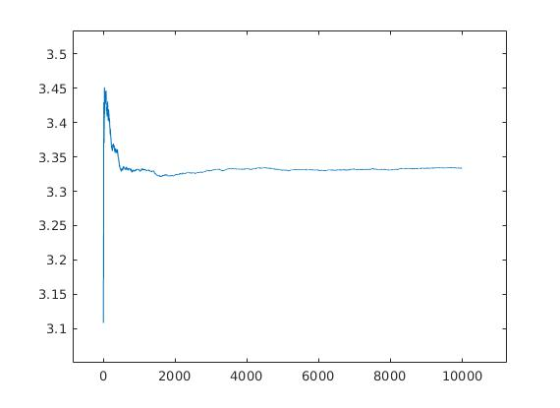
Will function converge to something if n gets large?
Yes in each loop s is incremented by 3 in each loop and r is random is variable between 0 and 1, r*r is added in each loop
taking average value r*r = 
So for any n s_norm(n) = 
Multiple runs how would plot look like?
 Function
takes almost every value between 3 and 4 for n = 1 and gradually
converge to 3.33333333 as number of iteration(n)
increases.
Function
takes almost every value between 3 and 4 for n = 1 and gradually
converge to 3.33333333 as number of iteration(n)
increases.
I HOPE YOU UNDERSSTAND..
PLS ..RATE THUMBSUP IT HELPS ME ALOT
THANKS GOODLUCK
THANK YOU....!
Add Answer to:
3. Consider the following Matlab code. s-0; clear s.norm for i 1:10000 r-rand(1); % generate a uniform random, numb...
code in Matlab Problem 1: The MATLAB humps function defines a curve that has 2 maxima (peaks) of unequal height over the interval 0 2, f(x) = r-0.3)2 +0.01 (r-09 +0.04 Use MATLAB to generate a plo...
 code in Matlab
Problem 1: The MATLAB humps function defines a curve that has 2 maxima (peaks) of unequal height over the interval 0 2, f(x) = r-0.3)2 +0.01 (r-09 +0.04 Use MATLAB to generate a plot of Kx) versus x with x [0:1/256:2: Do not use MATLAB's built-in humps function to generate the values of Rx). Also, employ the minimum number of periods to perform the vector operations needed to eneate x) values for the plo
Problem 1: The...
code in Matlab
Problem 1: The MATLAB humps function defines a curve that has 2 maxima (peaks) of unequal height over the interval 0 2, f(x) = r-0.3)2 +0.01 (r-09 +0.04 Use MATLAB to generate a plot of Kx) versus x with x [0:1/256:2: Do not use MATLAB's built-in humps function to generate the values of Rx). Also, employ the minimum number of periods to perform the vector operations needed to eneate x) values for the plo
Problem 1: The...
Consider the initial value problem y' +y=e-, with y(0) = 0. PROJECT 1.) Find the exact...
 Consider the initial value problem y' +y=e-, with y(0) = 0. PROJECT 1.) Find the exact solution to this equation, say 0(x). 2.) Use MATLAB to plot 6(x) in the interval [0.0, 4.0] . Use sufficient points to obtain a smooth curve. 3.) Now create a MATLAB program that uses Euler's Method to approximate the values of $(2) at N = 10 equally spaced points in (0,4). Plot these points on the same plot that was generated in part 2....
Generate N binary random variables Xi, i E {1,2,.., N] where X 1 or -1 with equal probability in ...
 Generate N binary random variables Xi, i E {1,2,.., N] where X 1 or -1 with equal probability in Matlab using rand or randn. According to central limit theorem, i= 1 should follow normal distribution when N is large. (1) Please plot the theoretical pdf of normal distribution (2) Please estimate the pdf of Vv by generating a lot of instances of Vv (hint: use hist command to get histogram then scaleit) (3) Please plot the theoretical pdf and the...
The following snippet of code will store the r and y coordinates of 10 points in 4 different row vectors and then plots 5 vectors between certain pairs of those points Show/hide Matlab code snippet 1...
 The following snippet of code will store the r and y coordinates of 10 points in 4 different row vectors and then plots 5 vectors between certain pairs of those points Show/hide Matlab code snippet 1 A-1:5; B A +1/sqrt (2); C = ones(1,5) D C +1/sqrt (2); plot([A; B], [C; D]) axis equal Which of the following statements about the plot produced by the above snippet of Matlab code are correct. The vectors plotted are the vectors from the...
This is a MATLAB Question. Below is my base code for a Fourier Series of a...
 This is a MATLAB Question. Below is my base code for a Fourier
Series of a half triangle wave.
So I am being asked to isolate the first 8 components so that
only those first 8 components of the half triangle function are
calculated by MATLAB fft function, and then afterwards I am asked
to do the same thing but with the first 20 components rather than
the first 8. How do I isolate the first x number of components...
This is a MATLAB Question. Below is my base code for a Fourier
Series of a half triangle wave.
So I am being asked to isolate the first 8 components so that
only those first 8 components of the half triangle function are
calculated by MATLAB fft function, and then afterwards I am asked
to do the same thing but with the first 20 components rather than
the first 8. How do I isolate the first x number of components...
Use the attached Matlab code as a basis to solve the following ordinary differential equation usi...
 Question 1
QUESTION 2
Use the attached Matlab code as a basis to solve the following ordinary differential equation using Euler's method, with timestep of 0.1, from t-0to t-100. d)0) -0 - sin (5vt cos(у Plot y versus t from t=0 to t=100. How many local maxima are on this interval(do not include end points). Be careful to count them all! Answer should be an integer 1 w% Matlab code for the solution of Module 2 3 dt-9.1; %dt is...
Question 1
QUESTION 2
Use the attached Matlab code as a basis to solve the following ordinary differential equation using Euler's method, with timestep of 0.1, from t-0to t-100. d)0) -0 - sin (5vt cos(у Plot y versus t from t=0 to t=100. How many local maxima are on this interval(do not include end points). Be careful to count them all! Answer should be an integer 1 w% Matlab code for the solution of Module 2 3 dt-9.1; %dt is...
Using MATLAB, not R codes, I repeat, please, not in R, just MATLAB codes, write the complete code for: 1. Assume Y is an exponential random variable with rate parameter λ=2. (1) Generate 1000 samples...
Using MATLAB, not R codes, I repeat, please, not in R, just MATLAB codes, write the complete code for: 1. Assume Y is an exponential random variable with rate parameter λ=2. (1) Generate 1000 samples from this exponential distribution using inverse transform method (2) Compare the histogram of your samples with the true density of Y.
Let G,()+3s+5) , K-1 and Ge 1 I Determine the loop transfer function L(s)-KG.G. Use 'margin' command in matlab to generate the Bode Plot for L(s). (a) What are its gain and phase margins (the...
 Let G,()+3s+5) , K-1 and Ge 1 I Determine the loop transfer function L(s)-KG.G. Use 'margin' command in matlab to generate the Bode Plot for L(s). (a) What are its gain and phase margins (these should be available in the plots). (b) Convert the gain margin in dB to absolute value. (c) For what value of the gain K would the closed loop system become marginally stable? (d) Show that, for this value of K, the closed loop system does...
I have all of the answers to this can someone just actually explain this matlab code and the results to me so i can get a better understanding? b) (c) and (d) %% Matlab code %% clc; close all; clear...
 I have all of the answers to this can someone just actually
explain this matlab code and the results to me so i can get a
better understanding?
b)
(c) and (d)
%% Matlab code %%
clc;
close all;
clear all;
format long;
f=@(t,y)y*(1-y);
y(1)=0.01;
%%%% Exact solution
[t1 y1]=ode45(f,[0 9],y(1));
figure;
plot(t1,y1,'*');
hold on
% Eular therom
M=[32 64 128];
T=9;
fprintf(' M Max error \n' );
for n=1:length(M)
k=T/M(n);
t=0:k:T;
for h=1:length(t)-1
y(h+1)=y(h)+k*f(t(h),y(h));
end
plot(t,y);
hold on
%%%...
I have all of the answers to this can someone just actually
explain this matlab code and the results to me so i can get a
better understanding?
b)
(c) and (d)
%% Matlab code %%
clc;
close all;
clear all;
format long;
f=@(t,y)y*(1-y);
y(1)=0.01;
%%%% Exact solution
[t1 y1]=ode45(f,[0 9],y(1));
figure;
plot(t1,y1,'*');
hold on
% Eular therom
M=[32 64 128];
T=9;
fprintf(' M Max error \n' );
for n=1:length(M)
k=T/M(n);
t=0:k:T;
for h=1:length(t)-1
y(h+1)=y(h)+k*f(t(h),y(h));
end
plot(t,y);
hold on
%%%...
Change the following code to give only the first 2 picks; or 3 picks (Matlab) %...
Change the following code to give only the first 2 picks; or 3 picks (Matlab) % colors for ball colors = ["red", "blue", "green", "yellow"]; % initial probabilites % change as required p = [0.20, 0.25, 0.35, 0.20]; % cumulative sum of p c = cumsum(p); % continue drawing until all are drawn while(size(p) > 0) % generate a random number r = rand(); % draw ball according to random number ball = 0; for i = 1:size(p, 2) if(r...
 code in Matlab
Problem 1: The MATLAB humps function defines a curve that has 2 maxima (peaks) of unequal height over the interval 0 2, f(x) = r-0.3)2 +0.01 (r-09 +0.04 Use MATLAB to generate a plot of Kx) versus x with x [0:1/256:2: Do not use MATLAB's built-in humps function to generate the values of Rx). Also, employ the minimum number of periods to perform the vector operations needed to eneate x) values for the plo
Problem 1: The...
code in Matlab
Problem 1: The MATLAB humps function defines a curve that has 2 maxima (peaks) of unequal height over the interval 0 2, f(x) = r-0.3)2 +0.01 (r-09 +0.04 Use MATLAB to generate a plot of Kx) versus x with x [0:1/256:2: Do not use MATLAB's built-in humps function to generate the values of Rx). Also, employ the minimum number of periods to perform the vector operations needed to eneate x) values for the plo
Problem 1: The...
 Consider the initial value problem y' +y=e-, with y(0) = 0. PROJECT 1.) Find the exact solution to this equation, say 0(x). 2.) Use MATLAB to plot 6(x) in the interval [0.0, 4.0] . Use sufficient points to obtain a smooth curve. 3.) Now create a MATLAB program that uses Euler's Method to approximate the values of $(2) at N = 10 equally spaced points in (0,4). Plot these points on the same plot that was generated in part 2....
 Generate N binary random variables Xi, i E {1,2,.., N] where X 1 or -1 with equal probability in Matlab using rand or randn. According to central limit theorem, i= 1 should follow normal distribution when N is large. (1) Please plot the theoretical pdf of normal distribution (2) Please estimate the pdf of Vv by generating a lot of instances of Vv (hint: use hist command to get histogram then scaleit) (3) Please plot the theoretical pdf and the...
 The following snippet of code will store the r and y coordinates of 10 points in 4 different row vectors and then plots 5 vectors between certain pairs of those points Show/hide Matlab code snippet 1 A-1:5; B A +1/sqrt (2); C = ones(1,5) D C +1/sqrt (2); plot([A; B], [C; D]) axis equal Which of the following statements about the plot produced by the above snippet of Matlab code are correct. The vectors plotted are the vectors from the...
 This is a MATLAB Question. Below is my base code for a Fourier
Series of a half triangle wave.
So I am being asked to isolate the first 8 components so that
only those first 8 components of the half triangle function are
calculated by MATLAB fft function, and then afterwards I am asked
to do the same thing but with the first 20 components rather than
the first 8. How do I isolate the first x number of components...
This is a MATLAB Question. Below is my base code for a Fourier
Series of a half triangle wave.
So I am being asked to isolate the first 8 components so that
only those first 8 components of the half triangle function are
calculated by MATLAB fft function, and then afterwards I am asked
to do the same thing but with the first 20 components rather than
the first 8. How do I isolate the first x number of components...
 Question 1
QUESTION 2
Use the attached Matlab code as a basis to solve the following ordinary differential equation using Euler's method, with timestep of 0.1, from t-0to t-100. d)0) -0 - sin (5vt cos(у Plot y versus t from t=0 to t=100. How many local maxima are on this interval(do not include end points). Be careful to count them all! Answer should be an integer 1 w% Matlab code for the solution of Module 2 3 dt-9.1; %dt is...
Question 1
QUESTION 2
Use the attached Matlab code as a basis to solve the following ordinary differential equation using Euler's method, with timestep of 0.1, from t-0to t-100. d)0) -0 - sin (5vt cos(у Plot y versus t from t=0 to t=100. How many local maxima are on this interval(do not include end points). Be careful to count them all! Answer should be an integer 1 w% Matlab code for the solution of Module 2 3 dt-9.1; %dt is...
 Let G,()+3s+5) , K-1 and Ge 1 I Determine the loop transfer function L(s)-KG.G. Use 'margin' command in matlab to generate the Bode Plot for L(s). (a) What are its gain and phase margins (these should be available in the plots). (b) Convert the gain margin in dB to absolute value. (c) For what value of the gain K would the closed loop system become marginally stable? (d) Show that, for this value of K, the closed loop system does...
 I have all of the answers to this can someone just actually
explain this matlab code and the results to me so i can get a
better understanding?
b)
(c) and (d)
%% Matlab code %%
clc;
close all;
clear all;
format long;
f=@(t,y)y*(1-y);
y(1)=0.01;
%%%% Exact solution
[t1 y1]=ode45(f,[0 9],y(1));
figure;
plot(t1,y1,'*');
hold on
% Eular therom
M=[32 64 128];
T=9;
fprintf(' M Max error \n' );
for n=1:length(M)
k=T/M(n);
t=0:k:T;
for h=1:length(t)-1
y(h+1)=y(h)+k*f(t(h),y(h));
end
plot(t,y);
hold on
%%%...
I have all of the answers to this can someone just actually
explain this matlab code and the results to me so i can get a
better understanding?
b)
(c) and (d)
%% Matlab code %%
clc;
close all;
clear all;
format long;
f=@(t,y)y*(1-y);
y(1)=0.01;
%%%% Exact solution
[t1 y1]=ode45(f,[0 9],y(1));
figure;
plot(t1,y1,'*');
hold on
% Eular therom
M=[32 64 128];
T=9;
fprintf(' M Max error \n' );
for n=1:length(M)
k=T/M(n);
t=0:k:T;
for h=1:length(t)-1
y(h+1)=y(h)+k*f(t(h),y(h));
end
plot(t,y);
hold on
%%%...
Most questions answered within 3 hours.
-
Where is the error in this code sequence?
String s1 = "Hello";
String s2 = "ello";...
asked 11 months ago -
Financial data for Joel de Paris, Inc., for last year
follow:
Joel de Paris, Inc.
Balance...
asked 11 months ago -
Consider this reaction:
Al2(SO4)3 (aq)+ BaCl3
(aq) Al2Cl6 (aq)- +
3BaSO4(s) . What is the...
asked 11 months ago -
Suppose that Savneet is considering increasing her
recent random sample from 20 car rentals to 40...
asked 11 months ago -
Trucks arrive at an unloading terminal at an average rate of 120
per hour.
Trucks arrive...
asked 11 months ago -
Why are methanol and ethanol completely soluble in water while
octanol is not very little soluble....
asked 11 months ago -
A facilities manager at a university reads in a research report
that the mean amount of...
asked 11 months ago -
When the CuSO4 is rehydrated by adding water to the anhydrous
compound, is this an endothermic...
asked 11 months ago -
A ray of sunlight is passing from diamond into crown glass; the
angle of incidence is...
asked 11 months ago -
A block of mass 0.249 kg is placed on top of a light, vertical
spring of...
asked 11 months ago -
how do the kidneys compensate in the presences of acidosis
a) trigger hyperventilate
b) reserve acid...
asked 11 months ago -
Question 501 pts
The rental rate of capital to the firm increases. Which of the
following...
asked 11 months ago