
Homework Answers
Add Answer to:
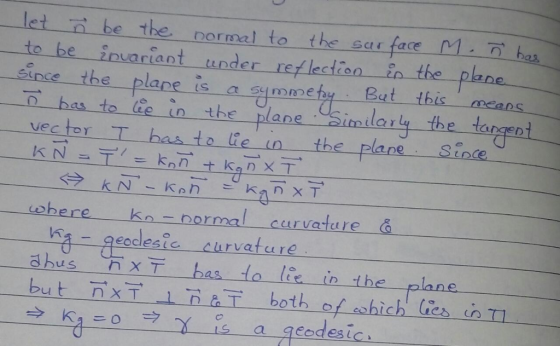
Let M be a surface and 11 a plane that intersects M in a curve γ. Show that y is a geodesic if II is a plane of symmetr...
5.1. Show that a meridian of a surface of revolution is a geodesic without solving the...
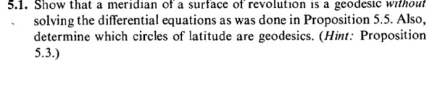 5.1. Show that a meridian of a surface of revolution is a geodesic without solving the differential equations as was done in Proposition 5.5. Also, determine which circles of latitude are geodesics. (Hin Proposition 5.3.) PROPOSITION 5.3. A unit speed curve 7(s) on a surface M is a geodesic if and only if y" is everywhere normal to the surface (i.e., is a multiple of the normal to M)
5.1. Show that a meridian of a surface of revolution is...
5.1. Show that a meridian of a surface of revolution is a geodesic without solving the differential equations as was done in Proposition 5.5. Also, determine which circles of latitude are geodesics. (Hin Proposition 5.3.) PROPOSITION 5.3. A unit speed curve 7(s) on a surface M is a geodesic if and only if y" is everywhere normal to the surface (i.e., is a multiple of the normal to M)
5.1. Show that a meridian of a surface of revolution is...
The plane y = 1 intersects the surface z = x4 + 9xy - 4 in...
 The plane y = 1 intersects the surface z = x4 + 9xy - 4 in a certain curve. Find the slope m of the tangent line to this curve at the point P = (1, 1, 9). m = eBook
component functions denoted by y(t) ((t), y(t), z(t). The plane curve t) = (x(t), y(t)) represents the projection of γ onto the xy-plane. Assume that γ, is nowhere parallel to (0,0,1), so that γ...
 component functions denoted by y(t) ((t), y(t), z(t). The plane curve t) = (x(t), y(t)) represents the projection of γ onto the xy-plane. Assume that γ, is nowhere parallel to (0,0,1), so that γ is regular. Let K and K denote the curvature functions of y and 7 respectively. Let v,v denote the velocity functions of γ and γ respectively. (1) Prove that R 2RV. In particular, at a time t e I for which v(t) lies in the ay-plane,...
(1096) Let Γ be the ellipse with center at the origin that is the intersection of the plane r y +...
 please use Lagrange multiplier,
and showing step by step.
(1096) Let Γ be the ellipse with center at the origin that is the intersection of the plane r y +2z0 and the surface 2 + 2y2 +422-35. a) Find the lengths of the major and the minor axes (b) Find the area of the region enclosed by Γ.
(1096) Let Γ be the ellipse with center at the origin that is the intersection of the plane r y +2z0 and...
please use Lagrange multiplier,
and showing step by step.
(1096) Let Γ be the ellipse with center at the origin that is the intersection of the plane r y +2z0 and the surface 2 + 2y2 +422-35. a) Find the lengths of the major and the minor axes (b) Find the area of the region enclosed by Γ.
(1096) Let Γ be the ellipse with center at the origin that is the intersection of the plane r y +2z0 and...
Questions. Please show all work. 1. Consider the vector field F(x, y, z) (-y, x-z, 3x + z)and the surface S, which is the part of the sphere x2 + y2 + z2 = 25 above the plane z = 3. Let C be the...
 Questions. Please show all work. 1. Consider the vector field F(x, y, z) (-y, x-z, 3x + z)and the surface S, which is the part of the sphere x2 + y2 + z2 = 25 above the plane z = 3. Let C be the boundary of S with counterclockwise orientation when looking down from the z-axis. Verify Stokes' Theorem as follows. (a) (i) Sketch the surface S and the curve C. Indicate the orientation of C (ii) Use the...
5.6. Blowing Up Curve Singularities. (a) Let Y be the cusp or node of (Ex. 5.1). Show that the cu...
 Algebraic Geometry Robin Hartshorne: Blowing Up Curve
Singularities Part (b):
5.6. Blowing Up Curve Singularities. (a) Let Y be the cusp or node of (Ex. 5.1). Show that the curve 1. obtained b;y blowing up Yat O (0.0) is nonsingular (cf. (4.9.1) and (Ex. 4.10)) (b) We define a node (also called ordinary double poini) to be a double point (i.e., a point of multiplicity 2) of a plane curve with distinct tangent directions (Ex. 5.3. If P s a...
Algebraic Geometry Robin Hartshorne: Blowing Up Curve
Singularities Part (b):
5.6. Blowing Up Curve Singularities. (a) Let Y be the cusp or node of (Ex. 5.1). Show that the curve 1. obtained b;y blowing up Yat O (0.0) is nonsingular (cf. (4.9.1) and (Ex. 4.10)) (b) We define a node (also called ordinary double poini) to be a double point (i.e., a point of multiplicity 2) of a plane curve with distinct tangent directions (Ex. 5.3. If P s a...
7. Let a be a unit-speed curve in M CR?. Instead of the Frenet frame field...
 7. Let a be a unit-speed curve in M CR?. Instead of the Frenet frame field on a, consider the Darboux frame field T, V, U—where T is the unit tangent of a, U is the surface normal restricted to a, and V = U * T (Fig. 5.34). (a) Show that T' = gV + kU V' =-gT + tU, U' = -KT - tv, 263/518 where k = S(T) · T is the normal curvature k(T) of M...
5.6. Blowing Up Cure Singularities. (a) Let Y be the cusp or node of (Ex. 5.1). Show that the cur...
 Algebraic Geometry Robin Hartshorne: Blowing Up Curve
Singularities Part (d):
5.6. Blowing Up Cure Singularities. (a) Let Y be the cusp or node of (Ex. 5.1). Show that the curve 1. obtained b;y blowing up Y at O = (0.0) is nonsingular (cf. (4.9.1) and (Ex. 4.10) . (b) We define a node (also called ordinary douhle poinı) to be a double point (i.e., a point of multiplicity 2) of a plane curve with distinct tangent directions (Ex. 5.3). If...
Algebraic Geometry Robin Hartshorne: Blowing Up Curve
Singularities Part (d):
5.6. Blowing Up Cure Singularities. (a) Let Y be the cusp or node of (Ex. 5.1). Show that the curve 1. obtained b;y blowing up Y at O = (0.0) is nonsingular (cf. (4.9.1) and (Ex. 4.10) . (b) We define a node (also called ordinary douhle poinı) to be a double point (i.e., a point of multiplicity 2) of a plane curve with distinct tangent directions (Ex. 5.3). If...
Question 4. Take the curve y cosh r in the r-y plane, and revolve it around the z axis. The resul...
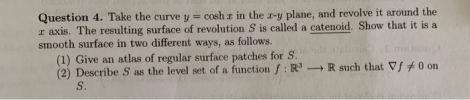 Question 4. Take the curve y cosh r in the r-y plane, and revolve it around the z axis. The resulting surface of revolution S is called a catenoid. Show that it is a smooth surface in two different ways, as follows. (1) Give an atlas of regular surface patches for S. Describe S as the level set of a function f : R3 → R such that ▽f S. 0 on
Question 4. Take the curve y cosh r...
Question 4. Take the curve y cosh r in the r-y plane, and revolve it around the z axis. The resulting surface of revolution S is called a catenoid. Show that it is a smooth surface in two different ways, as follows. (1) Give an atlas of regular surface patches for S. Describe S as the level set of a function f : R3 → R such that ▽f S. 0 on
Question 4. Take the curve y cosh r...
10. Stokes' Theorem and Surfac e Integrals of Vector Fields a. Stokes' Theorem: F-dr= b. Let S be th ky-plane. Draw a sketch of curve C in the xy-plane. et be the surface of the paraboloi...
 10. Stokes' Theorem and Surfac e Integrals of Vector Fields a. Stokes' Theorem: F-dr= b. Let S be th ky-plane. Draw a sketch of curve C in the xy-plane. et be the surface of the paraboloid z 4-x-y and Cis the trace of S in the c Let Fox.y.z) <2z, x, y>, Compute the curl (F) d. Find a parametrization of the surface S: G(u,v)- Compute N(u,v) F-dr Use Stokes' Theorem to compute , e.
10. Stokes' Theorem and Surfac...
10. Stokes' Theorem and Surfac e Integrals of Vector Fields a. Stokes' Theorem: F-dr= b. Let S be th ky-plane. Draw a sketch of curve C in the xy-plane. et be the surface of the paraboloid z 4-x-y and Cis the trace of S in the c Let Fox.y.z) <2z, x, y>, Compute the curl (F) d. Find a parametrization of the surface S: G(u,v)- Compute N(u,v) F-dr Use Stokes' Theorem to compute , e.
10. Stokes' Theorem and Surfac...
 5.1. Show that a meridian of a surface of revolution is a geodesic without solving the differential equations as was done in Proposition 5.5. Also, determine which circles of latitude are geodesics. (Hin Proposition 5.3.) PROPOSITION 5.3. A unit speed curve 7(s) on a surface M is a geodesic if and only if y" is everywhere normal to the surface (i.e., is a multiple of the normal to M)
5.1. Show that a meridian of a surface of revolution is...
5.1. Show that a meridian of a surface of revolution is a geodesic without solving the differential equations as was done in Proposition 5.5. Also, determine which circles of latitude are geodesics. (Hin Proposition 5.3.) PROPOSITION 5.3. A unit speed curve 7(s) on a surface M is a geodesic if and only if y" is everywhere normal to the surface (i.e., is a multiple of the normal to M)
5.1. Show that a meridian of a surface of revolution is...
 The plane y = 1 intersects the surface z = x4 + 9xy - 4 in a certain curve. Find the slope m of the tangent line to this curve at the point P = (1, 1, 9). m = eBook
 component functions denoted by y(t) ((t), y(t), z(t). The plane curve t) = (x(t), y(t)) represents the projection of γ onto the xy-plane. Assume that γ, is nowhere parallel to (0,0,1), so that γ is regular. Let K and K denote the curvature functions of y and 7 respectively. Let v,v denote the velocity functions of γ and γ respectively. (1) Prove that R 2RV. In particular, at a time t e I for which v(t) lies in the ay-plane,...
 please use Lagrange multiplier,
and showing step by step.
(1096) Let Γ be the ellipse with center at the origin that is the intersection of the plane r y +2z0 and the surface 2 + 2y2 +422-35. a) Find the lengths of the major and the minor axes (b) Find the area of the region enclosed by Γ.
(1096) Let Γ be the ellipse with center at the origin that is the intersection of the plane r y +2z0 and...
please use Lagrange multiplier,
and showing step by step.
(1096) Let Γ be the ellipse with center at the origin that is the intersection of the plane r y +2z0 and the surface 2 + 2y2 +422-35. a) Find the lengths of the major and the minor axes (b) Find the area of the region enclosed by Γ.
(1096) Let Γ be the ellipse with center at the origin that is the intersection of the plane r y +2z0 and...
 Questions. Please show all work. 1. Consider the vector field F(x, y, z) (-y, x-z, 3x + z)and the surface S, which is the part of the sphere x2 + y2 + z2 = 25 above the plane z = 3. Let C be the boundary of S with counterclockwise orientation when looking down from the z-axis. Verify Stokes' Theorem as follows. (a) (i) Sketch the surface S and the curve C. Indicate the orientation of C (ii) Use the...
 Algebraic Geometry Robin Hartshorne: Blowing Up Curve
Singularities Part (b):
5.6. Blowing Up Curve Singularities. (a) Let Y be the cusp or node of (Ex. 5.1). Show that the curve 1. obtained b;y blowing up Yat O (0.0) is nonsingular (cf. (4.9.1) and (Ex. 4.10)) (b) We define a node (also called ordinary double poini) to be a double point (i.e., a point of multiplicity 2) of a plane curve with distinct tangent directions (Ex. 5.3. If P s a...
Algebraic Geometry Robin Hartshorne: Blowing Up Curve
Singularities Part (b):
5.6. Blowing Up Curve Singularities. (a) Let Y be the cusp or node of (Ex. 5.1). Show that the curve 1. obtained b;y blowing up Yat O (0.0) is nonsingular (cf. (4.9.1) and (Ex. 4.10)) (b) We define a node (also called ordinary double poini) to be a double point (i.e., a point of multiplicity 2) of a plane curve with distinct tangent directions (Ex. 5.3. If P s a...
 7. Let a be a unit-speed curve in M CR?. Instead of the Frenet frame field on a, consider the Darboux frame field T, V, U—where T is the unit tangent of a, U is the surface normal restricted to a, and V = U * T (Fig. 5.34). (a) Show that T' = gV + kU V' =-gT + tU, U' = -KT - tv, 263/518 where k = S(T) · T is the normal curvature k(T) of M...
 Algebraic Geometry Robin Hartshorne: Blowing Up Curve
Singularities Part (d):
5.6. Blowing Up Cure Singularities. (a) Let Y be the cusp or node of (Ex. 5.1). Show that the curve 1. obtained b;y blowing up Y at O = (0.0) is nonsingular (cf. (4.9.1) and (Ex. 4.10) . (b) We define a node (also called ordinary douhle poinı) to be a double point (i.e., a point of multiplicity 2) of a plane curve with distinct tangent directions (Ex. 5.3). If...
Algebraic Geometry Robin Hartshorne: Blowing Up Curve
Singularities Part (d):
5.6. Blowing Up Cure Singularities. (a) Let Y be the cusp or node of (Ex. 5.1). Show that the curve 1. obtained b;y blowing up Y at O = (0.0) is nonsingular (cf. (4.9.1) and (Ex. 4.10) . (b) We define a node (also called ordinary douhle poinı) to be a double point (i.e., a point of multiplicity 2) of a plane curve with distinct tangent directions (Ex. 5.3). If...
 Question 4. Take the curve y cosh r in the r-y plane, and revolve it around the z axis. The resulting surface of revolution S is called a catenoid. Show that it is a smooth surface in two different ways, as follows. (1) Give an atlas of regular surface patches for S. Describe S as the level set of a function f : R3 → R such that ▽f S. 0 on
Question 4. Take the curve y cosh r...
Question 4. Take the curve y cosh r in the r-y plane, and revolve it around the z axis. The resulting surface of revolution S is called a catenoid. Show that it is a smooth surface in two different ways, as follows. (1) Give an atlas of regular surface patches for S. Describe S as the level set of a function f : R3 → R such that ▽f S. 0 on
Question 4. Take the curve y cosh r...
 10. Stokes' Theorem and Surfac e Integrals of Vector Fields a. Stokes' Theorem: F-dr= b. Let S be th ky-plane. Draw a sketch of curve C in the xy-plane. et be the surface of the paraboloid z 4-x-y and Cis the trace of S in the c Let Fox.y.z) <2z, x, y>, Compute the curl (F) d. Find a parametrization of the surface S: G(u,v)- Compute N(u,v) F-dr Use Stokes' Theorem to compute , e.
10. Stokes' Theorem and Surfac...
10. Stokes' Theorem and Surfac e Integrals of Vector Fields a. Stokes' Theorem: F-dr= b. Let S be th ky-plane. Draw a sketch of curve C in the xy-plane. et be the surface of the paraboloid z 4-x-y and Cis the trace of S in the c Let Fox.y.z) <2z, x, y>, Compute the curl (F) d. Find a parametrization of the surface S: G(u,v)- Compute N(u,v) F-dr Use Stokes' Theorem to compute , e.
10. Stokes' Theorem and Surfac...
Most questions answered within 3 hours.
-
Where is the error in this code sequence?
String s1 = "Hello";
String s2 = "ello";...
asked 10 months ago -
Financial data for Joel de Paris, Inc., for last year
follow:
Joel de Paris, Inc.
Balance...
asked 10 months ago -
Consider this reaction:
Al2(SO4)3 (aq)+ BaCl3
(aq) Al2Cl6 (aq)- +
3BaSO4(s) . What is the...
asked 10 months ago -
Suppose that Savneet is considering increasing her
recent random sample from 20 car rentals to 40...
asked 10 months ago -
Trucks arrive at an unloading terminal at an average rate of 120
per hour.
Trucks arrive...
asked 10 months ago -
Why are methanol and ethanol completely soluble in water while
octanol is not very little soluble....
asked 10 months ago -
A facilities manager at a university reads in a research report
that the mean amount of...
asked 10 months ago -
When the CuSO4 is rehydrated by adding water to the anhydrous
compound, is this an endothermic...
asked 10 months ago -
A ray of sunlight is passing from diamond into crown glass; the
angle of incidence is...
asked 10 months ago -
A block of mass 0.249 kg is placed on top of a light, vertical
spring of...
asked 10 months ago -
how do the kidneys compensate in the presences of acidosis
a) trigger hyperventilate
b) reserve acid...
asked 10 months ago -
Question 501 pts
The rental rate of capital to the firm increases. Which of the
following...
asked 10 months ago