The following problem applies to a perfectly competitive producer of widgets. A typical producer, say Widget Enterpri...
- The following problem applies to a perfectly competitive producer of widgets. A typical producer, say Widget Enterprises Inc., can sell widgets at a constant price of $30/pound. Widget Enterprises has the following costs in the short-run. Its total fixed costs are $45.
Quantity Total Cost
(pounds) $
0 45
1 65
2 80
3 90
4 105
5 125
6 150
7 180
8 215
9 255
a. What does it mean to say that Widget Enterprises is a price taker? What does it say about the widgets it makes and the widgets of other firms?
b. Complete the following schedule:
Q TC TFC TVC MC TR MR
(pounds) $ $ $ $ $ $
0 45
1 65
2 80
3 90
4 105
5 125
6 150
7 180
8 215
9 255
c. Profit is maximized where MR = MC. What is the profit maximizing quantity of widgets?
d. For the answer you gave in part c, compute the profit earned by the firm.
e. Complete the following schedule:
Q AFC AVC ATC
(pounds) ($/lb) ($/lb) ($/lb)
0 ---- ---- ----
1
2
3
4
5
6
7
8
9
g. What would the profit maximizing quantity of output be if the price of widgets were $35/lb? What if the price were $40/lb?
Homework Answers
Ans) a) Perfectly competitive market are those where there are large number of buyers and sellers. None is big enough to influence the price and hence the price is decided by market forces i.e supply and demand. This is the reason we say that firms in competitive market are price takers.
Also every seller in the market is selling homogeneous products. So here, the widgets sold by all the firms is same.
b) TC= FC+VC
TFC= FC÷Q
TVC= TC-TVC
TVC=TC- TFC
MC= change in total cost÷change in quantity
TR = P×Q
AFC=FC÷Q
AVC=VC÷Q
ATC=TC÷Q
In Perfectly competitive market, marginal revenue (MR) = Price
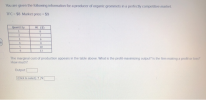
 cc) In the fig. Above, we see
that at Q=7, MR= MC. So profit maximising quantity is 7.
cc) In the fig. Above, we see
that at Q=7, MR= MC. So profit maximising quantity is 7.
d) Profit = TR-TC = 210-180 = $30
g)If P= 35, profit maximising quantity is 8 and if P= 40, profit maximising quantity is 9. As at profit maximising point, MR= MC
Add Answer to:
The following problem applies to a perfectly competitive
producer of widgets. A typical producer, say Widget Enterpri...
Q TC FC TVC MC TR AFC AVC ATC 0 45 45 - 0 - -...
Q TC FC TVC MC TR AFC AVC ATC 0 45 45 - 0 - - - - 1 65 45 20 20 30 45 20 65 2 80 45 35 15 60 22.5 17.5 40 3 90 45 45 10 90 15 15 30 4 105 45 60 15 120 11.25 15 26.25 5 125 45 80 20 150 9 16 25 6 150 45 105 25 180 7.5 17.5 25 7 180 45 135 30 210 6.4 19.28...
Demand and Cost Functions For the perfectly competitive firm, a price taker such that MR-P-Ave.Rev (AR)...
 Demand and Cost Functions For the perfectly competitive firm, a price taker such that MR-P-Ave.Rev (AR) 70 What is the profit maximizing quantity? 1) 65 60 27 What is the price? 55 3) What is average total cost at the profit maximizing quantity? 50 45 4 What, then, is per unit profit at the profit maximizing quantity? 40 МС What is total revenue at the profit maximizing quantity? 5) 35 ATC AVC What is total cost at the profit maximizing...
Problem 1 Deadweight Loss Given the following information: Qs = 2P P = Qs/2 QD= 180...
Problem 1 Deadweight Loss Given the following information: Qs = 2P P = Qs/2 QD= 180 - 4P P = (QD -180)/-4 AR = P = 45-.25Q TR = 45 - .25Q2 MR = 45 - .5Q Hint: MC – supply curve MR = 45 - 5Q Qs = supply Qd = demand A) Using the above information, 1) Graph and calculate the price-output solution under competitive market assumptions. 2) How much is the consumer surplus producer surplus and...
You are given the following information for a producer of organic grommets in a perfectly competitive...
 You are given the following information for a producer of organic grommets in a perfectly competitive market TFC = $8 Market price = $9 Quantity M C (5) 27 5 10 The marginal cost of production appears in the table above. What is the profit-maximizing output? Is the firm making a profit or loss? How much? Output (Click to select)
Willy's widgets, a monopoly, faces the following demand schedule (sales of widgets per month): Price $20 30 40 50 60 70 80 90 100 Quantity 40 35 30 25 20 15 10 5 0 Calculate marginal revenue over each interval in the schedule (for example, between Q
Willy's widgets, a monopoly, faces the following demand schedule (sales of widgets per month): Price $20 30 40 50 60 70 80 90 100 Quantity 40 35 30 25 20 15 10 5 0 Calculate marginal revenue over each interval in the schedule (for example, between Q = 40 and Q=35). Recall that the revenue is the added revenue from an additional unit of production/sales and assume MR is constant within each interval. If marginal cost is constant at $20...
Instructions Answer these 3 scenarios. Here is a handout Scenario #1 Scenario #2 Scenario #3 Suppose a price-discrimin...
 Instructions
Answer these 3 scenarios. Here is a handout
Scenario #1
Scenario #2
Scenario #3
Suppose a price-discriminating monopoly has segregated its
market into two sub-markets (Market 1 and Market 2) and can prevent
resale between the two. Assume that its marginal cost
is $10 and equal to its average total
cost of $10. The firm's demand schedule for the first
group is given by the first two columns of the table.
Market 1
Market 2
Output
Price
Total Revenue...
Instructions
Answer these 3 scenarios. Here is a handout
Scenario #1
Scenario #2
Scenario #3
Suppose a price-discriminating monopoly has segregated its
market into two sub-markets (Market 1 and Market 2) and can prevent
resale between the two. Assume that its marginal cost
is $10 and equal to its average total
cost of $10. The firm's demand schedule for the first
group is given by the first two columns of the table.
Market 1
Market 2
Output
Price
Total Revenue...
Deadweight Loss Given the following information: Qs = 2P P = Qs/2 QD= 180 - 4P...
Deadweight Loss Given the following information: Qs = 2P P = Qs/2 QD= 180 - 4P P = (QD -180)/-4 AR = P = 45-.25Q TR = 45 - .25Q2 Hint: MC – supply curve MR = 45 - 5Q Qs = supply Qd = demand Using the above information, Graph and calculate the price-output solution under competitive market assumptions. How much is the consumer surplus producer surplus and total surplus? Calculate the price and the...
EXERCISE A: Answer ONLY ONE OF the following. (10 points) 1- Construct a list of the...
 EXERCISE A: Answer ONLY ONE OF the following. (10 points) 1- Construct a list of the attributes of each market structure. 2-Assemble a list of firms from which you buy products in each of the four market structures. EXERCISE B: Answer ANY 5 (40 points- 8 points each) 1. Below is a cost and revenue table for a perfectly competitive firm producing purple- spotted people eaters, Fill in the missing information assuming that market price is $24. MR TR Profit...
Problem 1e. The slope of the demand curve indicates that if the price of Fluff increases...
 Problem 1e. The slope
of the demand curve indicates that if the price of Fluff increases
by 20 cents, consumers will buy one less unit. Determine what
happens to profit if price is increased by calculating the new
profit level for Fluff when price is set 20 cents higher than the
profit-maximizing price.
problem 2
Probem 3
Consider the graph, which illustrates the demand for Fluff. Fluff can be produced at a constant marginal and average total cost of $4...
Problem 1e. The slope
of the demand curve indicates that if the price of Fluff increases
by 20 cents, consumers will buy one less unit. Determine what
happens to profit if price is increased by calculating the new
profit level for Fluff when price is set 20 cents higher than the
profit-maximizing price.
problem 2
Probem 3
Consider the graph, which illustrates the demand for Fluff. Fluff can be produced at a constant marginal and average total cost of $4...
The table below presents the demand schedule and marginal costs facing a monopolist producer. The table...
 The table below presents the demand schedule and marginal costs
facing a monopolist producer.
The table below presents the demand schedule and marginal costs facing a monopolist producer. Q TR ($) MR ($) MC ($) P / ($) 13 0 5 1 12 2 11 10 - 3 Instructions: Round your answers to the nearest whole number and include a negative sign if appropriate. Leave no cells blank. Enter O if appropriate. a. Fill in the total revenue and marginal...
The table below presents the demand schedule and marginal costs
facing a monopolist producer.
The table below presents the demand schedule and marginal costs facing a monopolist producer. Q TR ($) MR ($) MC ($) P / ($) 13 0 5 1 12 2 11 10 - 3 Instructions: Round your answers to the nearest whole number and include a negative sign if appropriate. Leave no cells blank. Enter O if appropriate. a. Fill in the total revenue and marginal...
 Demand and Cost Functions For the perfectly competitive firm, a price taker such that MR-P-Ave.Rev (AR) 70 What is the profit maximizing quantity? 1) 65 60 27 What is the price? 55 3) What is average total cost at the profit maximizing quantity? 50 45 4 What, then, is per unit profit at the profit maximizing quantity? 40 МС What is total revenue at the profit maximizing quantity? 5) 35 ATC AVC What is total cost at the profit maximizing...
 You are given the following information for a producer of organic grommets in a perfectly competitive market TFC = $8 Market price = $9 Quantity M C (5) 27 5 10 The marginal cost of production appears in the table above. What is the profit-maximizing output? Is the firm making a profit or loss? How much? Output (Click to select)
 Instructions
Answer these 3 scenarios. Here is a handout
Scenario #1
Scenario #2
Scenario #3
Suppose a price-discriminating monopoly has segregated its
market into two sub-markets (Market 1 and Market 2) and can prevent
resale between the two. Assume that its marginal cost
is $10 and equal to its average total
cost of $10. The firm's demand schedule for the first
group is given by the first two columns of the table.
Market 1
Market 2
Output
Price
Total Revenue...
Instructions
Answer these 3 scenarios. Here is a handout
Scenario #1
Scenario #2
Scenario #3
Suppose a price-discriminating monopoly has segregated its
market into two sub-markets (Market 1 and Market 2) and can prevent
resale between the two. Assume that its marginal cost
is $10 and equal to its average total
cost of $10. The firm's demand schedule for the first
group is given by the first two columns of the table.
Market 1
Market 2
Output
Price
Total Revenue...
 EXERCISE A: Answer ONLY ONE OF the following. (10 points) 1- Construct a list of the attributes of each market structure. 2-Assemble a list of firms from which you buy products in each of the four market structures. EXERCISE B: Answer ANY 5 (40 points- 8 points each) 1. Below is a cost and revenue table for a perfectly competitive firm producing purple- spotted people eaters, Fill in the missing information assuming that market price is $24. MR TR Profit...
 Problem 1e. The slope
of the demand curve indicates that if the price of Fluff increases
by 20 cents, consumers will buy one less unit. Determine what
happens to profit if price is increased by calculating the new
profit level for Fluff when price is set 20 cents higher than the
profit-maximizing price.
problem 2
Probem 3
Consider the graph, which illustrates the demand for Fluff. Fluff can be produced at a constant marginal and average total cost of $4...
Problem 1e. The slope
of the demand curve indicates that if the price of Fluff increases
by 20 cents, consumers will buy one less unit. Determine what
happens to profit if price is increased by calculating the new
profit level for Fluff when price is set 20 cents higher than the
profit-maximizing price.
problem 2
Probem 3
Consider the graph, which illustrates the demand for Fluff. Fluff can be produced at a constant marginal and average total cost of $4...
 The table below presents the demand schedule and marginal costs
facing a monopolist producer.
The table below presents the demand schedule and marginal costs facing a monopolist producer. Q TR ($) MR ($) MC ($) P / ($) 13 0 5 1 12 2 11 10 - 3 Instructions: Round your answers to the nearest whole number and include a negative sign if appropriate. Leave no cells blank. Enter O if appropriate. a. Fill in the total revenue and marginal...
The table below presents the demand schedule and marginal costs
facing a monopolist producer.
The table below presents the demand schedule and marginal costs facing a monopolist producer. Q TR ($) MR ($) MC ($) P / ($) 13 0 5 1 12 2 11 10 - 3 Instructions: Round your answers to the nearest whole number and include a negative sign if appropriate. Leave no cells blank. Enter O if appropriate. a. Fill in the total revenue and marginal...
Most questions answered within 3 hours.
-
Where is the error in this code sequence?
String s1 = "Hello";
String s2 = "ello";...
asked 10 months ago -
Financial data for Joel de Paris, Inc., for last year
follow:
Joel de Paris, Inc.
Balance...
asked 10 months ago -
Consider this reaction:
Al2(SO4)3 (aq)+ BaCl3
(aq) Al2Cl6 (aq)- +
3BaSO4(s) . What is the...
asked 10 months ago -
Suppose that Savneet is considering increasing her
recent random sample from 20 car rentals to 40...
asked 10 months ago -
Trucks arrive at an unloading terminal at an average rate of 120
per hour.
Trucks arrive...
asked 10 months ago -
Why are methanol and ethanol completely soluble in water while
octanol is not very little soluble....
asked 10 months ago -
A facilities manager at a university reads in a research report
that the mean amount of...
asked 10 months ago -
When the CuSO4 is rehydrated by adding water to the anhydrous
compound, is this an endothermic...
asked 10 months ago -
A ray of sunlight is passing from diamond into crown glass; the
angle of incidence is...
asked 10 months ago -
A block of mass 0.249 kg is placed on top of a light, vertical
spring of...
asked 10 months ago -
how do the kidneys compensate in the presences of acidosis
a) trigger hyperventilate
b) reserve acid...
asked 10 months ago -
Question 501 pts
The rental rate of capital to the firm increases. Which of the
following...
asked 10 months ago