
Homework Answers
Add Answer to:
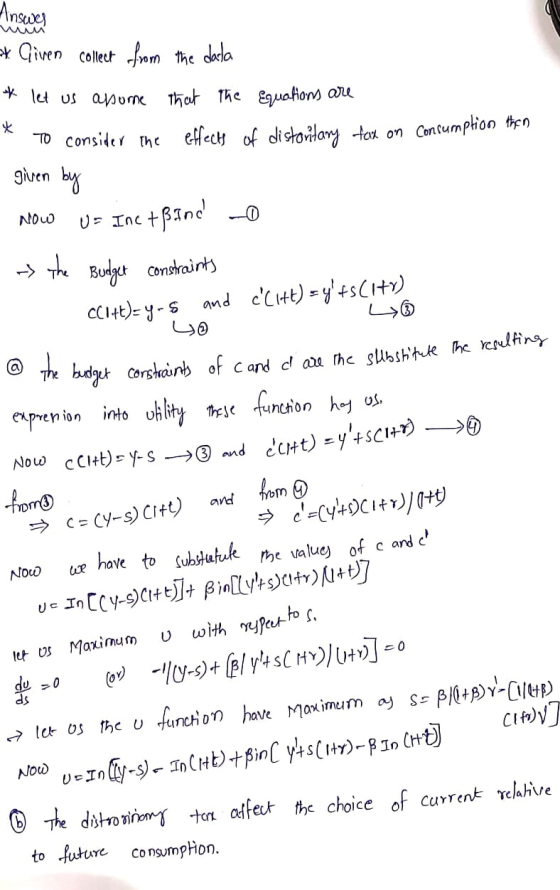
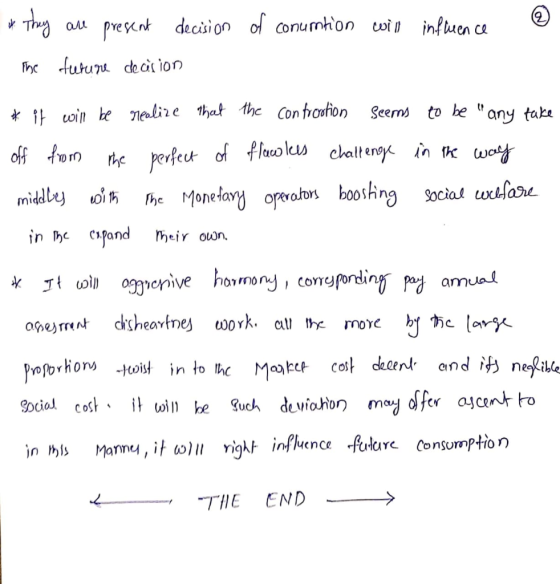
1. This problem asks you to consider the effects of a distortionary tax on consumption. Let utility be given by U = In...
Consumption-Savings Consider a consumer with a lifetime utility function U = u(Ct) + _u(Ct+1) that satisfies...
Consumption-Savings Consider a consumer with a lifetime utility function U = u(Ct) + _u(Ct+1) that satisfies all the standard assumptions listed in the book. The period t and t + 1 budget constraints are Ct + St = Yt Ct+1 + St+1 = Yt+1 + (1 + r)St (a) What is the optimal value of St+1? Impose this optimal value and derive the lifetime budget constraint. (b) Derive the Euler equation. Explain the economic intuition of the equa- tion. (c)...
Question 1: Households A household's utility over consumption C and leisure l is U - U(C,0)...
 Question 1: Households A household's utility over consumption C and leisure l is U - U(C,0) Cl 1. Plot the household's indifference curve for U-80 for values of C andlless than 20 (i.e. find the curve containing all combinations of C and ( such that U(C, 0) 80) The household has a time endowment of h=16 hours per day. The wage rate per hour is w 1.25. The household's labour income is therefore wNs, where N-h-l-16- l is the time...
This problem focuses on the labor supply effects of subsidies. Assume Ann gets utility from consumption...
This problem focuses on the labor supply effects of subsidies. Assume Ann gets utility from consumption c and leisure l. Ann chooses how many hours to supply to the labor market each day (h) but only has 16 hours per day for work and leisure (assuming 8 hours of sleep). For each hour she works, she earns an hourly wage w = 15. Assume Ann has no unearned income v = 0. 1. Write down Ann’s daily budget constraint in...
1. Consider the following two period consumption savings problem. A consumer cares about consumption (c and...
 1. Consider the following two period consumption savings problem. A consumer cares about consumption (c and future consumption c according to Assume that U(c) is given by for some constant y. In the present the consumer chooses how much to consume and how much to save out of her income y>0 This decision is made in the knowledge that in the future she will be retired, have no income, and thus future consumption will be entirely out of savings: c)a,...
For Question 12 to 15, let the utility function of the household be U(c,d) = ln(c)...
 For Question 12 to 15, let the utility function of the household be U(c,d) = ln(c) + Bln(c'), where B is a parameter between 0 and 1, and assume that there is always an interior solution to the household's problem. 12. What is the marginal rate of substitution of current consumption for future con- sumption MRS given this utility function? How does it change with c and c'? 13. Solve the household's optimization problem with the lifetime budget constraint. That...
Consider an economy occupied by two households (i- A, B) who are facing the two-period consumption...
 Consider an economy occupied by two households (i- A, B) who are facing the two-period consumption problem. Each household i - A, B is facing the following utility maximization problem: max subject to ci +biy(1+r)bo where Vi and US are household i's exogenous income in period t 1.2. cỈ and c are household i's consumption in period t 1,2. bo,bi is household i's bond holdings of which bo is exogenously given, r is the real interest rate, and 0 <...
Consider a consumer whose utility function is given by U(x, y) = x^1/4y^1/2, where x and...
Consider a consumer whose utility function is given by U(x, y) = x^1/4y^1/2, where x and y represent quantities of consumption of two consumer goods. (a) Derive and interpret the consumer’s Marshallian demand functions for x and y. (b) Derive and interpret the consumer’s Indirect Utility Function. (c) If the consumer’s income is $1000 and the prices of x and y are both $5, how should the consumer maximize her utility? What is her maximum level of utility? (d) Suppose...
Consider a consumer whose utility function is given by U(x, y) = x^1/3 y^2/3, where x...
Consider a consumer whose utility function is given by U(x, y) = x^1/3 y^2/3, where x and y represent quantities of consumption of two consumer goods. (a) If the consumer’s income is $100 and the prices of x and y are both $1, how should the consumer maximize her utility? What is her maximum level of utility? (b) If the price of y rose to $2, what would be the resulting income and substitution effects? Illustrate your answer.
2) Chimichanga Fest Your utility function is given by U-X,X, where xi s your consumption of Chimichangas and x, is your consumption of all the other goods in the economy. Yes, you spend 60% of...
 2) Chimichanga Fest Your utility function is given by U-X,X, where xi s your consumption of Chimichangas and x, is your consumption of all the other goods in the economy. Yes, you spend 60% of your budget on Chimichangas, which is totally reasonable after the Dumpling House tragedy. a) Solve the utility maximization problem, finding the uncompensated demand for x, & x, and the indirect utility function in terms of p,, p, and Y. b) Solve the expenditure minimization problem,...
3. A taxpayer has utility function U(x, L) = x ^1/2 − L where L is...
3. A taxpayer has utility function U(x, L) = x ^1/2 − L where L is hours of labour supply and x is consumption. The taxpayer earns a wage of $4 per hour worked (which is fixed throughout the analysis). (a) Suppose that the government imposes a proportional (percentage) tax at rate τ on labour income, so that the taxpayer’s budget constraint is x = (1 − τ )4L. Solve for the optimal labour supply (L) and consumption (x) as...
 Question 1: Households A household's utility over consumption C and leisure l is U - U(C,0) Cl 1. Plot the household's indifference curve for U-80 for values of C andlless than 20 (i.e. find the curve containing all combinations of C and ( such that U(C, 0) 80) The household has a time endowment of h=16 hours per day. The wage rate per hour is w 1.25. The household's labour income is therefore wNs, where N-h-l-16- l is the time...
 1. Consider the following two period consumption savings problem. A consumer cares about consumption (c and future consumption c according to Assume that U(c) is given by for some constant y. In the present the consumer chooses how much to consume and how much to save out of her income y>0 This decision is made in the knowledge that in the future she will be retired, have no income, and thus future consumption will be entirely out of savings: c)a,...
 For Question 12 to 15, let the utility function of the household be U(c,d) = ln(c) + Bln(c'), where B is a parameter between 0 and 1, and assume that there is always an interior solution to the household's problem. 12. What is the marginal rate of substitution of current consumption for future con- sumption MRS given this utility function? How does it change with c and c'? 13. Solve the household's optimization problem with the lifetime budget constraint. That...
 Consider an economy occupied by two households (i- A, B) who are facing the two-period consumption problem. Each household i - A, B is facing the following utility maximization problem: max subject to ci +biy(1+r)bo where Vi and US are household i's exogenous income in period t 1.2. cỈ and c are household i's consumption in period t 1,2. bo,bi is household i's bond holdings of which bo is exogenously given, r is the real interest rate, and 0 <...
 2) Chimichanga Fest Your utility function is given by U-X,X, where xi s your consumption of Chimichangas and x, is your consumption of all the other goods in the economy. Yes, you spend 60% of your budget on Chimichangas, which is totally reasonable after the Dumpling House tragedy. a) Solve the utility maximization problem, finding the uncompensated demand for x, & x, and the indirect utility function in terms of p,, p, and Y. b) Solve the expenditure minimization problem,...
Most questions answered within 3 hours.
-
Where is the error in this code sequence?
String s1 = "Hello";
String s2 = "ello";...
asked 10 months ago -
Financial data for Joel de Paris, Inc., for last year
follow:
Joel de Paris, Inc.
Balance...
asked 10 months ago -
Consider this reaction:
Al2(SO4)3 (aq)+ BaCl3
(aq) Al2Cl6 (aq)- +
3BaSO4(s) . What is the...
asked 10 months ago -
Suppose that Savneet is considering increasing her
recent random sample from 20 car rentals to 40...
asked 10 months ago -
Trucks arrive at an unloading terminal at an average rate of 120
per hour.
Trucks arrive...
asked 10 months ago -
Why are methanol and ethanol completely soluble in water while
octanol is not very little soluble....
asked 10 months ago -
A facilities manager at a university reads in a research report
that the mean amount of...
asked 10 months ago -
When the CuSO4 is rehydrated by adding water to the anhydrous
compound, is this an endothermic...
asked 10 months ago -
A ray of sunlight is passing from diamond into crown glass; the
angle of incidence is...
asked 10 months ago -
A block of mass 0.249 kg is placed on top of a light, vertical
spring of...
asked 10 months ago -
how do the kidneys compensate in the presences of acidosis
a) trigger hyperventilate
b) reserve acid...
asked 10 months ago -
Question 501 pts
The rental rate of capital to the firm increases. Which of the
following...
asked 10 months ago